
Autor Cointelegraph By Jesse Coghlan

Taco tokens: Chipotle adds crypto payments via Flexa

The popular Mexican fast food chain Chipotle is now accepting cryptocurrency payments through digital payment provider Flexa at all of its over 2,950 United States based restaurants.Flexa announced the partnership on June 1st which will see Chipotle accept all the 98 cryptocurrencies Flexa currently supports including Bitcoin (BTC), Ethereum (ETH) and seven U.S. dollar-pegged stablecoins including USD Coin (USDC). Chipotle’s website does not contain any information on the announcement however.Bitcoin, but make it **burritos.**We’re delighted to share that @ChipotleTweets is now accepting payments in #bitcoin, #ether, #dogecoin, and more, exclusively through Flexa. https://t.co/W0ktwPX7i3— Flexa (@FlexaHQ) June 1, 2022The fast food giant is the latest Flexa partner joining other large businesses such as cinema operator Regal Theaters and Bancoagrícola, El Salvador’s largest financial institution where Flexa enables both retail and merchant Bitcoin transactions for the bank’s customers.Chipotle has briefly experimented with cryptocurrencies in the past. In April 2021 to celebrate National Burrito Day it gave away $100,000 worth of Bitcoin along with free burritos and claimed it was the first U.S. restaurant brand to offer a crypto giveaway.For the so called “chiptocurrency” giveaway Chipotle partnered with former Ripple CTO Stefan Thomas, creating a game where players guessed a code possibly winning either a burrito or up to $25,000 worth of Bitcoin.The game parodied Thomas’ experience of losing over 7,000 BTC due to forgetting the password for his crypto wallet which today would be worth over $208 million.Other fast food names have explored or signaled interest in crypto and metaverse applications for their brands. Burger King partnered with trading platform Robinhood in Nov 2021 and gave away free Dogecoin (DOGE) BTC and ETH with meal purchases.Related: How can the Metaverse help the food industry?McDonald’s, known for poking fun at crypto Twitter, filed multiple trademark applications in February including plans for “a virtual restaurant featuring actual and virtual goods” in the Metaverse and “operating a virtual restaurant featuring home delivery.”With crypto adoption in the U.S. remaining high despite market turbulence merchants have expressed desire to implement payment solutions to capture the growing interest.A Crypto.com global survey of merchants released in February showed only 4% were already accepting cryptocurrency payments, but nearly 60% of merchants responded with an interest in accepting crypto payments within the next year.Although enthusiasm from merchants overall was high only around 25% of the hospitality industry respondents were keen on crypto payment adoption.

Čítaj viac

11% of US insurers invest — or are interested in investing — in crypto

United States based insurers are the most interested in cryptocurrency investment according to a Goldman Sachs global survey of 328 chief financial and chief investment officers regarding their firm’s asset allocations and portfolios.The investment banking giant recently released its annual global insurance investment survey which included responses regarding cryptocurrencies for the first time, finding that 11% of U.S. insurance firms indicated either an interest in investing or a current investment in crypto.Speaking on the company’s “Exchanges at Goldman Sachs” podcast on May 31 Goldman Sachs’ global head of insurance asset management Mike Siegel said he was surprised to get any result.“We surveyed for the first time on crypto, which I thought would get no respondents but I was surprised. A good 6% of the industry respondents indicated that they’re either invested in crypto, or considering investing in crypto.”Asia based insurers were next in line with 6% interested or currently invested, and European insurers came in at only 1%.The report found cryptocurrencies were in fifth place for the asset class insurers expect to deliver the highest returns over the next 12 months with 6% ranking it as their first choice beating United States and European equities.Around 2% of firms indicated a current crypto investment and whilst it’s a small amount of firms indicating investment or interest, Goldman Sachs analysts wrote that this level of interest “is still notable.”On the podcast, Siegel discussed a follow-up survey conducted of crypto interested firms to understand their motivation behind purchasing:“We did some follow-up questions on that, and generally, the companies that are either invested or considering crypto are doing so to understand the market and to understand the infrastructure. But if this becomes a transactable currency, they want to have the ability down the road to denominate policies in crypto, and also accept premium in crypto, just like they do in, say, dollars or yen or sterling or euro.”Only 1% of the total surveyed firms said they would increase their crypto position over the next 12 months, 7% said they would maintain their current position and 92% said they will not invest in crypto over the next year.Related: Wealth report: As old money procrastinates, young money goes cryptoDespite the growing interest there are still those pessimistic about crypto as 16% said it was asset class they expected to deliver the lowest returns over the next 12 months. Overall crypto was the third-lowest ranked asset class on this measure.Mathew McDermott the bank’s global head of digital assets wrote in the report:“As the crypto market continues to mature, coupled with growing regulatory certainty, a cross-section of institutions are becoming more confident to explore investment opportunities as well as recognizing the disruptive impact of the underlying blockchain technology. I have been positively surprised by the rising adoption by global Asset Managers, who clearly recognize the potential of this market.”

Čítaj viac

The more you know about Bitcoin, the more optimistic you are: Block survey

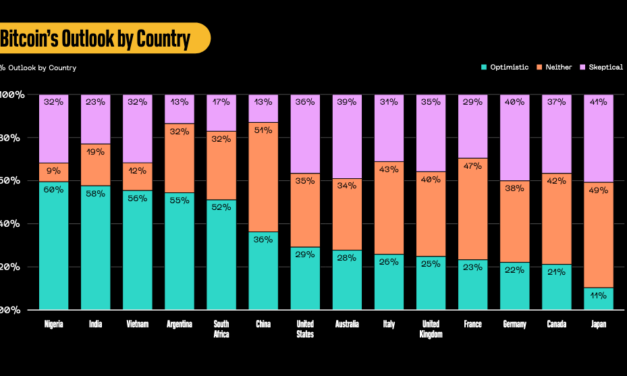
A survey from digital payment company Block Inc. has found that the higher respondents rated their own level of cryptocurrency knowledge, the more optimistic they are about the future of Bitcoin (BTC).Block surveyed more than 9,500 people from the Americas (2,375), EMEA (4,360) and APAC (2,860) regions in January, ensuring to include 100 Bitcoin owners in each region for its 2022 Bitcoin Knowledge and Perceptions Report.The report, released on May 31, shows a correlation between optimism and the likelihood of purchasing and compared the result with the respondent’s self identified level of knowledge.Of those who identified as having fair to expert knowledge of crypto 41% say they’re “very likely” to purchase Bitcoin in the next 12 months, compared to just 7.9% of those with “limited to no knowledge.”Despite higher income individuals having slightly more optimism for Bitcoin’s future than lower income individuals, the lower income countries of Nigeria, India, Vietnam, and Argentina reported the highest rates of optimism and the highest claimed levels of cryptocurrency knowledge.Source: Block Inc. Bitcoin Knowledge and Perceptions Report 2022Education and promotion seems like the key to adoption as the biggest reason (cited by 51% of respondents) for not buying Bitcoin was a lack of knowledge. The second most cited reason was the potential risk of theft (32%) and the perception that BTC had too much price volatility (30%) came in third.Lower income nations see the utilityThe report details that individuals on lower incomes actually use Bitcoin practically, with more than 40% responding they’re most likely to buy it as an easy way to send money or purchase goods.In comparison higher income people more often consider Bitcoin a way to make money (50%) or to diversify an investment portfolio (30%), however around the same amount (39%) signaled purchasing goods was also a reason they would buy. Respondents from countries reporting a higher level of income from remittances and lower per-capita gross domestic product (GDP) were more likely to cite a Bitcoin purchase as a good way to send money or purchase goods.Source: Block Inc. Bitcoin Knowledge and Perceptions Report 2022Block also reported a strong correlation between countries with high inflation rates to those who responded that Bitcoin was a “protection against inflation” with 45% of Argentinian respondents using Bitcoin this way, the highest percentage of any country.Related: Accessibility is the main barrier to crypto adoption — Here are the solutionsAs previously reported by Cointelegraph, crypto adoption in Argentina is double the rate of other countries in the region with many turning to Bitcoin attempting to hedge against an inflation rate of nearly 60%.Source: Block Inc. Bitcoin Knowledge and Perceptions Report 2022Overall and across regions, Bitcoin was the cryptocurrency which respondents were most aware of with 88% saying they’ve heard of it which is twice as many as the 43% who say they’ve heard of Ethereum (ETH).

Čítaj viac

Aussie banks ANZ and NAB won’t 'endorse' retail speculation on crypto

Executives at two of Australia’s “big four” banks have ruled out allowing retail customers to trade cryptocurrency on their platforms, with one reasoning that customers don’t understand “basic financial well-being.”Speaking at the Australian Financial Review Banking Summit on May 31 Maile Carnegie, executive for retail banking at Australia and New Zealand Banking Group (ANZ) said that from speaking to retail customers she believed “the vast majority of them don’t understand really basic financial well-being concepts.”“Are we really going to make it easier and less friction and implicitly endorse speculating on crypto when they don’t understand basic financial well-being? The answer was no.”Carnegie said ANZ had considered a cryptocurrency product from as early as 2017 adding she was “happy we didn’t go head long” into the offering.Also attending the summit was chief digital officer for National Australia Bank (NAB) Angela Mentis who was asked if NAB would consider offering crypto trading. She answered “not in the foreseeable future and not for retail” but added there are already applications for blockchain technology for institutional clients.In March ANZ became the first bank in Australia to mint an Australia dollar (AUD) pegged stablecoin called A$DC and NAB is also gearing up to launch its own stablecoin which is expected to be operational by the end of 2022.Both stablecoin projects from the big banks will initially be offered for institutional clients seeking an on-ramp for crypto investments, the pilot transaction of A$DC for exampl was a $30 million AUD transfer.The only big four bank with plans to launch a retail crypto trading product is the Commonwealth Bank of Australia (CBA). At the summit its CEO Matt Comyn said despite facing challenges it was still its “intent” to launch the service.Related: Crypto’s youngest investors hold firm against headwinds — and headlinesCBA revealed plans to enable crypto trading in November 2021 by partnering with the Gemini crypto exchange and limited trials began soon after. But in April news emerged that the Australian Securities and Investment Commission (ASIC) had tied up the launch with regulatory red tape citing concerns of consumer protections and the CBA started to plan a second pilot of the product.In late May, CBA put its plans for the second pilot on hold indefinitely and cut off crypto trading to those in the first round of testing with Comyn saying at the time the bank was still waiting on regulatory clarity.At the summit Comyn added that if it were to proceed with the offering the bank would look to restrict trading to those “who understand the risky asset class.”Hitting back at the comments from the banking executives, Ian Love the founder and CEO of crypto investment firm Blockchain Assets tweeted:“How will we ever reduce wealth inequality when our regulatory system has financial discrimination at it’s core? It’s time to remove the ‘Sophisticated Investor’ discrimination rules that advisors use to hide behind and allow everyone access to financial advice and services.”

Čítaj viac

China state media signals tighter crypto regulations in Terra aftermath

The China state-owned media outlet the Economic Daily has signaled that the Chinese government may introduce even tighter regulations on cryptocurrencies and stablecoins due to the collapse of the Terra ecosystem.In an article published May 31, the outlet detailed the collapse of TerraUSD (UST) and Luna (LUNA) explaining the workings of the algorithmic stablecoin. It used the so-called “black swan” event to praise the Chinese government’s decision to ban cryptocurrency.“My country has been cracking down on virtual currency trading speculation and a large number of trading platforms,” reporter Li Hualin wrote before adding, “this has effectively blocked the transmission of this risk in China and avoided investment risks to the greatest extent possible.”Hualin explained that “many other countries” are looking to regulate stablecoins following the Terra collapse and quoted Zhou Maohua, a researcher at the China Everbright Bank, to make the case for further restrictions within China (translation):“In the future, our country will also speed up the completion of regulatory shortcomings, and introduce targeted regulatory measures for the risk of stablecoins to further reduce the space for virtual currency speculation, illegal financial activities and related illegal and criminal activities, and better protect the safety of the people.”After banning crypto exchanges back in 2017, the Chinese government has been toughening its stance on crypto again since mid-2021. Multiple agencies warned of the risk of investing in crypto and a major crackdown on mining within the country took place.Colin Wu, a China focused cryptocurrency reporter, cleared up the misconception around the ban telling Cointelegraph that laws don’t allow institutions to provide crypto services “but they don’t prohibit ordinary people from using cryptocurrencies, there is no clear law to prohibit it,” adding:“Institutions and enterprises are completely banned from trading or owning cryptocurrency in China, but individuals are free to own, buy and sell, and some local courts even consider them to be legally protected as virtual property.”Earlier in May, a Shanghai court found that Bitcoin (BTC) is subject to property rights laws and regulations as its value, scarcity, and disposability meet the definition of virtual property according to the court.As for how traders obtain crypto in the first place, Cointelegraph previously highlighted the rising use of VPNs among Chinese traders. Following the last round of restrictions, traders began increasingly using offshore exchanges or peer-to-peer platforms for all of their activities. Related: City of Shenzhen airdrops 30M in free digital yuan to stimulate consumer spendingWu says there is a “great possibility” that the Chinese government would impose even tighter restrictions or even complete bans on stablecoins to prohibit ownership, transfer, purchase, and sale of the assets, “especially for Tether” he added.But China may not stop at its own borders, the Chinese Communist Party owned outlet said that regulators in other countries should “strive to formulate global general rules” to tighten scrutiny on cross-border payments.The Beijing regime mouthpiece concluded that the move will “prevent virtual currency from becoming a tool for money laundering, fraud, and illegal fundraising.”

Čítaj viac

Získaj BONUS 8 € v Bitcoinoch

nakup bitcoin z karty

Registrácia Binance

Burza Binance

Aktuálne kurzy