Autor Cointelegraph By Jesse Coghlan

BitMEX co-founder Benjamin Delo avoids jail, receives 30 months probation

Benjamin Delo the co-founder of cryptocurrency exchange BitMEX has been sentenced to 30 months probation for violating the Bank Secrecy Act (BSA), which is an anti-money laundering law.The sentence, handed down at a federal court in New York on June 15th, follows his guilty plea to charges in February of “willfully failing to establish, implement and maintain an Anti-Money Laundering (AML) program” in his role at BitMEX.Prosecutors had argued Delo should serve a year in prison or at least receive a two-year probation along with six months of home detention, as was given to former CEO Arthur Hayes in May.For Delo, his lesser sentence closes the legal saga which started in October 2020 which also saw co-founders Hayes and Samuel Reed along with BitMEX’s first official employee Gregory (Greg) Dwyer charged with similar violations.Judge John Koeltl called Delo’s violations “very serious” and said that heo knew BitMEX was breaking U.S. laws by not implementing an AML and know your customer (KYC) system.Judge Koeltl noted however that the exchange did later take steps to rectify the issue and become compliant.“When I look back, I see a fundamental failure to address a flaw in our systems,” Delo told the court, adding he deeply regrets the actions that brought him in contact with the justice system and vowed that it would be his last brush with it.A citizen of the United Kingdom residing in Hong Kong, Judge Koeltl ordered Delo be allowed to serve his probationary sentence in Hong Kong. Related: The CFTC’s action against Gemini is bad news for Bitcoin ETFsJudge Koeltl also took into consideration the fact that Delo paid a $10 million fine settling a court order from May in a civil case brought by the Commodity Futures Trading Commission (CFTC) for violating aspects of the Commodity Exchange Act.A spokesperson for Delo’s legal team said after the sentencing hearing they’re pleased the court rejected “the government’s cynical attempt to exaggerate the seriousness of the Bank Secrecy Act charge in this case.”Delo’s lawyers said he intends to soon leave the U.S. for Hong Kong.Meanwhile, Australian-born former BitMEX head of business development Greg Dwyer, who currently resides in Bermua, is in talks with the New York federal court to extend a deadline for filing pre-trial documentation according to the Sydney Morning Herald.A letter sent to the court by Dwyer’s lawyer said “the parties continue to engage in discussions regarding a possible resolution to the matter.”

Čítaj viac


71% of high net worth individuals have invested in digital assets: Survey

High net worth individuals (HNWI) have embraced cryptocurrencies and other digital assets, with 71% of wealthy individuals investing in digital assets according to a new survey.Technology consulting company Capgemini released its 2022 World Wealth Report on June 14. It polled 2,973 global HNWIs, with 54% reporting a wealth band ranging from $1 million to $30 million and 46% reporting wealth of $30 million and over.The survey asked about investment preferences for emerging asset classes such as digital assets, classifying them as cryptocurrencies, related exchange-traded funds (ETFs), non-fungible tokens (NFTs) and metaverse-related products.Of the roughly one in seven wealthy individuals investing in digital assets, the highest concentration were under 40. More than nine in ten in this age group have invested in digital assets. The younger cohort said cryptocurrencies are their favorite investment, with crypto ETFs and metaverse products also highly desired.Crypto does not make up the majority of portfolios however and on average, HNWIs have only allocated around 14% into “alternative investments” which includes crypto alongside commodities, currencies private equity and hedge funds. Capgemini observed, however, the wealth management industry is seeing an influx of investments into digital assets and this has “increased the demand for educational capabilities.” Nilesh Vaidya, the firm’s head of retail wealth management said:“The influx of new investment avenues such as sustainable investing and digital assets is having a crucial impact on the wealth management industry. Wealth management firms must prioritize providing timely education around this trend to retain their customers.”Some firms are already clued into this trend and are wanting the first-mover advantage into this niche sector by launching investment products targeted at the demographic.Related: Wealth report: As old money procrastinates, young money goes cryptoInvestment bank Morgan Stanley introduced exposure to Bitcoin (BTC) for its millionaire clientele in March 2021 with only those holding $2 million or more in capital able to invest.Private banking clients for BBVA Switzerland were also given access to crypto trading and custody services, along with a similar offering from Wells Fargo in 2021.The report comes after earlier research by Accenture which revealed 52% of wealthy investors in Asia held some form of a digital asset during the first quarter of 2022 making up, on average, 7% of the surveyed investors’ portfolios.Similarly, Accenture also found that wealth management firms have been slow to adopt investment products with cryptocurrency or digital asset exposure, with a majority saying they have no plans to offer related services.

Čítaj viac

Legal battle avoided after YGG and Merit Circle DAO agree to a deal

A potential legal battle has been prevented between the Merit Circle decentralized autonomous organization’s (DAO) backing company Merit Circle Ltd and Yield Guild Games (YGG) after the organizations reached a deal after the DAO originally voted to remove YGG.Merit Circle Ltd is a company that created the Merit Circle DAO to help gamers interested in play-to-earn games by lending items from its treasury to be used for gameplay as well as delivering educational content.Originally, the DAO passed a proposal that would cancel YGG’s Simple Agreement for Future Tokens (SAFT) and refund it only with its initial 175,000 USD Coin (USDC) seed contribution.Despite some acrimony, YGG has still walked away with ten times its initial investment.The improvement proposal, called MIP-13, passed on May 28 alleging YGG provided a “lack of value” to the DAO and the guild was actually a “top competitor” to Merit Circle, not a partner. The proposal would “trim the fat” from the DAO to “ensure only those who want to see Merit Circle succeed remain”.But, the passing of MIP-13 may not have honored a legal agreement between Merit Circle and YGG which would see YGG receive tokens in return for its financial contribution toward Merit Circle.YGG said in response to the proposal that it wasn’t clear what legal authority the DAO has to nullify a contract Merit Circle Ltd signed on its behalf and that no condition existed for Merit Circle to cancel the contract “regardless of how this has been presented by them to the community.”Merit Circle agreed upon a counterproposal with YGG to honor the legal agreement. It was posted and unanimously passed on June 9 and the DAO bought out YGG’s fund allocation. This netted the guild 1,750,000 USDC, a ten times return on its original seed investment.On June 14, both Merit Circle and YGG stated they were amicable on the outcome, saying the solution “still satisfies the will of the Merit Circle community, but was also acceptable to YGG.”They added that as the original proposal clashed with the prior legal agreement Merit Circle made with YGG, it likely would have led to legal action. Both parties stated they recognized the “danger a precedent like this could set for the Merit Circle DAO and the industry as a whole if agreements are not upheld and investors are not respected.”Related: Number of DAOs increases 8x along with spike in votes and proposals“Whilst the legal question is one that could probably be argued at length,” the organizations said, “both parties agreed it was better to settle.”“This would spare both parties from a costly, time-consuming, legal process with uncertain outcomes. None of the parties had to settle, but both parties chose the constructive path to help Merit Circle move forward.”Merit Circle and YGG said whilst the solution terminates the formal relationship between them, each will continue to “give their all to growing the blockchain gaming ecosystem” and that Merit Circle would still have “continued support” from YGG.

Čítaj viac

SEC boss worries crypto bill undermines financial protections

United States Securities and Exchange Commission (SEC) Chairman Gary Gensler said he’s worried that a proposed bill to create a regulatory framework for cryptocurrencies could weaken investor protections in the traditional financial market.Speaking at The Wall Street Journal’s CFO Network Summit on June 14 Gensler was asked his thoughts regarding a recent bill introduced on June 7 by Senators Cynthia Lummis (R-WY) and Kirsten Gillibrand (D-NY).He responded saying “we don’t want to undermine the protections we have in a $100 trillion capital market,” adding:“We don’t want our current stock exchanges, mutual funds, or public companies to, sort of inadvertently by a stroke of a pen, say ‘you know what, I want to be non-compliant as well, I want to be outside of this regime that I think has been quite a benefit to investors and economic growth over the last 90 years.’”The bipartisan Lummis-Gillibrand “Responsible Financial Innovation Act” aims to address many facets of crypto regulation such as tax treatment of digital assets, stablecoins, and agency jurisdiction.One provision of the bill gives “clear authority” to the Commodity Futures Trading Commission (CFTC) over digital asset spot markets, Gensler has long been adamant in declaring most cryptocurrencies are securities, subject to the SEC’s authority. The Senators have mostly agreed with Gensler’s point, saying some altcoins would likely be considered securities under the proposed law, with Bitcoin (BTC) and Ethereum (ETH) considered commodities.At the summit, Gensler said the SEC wasn’t looking to extend its jurisdiction and that some cryptocurrencies are already under the jurisdiction of the agency since they qualify as being a security.“We’re just looking out for the retail public […] these tokens are being offered to the public, and the public is hoping for a better future. That’s the characteristics of an investment contract.”Meanwhile CFTC commissioner Christy Goldsmith Romero — who says she hasn’t yet read the Lummis-Gillibrand bill — welcomed regulatory action by Congress when speaking at an event on June 14.Related: SEC reportedly launches investigation into insider trading on exchangesRomero, also a former senior counsel in the SEC’s enforcement division, was asked if the view that the CFTC was a more laissez-faire regulator in comparison to the SEC was accurate.“No, not at all […] they’re actually pretty similar,” she said, adding that the CFTC has brought multiple enforcement actions in the crypto space and each agency cares about having “rigorous oversight of markets.”Explaining the differences she’s witnessed, Romero said the CFTC has allowed more cryptocurrency products to trade on its regulated exchanges with 18 products trading across 11 regulated entities:“What that means is that the CFTC is pretty experienced and how to regulate trading in this market, and that’s really, really helpful as we move forward. It’s still going to take cooperation and coordination with the SEC, I’m 100% committed to that, that’s my former home.”

Čítaj viac

Illicit crypto usage as a percent of total usage has fallen: Report

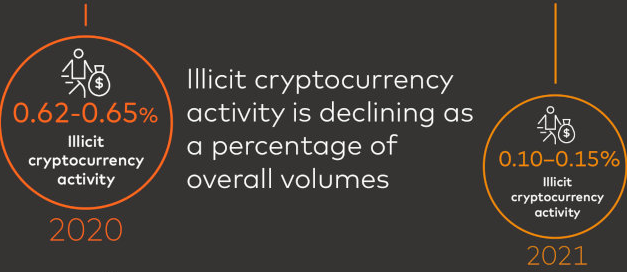
Illicit cryptocurrency activity in 2021 and the first quarter of 2022 has declined as a percentage of overall crypto activity, according to blockchain forensics firm CipherTrace.The cryptocurrency industry has long held a reputation in some jurisdictions as a haven for illegal activity. However, CipherTrace estimates that illicit activity was between 0.62% and 0.65% of overall cryptocurrency activity in 2020. The firm reported that it has now fallen to between 0.10% and 0.15% of overall activity in 2021.Source: CipherTraceIn its Cryptocurrency Crime and Anti-Money Laundering Report released June 13, CipherTrace outlined that the top ten decentralized finance (DeFi) hacks in 2021 and Q1 2022 netted attackers $2.4 billion.Over half of that figure came from just two events, the largest being the late March 2022 Ronin Network exploit worth about $650 million and the $610 million August 2021 hack of the Poly Network, most of which was returned by the anonymous hacker.Within a similar time period, anti-money laundering (AML) related fines in the banking sector increased dramatically with 80 institutions fined in 2021, up from just 24 in 2020 according to Kyckr.While the total dollar amount of the fines fell from 2020, last year saw the banks pay $2.7 billion worth of fines for AML or Know Your Customer (KYC) related violations, the largest single fine totaling around $700 million.While significant sums have been exploited in crypto, CipherTrace detailed the rapidly expanding crypto ecosystem, noting the total crypto market activity for 2020 was around $4.3 trillion, which grew to approximately $16 trillion of activity just in the first half of 2021.CipherTrace says that the growth of the crypto market also brings with it increased scrutiny from the world’s regulators, who are “starting to take decisive action to ensure that the space isn’t just a modern-day wild west.”Related: A life after crime: What happens to crypto seized in criminal investigations?Some of the most significant regulatory events cited in the report include the United States President Biden’s crypto executive order in March to study blockchain technology, Dubai establishing a virtual assets regulator, and the European Union’s proposed anti-money laundering laws.CipherTrace added organizations are going to have a “very real incentive to shape up” or face “heavy losses at the hands of the government,” adding it expects the threats existing in crypto will be the focus of future regulatory efforts.

Čítaj viac

Získaj BONUS 8 € v Bitcoinoch

nakup bitcoin z karty

Registrácia Binance

Burza Binance

Aktuálne kurzy