Autor Cointelegraph By Jesse Coghlan

US government watchdog urges FDIC coordinate on crypto oversight

The US Government Accountability Office has urged the Federal Deposit Insurance Corporation to make an effort to coordinate with other federal agencies to address risks from blockchain technology.GAO made a June 8 letter to FDIC Chairman Travis Hill public on Monday, which said that it first flagged priority recommendations with the regulator in May last year, including addressing blockchain technology risks.It said that blockchain technology was an area of concern that it put on its “High Risk List,” as it deems that regulators have struggled to oversee blockchain-based financial products and the risks they could pose to US markets.Under the GENIUS Act passed last year, the FDIC is the main regulator for stablecoin issuers that are subsidiaries of the banks it supervises. Senate lawmakers are currently looking to pass a bill that would outline how federal agencies would regulate the wider crypto market.Source: U.S. GAOIn its letter to Hill, the GAO said that it found in 2023 that financial regulators “lacked an ongoing coordination mechanism for addressing blockchain risks” and in the meantime, “blockchain-related financial products and services have grown substantially.”“Establishing such a mechanism, as we recommended, would help FDIC and other regulators collectively identify risks and develop and implement a regulatory response in a timely manner,” it added.The GAO also urged that the FDIC rotate case managers assigned to banks to strengthen supervision of the sector.Related: FDIC moves to regulate stablecoin issuers under the GENIUS ActIt said it found in 2024 that the agency did not require supervisors to rotate to different banks, which “could compromise their independence and interfere with supervision outcomes,” and a rotation requirement “could mitigate threats to independence.”The GAO said that the failure of multiple crypto and tech industry-linked banks in 2023 “raised questions” about whether the bank watchdogs took enough action to ensure institutions “promptly addressed supervisory concerns.”Silicon Valley Bank, Silvergate Bank and Signature Bank, which all had significant exposure to the crypto industry, all collapsed in less than a week in March 2023 in the fallout of the bankruptcy of FTX, which sent crypto markets tumbling.Magazine: Does ‘Paper Bitcoin’ mean there’s an unlimited supply of BTC?

Čítaj viac
CFTC sues New Mexico over prediction market jurisdiction

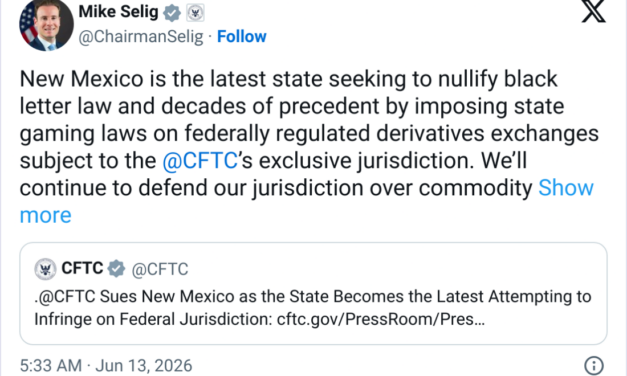
New Mexico is the latest US state to be pulled into the Commodity Futures Trading Commission’s legal fight for its jurisdiction over prediction markets after the state sued Kalshi for allegedly offering illegal sports betting.The CFTC said on Friday that it sued New Mexico Governor Michelle Lujan Grisham, state Attorney General Raúl Torrez, and members of the New Mexico Gaming Control Board in federal court “to block the state’s efforts to apply state gaming laws against CFTC-registered contract markets.”New Mexico sued Kalshi on June 4, arguing the company is offering sports betting to residents without a license and that its sports event contracts function the same as traditional sports bets.The state also claimed Kalshi allowed those aged between 18 and 20 to use the platform, below New Mexico’s minimum gaming age of 21.New Mexico is the eighth state that the CFTC has sued after state authorities had taken enforcement action against prediction market platforms, with Rhode Island, Wisconsin, Minnesota, New York, Arizona, Connecticut and Illinois also facing lawsuits from the regulator.In its complaint against New Mexico, the CFTC claimed that event contracts are “swaps” under federal commodities laws, and Kalshi is a Designated Contract Market (DCM) under the “exclusive jurisdiction” of the CFTC.“New Mexico’s attempt to prevent a CFTC-regulated DCM from offering CFTC-approved financial products intrudes on the exclusive federal scheme Congress designed to oversee United States commodity derivatives markets,” the CFTC argued.“New Mexico is the latest state seeking to nullify black letter law and decades of judicial precedent by imposing state gaming laws on federally regulated derivatives exchanges subject to the CFTC’s exclusive jurisdiction,” CFTC Chairman Mike Selig said in a statement.Source: Mike Selig“The CFTC has the expertise and responsibility to protect its exclusive jurisdiction over commodity derivatives, and that’s exactly what we’ll continue to do,” he said.The CFTC asked the court to rule that New Mexico state laws that would apply to transactions on CFTC-regulated DCMs are invalid and for a permanent injunction prohibiting the state from taking action against prediction market platforms.Gary Gensler doubts CFTC claim over sports betsGary Gensler, a former chair of the Securities and Exchange Commission and the CFTC, also weighed in on the CFTC’s legal battle with the states, casting doubt on the federal regulator’s claim that it has authority over sports event contracts.In an amicus brief filed to the Sixth Circuit on Thursday in Kalshi’s fight with Ohio’s authorities, Gensler argued that the Dodd-Frank Act, passed in 2010 in response to the 2008 financial crisis to regulate swaps, was not meant to encompass sports event contracts.Related: CFTC proposes framework favoring sports event contracts over gambling“Congress did not include sports betting contracts within the statutory Dodd-Frank definition of swap,” Gensler argued. He added that sports event contracts do not fit the purpose or language defining a swap under commodities laws, “which focus on hedging economic risk.”Gary Gensler appearing on CNBC to discuss his amicus brief. Source: YouTube“Sports bets are very rarely, if ever, about hedging,” Gensler argued.Gensler told CNBC on Thursday that the question “at the core of this issue is did Congress in 2010 say, ‘No, none of the states can regulate this’ — it’s going to this little small agency that I once was proud to run — and the answer is categorically ‘No.’”Magazine: Should users be allowed to bet on war and death in prediction markets?

Čítaj viac

SEC plan to scrap ‘Rule 611’ a boon for tokenized US stocks: Galaxy

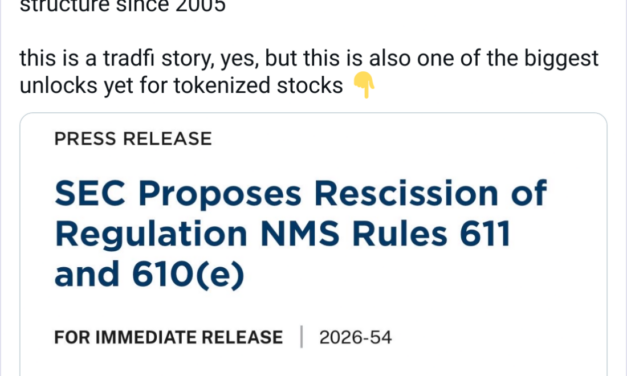
The US Securities and Exchange Commission proposal to rescind rules around order protections and price quotes could remove a major legal barrier for tokenized US stocks.The SEC on Thursday proposed to scrap two rules in its national market system regulations. Rule 611 that bans “trade-throughs,” where a stock order on one exchange can’t be for a worse price than on another, and Rule 610(e) banning exchanges from displaying a bid at the same or higher price than what is available elsewhere.Galaxy head of research Alex Thorn said the proposal is “one of the biggest unlocks yet for tokenized stocks” as it would remove “one of the biggest structural barriers to tokenized US equities trading in DeFi.”The SEC has been looking to undo rules that restrict crypto and blockchain technology. It launched “Project Crypto” in August 2025 with the goal of making rules for the use of digital assets and blockchain in US markets.Source: Alex ThornThorn said that automated market makers (AMM) in crypto, or programs that facilitate trading by pooling assets, can’t comply with trade-through rules as they execute orders against “whatever the pool price is.”He added that an AMM also can’t stop a trade if a better quote exists elsewhere, meaning any pool in a tokenized stock governed by the current rules “would commit trade-throughs constantly and arguably be an illegal trading center.”Related: SEC makes digital assets strategic priority through 2030Prices from AMMs also constantly fluctuate and would also be in constant violation of the rule aiming to guarantee investors get the best price across all platforms, Thorn said.The SEC is likely to replace the rules with a “best execution” framework, which could permit AMMs under the rules, Thorn said.The agency put its proposal up for feedback for 60 days, where it will then review responses and may change its proposal in response to comments.It comes as the SEC was reportedly set to release a plan last month allowing tokenized stock trading, but postponed the plan after officials from stock exchanges raised concerns over how the plan would be executed.Magazine: Can Robinhood or Kraken’s tokenized stocks ever be truly decentralized?Cointelegraph is committed to independent, transparent journalism. This news article is produced in accordance with Cointelegraph’s Editorial Policy and aims to provide accurate and timely information. Readers are encouraged to verify information independently.

Čítaj viac

Coinbase launches tool letting AI agents make payments and trade crypto

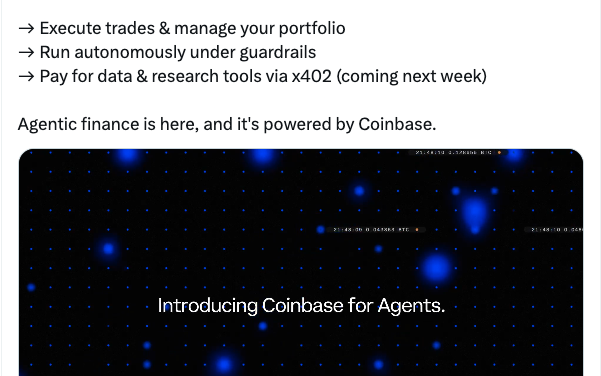
Crypto exchange Coinbase has launched a tool that allows artificial intelligence agents to make payments and trade crypto on behalf of users, as crypto companies look to ride a wave of interest in AI.Coinbase said Thursday that it is launching Coinbase for Agents, which will allow AI models like ChatGPT and Claude to connect with a user’s exchange account and be prompted to make trades or execute strategies.AI agents can also make payments using Coinbase’s AI payments protocol x402, allowing the bots to pay for data services to gather information for carrying out trading strategies without human intervention.Crypto companies have been positioning the technology as a means to support the high-frequency microtransactions that agents typically carry out. AI agents have grown in popularity with the release of better models, with more traders trusting them to autonomously execute trading strategies.Coinbase said the tool is available via both a model context protocol (MCP), allowing AI models to connect with a user account, and a command-line interface for developers.Source: CoinbaseThe company said it also introduced Coinbase Advisor, an AI agent integrated into its app that it says is a US Securities and Exchange Commission and Commodity Futures Trading Commission-registered financial adviser that can give guidance on trades.Coinbase said the tool could help users manage their crypto “without the constant manual oversight” and can undertake tasks like allocating funds to reward programs or making recurring buys.“Imagine you want to dollar-cost average into ETH at the optimal time of day. Just tell your agent your target and timeframe. It can pull 30 days of hourly price data to identify when ETH historically trades lowest, set a recurring $20 market buy at that time, and schedule it to run daily for the next two weeks,” the company explained.While many companies are pitching for investors to start using AI, a study published last month found that users of AI agents are losing money, and the agents themselves may not really be working alone.Researchers at Pantera Capital, Stanford University, Ava Labs and the Initiative for Cryptocurrencies and Contracts studied over 925,000 token holders and found that agent treasuries made gains of $30 million on paper, while their token holders collectively lost $191.7 million.It also found that many of the projects it studied “do not yet provide clear evidence of autonomous trade execution” with a “substantial share” of projects being “basic API integrations.”Related: AI agents with crypto could escape and become ‘unstoppable,’ experts warnCoinbase is the latest to bet that AI agents will interact with and transact across multiple services. Stablecoin issuer Circle last month launched tools letting AI agents use wallets, discover services and make programmable payments with its token. Circle CEO Jeremy Allaire has predicted that billions of AI agents will use stablecoins within five years.Earlier this month, the stablecoin and wallet infrastructure provider Crossmint launched a service that enabled AI agents to make payments using eligible Visa credit and debit cards.Crypto investment firm Keyrock said in a report in May that AI agents had quickly created a “developed ecosystem,” and had settled $73 million across 176 million transactions between May 2025 and April 2026.AI Eye: How AI just dramatically sped up the quantum risk for Bitcoin

Čítaj viac

TradFi advisors want stablecoins, tokenization over Bitcoin: Bitwise

Advisors to some of the largest financial institutions are taking more of an interest in stablecoins and tokenization than in Bitcoin, which could help pull crypto out of its current slump, said Bitwise investment chief Matt Hougan.Hougan said in a note on Wednesday that he recently spoke with more than 40 advisors who were “still interested in crypto” but are “more interested today in stablecoins and tokenization than they are in Bitcoin.”“It was pretty hard to engage with advisors on Bitcoin this week,” he said. “In call after call, they expressed much more curiosity over the real-world applications of crypto that are quickly reshaping everything from capital markets to global payments.”Stablecoins and tokenization have recently captured the interest of Wall Street, as Bitcoin (BTC) has struggled to maintain momentum, trading down almost 30% so far this year to $62,500.Stablecoin issuer Circle saw a buzzy initial public offering in June 2025, with its stock quickly rallying to a peak of $240 from its debut price of $31. It has since struggled amid a wider rout in crypto stocks, closing at just under $79 on Wednesday.Tokenization is also set for a boost as the US Securities and Exchange Commission is reportedly planning to allow tokenized stock trading, which could give traditional investors confidence and spur investment.“It’s hard to turn on CNBC and not hear someone like SEC Chair Paul Atkins or Goldman Sachs CEO David Solomon or BlackRock CEO Larry Fink talking about stablecoins and tokenization,” Hougan said. “Investors want to be a part of that.”Matt Hougan, pictured appearing on a podcast in January, says advisors are becoming less interested in Bitcoin. Source: YouTubeHe said interest in the technologies could be what pulls crypto into a bull market, which has historically been triggered by “new product breakthroughs and new types of investors.”Related: Bitcoin may act as a ‘canary in the coal mine’ as risk-off pressure spreadsThe “best hope,” according to Hougan, is that financial advisors and institutional investors make up the new crypto investment class, and their money is likely to flow into stablecoin and tokenization investments.He said Ethereum, Solana, Canton, Chainlink and Avalanche were mentioned during his conversations, along with trading platform Hyperliquid and crypto companies Figure, Circle and Coinbase.Coinbase and other crypto exchanges have been expanding into business lines beyond crypto trading in a bid to capitalize on investor interest in blockchain-linked services.Many exchanges have begun to offer tokenized stocks, albeit outside of the US, which have grown in popularity as investors seek to gain exposure to popular stocks and intensely-hyped public offerings, such as SpaceX’s planned debut on Friday.Magazine: Does ‘Paper Bitcoin’ mean there’s an unlimited supply of BTC?

Čítaj viac
Získaj BONUS 8 € v Bitcoinoch

nakup bitcoin z karty

Registrácia Binance

Burza Binance

Aktuálne kurzy