Autor Cointelegraph By Jesse Coghlan

Fed conference hears stablecoins may boost USD as global reserve currency

A note published by the United States Federal Reserve on a recently held conference found a majority of exports believe a U.S. dollar central bank digital currency (CBDC) would not drastically change the global currency ecosystem. Panelists at the conference also agreed CBDC development outside of the U.S. doesn’t threaten the status of the dollar, but th development of cryptocurrencies could alter the role of the dollar globally, with some saying stablecoins could even boost the U.S. dollar’s role as the global dominant reserve currency.The assessments came from expert panelists at a June 16 and 17 conference hosted by the Federal Reserve on the “International Roles of the U.S. dollar” collated into a note and published by The Fed on July 5. The conference was used to gain insight from policymakers, researchers, and market experts to understand “potential factors that may alter the dominance of the U.S. dollar in the future” including new technologies and payment systems.A discussion on a panel addressing digital assets and if CBDCs would provide advantages for the dollar had panelists agree that the underpinning technology alone wouldn’t “lead to drastic changes in the global currency ecosystem”.Speakers on the panel included digital currency initiative director at MIT, Neha Narula, head of research at the Bank of International Settlements, Hyun Song Shin, chief investment strategist at asset management firm Bridgewater, Rebecca Patterson and HSBC bank’s head of FX research Paul Mackel.The panelists agreed that factors such as market and political stability, along with market depth, are more crucial for dominant reserve currencies like the U.S. dollar that the development of a Fed issued digital dollar.The development of CBDCs by other countries was also generally agreed by the panel to have a tendency to focus more heavily on that country’s own domestic retail market, and therefore was considered “not a threat to the U.S. dollar’s international status”.The Federal Reserve noted the amount and scope of CBDC’s for making cross-border payments is “still quite limited”, suggesting that these systems don’t yet pose a threat to the dollar, which accounts for a majority of international financial transactions according to an October 2021 note.Focusing on cryptocurrencies, panelists said further development of digital assets could change the international role of the dollar, but adoption by institutional investors was throttled by a lacking regulatory framework, leaving the current crypto market to be dominated by speculative retail investors.Another panel including Fed financial research advisor Asani Sarkar and finance professor Jiakai Chen, concluded that part of the demand for crypto, especially Bitcoin (BTC), was driven by a desire to evade domestic capital controls, citing BTC prices in China trading at a premium in comparison to other countries.Despite this, the Fed says panelists didn’t see crypto as a threat to the global role of the dollar in the short term. Some even suggested in the “medium run” that crypto could reinforce the dollars’ role if “new sets of services structured around these assets are linked to the dollar”, a likely reference to stablecoins, cryptocurrencies pegged to the value of a fiat currency (usually USD.)Related: US lawmaker lays out case for a digital dollarThe advice by panelists may help put a new spin on things for members of the Federal Reserve.Previously, the Federal Reserve Board of governors said in June that stablecoins not sufficiently backed by liquid assets and proper regulatory standards “create risks to investors and potentially to the financial system” likely referencing the collapse of TerraUSD Classic (USTC).The comment by the Board came before Federal Reserve chair Jerome Powell stated a CBDC could “potentially help maintain the dollar’s international standing”.

Čítaj viac

Bitcoin ‘tourists’ have been purged, only hodlers remain: Glassnode

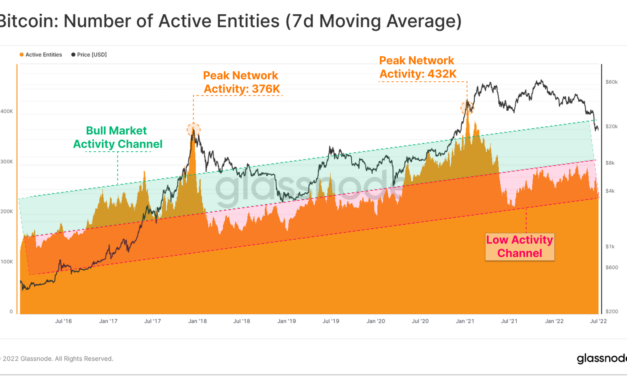
So-called “market tourists” are fleeing from Bitcoin (BTC), leaving only long-term investors holding and transacting in the top cryptocurrency, according to blockchain analytics firm Glassnode.In its July 4 Week Onchain report, Glassnode analysts said June saw Bitcoin have one of its worst-performing months in 11 years, with a loss of 37.9%. It added activity on the Bitcoin network is at levels concurrent with the deepest part of the bear market in 2018 and 2019, writing:“The Bitcoin network is approaching a state where almost all speculative entities, and market tourists have been completely purged from the asset.”However, despite the almost complete purge of “tourists,” Glassnode noted significant accumulation levels, stating that the balances of shrimps — those holding less than 1 BTC, and whales — those with 1,000 to 5,000 BTC, were “increasing meaningfully.”Shrimps, in particular, see the current Bitcoin prices as attractive and are accumulating it at a rate of almost 60,500 BTC per month, which Glassnode says is “the most aggressive rate in history,” equivalent to 0.32% of the BTC supply per month.Explaining the purge of these tourist-type investors, Glassnode revealed that both the number of active addresses and entities have seen a downtrend since November 2021, implying new and existing investors alike are not interacting with the network. Address activity has fallen from over 1 million daily active addresses in November 2021 to around 870,000 per day over the past week. Similarly, active entities, a collation of multiple addresses owned by the same person or institution, are now approximately 244,000 per day, which Glassnode says is around the “lower end of the ‘Low Activity’ channel typical of bear markets.”“A retention of HODLers is more evident in this metric, as Active Entities is generally trending sideways, indicative of a stable base-load of users,” the analysts added.Source: GlassnodeThe growth of new entities has also dived to lows from the 2018 to 2019 bear market, with the user-base of Bitcoin hitting 7,000 daily net new entities.The transaction count remains “stagnant and sideways,” which indicates a lack of new demand but also means that holders are being retained through the market conditions. “Transactional demand can be seen to move sideways throughout the main body of the bear,” – GlassnodeRelated: Institutional investors shorting Bitcoin made up 80% of weekly inflowsDriving home its point, Glassnode concluded that the number of addresses with a non-zero balance, those that hold at least some Bitcoin, continues to hit all-time-highs and is currently sitting at over 42.3 million addresses.Past bear markets saw a purge of wallets when the price of Bitcoin collapsed. Still, with this metric indicating otherwise, Glassnode says it shows an “increasing level of resolve amongst the average Bitcoin participant.”

Čítaj viac

Nifty News: NFT and Web3 gaming console to launch in 2024, Chinese firms to check ID for NFT buying, and more

Polium, a company that markets itself as “building the products and infrastructure for Web3 gaming,” has said it’s launching a gaming console that will support multiple blockchains and nonfungible tokens (NFTs).The “Polium One” console announced on July 3 is slated for an initial Q3 2024 release and will support the Ethereum (ETH), Solana (SOL), Polygon (MATIC), BNB Chain (BNB), ImmutableX, Harmony, EOS, and WAX blockchains.We are introducing the Polium One, A multi-chain console for Web 3 Gaming. #Web3OnConsole pic.twitter.com/tkRaP2O13A— Polium (@Polium__) July 2, 2022Currently, the only specifications listed for the console are that it will support a 4K Ultra HD resolution at 120 frames per second. Polium says its community will help them build the console’s hardware and software and states it will have a functional prototype in “a few months.”According to Polium, the console will feature its own multichain cryptocurrency wallet, and the controller will have a wallet button for users to make trades more efficiently. Security and verification of transactions from the console will be enabled via a fingerprint scanner on the controller.The console’s price is unknown, but Polium does plan to mint a “Polium Pass” NFT, which will allow holders to claim a console on the initial launch day. Pass holders will receive another NFT, which in the future can be staked for a “PLAY” token, the console’s native token for transacting on its marketplace app. Polium plans on releasing 10,000 consoles to Polium Pass holders and partners on the Q3 2024 initial launch, with more units manufactured for the public in Q3 2025. It has set a goal of selling over 1 million units.The company has already received criticism for its logo looking similar to another popular console, the Nintendo GameCube. Polium said it didn’t copy the logo and is already creating a new logo “that is original.”Man logo looks kinda familiar… pic.twitter.com/bruj4gX35D— ben shambrook (@shambrookben) July 4, 2022

Chinese tech giants to check ID before NFT purchasesChina’s NFT industry players and the country’s largest technology firms have signed an agreement to check the identity of users using digital collectible trading platforms, according to a report on July 4 from the South China Morning Post.A so-called “self-discipline initiative” document was signed by companies with a stake in China’s NFT market, such as JD.com, Tencent Holdings, Baidu, and digital payments platform Ant Group, an affiliate of Alibaba Group.The document was published on June 30 by the China Cultural Industry Association and, while not legally binding, calls on the firms to “require real-name authentication of those who issue, sell and buy” NFTs, and “only support legal tender as the denomination and settlement currency.”The initiative also seeks for the companies to promise not to create secondary marketplaces for NFTs to combat trading speculation.The popularity of NFTs in China is on the rise, and digital collectable platforms have grown 5X in just four months from February to mid-June 2022 despite multiple warnings from the government.Nike looking to create video game NFTsA patent filed by Nike Inc. on June 30 with the United States Patent and Trademark Office (USPTO) shows the fitness clothier is interested in a “video game integration” of NFTs.As per the filing, Nike seeks to patent a method where a “virtual object” will display in games, where that object is a “virtual shoe, article of apparel, headgear, avatar, or pet.” Other language in the filing suggests Nike plans to sell the physical shoes and clothes represented within the NFTs.Related: NFT hype evidently dead as daily sales in June 2022 dip to one-year lowsThe reasoning presented in the filing suggests Nike is concerned with counterfeit digital collectibles and says there “exists a need for a retailer to more directly influence and control the nature and ultimate supply of digital objects within this virtual market.”It also reasons an opportunity exists for it to capitalize and engage with video game players as most games feature customizable characters, which could make them “more engaged with a brand in the physical world.”More Nifty News:The second-largest sale of an Ethereum Name Service (ENS) domain not only in U.S. dollars but also in Ethereum happened on July 3 when the domain “000.eth” sold for 300 ETH, roughly $320,000. The highest sale of an ENS domain was for “paradigm.eth” in October 2021, which fetched 420 ETH, around $1.5 million at the time.Social media platform Facebook will add support for NFTs, and a “digital collectibles” tab will appear on the pages of selected creators in the U.S., with a feature to cross-post between Instagram and Facebook rolling out eventually.

Čítaj viac

Worst quarter in 11 years as Bitcoin price and activity plunges

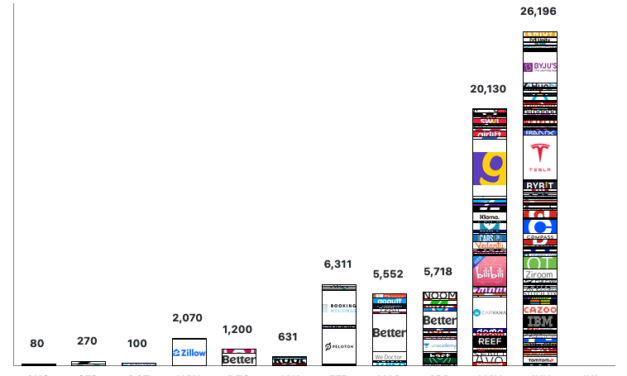
Bitcoin (BTC) has seen its worst quarterly loss in 11 years with price and activity on the blockchain both plunging over the last three months. The second quarter ending June 30 saw Bitcoin’s price fall from around $45,000 at the start of the quarter to trade at $19,884 before midnight ET on June 30 according to CoinGecko, representing a 56.2% loss according to crypto analytics platform Coinglass. It’s the steepest price fall since the third quarter of 2011, when BTC fell from $15.40 to $5.03, a loss of over 67% and worse than the bear markets of 2014 and 2018, when Bitcoin’s price slumped 39.7% and 49.7% in their worst quarters respectively. The past quarter saw eight weekly red candles in a row for Bitcoin and the month of June saw a draw down of over 37%, the heaviest monthly losses since September 2011 which saw the price fall more thaner 38.5% in the month.There are also signs that investors are keeping their powder dry — or they’ve run out of funds — during the bear. Activity on the blockchain is taking a dive with Bitcoin’s spot volume — the total amount of coins transacting on the blockchain — dropped over 58.5% in just nine days according to a June 29 analysis from Arcane Research.But its not just crypto markets in turmoil. Thanks to sky high inflation and rising interest rates the traditional stock market has also taken a pounding, with some calling it the “worst quarter ever” for stocks.Charlie Bilello, CEO of Financial advisory firm Compound Capital Advisors shared a chart on Twitter showing the S&P 500 index was down 20.6% in the first half of 2022, the worst start to the year for the index since 1962, when price return was -26.5%. The S&P was down 20.6% in the first half of 2022, the worst start to a year for the index since 1962. $SPX pic.twitter.com/OMcX7yfP5o— Charlie Bilello (@charliebilello) June 30, 2022The difficult economic conditions have seen a swath of staff layoffs from crypto companies including Gemini, Crypto.com and BlockFi. Most recently the crypto and stock trading platform Bitpanda cut its employee count by approximately 277 full-time and part-time employees.Related: 80,000 Bitcoin millionaires wiped out in the great crypto crash of 2022Crypto is closely tied to the wider tech sector and the tech heavy NASDAQ composite index has fell by almost 22.5% over the second quarter.A “Tech Layoff Tracker” from technology jobs board TrueUp reveals over 26,000 tech employees across 200 company wide cutbacks just in June alone.Tech Layoff Tracker. Source: TrueUpOver the quarter, 307 layoffs impacted over 52,000 staff with one of the largest coming from Elon Musk’s Tesla, with 3,500 impacted. Crypto exchange Coinbase features twice, firstly for its June 2 hiring freeze and job offer rescission of nearly 350 people and second for its June 14 staff layoff, affecting 1,100 individuals.

Čítaj viac

Získaj BONUS 8 € v Bitcoinoch

nakup bitcoin z karty

Registrácia Binance

Burza Binance

Aktuálne kurzy