
Autor Cointelegraph By Jesse Coghlan

Further BTC mining consolidation as Crusoe acquires peer mining firm

Amid soaring Bitcoin (BTC) mining difficulty and sinking mining profitability, Colorado-based Bitcoin miner Crusoe Energy Systems has announced the acquisition of the operating assets of portable BTC mining operator Great American Mining (GAM).The deal will see GAM’s operations integrate into Crusoe’s, adding over 10 megawatts (MW) to its mining output and around 4,000 application-specific integrated circuit (ASIC) crypto mining rigs — increasing Crusoe’s capacity by about 9%, according to the company.GAM builds and deploys portable BTC mining facilities — vehicle trailer-mounted containers enclosed with ASIC miners — with the goal of helping oil and gas companies take advantage of stranded or otherwise wasted natural gas by using it to power the facility to mine BTC.Crusoe will have roughly 125 of these gas-powered waste containers deployed and operating following the acquisition, which it says could reduce an annual CO2-equivalent emission of around 170,000 cars.The consolidation of these two mining operations comes as the sector faces pressure from both the traditional and crypto markets, along with an all-time high BTC mining difficulty, all of which is negatively affecting miner profitability.Markus Thielen, head of research and strategy for digital asset services platform Matrixport, told Cointelegraph the majority of the mining hash rate moving to the United States over the last two years had “significant consequences” on how the industry was positioned into the wider economic downturn.“Around 20 Bitcoin mining companies raised additional capital through IPOs where shareholders demanded a high correlation to the underlying Bitcoin price,” he said, explaining orders for new mining machines were placed a year in advance, which was expected to come online in the third quarter of 2022:“The result was that mining companies bought Bitcoin directly from the market at higher costs than their mining operations and were negatively exposed to further capital expenditure investments as they placed equipment orders a year in advance.”As miners waited for the equipment, some sold significant parts of their BTC reserves to recoup expenditures, but Thielen says “this has not been enough,” and expects an “outright industry restructuring.”Related: Canaan exec says opportunity outweighs crisis as Bitcoin miners struggle with shrinking profitsCrypto miners such as CleanSpark have already shown to be interested in snapping up cheap assets amid tough market conditions, purchasing over 1,000 ASIC mining rigs at a “substantially discounted price” in July and 1,800 Antminer S19 XP rigs the month prior.In September, CleanSpark went on to purchase a $33 million facility in the United States from Australian-based miner Mawson, spending an extra $9.5 million buying the firms’ 6,468 ASIC mining rigs.Rising energy costs and the crypto bear market caused mining hosting firm Compute North to file for Chapter 11 bankruptcy in September, with the company owing $500 million to 200 creditors with assets worth anywhere between $100 million and $500 million.

Čítaj viac

Further BTC mining consolidation as Crusoe acquires peer mining firm

Amid soaring Bitcoin (BTC) mining difficulty and sinking mining profitability, Colorado-based Bitcoin miner Crusoe Energy Systems has announced the acquisition of the operating assets of portable BTC mining operator Great American Mining (GAM).The deal will see GAM’s operations integrate into Crusoe’s, adding over 10 megawatts (MW) to its mining output and around 4,000 application-specific integrated circuit (ASIC) crypto mining rigs — increasing Crusoe’s capacity by about 9%, according to the company.GAM builds and deploys portable BTC mining facilities — vehicle trailer-mounted containers enclosed with ASIC miners — with the goal of helping oil and gas companies take advantage of stranded or otherwise wasted natural gas by using it to power the facility to mine BTC.Crusoe will have roughly 125 of these gas-powered waste containers deployed and operating following the acquisition, which it says could reduce an annual CO2-equivalent emission of around 170,000 cars.The consolidation of these two mining operations comes as the sector faces pressure from both the traditional and crypto markets, along with an all-time high BTC mining difficulty, all of which is negatively affecting miner profitability.Markus Thielen, head of research and strategy for digital asset services platform Matrixport, told Cointelegraph the majority of the mining hash rate moving to the United States over the last two years had “significant consequences” on how the industry was positioned into the wider economic downturn.“Around 20 Bitcoin mining companies raised additional capital through IPOs where shareholders demanded a high correlation to the underlying Bitcoin price,” he said, explaining orders for new mining machines were placed a year in advance, which was expected to come online in the third quarter of 2022:“The result was that mining companies bought Bitcoin directly from the market at higher costs than their mining operations and were negatively exposed to further capital expenditure investments as they placed equipment orders a year in advance.”As miners waited for the equipment, some sold significant parts of their BTC reserves to recoup expenditures, but Thielen says “this has not been enough,” and expects an “outright industry restructuring.”Related: Canaan exec says opportunity outweighs crisis as Bitcoin miners struggle with shrinking profitsCrypto miners such as CleanSpark have already shown to be interested in snapping up cheap assets amid tough market conditions, purchasing over 1,000 ASIC mining rigs at a “substantially discounted price” in July and 1,800 Antminer S19 XP rigs the month prior.In September, CleanSpark went on to purchase a $33 million facility in the United States from Australian-based miner Mawson, spending an extra $9.5 million buying the firms’ 6,468 ASIC mining rigs.Rising energy costs and the crypto bear market caused mining hosting firm Compute North to file for Chapter 11 bankruptcy in September, with the company owing $500 million to 200 creditors with assets worth anywhere between $100 million and $500 million.

Čítaj viac

Taliban had a ‘massive chilling effect’ on Afghan crypto market: Report

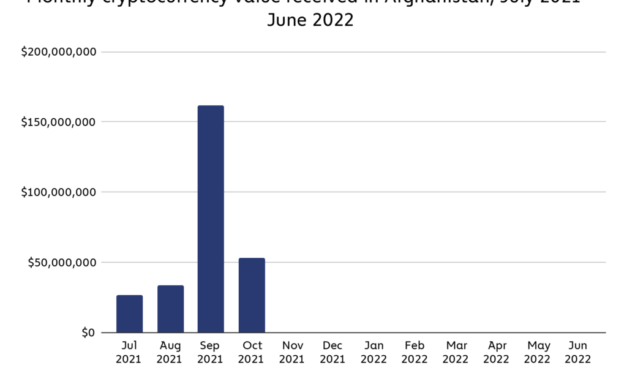
The Taliban’s takeover of Afghanistan has had a “massive chilling effect” on the local cryptocurrency market, bringing it to an effective “standstill,” according to a recent report.Blockchain analytics firm Chainalysis in an Oct. 5 report stated the Middle East and North Africa (MENA) region saw the largest crypto market growth in 2022 but noted that Afghani crypto dealers had three options: “flee the country, cease operations, or risk arrest.”The report states after the Taliban seized power in August 2021, crypto value received in August and September that year spiked to a peak of over $150 million, then fell sharply the following month. Before the takeover, Afghani citizens would on average receive $68 million per month in crypto value mainly used for remittances. That figure has now dropped to less than $80,000 post takeover.Graph from Chainalysis 2022 Geography of Cryptocurrency Report. Source: ChainalysisAfghanistan was 20th place in Chainalysis’ 2021 crypto adoption index released in October 2021, but now is at the bottom of the list following the Taliban takeover.The reinstated Ministry for the Propagation of Virtue and the Prevention of Vice in charge of implementing Islamic law in the country is the reason for the change. Chainalysis explains the agency equated cryptocurrency to gambling declaring it haram — forbidden under Islamic law.Related: Terror groups may turn to NFTs to raise funds and spread messages: WSJA large portion of the activity still undertaken in the country comes from money laundering from illicit sources such as bribes or drugs, an anonymous source cited to Chainalysis.The individual added only a “small portion” is “young people who have a few hundred bucks” to day-trade digital assets.

Čítaj viac

Coinbase expands to Australia with focus on institutions in 'months to come’

United States-based cryptocurrency exchange Coinbase will expand its services in Australia, launching a local entity and an updated suite of services for retail crypto traders, hinting that institutional products are soon to follow.Speaking to Cointelegraph, Nana Murugesan, Coinbase’s VP of international and business development, said building during bear markets has “paid off big time during the bull run” and he’s confident in what he sees in the local market.The “baseline signals” Murugesan explains such as the local awareness of crypto and people who view it as the future of finance are “kind of on par or even better” in Australia compared to the U.S. and other markets.“Australia definitely punches way, way over its weight in the APAC region, certainly at a global level too and from a revenue contribution standpoint, I feel pretty good about what it’s going to do.”Murugesan explains it started with building a localized infrastructure, incorporating a local entity, Coinbase Australia Pty Ltd, and obtaining registration to provide digital currency exchange services with the Australian Transaction Reports and Analysis Centre (AUSTRAC), the country’s financial intelligence agency.“We’ve been very impressed with the open door that we’ve received in Canberra and with different policymakers,” Murugesan says, adding the exchange has received “tough questions” regarding its platform and token listings.“Given the token mapping exercise that’s going on, there are a lot of technical questions that we are getting from the Treasury and other departments […] deep technical questions is another thing that we are seeing in Australia at a level deeper than some other countries.”Initially, Coinbase is providing Australian crypto traders with new “fast payments” for local bank accounts, access to its advance trading platform and 24/7 chat support which Murugesan says “opens the door” for the company to launch its full range of institutional and development products.While he didn’t have a specific timeline on when the products will become available, Murugesan added he knows Australian institutions will want to “do everything locally” and added that Coinbase will be “very much focused on institutions” in the coming months.The exchange will also collaborate with RMIT University’s Blockchain Innovation Hub to assess Web3 opportunities in the country, Murugesan adds it’s working with the University of New South Wales (UNSW) and others to create related courses and assist in research programs.Related: Rushing ‘token mapping’ could hurt Aussie crypto space — Finder founderMurugesan says as Coinbase looks to further expand into Asia, he sees regulation as a business enabler as “resources are limited, especially during a bear market.” With some countries in the region having unclear crypto policies, it’s likely it will focus “more towards markets that have clarity or are going towards clarity,” he said. He mentioned the high level of interest G20 nations have in crypto and how blockchain and digital currencies fit into the future of finance, expecting it to be a “hot topic” among G20 member nations by next year, adding:“There’s a lot of interest among Australian policymakers to take a leadership role in those type of discussions, too.”

Čítaj viac

Anchorage co-founder sees 'tons of opportunity' as it expands into Asia

Anchorage Digital co-founder and president Diogo Mónica believe there is immense opportunity in Asia’s institutional investors, with the digital asset infrastructure provider on Oct. 5 announcing a “major expansion” of its platform into the region. Speaking to Cointelegraph, Mónica said the company chose Singapore as a “jump point” into the wider Asia market as the country has become a hub for crypto companies and has a strong regulatory environment. Anchorage is currently undertaking the application process with the Monetary Authority of Singapore (MAS), the city-state’s central bank. “It’s about being in a regime that’s friendly towards crypto and that businesses want to do business in. We’re institutional only, institutions are going to Singapore, so we’re following suit.”However, Mónica said he sees “tons of opportunity” in the Thai, Indonesian, Japanese and South Korean crypto markets as well, after speaking to regulators there, though he expects the company will need a more local presence.“Right now our strategy is being regulated in Singapore as it’s recognized by all the other regulators as a great location,” Mónica says, adding other regulators in the region have “very strict, but very clear rules, which is amazing.”Anchorage provides infrastructure for use by financial institutions to enable digital asset custody, exchange, staking and other Web3-related services.Mónica said however that Asian institutional investors have changed their tune on how they approached crypto investments after the wake of the Terra ecosystem collapse. He said it was rarer for Asia-based institutions to care about the security of the assets up until recently, with a tendency of focusing more on product features. However, in the wake of the collapse and the resulting sluggish crypto market, the focus has shifted to regulation, risk management and business continuity.“I now have conversations about bankruptcy, and whether their assets are bankruptcy remote, and whether they’re on your balance sheet […] but a year ago, nobody’s asking me questions about bankruptcy. A year ago, everybody was asking me questions about DeFi and things like that.”Mónica says Anchorage already has a team in Singapore with clients from the region making up roughly 10% of its business. He sees that expanding to 25% over the next 12 to 18 months.He said the bear market is a good time to gain a foothold and build relationships with regulators as it demonstrates its ability to attract well-established clients who “are not just tourists to the space.”“You’re seen as the leader, and you’re seen as the people that expanded and have conviction, even during the bear market.”Related: State Street: Institutional investors undeterred by crypto winterThe most popular use case for crypto that Mónica is witnessing in the region is cross-border remittances and borrowing and lending. He also mentioned mining is a common use case, not just for Bitcoin (BTC) but also companies running proof-of-stake validators.As for the future, he says announcements of “some very large traditional firms” using its technology to offer services themselves are on the horizon, along with a focus on stablecoins and the infrastructure component which will serve use cases for those assets.

Čítaj viac

Získaj BONUS 8 € v Bitcoinoch

nakup bitcoin z karty

Registrácia Binance

Burza Binance

Aktuálne kurzy