Autor Cointelegraph By Jesse Coghlan

Three Aussie crypto funds halted as regulator cites non-compliance

Australia’s chief financial market regulator has placed interim stop orders on three cryptocurrency-related funds set to be offered to retail investors, due to non-compliant target market determinations (TMDs).In a media release dated Oct. 17 local time, the Australian Securities and Investments Commission (ASIC) said it has placed interim stop orders on three of Australian asset manager Holon’s crypto funds — which separately aim to invest in Bitcoin (BTC), Ethereum (ETH), and FileCoin (FIL).A target market determination is a document that describes who a product is appropriate for, based on likely needs, objectives, and financial situation as well as how the product can be distributed, according to Invest Smart. In a statement to Cointelegraph, a spokesperson from ASIC said the TMDs were “too broad […] given the volatility and speculative nature of crypto markets.”They added the regulator’s concern that Holon has “not appropriately considered the features and risks of the funds in determining their target markets.”In its statement, ASIC said it considers the funds not suited to the wide target market defined in the TMDs, including those with a “medium, high, or very high risk and return profile,” those intending to use the fund as a “satellite component” — up to 25% of their portfolio, and those who intend to use the fund for 75% to 100% of their investment portfolio.ASIC added that cryptocurrency funds could see investors exposed to significant negative returns but stated the product disclosure statements (PDS) provided by Holon say they could face a “total loss of value.”“ASIC made the interim orders to protect retail investors from potentially investing in funds that may not be suitable for their financial objectives, situation or needs,” it said, adding that the order would be valid for 21 days unless revoked earlier. The specifics of what ASIC has requested Holon to change are unclear and the ASIC spokesperson did not provide further details, however, the regulator said it expects Holon to consider the concerns and take immediate steps to ensure compliance. The interim stop will prevent Holon from sharing a PDS, providing general advice on the funds, or issuing shares of the funds to retail investors.The regulator also expects Holon to address the concerns “within a timely manner” otherwise a final stop order will be issued, though Holon will be given the opportunity to make submissions before such an order is made. A spokesperson from Holon told Cointelegraph the company is not making comments on the matter “at this stage.”Related: 1M Aussies will enter crypto over the next 12 months — Swyftx surveyThe funds, named the Holon Bitcoin Fund, Holon Ethereum Fund, and Holon FileCoin Fund are all managed investment schemes that aim to give exposure to the price of the corresponding crypto and work by investors pooling money who in return receive a relative stake in the scheme.In this case, the pooled money is used to purchase the digital asset named in the fund with custody handled by the Gemini crypto exchange according to a July blog from the company.

Čítaj viac


Bankman-Fried '100%' supports knowledge tests for retail derivatives traders

The founder and CEO of cryptocurrency exchange FTX, Sam Bankman-Fried has backed the idea of knowledge tests and disclosures to protect retail investors but said it shouldn’t just be crypto-specific. Bankman-Fried tweeted his thoughts in response to an idea floated by the Commodities Future Trading Commission (CFTC) commissioner Christy Goldsmith Romero on Oct. 15, saying the establishment of a “household retail investor” category for derivatives trading could give greater consumer protections.Romero said due to crypto, more retail investors are entering the derivatives markets and called for the CFTC to separate these investors from professional and high-net-worth individuals and have “disclosures written in a way that regular people understand or could be used when weighing rules on the use of leverage.”Derivatives trading is when traders speculate on the future price of an asset, such as stock, commodities, fiat currency, or cryptocurrency through the buying and selling of derivative contracts, which can involve leverage. The FTX founder said he “100%” agrees with mandating disclosures and knowledge tests for all Future Commissions Merchants (FCMs) and Designated Contract Markets (DCMs) who face retail traders, adding it “could make sense.”He added however that it doesn’t “necessarily make sense” for the disclosures and tests to be specific to cryptocurrencies, suggesting these should apply to all derivative products.DCMs are CFTC-regulated derivate exchanges on which products such as options or futures are offered which can only be accessed through an FCM, which accepts or solicits buy and sell orders on futures or futures options contracts from customers.Bankman-Fried’s comments come as FTX.US, FTX’s United States-based entity, looks to launch cryptocurrency derivatives trading and the exchange has already created a knowledge test that could be used for its platform according to Bankman-Fried.Related: CFTC action shows why crypto developers should get ready to leave the USThe CFTC is ramping up its efforts to become the regulator of choice for the U.S. crypto market as calls for regulatory clarity become more persistent.On Sept. 27 CFTC Commissioner Caroline Pham said the regulator should create a crypto retail investor-focused office to expand its consumer protections, the proposed office would be modeled off a similar office at the Security and Exchange Commission (SEC).

Čítaj viac

China floats idea of 'Asian yuan' to reduce reliance on US dollar

Researchers from a Chinese state-run think tank have floated the idea of an Asia-wide digital currency with the aim to reduce its reliance on a United States dollar-based economy. The views of researchers Liu Dongmin, Song Shuang, and Zhou Xuezhi from a unit of the Chinese Academy of Social Sciences (CASS) were published in an issue of the “World Affairs journal” posted online in late September, who said the establishment of an “Asian yuan” token would lower Asia’s reliance on the U.S. dollar.Much like similar existing and trialed Central Bank Digital Currencies (CBDCs), the researchers said distributed ledger technology (DLT) would form the backing of the Asiatoken which would be pegged to a bundle of 13 currencies.The currencies would include those of all 10 of the member nations in the Association of Southeast Asian Nations (ASEAN) along with China’s Yuan, Japan’s Yen, and South Korea’s Won according to the researchers.“More than 20 years of deepened economic integration in East Asia has laid a good foundation for regional currency cooperation. The conditions for setting up the Asian yuan have gradually formed,” the researchers wrote in the journal seen by the South China Morning Post.The journal is affiliated with China’s Foreign Affairs department with the researchers hailing from the “Institute of World Economics and Politics” one of many research units under CASS, a think tank with various ties to the country’s ruling party.The U.S dollar, and more recently cryptocurrencies have become a popular method for those in South East Asia to conduct business, send remittances, and hedge against the inflation of their respective local currencies. Related: China accounts for 84% of all blockchain patent applications, but there’s a catchThe research came a few weeks before a milestone in China’s CBDC pilot, the Bank of China on Oct. 10 said its e-CNY had transacted over 100 billion yuan, around $14 billion in value, with around 5.6 million merchant stores already supporting the digital yuan.The country’s central bank is also partaking in Project Inthanon-LionRock, a DLT-backed cross-border payment CBDC trial also involving the ​​Thai, Hong Kong, and United Arab Emirates central banks.In September the trial saw the “successful” transaction of over $22 million worth of value in a month on its “Multiple CBDC Bridge” platform overseen by the Bank for International Settlements (BIS).

Čítaj viac

Web3 devs ‘more active than ever’ amid crypto winter: Report​​

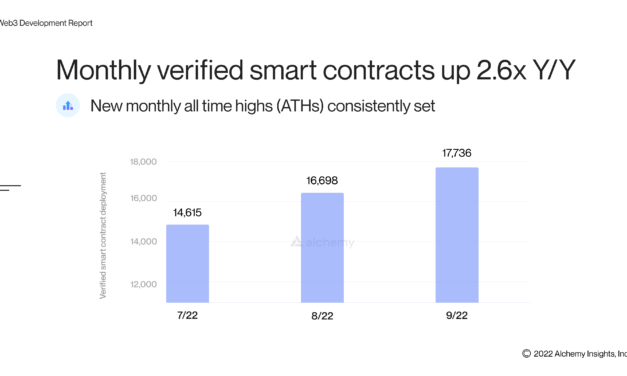
Web3 developers don’t appear to be fazed by the crypto bear market, with one Web3 platform suggesting they’re “more active than ever” — particularly on the Ethereum (ETH) network. In a new Q3 2022 report on Oct. 13 by Web3 development platform Alchemy, the company said that 2022 could be the “biggest year yet” for development on Ethereum. Around 36% of all smart contracts ever deployed and verified on the blockchain have been in 2022, a count of nearly 118,000 compared to the over 323,700 ever deployed, according to the report. This is despite the price of ETH falling by nearly 66% since the start of the year and the total value locked in decentralized finance (DeFi) protocols falling around 70% year-to-date according to DappRadar. Nonfungible token (NFT) trading volumes have also taken a beating, decreasing by 98% since late January.Alchemy states the deployment of smart contracts increased by 40% from the first quarter of the year with consecutive all-time highs hit every month over the third quarter peaking at 17,376 in September alone.Monthly verified smart contracts in Q3 2022. Image: AlchemyThe data also shows smart contract deployments increased by 143% compared to the third quarter of 2021, reaching over 48,500 for the third quarter of 2022.Alchemy noted that in the two weeks following Ethereum’s Merge — when the blockchain moved from a proof-of-work to proof-of-stake consensus — smart contract deployment increased by 14% suggesting some developers may have been waiting for the event to launch their projects.The company also analyzed the usage of two Web3 script libraries Ethers.js and Web3.js, which allow developers to read blockchain data and build Web3 products.The team found the number of developers installing either library had increased by three times that of Q3 2021 to over 1.5 million downloads on average per week.Related: Demand for talent in crypto less dependent on market as industry maturesAlthough some have claimed this current crypto bear market is a good time to build products in Web3 that hasn’t always been the case in previous cycles.As evidenced in Alchemy’s data the 2017 to 2020 bear market saw a 45% decline in smart contract deployments in the middle of the cycle, from 2018 to 2019, although so far that metric has increased by 50% this year from 2021.

Čítaj viac

Barely halfway and October’s the ‘biggest month’ in crypto hacks: Chainalysis

Blockchain analytics firm Chainalysis has labeled October 2022 as “the biggest month in the biggest year ever for hacking activity” with the total hacked value for the month nearly reaching $718 million.Despite not being more than halfway through the month, Chainalysis said 11 different hacks on decentralized finance (DeFi) protocols had seen hundreds of millions exploited.Four exploits alone took place on Oct. 11 worth around $122 million. Hackers siphoned $200,000 in crypto using a smart contract from crypto wallet Rabby Wallet, $1.89 million from blockchain QANplatform’s Ethereum bridge, $2 million from TempleDAO and a $118 million exploit on the Solana-native Mango Markets.Chainalysis says 2021 was the biggest year for blockchain-based hacks on record both in terms of total value hacked and the total number of hacks, but at the current rate, 2022 could “likely surpass” last year’s figures as over $3 billion has been exploited across 125 hacks so far.2/ At this rate, 2022 will likely surpass 2021 as the biggest year for hacking on record. So far, hackers have grossed over $3 billion dollars across 125 hacks. pic.twitter.com/vgT3pz2iOu— Chainalysis (@chainalysis) October 12, 2022The firm says it’s seeing a shift in where exploits are taking place too. In 2019 most hacks took place on centralized cryptocurrency exchanges but as those companies increased security, the huge majority of hacks, around 90% in 2022, have taken place on DeFi protocols.Related: From neglecting security to bad tokenomics, DeFi has played a hand in its own declineThe biggest target for hackers is cross-chain bridges, with three bridges targeted this month accounting for 82% of October’s losses. According to Chainalysis, the largest of these bridge hacks was a roughly $100 million exploit in the bridge between crypto exchange Binance’s BNB Smart Chain and Beacon Chain.

Čítaj viac

Získaj BONUS 8 € v Bitcoinoch

nakup bitcoin z karty

Registrácia Binance

Burza Binance

Aktuálne kurzy