Autor Cointelegraph By Jesse Coghlan

‘47 Ronin’ director who gambled Netflix funds on crypto gets 30 months

Hollywood director Carl Rinsch has been sentenced to two and a half years in prison for defrauding Netflix out of $11 million, which he spent on crypto, stocks and luxury goods.A Manhattan federal court on Monday sentenced Rinsch, known for directing the 2013 film “47 Ronin,” starring Keanu Reeves, to 30 months in prison after he was convicted in December on charges including fraud and money laundering.“Rinsch orchestrated a scheme to steal millions by seeking $11 million from a subscription streaming service, falsely claiming that money would be used to finance a television show that he was creating,” Manhattan US Attorney Jay Clayton said in a statement Monday.“Instead of using the money to make the show, Rinsch made risky bets on highly speculative stock options and cryptocurrency, and spent millions of dollars on luxury goods for himself,” Clayton added. “Today’s sentence sends a deterrent message: fraud will not be tolerated.”Rinsch’s sentence was far below the maximum possible prison time of 90 years he was facing for his seven total charges, to which he pleaded not guilty. His defense also argued that he suffered from mental health issues.The sentence brings to a close a 15-month saga after Rinsch was arrested in March 2025 for defrauding what prosecutors referred to in court documents as “Streaming Company-1,” which multiple reports have identified as Netflix.Source: US Attorney SDNYRinsch makes $27 million on Dogecoin betAccording to a March 2025 indictment and a November 2023 New York Times report on a confidential arbitration proceeding between Netflix and Rinsch, the company initially gave Rinsch $44 million for his sci-fi show “White Horse,” later renamed “Conquest,” but he asked for more funds to finish the show, prompting Netflix to wire an additional $11 million in March 2020.Rinsch used $10.5 million from the fresh funding to gamble on the stock market and quickly lost about half of it in a few weeks by trading options on pharmaceutical companies and the S&P 500.Rinsch transferred more than $4 million in remaining funds to crypto exchange Kraken and went all in on the memecoin Dogecoin (DOGE), a bet that ultimately generated around $27 million when he liquidated in May 2021, according to an account statement seen by The Times.Carl Rinsch giving an interview in 2013 for his feature directorial debut film 47 Ronin. Source: YouTubeWith the DOGE winnings, Rinsch then spent about $10 million on personal expenses and luxury goods, including $1.8 million on credit card bills, $1 million on lawyers to sue Netflix, $3.8 million on furniture and antiques, $2.4 million on five Rolls-Royces and a Ferrari, and $652,000 on watches and clothes, according to the indictment.Related: Onchain, in court: What happened in crypto legal news this weekRinsch never finished the show or returned the funds Netflix provided to complete it.Prosecutors asked for five yearsRinsch was convicted of one count each of wire fraud and money laundering, each carrying a maximum sentence of 20 years in prison, along with five counts of making monetary transactions in property derived from unlawful activity, each carrying a maximum of 10 years.Prosecutors asked the court in a mid-June sentencing memo to give Rinsch five years in prison after he argued for a sentence without prison time.Rinsch’s defense said he suffered from mental health issues, with friends and family members writing to the court to say that his behavior changed around the time of the offenses. Keanu Reeves also wrote to the court in support of Rinsch.In addition to his two-and-a-half-year prison term, Rinsch was sentenced to three years of supervised release, $11 million in forfeiture and $700 in mandatory special assessments.Magazine: China’s 107 Bitcoin memory thief, Bithumb CEO booked: Asia Express

Čítaj viac
Australia’s crypto travel rule is coming into effect: Here’s what's changing

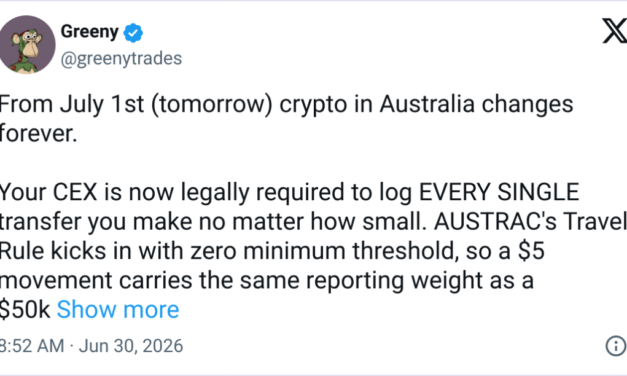
Crypto exchange users in Australia will soon face stricter rules on all transfers as the country’s travel rule is set to come into force on Wednesday, aligning it with similar rules in the EU, US and UK.From July, all crypto sent and received on locally-regulated crypto exchanges will require users to provide additional information, such as the name of the person the crypto is being sent to or received from, and the name of the platform.Gabby Lewis, the head of fraud and financial crime at Swyftx, told Cointelegraph that for most exchange users, “the impact should be very limited. They’ll provide the required details once, and then these will be saved for future use.”The rules are set to bring Australia in line with other countries that have implemented the travel rule for years, which the Financial Action Task Force, an international policy-making body, first extended to crypto in 2019.Crypto users have long expressed concern that the rule would impact the anonymity of the technology and the risks of data linking crypto transfers to personal information being leaked.However, Lewis said that the “travel rule isn’t crypto-specific. It already applies across financial services and has been implemented in areas including Singapore, the United States, New Zealand and the UK. Australia is now following suit.”The rule aims to prevent money laundering, terrorist financing and scams by increasing the traceability of crypto transfers. It will be enforced by the Australian Transaction Reports and Analysis Centre (AUSTRAC), the country’s financial intelligence agency.Transfers from a regulated crypto exchange to a self-custodial address, such as a cold storage wallet, will also prompt a user to verify and declare that they are the owner of that address. “We’re generally talking about a quick confirmation that the wallet is theirs,” Lewis said. “The additional steps mainly come into force for transfers that involve another party or another exchange.”Australia’s travel rule has no minimum value threshold, meaning a transfer of any size will require an exchange to gather information, aligning it with countries including France, the Netherlands and Japan that have no minimum.Source: Sam GreenOther countries have set minimum reporting thresholds, such as the US, which only collects information on transfers starting at $3,000.Some crypto exchanges operating in Australia have already begun to implement the travel rule, such as Kraken, which started on March 31, and CoinJar, which started on Tuesday.Related: Australia passes digital asset bill bringing crypto platforms under licensingCrypto users online have recently given mixed reactions to the rule, which the Australian parliament passed into law in 2024.“With these new rules, you can forget about sending crypto anonymously,” a Reddit user wrote earlier this month.“New travel rule is insane,” another Reddit user wrote earlier in June. “Thinking of moving everything to cold storage instead now.”In response, one Reddit user said that “the regulated platforms were never anonymous.” “This is less of a problem than you’re making it out to be unless you’re involved in activities the authorities would be interested in already,” another user wrote.Magazine: Crypto scammers face death, Aussie CGT makes Asian hubs attractive: Asia Express

Čítaj viac

Bitmine lifts Ether holdings to 5.7M as it joins Russell 1000

Ether treasury company Bitmine Immersion Technologies added more than 27,000 Ether to its holdings last week as the firm joined the Russell index tracking the largest 1,000 US companies.Bitmine said Monday that after its latest $43 million purchase, it held just over 5.7 million Ether (ETH) bought at an average price of $1,569 per token and held 4.7% of the ETH supply of 120.7 million tokens, closer to its goal of owning 5% of Ether’s supply.Bitmine chairman Tom Lee said the past week “was a challenging one for crypto investors as ETH fell by 8%, even as Ethereum witnessed notable positive developments such as the creation of Ethlabs, and even the Bank of England softened its stance around stablecoins.” The latest Ether purchase adds to Bitmine’s lead as the largest public corporate holder of Ether. Meanwhile, its inclusion in the Russell 1000 means more investor demand for Bitmine shares, as many mutual funds, ETFs and pension funds track the Russell 1000 and must buy the stock once it’s added. Related: Bitmine eyes dividend-paying preferred shares, echoing Strategy’s playbook“Being added to the Russell 1000 is expected to add hundreds and possibly thousands of additional institutional investors as equity owners of Bitmine,” Lee said.Lee had said in May, when Bitmine was first considered for the Russell index, that up to 25% of the market cap of a stock included in the index is held by passive index funds.Shares in Bitmine (BMNR) gained 1.7% Monday to end trading at $13.80, but the company’s stock has slid 9% over the past trading week alongside Ether.Shares in Bitmine rose Monday, stemming losses over the past trading week. Source: Google FinanceMeanwhile, rival crypto treasury firms Sharplink and Forward Industries, along with crypto exchange Gemini and crypto services firm Galaxy Digital, were also added to the Russell 3000 Index on Friday, which tracks the largest 3,000 US companies.Ether fell below $1,600 last week, with Lee commenting that “it is not surprising to see ‘window dressing’ leading to investors reducing their holdings in assets that have fallen in the past three months.”Magazine: Bitcoin slides to $58K, XRP hits $1 but onchain data promising: Market Moves 

Čítaj viac

Securitize expects to raise $400M ahead of public debut

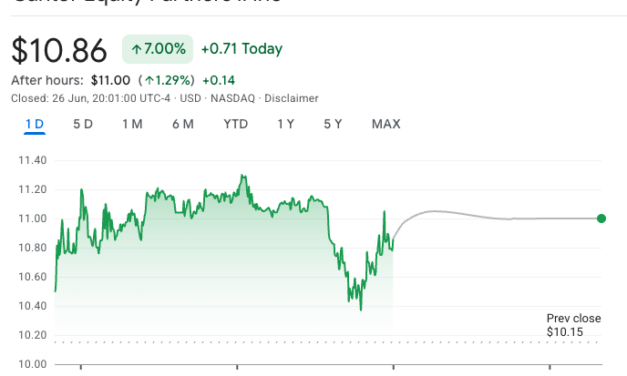
Tokenization platform Securitize says it expects to raise $400 million in its upcoming public debut through a merger with a company backed by Cantor Fitzgerald. Securitize said on Friday that its final redemption results showed less than 30% of shareholders in Cantor Equity Partners II (CEPT), the special purpose acquisition company that will take Securitize public, had elected to redeem.The company said it expects to receive approximately $400 million in gross proceeds from the merger, including related private investment in public equity, or PIPE, financings and excluding transaction-related expenses.Securitize is set to be the latest buzzy crypto-related public debut as Wall Street seeks exposure to tokenization, an area that is seeing heightened investor interest and attention from US regulators.Shares in Cantor’s acquisition vehicle rose on Friday, closing the trading day up 7% to $10.86 and continuing to rise after-hours to $11.CEPT shares climbed on Friday as Securitize announced fewer shareholder redemptions than expected. Source: Google FinanceThe merger between Securitize and CEPT is expected to close on Wednesday, July 1, subject to shareholder approval on Monday and other closing conditions, and the company will then trade under the ticker SECZ on the New York Stock Exchange on Thursday, July 2.”Reaching the public markets is a significant milestone for Securitize and a reflection of the growing momentum behind tokenization,” said Securitize co-founder and CEO Carlos Domingo.Source: Carlos Domingo“When we started more than eight years ago, the idea that major institutions would embrace tokenized securities was still largely theoretical,” Domingo added. “Today, tokenization is moving into the mainstream.”Related: Franklin Templeton, BNP Paribas see tokenization boosting EU’s capital efficiency Securitize is backed by major institutions, such as BlackRock and Morgan Stanley, and crypto firms, including Coinbase and Circle, and has carved out a lead in the tokenization sector, where assets are represented on blockchains.The company partnered with the New York Stock Exchange in March to create tokenized assets for the exchange’s upcoming tokenized securities platform,Standard Chartered said earlier this month that it expects the amount of tokenized assets active in decentralized finance to grow 37-fold to $2.7 trillion by the end of 2030.In mid-May, the US Securities and Exchange Commission was reportedly ready to allow trading of tokenized stocks, but delayed the plan later that month after stock exchange officials raised concerns over how it would be implemented.Magazine: Bitcoin slides to $58K, XRP hits $1 but onchain data promising: Market Moves

Čítaj viac

US senators urge CFTC probe Polymarket over ‘deceptive marketing’

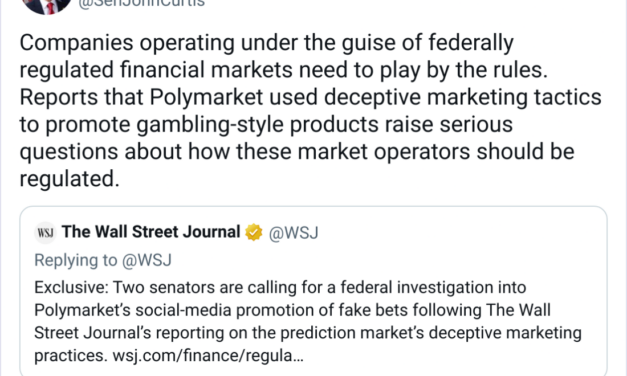
A bipartisan pair of US senators has called on the Commodity Futures Trading Commission to investigate the prediction market platform Polymarket after it reportedly paid social media influencers to make videos of fake bets.Republican Senator John Curtis and Democratic Senator Adam Schiff sent a letter to CFTC Chair Mike Selig on Thursday, saying they were concerned Polymarket “used deceptive marketing tactics to promote gambling-style products to US audiences.”“If accurate, these allegations are deeply troubling and demand immediate scrutiny from the Commodity Futures Trading Commission,” they wrote.The letter comes after The Wall Street Journal reported on June 20 that Polymarket paid influencers to film fake trades on websites resembling its platform and that many creators didn’t disclose that Polymarket paid them.The Journal said it reviewed over 1,100 videos and found that 70% featured fake bets amounting to nearly $2 million.In response to the report, a Polymarket spokesperson told Cointelegraph earlier this week that it was “conducting a comprehensive audit of active promotional content to ensure it complies with our standards, as well as applicable regulatory and legal disclosure requirements.”The letter also came ahead of reports in the Journal and CNBC on Friday that the CFTC was investigating Polymarket.CNBC reported, citing a person familiar with the inquiry, that the CFTC has an ongoing and extensive investigation into Polymarket, but the timeline for when the investigation began was not shared.Polymarket declined to comment on the letter or on the reported CFTC investigation.Prediction markets have recently exploded in popularity and have seen billions of dollars in volume each month, with Senators Curtis and Schiff expressing their concerns about the CFTC’s ability to regulate the platforms.Source: John Curtis“The CFTC has repeatedly asserted regulatory authority over prediction markets and event contracts,” the senators wrote. “Yet with content creators routinely portraying prediction markets as ‘free money,’ there is little basis for treating them differently from gambling.”“These contracts are not in the public interest and should not be treated as derivative products with hedging value,” they added. “We remain concerned that the Commission is neither enforcing the law appropriately, nor is equipped to serve as a federal gambling regulator.”Related: US senators push to end CFTC ‘assault’ on state oversight of prediction marketsThe CFTC has claimed it has authority over prediction markets as the platforms are registered with the agency and operate under federal commodities law.The regulator has sued nine US states that have filed legal action against prediction markets to accuse the platforms of offering unlicensed sports betting via event contracts.Senators Curtis and Schiff asked Selig to give written responses to a list of questions by July 10, which asked if the CFTC was investigating Polymarket, if the reported advertising was legal and if it has the resources to police prediction markets, among others.Magazine: Should users be allowed to bet on war and death in prediction markets?

Čítaj viac

Získaj BONUS 8 € v Bitcoinoch

nakup bitcoin z karty

Registrácia Binance

Burza Binance

Aktuálne kurzy