Autor Cointelegraph By Jesse Coghlan

FTX to give a 'one-time' $6M compensation to phishing victims

Cryptocurrency exchange FTX will provide around $6 million in compensation to victims of a phishing scam that allowed hackers to conduct unauthorized trades on certain FTX users’ accounts. FTX founder and CEO Sam Bankman-Fried posted in a Twitter thread on Oct. 23 that the exchange generally doesn’t award compensation to its users “phished by fake versions of other companies in the space” but in this case, it would compensate users.Bankman-Fried said that this was a “one-time thing” and FTX would “not do this going forward.” “THIS IS NOT A PRECEDENT,” he wrote, clarifying it was only the accounts of FTX users that would be reimbursed.14) But this once, we’ll do it; roughly $6m total.(To be clear, only for FTX accounts! Hopefully other exchanges will comp theirs.)BUT AGAIN NOT A PRECEDENT, WE WILL NOT GOING FORWARD.— SBF (@SBF_FTX) October 23, 2022The recent phishing attack saw attackers gaining user account application programming interface (API) keys which allowed them to conduct unauthorized trades with their crypto exchange accounts. The attack came to light on Oct. 21 after 3Commas said it was alerted that some of its users had unauthorized trading activity. After an initial investigation, FTX and 3Commas then suspended the suspicious accounts to avoid further losses and disabled all compromised API keys.Related: Mango Market exploiter brags after rug pulling Mango Inu ‘shitcoin’On Oct.19 Bankman-Fried published a blog post detailing his thoughts on crypto regulation that included a proposal he dubbed the “5-5 standard” where hackers keep either $5 million or 5% of the amount they’ve stolen, whatever is smaller.In his most recent tweet thread, he thought it time to try his newly thought-up standard, imploring the hacker to send back 95%, around $5.7 million, of the stolen funds within 24 hours, saying “we’ll absolve them.”October has been dubbed “hacktober” by the crypto community as Chainalysis revealed on Oct. 13 that October 2022 has been the “biggest month” ever for hacking activity, despite the report coming out not even halfway through the month.At the time of the report around $3 billion had been exploited through over 125 separate incidents since the start of the month.

Čítaj viac

Nifty News: OpenSea dominance fades, Azuki skateboards fetch $2.5M and more

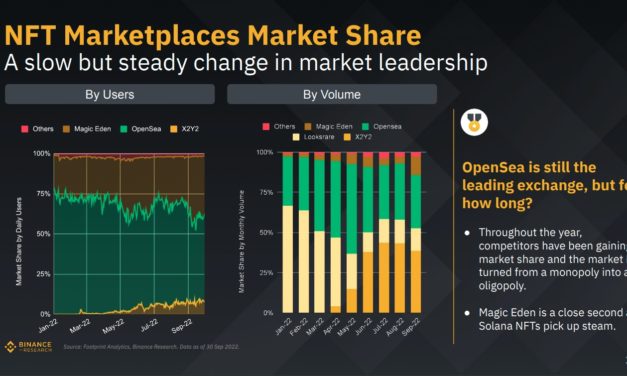
Opensea’s dominance begins to waiverNonfungible token (NFT) marketplace Opensea has seen its competitors chomping at its ankles this year as they gain market share — turning the market from a “monopoly” into an “oligopoly,” a new report states.  Binance Market Pulse released on Oct. 20 says there has been a slow and steady change in market leadership, noting that while OpenSea is still the dominant marketplace in terms of users and volume, Ethereum (ETH)-based exchanges X2Y2 and Looksrare have been gaining their share of the market over 2022. The report also pointed out that OpenSea is facing stiff competition when it comes to Solana (SOL)-based NFTs, its most used native marketplace Magic Eden is a “close second” to the multi-chain OpenSea exchange.OpenSea’s market dominance in terms of volume peaked in May 2022 but has seen a decline since. Image: BinanceIt comes amid a possible sea-change across NFT marketplaces. On Oct.14, the Solana-native NFT market Magic Eden opted to introduce optional royalties on its platform, following a similar move by the Ethereum-based marketplace X2Y2 in August. It noted that the “market has been shifting towards optional creator royalties for awhile.”Binance’s Q3 report added that Ethereum overall still dominates holding 65% of the NFT volume market share at the end of the third quarter, but NFT buyers may be moving blockchains in search of profits or following the latest trends.The data also shows Solana’s NFT sales volume increased by 13% in Q3 and Ethereum’s dropped by 16% since the end of the second quarter.Record-breaking bids on first wave of ‘Physical Backed Tokens’The Azuki NFT project has broken the record for the most expensive skateboard ever sold, with the highest bid for a limited-edition 24-karat gold-plated skateboard fetching 309 ETH, or $400,000. A total of eight skateboards were sold through its new Physical Backed Token (PBT) technology, netting the project a total of $2.5 million worth of ETH.The highest bid far surpassed the previous record holder, the over $38,000 “Blowin’ in the Wind Skateboard” created by skateboarder Jamie Thomas which included handwritten lyrics from singer Bob Dylan.The Golden Skateboard is a marvel of art & technology showcasing our first implementation of PBT, which paves the way for a new era of storytelling. We broke the record for the most expensive skateboard ever sold (in fact, the 8 most expensive skateboards ever sold). pic.twitter.com/XG2fgfrVgU— Azuki (@AzukiOfficial) October 23, 2022It was the first time the project implemented its Physical Backed Token (PBT) technology standard.PBT is a token standard created by the project that uses a cryptographic chip to authenticate ownership of a physical item, generating an NFT in a user’s crypto wallet after its scanned with a mobile phone.MLB players union seeks NFT licensing managerThe union representing all Major League Baseball (MLB) players appears to be looking at expanding its members’ presence in Web3, as it looks to hire a licensing manager to help expand its portfolio across NFT, Metaverse, digital games and augmented and virtual reality technology.The job posting by the MLB Players Association states that “NFTs, the Metaverse, wearable technology, and AR/VR are part of our expanding business model” with the role requiring the person to create “strong relationships” with “crypto projects”.A major role of the MLB Players Association is assisting sponsors seeking to associate their brand or product with players, the association holds the rights to license and use the names, nicknames, likenesses, and other indicating information of MLB players for use to that end.Warner Bros launches NFT-gated exclusive filmsEntertainment company Warner Bros is looking to use NFTs to distribute exclusive content and films after announcing on Oct. 20 that it partnered with Web3 firm Eluvio to launch its NFT-backed “WB Movieverse.”The “movieverse” is essentially Warner Bros-owned films available online using NFTs as authentication for users to access the film along with related exclusive content such as behind-the-scenes videos and images.The first offering in its movieverse sees a 4K resolution extended edition of one if its Lord of The Rings titles along with bonus material made available through two tiers of NFTs. Related: Magic Eden defends launch of NFT royalty enforcement toolThe sold-out upper tier of 999 NFTs was priced at $100 but now sees an average listing price of $2,500 according to the official secondary listings page, while the lower tier of 10,000 NFTs is priced at $30.Warner Bros has delved into the NFT space before, recently licensing characters from its DC Comics-owned properties to pop culture brand Funko to sell Walmart-exclusive NFTs.More Nifty News:Metaverse casino Slotie has been hit with multiple cease and desist orders from state-level authorities in the United States who allege Slotie hasn’t registered as a broker-dealer, failed to provide the proper disclosures as a gambling platform and consider its NFTs to be unregistered securities.Ethereum-based NFT marketplace Rarible upgraded its platform on Oct. 20 adding an aggregation tool that allows users to browse and purchase Ethereum NFTs from other marketplaces such as Rarible, OpenSea, LooksRare, X2Y2, and Sudoswap.

Čítaj viac

Binance US taps “most feared man on Wall Street” for new investigations unit

United States crypto exchange Binance US has created a new “investigations unit” and tapped a former FBI special agent as its new head, with the aim of seeking out and stopping illegal activity on its platform. The “investigations unit” is a brand new unit within the U.S. crypto exchange, the firm’s head of legal Krishna Juvvadi confirmed to Cointelegraph and sees former FBI agent BJ Kang become the company’s first “head of investigations.”The role will see him partnering with law enforcement, regulators, and even other exchanges to seek out and stop illegal activity on its platform, Kang will also build an “investigations infrastructure” for Binance US.In an Oct. 20 statement, Binance US said it has strengthened its legal, compliance, and risk operations over the past year by increasing its department headcount by 145% and dedicating over one-fifth of the company’s total workforce to those functions.Kang is known for his high-profile investigations into securities fraud and insider trading in the traditional finance space during his nearly 20-year stint at the FBI.The former FBI agent was once dubbed as “the most feared man on Wall Street” by Reuters after gaining notoriety for being photographed arresting Bernie Madoff — who was found guilty of running the largest Ponzi scheme to date — and Raj Rajaratnam, a former hedge fund manager found guilty of insider trading.He previously served at the FBI Washington Field Office’s cybercrime squad investigating cyber-enabled money laundering, extortion, and hackers targeting crypto and financial firms amongst other crimes.The appointment of Kang comes as the exchange is facing probes from the Securities and Exchange Commission (SEC) which reportedly requested information regarding two companies supposedly acting as market makers for the platform and is investigating how Binance US may have disclosed its potential links to the companies to users.Binance, which operates separately from its US arm, has also had to fight back against two Reuters exposes over the past year which accused the platform of processing at least $2.35 billion worth of transactions from hacks, investment frauds, and narcotics sales between 2017 and 2021.Related: Government crackdowns are coming unless crypto starts self-policingThe most recent allegations on Oct. 17 claimed the platform “swerved scrutiny” from regulators in the U.S. and United Kingdom, pointing out two separate proposals submitted by either employees or affiliates. In the case of the U.K allegation, it was proposed that Binance backdate service agreements to gain a financial registration exemption, and in the U.S. a proposal to direct authorities’ attention to a U.S. entity instead of to Binance itself.

Čítaj viac

Remittances drive ‘uneven, but swift’ crypto adoption in Latin America

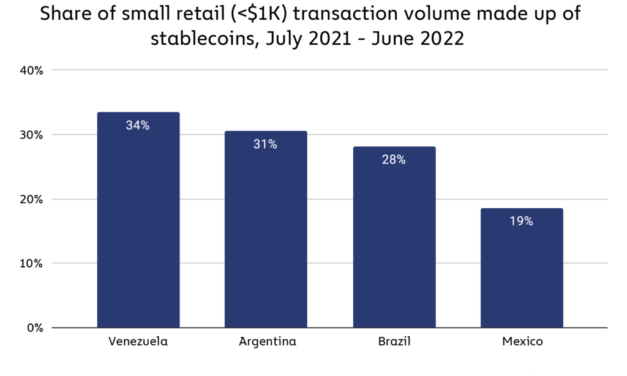
Remittance payments, fiat fears, and profit-chasing have been the three most significant drivers of crypto adoption in Latin America, according to a new report. The seventh-largest crypto market in the world saw the value of cryptocurrencies received by individuals rocket 40% between July 2021 to June 2022, reaching $562 billion, according to an Oct. 20 report from Chainalysis. Part of the surge was attributed to remittances, with the region’s overall remittance market estimated to have reached $150 billion in 2022. Chainalysis noted that crypto-based service adoption was “uneven, but swift.”The firm pointed to one Mexican exchange operating in the “world’s largest crypto remittance corridor” which processed over $1 billion in remittances between Mexico and the United States in the year to June 2022 alone.It marked an increase of 400% year-on-year and accounted for 4% of the country’s remittance market. However, the region’s soaring inflation rates have also played a huge part in crypto adoption, according to the analytics firm, particularly in the adoption of U.S. dollar-pegged stablecoins.“Stablecoins – cryptocurrencies that are designed to stay pegged to the price of fiat currencies like USD – are a favorite in the most inflation-ravaged countries in the region,” explained the firm. The region has been battling with staggeringly high inflation rates, with an estimate from the International Monetary Fund revealing that inflation across the largest five Latin American countries reached a 25-year high in August to 12.1%. This has led to regular consumers, attempting to protect themselves from their plummeting national currencies, to take and hold stablecoins in order to make their everyday purchases. The report cited a June Mastercard survey that found over a third of consumers already use stablecoins to make everyday purchases, while Chainalysis noted that citizens from Venezuela, Argentina, and Brazil were most likely to use stablecoins for small retail transactions (under $1,000).Venezuela in particular has seen its national fiat currency the bolívar depreciate by over 100,000% since December 2014, the firm added. Argentina and Brazil also saw significant shares of stablecoins used for sub $1,000 transactions. Source: ChainalysisInterestingly, the report found that citizens in the larger and more developed Latin American economies were also likely to adopt cryptocurrencies as a means of profit. Related: Latin America is ready for crypto — Just integrate it with their payment systemsChileans were the most involved in DeFi, with over 45% of all crypto transaction volume taking place on DeFi platforms followed by Brazil at just over 30%, Brazil was the number one country in the region for crypto value received closing in on $150 billion.“Latin America’s more DeFi-centric crypto markets are not unlike Western Europe’s or North America’s, where market participants are embracing cutting edge, returns-focused crypto platforms moreso than savings-centric centralized services,” Chainalysis explained.

Čítaj viac

HODL! Tesla hangs onto all its remaining $218M in Bitcoin in Q3

Electric vehicle manufacturer Tesla has made no further changes to its remaining stash of Bitcoin (BTC) in the third quarter of 2022, despite nearly a $1 billion sell-off in the previous quarter. The company’s Q3 report released Oct. 19 shows $218 million worth of “digital assets” remains on its balance sheet, with no reported losses in the value of its holdings. Based on current prices, it’s estimated that Tesla still holds around 9,720 BTC.In Q2 earnings report, Tesla said it sold 75% of its Bitcoin during the quarter, adding $936 million in cash to its books and recording a $64 million profit from the sale.Tesla CEO Elon Musk explained at the time that the sell-off was due to liquidity concerns from the COVID-19 lockdowns in China.The sell-off during the quarter took a large chunk of the company’s $1.5 billion position in Bitcoin, which it had revealed in February 2021, which at the time, made it one of the largest corporate holders of Bitcoin.Overall for Q3 2022, Tesla posted $3.3 billion in profits attaining revenues of $21.45 billion, which reportedly fell short of analysts’ expectations, and saw Tesla’s stock price fall by nearly 14% in after-hours trading according to Yahoo Finance. Related: Binance, Sequoia still backing Elon Musk’s bid for TwitterUnder Musk’s leadership, the vehicle company has seen its range of merchandise available for purchase using Dogecoin (DOGE) since January. His rocket-building company SpaceX soon followed suit in May.One of Tesla’s recent products was a limited edition whistle it posted for sale in September which could only be purchased using DOGE retailing for 1,000 DOGE, or around $60 at the time. It’s unknown exactly how many units were made available but it reportedly sold out within hours.

Čítaj viac

Získaj BONUS 8 € v Bitcoinoch

nakup bitcoin z karty

Registrácia Binance

Burza Binance

Aktuálne kurzy