Autor Cointelegraph By Jesse Coghlan

Genesis denies 'imminent' plans to file for bankruptcy

Cryptocurrency lending company Genesis has refuted speculation that it is planning an “imminent” bankruptcy filing should it fail to cover a $1 billion shortfall caused by the fall of crypto exchange FTX.The firm has reportedly faced difficulties raising money for its lending unit and told investors it would have to file for bankruptcy, according to a Nov. 21 Bloomberg report citing people familiar with the matter.A spokesperson for Genesis told Cointelegraph that there were no plans to file for bankruptcy “imminently” and that it continued to have “constructive” discussions with creditors. “We have no plans to file bankruptcy imminently. Our goal is to resolve the current situation consensually without the need for any bankruptcy filing. Genesis continues to have constructive conversations with creditors.”On Nov. 16, Genesis announced it had temporarily suspended withdrawals citing “unprecedented market turmoil” after FTX’s collapse. The company previously revealed on Nov. 10 it had around $175 million worth of funds stuck in an FTX trading account.Related: The FTX contagion: Which companies were affected by the FTX collapse? Reports have also suggested that crypto exchange Binance had been in talks to potentially bail out the Digital Currency Group-owned lender, but sources quoted in a Nov. 21 report from The Wall Street Journal claimed Binance had walked away from the deal as the business could create a conflict of interest.Cointelegraph contacted Binance for clarification on the matter but did not immediately receive a response.

Čítaj viac

Nifty News: Chinese firms to offer World Cup metaverse viewings, X2Y2 backtracks on royalties, and more

Chinese firms bet on ‘Metaverse-like’ experiences for FIFA World CupChina-based technology companies are reportedly working on tech that would give Chinese soccer fans the ability to watch the FIFA World Cup within the Metaverse.The efforts are part of a five-year plan released by the Chinese government in early November to boost the capabilities and development of the local Virtual Reality (VR) industry.Video streaming platform Migu is one of six Chinese firms that has secured the rights to show the World Cup and plans to create a “Metaverse-like” space accessed through VR headsets for users to watch a live stream of the game, according to a Nov. 20 report from the state-run media outlet Global Times.ByteDance, who owns TikTok and its Chinese version Douyin received licensing rights to air the competition, with ByteDance’s VR headset subsidiary Pico offering live broadcasts of the World Cup with the ability for users to create and hang out in “digital rooms” to watch the game together.The World Cup is seemingly being used by China’s nascent VR industry as a testbed for the technology, as the country’s Ministry of Industry and Information Technology along with four other agencies pushed an ambitious industry plan on Nov. 1.The five-year plan from 2022 until 2026 outlined that China wants to bolster its VR industry and ship over 25 million units to the tune of $48.56 billion, although the plan doesn’t clarify if its unit target is annually or cumulative over the life of the plan.The stated plans don’t mention whether the Metaverse will utilize blockchain technology, such as the one posed by the Chinese city of Wuhan which was later revised to remove reference to nonfungible tokens (NFTs).X2Y2 rolls back optional royaltiesNFT marketplace X2Y2 has backtracked on its opt-in royalties play, saying in a Nov. 18 Twitter thread that it will again enforce creator royalties on all existing and new collections.The marketplace was one of the first to introduce optional royalties in August moving to a “Flexible Royalty” allowing buyers to set the amount they want to pay, receiving mixed reaction from the NFT community.2/We used to believe the best way to handle royalties is to give both parties, creators and traders, the right to choose.It is the rationale behind our Flexible Royalty feature. And we still believe so.— X2Y2 (@the_x2y2) November 18, 2022X2Y2 said it decided to reinstate royalty enforcement after taking a page from its peer Opensea, which decided on Nov. 9 to enforce royalties.X2Y2 also admitted many new collections are using OpenSea’s royalty enforcement tool that blacklists NFTs being sold on markets that don’t enforce royalties. In response, OpenSea said it was “proud to stand” with X2Y2 adding it removed the marketplace from its blacklist.Proud to stand with you–and the many brilliant creators in our community–on this critical measure. @the_x2y2 has been removed from our OperatorFilter and we hope other marketplaces will continue to join us. Onwards and upwards — OpenSea (@opensea) November 18, 2022

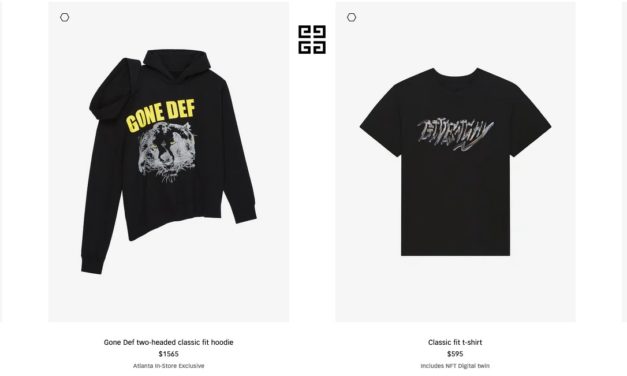
Givenchy drops ‘phygital’ NFTsFrench luxury fashion brand Givenchy has become the latest company to offer “phygital” NFTs — a physical good backed by a digital token.On Nov. 18, the company released a collection of physically backed NFTs as part of a collaboration with streetwear label Bstroy.The collaboration between the two brands sees a new limited “capsule collection” of six items that include a “complimentary NFT twin” of the physical piece.As expected of a luxury brand, the items don’t come cheap with the lowest priced item being a $595 t-shirt and the most expensive, a $5,450 wool and leather bomber jacket.Screenshot of a selection of items listed on Givenchy’s site that include an NFT. Source: GivenchyGivenchy Creative Director Matthew M. Williams was quoted saying how Bstroy’s founders are “longtime friends” who “share [his] vision of fashion” and that Givenchy and Bstroy “focused on creating streetwear with unexpected treatments” that “enters the realm of contemporary art on the street and in Web3.”Other recently offered “phygital” NFTs include the Azuki NFT project, which created a Physical Backed Token (PBT) standard that has sold skateboards and been used in streetwear collaborations. The sandals of the late Apple founder Steve Jobs were also sold as a “phygital” NFT at auction.Johnnie Walker keeps on walking into Web3Scotch whisky maker Johnnie Walker has continued its Web3 push by allowing NFT holders to vote on the design of a bottle for a limited-edition drop of its top “blue label” range.The whisky company has partnered with BlockBar, a luxury alcohol NFT marketplace, and streetwear designer Junghoon Vandy Son, known as VANDYTHEPINK, the latter of who will be creating the bottle’s design.Johnnie Walker has left the design up to NFT holders, who will vote on the final design or artwork that Son will make for the bottle. It’s the designers first time taking on a Web3-related project according to the brand.Related: Helping mainstream artists into Web3: The triumphs and strugglesOnce the physical bottles are made, they’ll be held by BlockBar who will only release the physical bottle to an NFT holder once they’re ready to swap, “burning” their NFT “bottle”, initially priced at $355, for a replacement of the real thing.The brand has delved into Web3 in the past partnering with Gary Vaynerchuk’s NFT project VeeFriends in May giving holders of particular NFTs spirits-related offerings. This collaboration was also spearheaded alongside Vayner3, Vaynerchuk’s Web3 consultancy firm.More Nifty NewsMetaplex is feeling the sting of the collapse of crypto exchange FTX with the NFT protocol laying off “several members” of its team on Nov. 18 citing the “indirect impact” of FTX’s fall. Its treasury wasn’t directly affected but Metaplex CEO Stephen Hess said a “more conservative approach moving forward” was needed for the company.A partner for the Australian arm of Big Four accounting firm KPMG, James Mabbott, told Cointelegraph on Nov. 18 he believes the Metaverse “explosion” will be driven by businesses. The company created a new Head of Metaverse Futures role that looks to build its own metaverse for the company’s internal business operations and business-to-business services.

Čítaj viac

FTX leadership pressed for information by US subcommittee chairman

The former and current CEOs of the bankrupt FTX cryptocurrency exchange have been pressed by the chair of a United States House subcommittee calling for documents relating to the exchange’s finances.“FTX’s customers, former employees, and the public deserve answers,” Raja Krishnamoorthi, Chairman of the Subcommittee on Economic and Consumer Policy wrote in a Nov. 18 letter addressed to both former FTX CEO Sam Bankman-Fried and the exchange’s current CEO John J. Ray III, who took over in the wake of FTX’s bankruptcy filings.Krishnamoorthi added the subcommittee was “seeking detailed information on the significant liquidity issues faced by FTX, the company’s abrupt decision to declare bankruptcy, and the potential impact of these actions on customers who used your exchange.”He insisted the exchange hand over a slew of information relating to its finances, including explainers on its liquidity issues, balance sheets from before its collapse in early November, its current crypto holdings, and a plan on how it will repay customers.Krishnamoorthi also requested information regarding who maintained the exchange’s finances, any input FTX received from Alameda Research CEO Caroline Ellison, and a description of any “backdoor” that may have been used to move funds under the nose of auditors or other FTX departments.The former and current FTX bosses were reminded to submit documentation as part of an Aug. 30 request to Bankman-Fried asking for information regarding the steps FTX is taking to combat fraud and scams.Similar letters were sent to the crypto exchanges Binance.US, Coinbase, Kraken, and KuCoin.The subcommittee set a deadline of Dec. 1 for FTX to procure the requested documentation to help it determine “what went wrong at FTX” and what steps Congress could enact to ensure the crypto industry “is appropriately regulated and investors are protected.”Related: CFTC Commissioner Mersinger says the time has come for action on crypto regulationThe subcommittee’s deadline coincides with a Nov. 16 announcement of a scheduled December hearing by members of the U.S. House Financial Services Committee that will explore the collapse of FTX and the “broader consequences for the digital asset ecosystem.”Krishnamoorthi’s letter follows similar demands laid out on Nov. 16 by Senators Elizabeth Warren and Richard Durbin who wrote to Bankman-Fried and Ray asking for a similar mass of documents related to the collapse of FTX.

Čítaj viac

Grayscale cites security concerns for withholding on-chain proof of reserves

Cryptocurrency investment product provider Grayscale Investments has refused to provide on-chain proof of reserves or wallet addresses to show the underlying assets of its digital currency products citing “security concerns.”In a Nov. 18 Twitter thread addressing investor concerns, Grayscale laid out information regarding the security and storage of its crypto holdings and said all crypto underlying its investment products are stored with Coinbase’s custody service, stopping short of revealing the wallet addresses.6) Coinbase frequently performs on-chain validation. Due to security concerns, we do not make such on-chain wallet information and confirmation information publicly available through a cryptographic Proof-of-Reserve, or other advanced cryptographic accounting procedure.— Grayscale (@Grayscale) November 18, 2022“We know the preceding point in particular will be a disappointment to some,” Grayscale added, “but panic sparked by others is not a good enough reason to circumvent complex security arrangements that have kept our investors’ assets safe for years.”The move by Grayscale comes as pressure mounts on crypto business to introduce proof of reserves in the wake of FTX’s liquidity issues and subsequent bankruptcy.Some Twitter users hit out at Grayscale’s view that security concerns surrounded its decision to withhold its wallet addresses, with one commenting the addresses of Bitcoin (BTC) inventor Satoshi Nakamoto are well known and are of higher value to attackers, “yet Satoshi’s Bitcoin remains secure.”Grayscale shared a letter co-signed by Coinbase CFO, Alesia Haas, and Coinbase Custody CEO, Aaron Schnarch, that broke down Grayscale’s holdings by its investment products and reaffirmed the assets “are secure”, that each product has its “own on-chain addresses” and the crypto always belongs “to the applicable Grayscale product.”Grayscale added that each of its products is set up as a separate legal entity and “laws, regulations, and documents […] prohibit the digital assets underlying the products from being lent, borrowed, or otherwise encumbered.”Related: Nickel Digital, Metaplex and others continue to feel the impact of FTX collapseGrayscale is known for its Grayscale Bitcoin Trust (GBTC), a security tracking the price of Bitcoin, it also has products tracking the price of other cryptocurrencies such as Ether (ETH) and Solana (SOL).Investor concerns come as Genesis Global, serving as the liquidity provider for GBTC announced on Nov. 16 that it had halted withdrawals citing “unprecedented market turmoil” resulting in significant withdrawals from its platform that exceeded its current liquidity. Genesis is a part of the crypto-focused venture capital company Digital Currency Group (DCG) which also owns Grayscale. GBTC is trading at a discount of nearly 43% compared to its net asset value in part due to investor speculation on GBTC’s exposure to Genesis.

Čítaj viac

Crypto scammers are using black market identities to avoid detection: CertiK

Crypto scammers have been accessing a “cheap and easy” black market of individuals willing to put their name and face on fraudulent projects — all for the low price of $8, blockchain security firm CertiK has uncovered. These individuals, described by CertiK as “Professional KYC actors” would, in some cases, voluntarily become the verified face of a crypto project, gaining trust in the crypto community prior to an “insider hack or exit scam.”Other uses of these KYC actors include using their identities to open up bank or exchange accounts on behalf of the bad actors. According to a Nov. 17 blog post, CertiK analysts were able to find over 20 underground marketplaces hosted on Telegram, Discord, mobile apps, and gig websites to recruit KYC actors for as low as $8 for simple “gigs” like passing the KYC requirements “to open a bank or exchange account from a developing country.”Pricier jobs involve the KYC actor putting their face and name on a fraudulent project. CertiK noted that most actors are seemingly exploited as they are based in developing countries “with an above-average concentration in South-East Asia” and paid around $20 or $30 per role.Meanwhile, more complex requirements or verification processes could fetch an even higher asking price, particularly if the KYC actors are residents of countries considered a low money laundering risk.Some roles paid up to $500 a week if an actor was to play the role of CEO for a malicious project but the KYC actor market was “marginal” compared to the market for already KYCed bank and crypto exchange accounts according to CertiK.Crypto to fiat — or vice-versa — conversions were also cited as a significant percentage of the transactions seen on these marketplaces with CertiK calculating that more than 500,000 members in marketplace sizes ranging from 4,000 to 300,000 were buyers and sellers on these black markets.Related: Scary stats: $3B stolen in 2022 as of ‘Hacktober,’ doubling 2021CertiK warned that over 40 websites claiming to vet crypto projects and offer “KYC badges” are “worthless” as the services are “too superficial to detect fraud or simply too amateur to detect insider threats.” They added the teams behind these websites are “missing the needed “investigation methodology, training, and experience” meaning these badges are then leveraged by scammers to mislead the community and investors.That being said, the industry has been working hard and is gaining ground in its fight against crypto scammers. A tool released in October by traditional finance giant Mastercard combines artificial intelligence and blockchain data to help find and prevent fraud.Contrary to popular belief, the open nature of blockchain transactions means it’s harder for fraudsters to hide the movement of funds. Another recent example has been the work of French authorities using on-chain analysis to find and charge five people who stole nonfungible tokens (NFT) through a phishing scam.

Čítaj viac

Získaj BONUS 8 € v Bitcoinoch

nakup bitcoin z karty

Registrácia Binance

Burza Binance

Aktuálne kurzy