Autor Cointelegraph By Jesse Coghlan

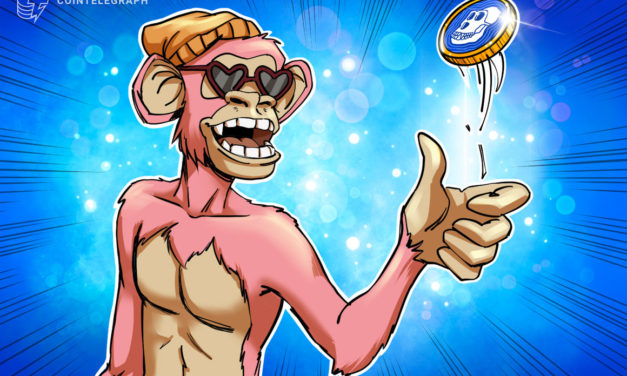
ApeCoin geo-blocks US stakers, two Apes sell for $1M each, marketplace launched

United States-based ApeCoin (APE) holders could miss out on staking rewards after the U.S. was added to a list of regions geo-blocked from using an upcoming APE staking service.Blockchain infrastructure company Horizen Labs, which is building the site on behalf of the ApeCoin decentralized autonomous organization (DAO), revealed the news in a Nov. 24 update regarding ApeStake.io on Twitter, saying “unfortunately, in today’s regulatory environment, we had no good alternative.”Ape Staking Update: Big thanks to the talented community devs for their helpful improvements. Bug Bounty AIP delayed us a bit, so we shortened the pre-deposit period by a week to keep our original 12/12 go-live. Alternate front-end sites going live. See card. pic.twitter.com/mgmP7X3SwQ— Horizen Labs (@HorizenLabs) November 24, 2022Canada, North Korea, Syria, Iran, Cuba, Russia, and the Russian-controlled areas of Ukraine, Crimea, Donetsk, and Luhansk are also on the block list.There are likely ways to get around the geo-block. The update noted the website is only an interface to interact with the Ethereum-based open-source smart contract, and “several other” interfaces are being crafted by parties such as exchanges and DeFi platforms.Prominent Twitter user “Zeneca” told their 312,00 followers that those from regions geo-blocked by ApeStake.io will still be able to stake by interacting with the smart contract directly or using another interface without geo-blocks. Those in blocked regions could also use a virtual private network (VPN) to spoof their location.The decision to block U.S. users likely resulted from the probe in October by the Securities and Exchange Commission (SEC) into APE creator Yuga Labs. The regulator is investigating if the company’s nonfungible tokens (NFTs) act more like securities and are subsequently violating federal laws.Two Bored Ape NFTs sell for nearly $1M eachMeanwhile some Bored Apes are still fetching high prices even during the depths of Crypto Winter. An NFT from Yuga Labs’ flagship Bored Ape Yacht Club (BAYC) collection sold for 800 Ether (ETH), or almost $950,000 at the time of sale on Nov. 23.BAYC #232 was sold to pseudonymous NFT collector “Keungz” — who seemingly has multiple Yuga Labs NFTs according to their OpenSea profile — by Deepak Thapliydal.Thanks @dt_chain for the good deal⚓️#NewNFTProfilePic NFT by @BoredApeYC pic.twitter.com/CgIy73fBx5— Keungz ❤️ Memeland ‍☠️ YGPZ ‍♀️ (@keung) November 23, 2022

Thapliydal is the CEO of Web3 infrastructure company Chain and gained notoriety for making the Guinness World Records for buying the “most expensive NFT collectible” after purchasing CryptoPunk #5822 for 8,000 ETH, or $23.7 million, on Feb. 12.The sale of BAYC #232 was closely followed by another on Nov. 24 for BAYC #1268 between two unidentified wallets for 780 ETH, or almost $940,000 at the time of sale.The sales are significant as the NFTs sold far above the current floor price for the collection which has seen a decline over the past months.According to data from NFT Price Floor, the minimum price for a Bored Ape at the time of writing is just under 63 ETH, or about $75,600, and is 80% down in U.S. dollar terms from its May 1 all-time high of 144.9 ETH, or over $391,000 at the time.ApeCoin DAO launches marketplace The community-led DAO made up of ApeCoin holders has launched its own marketplace to buy and sell NFTs from the Yuga Labs ecosystem.The aptly named ApeCoin Marketplace built by NFT infrastructure firm Snag Solutions was launched on Nov. 24 and supports transactions of the BAYC, Mutant Ape Yacht Club, Bored Ape Kennel Club, and Otherdeed NFT collections.In a Nov. 24 Twitter thread Snag Solutions CEO, Zach Heerwagen, said the marketplace “includes unique features” specifically for NFT communities including the ability to stake APE.1/ The custom marketplace includes unique features built specifically for the BAYC and Otherside communities, including ApeCoin staking and NFT metadata integrations. pic.twitter.com/mem2ZsXNkt— Zach | Zheerwagen.eth (@ZHeerwagen) November 23, 2022

The marketplace “respects royalties while heavily reducing fees” according to Heerwagen. A 0.25% slice of each sale is held in a multi-signature wallet and used to fund DAO initiatives.Related: Industry expresses confidence in the NFT space amid the FTX collapseThe marketplace’s support for royalties comes as some other NFT marketplaces such as the Solana (SOL)-based Magic Eden and Ethereum-based LooksRare stopped enforcing creator royalties by default.Others such as OpenSea have continued to enforce royalties and even created a tool to help NFT creators with on-chain enforcement of royalties, allowing them to blacklist the sale of their NFTs on royalty-free marketplaces.

Čítaj viac

FTX miniseries gets go ahead, covering the ‘most brazen frauds ever committed’

An eight-episode limited series exploring the unraveling and scandals behind sunken crypto exchange FTX and its leadership is slated to soon begin production. The series has been purchased by technology conglomerate Amazon, and will likely air on Amazon’s video streaming service Prime.It’s understood to be based on “insider reporting” from journalists covering FTX and its founder Sam Bankman-Fried according to a Nov. 23 report from the entertainment magazine Variety.Brothers Joe and Anthony Russo, famed for directing Avengers: Endgame and multiple other Marvel-owned movies are reported to have sold the idea to Amazon and are slated to direct the mini-series.Details are sparse with what direction the series will take, the source material it will draw from, and what time period and people it will focus on, with all of it still kept under wraps for the time being.In their reason for pursuing a series on the FTX story, the Russos brothers told Variety what happened with the exchange “is one of the most brazen frauds ever committed,” and opined on Bankman-Fried:“At the center of it all sits an extremely mysterious figure with complex and potentially dangerous motivations. We want to understand why.”Amazon is slated to start producing the show as early as March 2023, and while the characters and the actors who will play them are unknown, it’s reported the Russos are in discussions with prior Marvel actors they’ve worked with to fill the main roles. The idea for FTX-inspired movies akin to The Big Short and the Wolf of Wall Street has already been joked around on Twitter over a week ago, with some members of the community already taking the initiative to cast who would play Sam Bankman-Fried, Alameda CEO Caroline Ellison, Binance CEO Changpeng Zhao and other related players, such as Terra’s Do Kwon. One Twitter user pitched the idea of “FTX THE MOVIE” on Nov. 12, selecting Wolf of Wall Street’s Jonah Hill to play Bankman-Fried, while comedian Jimmy O. Yang could play Changpeng Zhao. #FTX THE MOVIE @SBF_FTX @cz_binance pic.twitter.com/DWorL6G7An— EvilEyes (@SolanaEyes) November 11, 2022Another user created a promotional poster with their take on the film’s title: “The Wolf of Effective Altruism” spoofing The Wolf of Wall Street and poking fun at Bankman-Fried’s philosophical stance of wanting to help others. pic.twitter.com/o76cejBB4y— Hanal Capital (@chillhanachill) November 13, 2022

It appears Hollywood is eager to snap up the rights to stories centered on the collapse of the world’s top crypto exchanges.Related: Sam Bankman-Fried still speaking at events and the community is furiousAuthor and financial journalist Michael Lewis, known for his book “The Big Short” on the 2008 financial crisis, is reportedly looking to sell book rights on an FTX story after spending six months with Bankman-Fried in the months leading up to FTX’s implosion.Big Tech player Apple is reportedly the front-runner for the rights beating out competitors Amazon and Netflix, with intentions to create a film for its video-streaming service Apple TV Plus.

Čítaj viac

Block Earner CEO calls for licensing clarity after being sued for crypto products

The CEO of fintech firm Block Earner has lashed out over the “lack of clarity” in Australia’s financial licensing regime after his company was sued by the country’s financial services regulator for providing unlicensed crypto-based investment products.The Australian Securities and Investment Commission (ASIC) announced on Nov. 23 local time that it started civil legal proceedings against the company because it offered three crypto-linked fixed-yield earning products without an Australian Financial Services (AFS) license.ASIC stated that the products should have been licensed as they were “managed investment schemes” where investors contribute money that is pooled together for an interest in the scheme.The products, named “Crypto Earner”, “USD Earner” and “Gold Earner,” offered yields through users depositing Australian dollars that would be converted to Bitcoin (BTC), Ether (ETH), USD Coin (USDC) or PAX Gold (PAXG) depending on the product according to Block Earner’s website.The crypto-assets are then lent to borrowers on Decentralized Finance (DeFi) protocols Aave (AAVE) and Compound Finance (COMP) to generate yield for the product.ASIC Deputy Chair Sarah Court aired her concern that Block Earner offered the products without “appropriate registration” or an AFS license that she claimed left “consumers without important protections,” adding:“Simply because a product hinges on a crypto-asset, does not mean it falls outside financial services law.”In an emailed statement to Cointelegraph Block Earner CEO and co-founder, Charlie Karaboga, said although the firm “[understands] the backdrop” it was a “disappointing outcome.”He said it welcomes regulations, claiming the firm “spent considerable resources building regulatory infrastructure” to be able to offer services “under existing guidelines provided by ASIC.”Related: FTX Australia’s license suspended as 30K Aussies left in the lurchKaraboga took aim at the unclear regulatory environment for crypto in the country and said the “lack of clarity […] creates friction between regulators and innovators,” adding:“In an ideal world, we would build these products in a regulatory sandbox with more clarity around licensing regimes. In the future, we look forward to working with ASIC and other regulators in this space.”According to Karaboga, Block Earner had filed for a credit license and advised ASIC it would apply for an AFS license for its upcoming products as “the licensing requirements are clear.”ASIC has previously given a warning to crypto-asset providers in the country after it took action against the creators of the Qoin token.It said its “key priority” is targeting “unlicensed conduct and misleading promotion of crypto-asset financial products” after it alleged the Qoin token creators were “misleading” its users.

Čítaj viac

Sam Bankman-Fried deepfake attempts to scam investors impacted by FTX

A faked video of Sam Bankman-Fried, the former CEO of cryptocurrency exchange FTX, has circulated on Twitter attempting to scam investors affected by the exchange’s bankruptcy.Created using programs to emulate Bankman-Fried’s likeness and voice, the poorly made “deepfake” video attempts to direct users to a malicious site under the promise of a “giveaway” that will “double your cryptocurrency.”Over the weekend, a verified account posing as FTX founder SBF posted dozens of copies of this deepfake video offering FTX users “compensation for the loss” in a phishing scam designed to drain their crypto wallets pic.twitter.com/3KoAPRJsya— Jason Koebler (@jason_koebler) November 21, 2022The video uses appears to be old interview footage of Bankman-Fried and used a voice emulator to create the illusion of him saying “as you know our F-DEX [sic] exchange is going bankrupt, but I hasten to inform all users that you should not panic.”The fake Bankman-Fried then directs users to a website saying FTX has “prepared a giveaway for you in which you can double your cryptocurrency” in an apparent “double-your-crypto” scam where users send crypto under the promise they’ll receive double back. A now-suspended Twitter account with the handle “S4GE_ETH” is understood to have been compromised, leading to scammers posting a link to the scam website — which now appears to have been taken offline.The crypto community has pointed to the fact that scammers were able to pay a small fee in order to get Twitter’s “blue tick” verification in order to appear authentic. Meanwhile, the video received widespread mockery for its poor production quality with one Twitter user ridiculing how the scam production pronounced “FTX” in the video, saying they’re “definitely using […] ‘Effed-X’ from now on.”At the same time, it gave many the opportunity to criticize the FTX founder, one user said “fake [Bankman-Fried] at least admits FTX is bankrupt” and YouTuber Stephen Findeisen shared the video saying he “can’t tell who lies more” between the real and fake Bankman-Fried.Related: Crypto scammers are using black market identities to avoid detection: CertiKAuthorities in Singapore on Nov. 19 warned affected FTX users and investors to be vigilant as websites offering services promising to assist in recovering crypto stuck on the exchange are scams that mostly steal information such as account logins.The Singapore Police Force warned of such a website which prompted FTX users to log in with their account credentials that claimed to be hosted by the United States Department of Justice.Others have attempted to profit from the attention FTX and its former CEO are receiving. On Nov. 14, shortly after Bankman-Fried tweeted “What” without further explanation, some noticed the launch of a so-called “meme token” called WHAT.Somebody just launched a $WHAT token and it’s done a 4x.It’s over. pic.twitter.com/VB2UtENSGH— Tyler (@ApeDurden) November 14, 2022

“Deepfake” videos have long been used by cryptocurrency scammers to try to con unwitting investors. In May, faked videos of Elon Musk promoting a crypto platform surfaced on Twitter using footage from a TED Talk the month prior.The video caught Musk’s attention at the time, who responded: “Yikes. Def not me.”

Čítaj viac

FTX crisis leads to record inflows into short-investment products

Institutional investors have responded to the negative sentiment caused by FTX’s collapse, with record institutional inflows into crypto-focused short-investment products. According to CoinShares’ chief strategy officer James Butterfill, 75% of the total inflows by institutional crypto investors for the week ending Nov. 18 were placed in short investment products — essentially a bet that crypto prices will decline.Butterfill said the takeup of short positions by investors is likely “a direct result of the ongoing fallout from the FTX collapse,” while the total assets under management (AUM) for institutional investors is now at $22 billion — the lowest in two years.Over the week, $14 million was poured into short-ETH investment products. CoinShares said it was “the largest weekly inflow on record.”CoinShares cited “renewed uncertainty” over Ethereum’s Shanghai upgrade slated for Sep. 2023 and mentioned that the sizeable amount of ETH held by the FTX exploiter as possible reasons for the negative sentiment.Inflows into short investment products for Bitcoin (BTC) hit $18.4 million. Bitcoin short products were reported to have an AUM of $173 million coming close to the $186 million high.Investors are also seemingly dropping altcoins with Solana (SOL), XRP (XRP), BNB (BNB), and Polygon (MATIC) product outflows totaling $6 million.The newly reported inflows are a slight change from the week prior which saw the largest inflows in 14 weeks to crypto products totaling $42 million, although short Bitcoin products already started to see inflows of $12.6 million and blockchain equity products recorded the largest weekly outflow since May 2022.Related: FTX will be the last giant to fall this cycle: Hedge fund co-founderMeanwhile, the ripple effect of investor distrust for centralized exchanges is taking hold in the traditional finance market with Coinbase posting an all-time low share price on Nov. 21.The crypto exchange’s share price dropped 8.9% on the day, slipping to under $41 according to Google Finance. It has now slightly recovered to around $41.20 at the time of writing but continued to trade at a slight 0.19% negative after hours.Coinbase’s stock price is down almost 88% since it went public on Apr. 16, 2021.

Čítaj viac

Získaj BONUS 8 € v Bitcoinoch

nakup bitcoin z karty

Registrácia Binance

Burza Binance

Aktuálne kurzy