

Autor Cointelegraph By Jesse Coghlan

Iggy Azalea faces class lawsuit over MOTHER memecoin

Rapper Iggy Azalea is facing a class-action lawsuit in the US, accusing her of misleading investors about the real-world utility and future development of her Solana-based memecoin Mother Iggy (MOTHER).The complaint filed by plaintiff Kenneth Kolbrak in a Manhattan federal court on Monday claimed Azalea, whose real name is Amethyst Amelia Kelly, made representations about the token having real-world utility, commercial integrations and continuing development that never materialized.“Those representations were limited, incomplete, contradicted, temporary, or not delivered in a durable way,” the complaint said. “The terms and effects of the market support arrangements were never disclosed to consumers.”Azalea’s MOTHER was one of the buzzier tokens launched amid a frenzy of celebrity-tied memecoins in 2024. The token was launched in May 2024 and reached a peak market value of over $136 million by mid-June. Its market capitalization is now sitting at $1.3 million, according to CoinGecko.Unlike other celebrities who launched memecoins, Azalea has remained involved with the token, interacting with supporters on social media and promoting it on X.Kolbrak, the lead plaintiff, claimed he lost “several hundred dollars” investing in MOTHER, which the lawsuit said he would not have done, or would have paid less for, if not for Azalea’s promotions.According to the complaint, Azalea promoted the token as “the native currency of an expanding ecosystem of real businesses controlled or co-founded by Azalea, including a telecommunications company, an online casino, a luxury gifting marketplace, a merchandise store, and entertainment integrations.”Source: Burwick LawThe lawsuit claimed that Azalea promoted the online casino MOTHERLAND, which was marketed as being “powered by $MOTHER,” but when it launched in January 2025, the platform used Tether (USDt) for its “wagering, bonus accounting, and settlement.” The complaint also claimed that Azalea said MOTHER could be used to buy phones and mobile plans through the provider Unreal Mobile, however, “no durable, publicly observable MOTHER payment integration exists on the Unreal Mobile platform” as of the filing of the lawsuit.It further accuses Azalea of not telling tokenholders about the terms or risks involved when crypto market makers Wintermute and DWF Labs were brought on to manage MOTHER’s trading. Related: World Liberty sues Justin Sun for defamation in WLFI disputeThe lawsuit seeks damages for MOTHER buyers who lost money, along with attorney fees and costs.The class is represented by Max Burwick of Burwick Law, who has helped launch multiple class-action lawsuits against crypto projects.Information on Azalea’s lawyers was not available at the time of writing. Azalea and her management could not be reached for comment.Magazine: Meet lawyer Max Burwick — ‘The ambulance chaser of crypto’Cointelegraph is committed to independent, transparent journalism. This news article is produced in accordance with Cointelegraph’s Editorial Policy and aims to provide accurate and timely information. Readers are encouraged to verify information independently.

Čítaj viac

Haun Ventures raises $1B, adding AI to crypto focus

Haun Ventures has raised $1 billion to back early- and late-stage crypto startups, while expanding into artificial intelligence for the first time.The funds will focus on three areas: crypto financial infrastructure, tokenization and AI agents. The firm’s founder, Katie Haun, called these areas the “new economy.” “I’ve been following the flow of assets my entire career, and this is the most dynamic period in technology and finance I’ve ever witnessed,” said Haun, a former US government prosecutor turned crypto executive, in a blog post on Monday.“The foundations of capital, commerce and trust are undergoing meaningful structural changes,” she added. “The founders who can see across all of it, and build accordingly, will be defining entrepreneurs of this era.”It’s a significant shift for Haun Ventures, as it is the first time the crypto-focused firm has looked to invest in AI startups, joining a rush of venture firms that are moving into the growing industry.Crunchbase reported in April that AI firms received a record $242 billion in venture funding in the first quarter of 2026, capturing 80% of the total global venture funding over the quarter, which hit an all-time record of $300 billion.Haun’s vision for AI agents Haun said that AI agents, software that autonomously performs tasks, will “increasingly begin to conduct economic activity on our behalf,” and new products and services would need to be “developed for a world in which computers are the customers.”AI agents currently make a small number of payments, around $1.6 million worth over a 30-day period as of early March, according to Andreessen Horowitz partner Noah Levine, a number that the Boston Consulting Group expects to rise to $2.4 trillion a year by 2029.Source: Katie Haun“Every supporting layer will need to be rearchitected for this world: fraud prevention, credit, insurance, identity, privacy, provenance, reputation, and verification all require native versions designed for how agents transact, and cryptographic tools will be important here,” she added.Related: DTCC eyes October tokenized securities launch with 50 DeFi and TradFi giantsMeanwhile, Haun said that “the core plumbing of global finance” was being shifted to accommodate an always-on digital world, and noted tokenization as a technology that allowed traditional assets such as gold and oil to be “borderless, always on, and programmable.”She told Bloomberg on Monday that her company wants to focus on the cross-section of AI agents and crypto infrastructure, wanting to invest in “AI that is in our lane.”Magazine: AI-driven hacks could kill DeFi — unless projects act nowCointelegraph is committed to independent, transparent journalism. This news article is produced in accordance with Cointelegraph’s Editorial Policy and aims to provide accurate and timely information. Readers are encouraged to verify information independently.

Čítaj viac
CFTC sees mixed responses to prediction market rulemaking

The US Commodity Futures Trading Commission received more than 1,500 responses to a proposed rule tied to prediction markets, with some backing the regulator while others called for a tougher crackdown on the platforms.The CFTC’s request for public comments on a rule it proposed in March that would allow it to amend or issue new regulations for event contracts on prediction markets ended on Thursday, drawing responses from prediction markets, crypto firms and consumer advocacy groups.Kalshi co-founder and chief operating officer Luana Lopes Lara backed the CFTC in a letter on Thursday, saying its existing regulations were “well-designed and effective,” urging it to give guidance to ensure “that the universe of event contracts can continue to be listed, traded, and overseen by the Commission.”The CFTC’s proposed rule comes as it looks to cement its authority over prediction markets, which have faced legal challenges from multiple US states that accuse the platforms of offering unlicensed sports gambling.Kalshi, Polymarket and Coinbase are among the companies that have been sued over their sports prediction market offerings and have argued they are under the CFTC’s sole authority, a position the regulator has backed by suing at least five state governments that took legal action against prediction markets.Polymarket US CEO Justin Hertzberg applauded CFTC Chair Mike Selig in his letter for “asserting the CFTC’s longstanding exclusive jurisdiction over prediction markets,” adding the company believes the regulator “should continue to exercise its exclusive jurisdiction over prediction markets.”Mike Selig, pictured on a podcast in March, has threatened to sue any state that takes action against prediction markets. Source: YouTubeVenture capital firm Andreessen Horowitz also supported the CFTC, arguing in its letter that “state actions to regulate or ban prediction markets impose a serious barrier to impartial access,” a key rule for CFTC-regulated firms.Meanwhile, gambling regulators in Tennessee, Missouri and Pennsylvania, among others, blasted the CFTC over its defense of sports event contracts, urging the regulator to drop its support.Pennsylvania Gaming Control Board Executive Director Kevin O’Toole said the CFTC was allowing prediction markets “to masquerade as unregulated sportsbooks,” while Tennessee Sports Wagering Council Executive Director Mary Beth Thomas said the council disputes “that sports event contracts offered on prediction markets fall within the jurisdiction of the CFTC at all.”Related: Polymarket pushes for broader US relaunch with CFTC talks: ReportMissouri Gaming Commission executive director Michael Leara said that Congress “did not intend futures markets to encompass gambling activities,” and urged the CFTC to “properly reserve jurisdiction over sports event contracts for the states.” Prediction markets have also come under scrutiny from some federal lawmakers, who are concerned about the platforms’ offering markets tied to geopolitical events and their possible use by those with insider knowledge after well-timed bets on the Iran war.Dennis Kelleher, the CEO and co-founder of the consumer advocacy group Better Markets, and 12 other consumer groups, told the CFTC in a joint letter that it should “prohibit event contracts that involve elections or geopolitical events,” arguing such contracts could influence government actions.Kalshi and Polymarket said last week, after the US Senate passed a ban on its members and staff using prediction markets, that they have cracked down on insider trading and ban or prohibit some users, such as politicians, from using their platforms.Magazine: Should users be allowed to bet on war and death in prediction markets?Cointelegraph is committed to independent, transparent journalism. This news article is produced in accordance with Cointelegraph’s Editorial Policy and aims to provide accurate and timely information. Readers are encouraged to verify information independently.

Čítaj viac

Bitcoin risks extended retreat as April rally was futures-driven: CryptoQuant

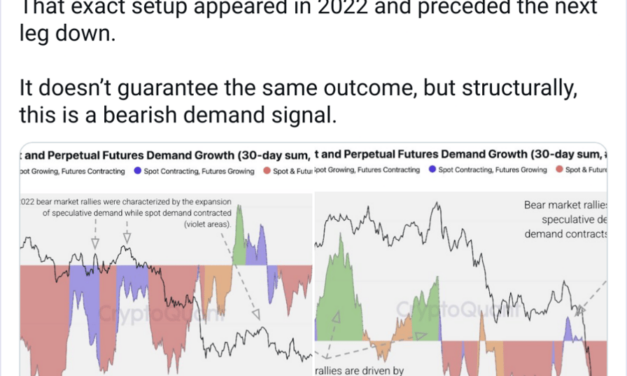
Bitcoin could be setting up for a multimonth price decline, after a rally in April driven mainly by futures traders while spot demand declined, according to the crypto analytics firm CryptoQuant.Bitcoin gained around 20% in April, rising from $66,000 to a peak of $79,000 in a rally “driven entirely by growth in perpetual futures demand,” CryptoQuant said in a report on Thursday. Meanwhile, spot demand for Bitcoin contracted throughout the rally, “indicating that the market’s marginal buyer was speculative, not fundamental,” it said.“The divergence between rising price and contracting spot demand is one of the clearest on-chain signals that price gains are speculative rather than structural,” CryptoQuant added.Bitcoin is trading around $77,000 at the time of writing, rising 2.1% over the past 24 hours. CryptoQuant said Bitcoin’s correction from $79,000 last month is consistent with rallies led only by strong futures demand.Current demand for Bitcoin mirrors a pattern at the start of the 2022 bear market, when futures demand surged while spot demand dropped, a setup that “ultimately preceded a sustained price decline.”Source: CryptoQuantRelated: Bitcoin price hits one-week low as $100 oil sparks fresh Asia crisis fears“History suggests this setup carries meaningful downside risk as Bitcoin remains in a bear market regime,” CryptoQuant said.The report is in contrast with a note on Tuesday from Bitwise chief investment officer Matt Hougan, which said the Bitcoin treasury company Strategy has been the “single biggest factor” in Bitcoin’s recent rally.“There have been multiple drivers of the recent rally, including strong buying from ETFs [exchange-traded funds], $3.8 billion since March 1, and renewed purchases by long-term holders. But Strategy has been the single biggest factor,” Hougan argued.CryptoQuant added that its Bull Score Index, which analyzes market and network activity to gauge market sentiment on a scale of 100, fell from 50 to 40 in April despite the price increase.“The Bull Score returning back to 40 indicates conditions are ‘getting bearish’ and places the market in the same range that historically preceded continued price weakness,” CryptoQuant said.Magazine: Bitcoin will not hit $1M by 2030, says veteran trader Peter BrandtCointelegraph is committed to independent, transparent journalism. This news article is produced in accordance with Cointelegraph’s Editorial Policy and aims to provide accurate and timely information. Readers are encouraged to verify information independently.

Čítaj viac

US Senate bans itself from betting on prediction markets

The US Senate on Thursday unanimously approved a resolution banning its members and staff, who are often exposed to sensitive information, from using prediction markets.The resolution, passed by unanimous consent, changed the Senate’s rules and took immediate effect. “Engaging in any way in a prediction market or trying to place bets where we might have inside information deteriorates the confidence that our constituents have in us,” Republican Senator Bernie Moreno, who introduced the resolution, said on the Senate floor.“By changing the standing rules of the Senate, what we’re doing is allowing our constituents to know, once and for all, that no member of the United States Senate, no member of the staff of the United States Senate, can ever use that inside information as a way to monetize this job whatsoever,” he added.Source: Bernie MorenoThe resolution comes after a special forces soldier involved in the plan to capture former Venezuelan President Nicolás Maduro was charged last week, on April 23, with using classified information to make bets on Polymarket, as lawmakers also air concerns over well-timed bets on the Iran war. He has pleaded not guilty. Senate Democratic leader Chuck Schumer said on the Senate floor that “of all the issues we debate in Washington, this falls clearly in the category of a ‘no-brainer.’”“We must never allow Congress to turn into a casino where members representing the public can gamble on wars, or economic crises, or elections,” he said.Related: Insider trading backlash forces Polymarket to step up surveillance“We should go further; this is a good start, but not enough,” Schumer said. “The administration and its employees must apply these very same rules too, particularly this administration, which shows such a troubling affinity to corruption and self-dealing.”Republican Representative Ashley Hinson posted to X that she would introduce a similar resolution to ban the use of prediction markets in the House.Polymarket posted on X that it fully supported the Senate resolution and its terms of service “already prohibit such conduct, but codifying this into law is a step forward for the industry.”Tarek Mansour, co-founder and CEO of rival prediction market platform Kalshi, also celebrated the resolution in a post on X, adding that it “already proactively blocks members of Congress and enforces against insider trading.”Magazine: How to fix suspected insider trading on Polymarket and KalshiCointelegraph is committed to independent, transparent journalism. This news article is produced in accordance with Cointelegraph’s Editorial Policy and aims to provide accurate and timely information. Readers are encouraged to verify information independently.

Čítaj viac

Získaj BONUS 8 € v Bitcoinoch

nakup bitcoin z karty

Registrácia Binance

Burza Binance

Aktuálne kurzy