Autor Cointelegraph By Jesse Coghlan

Bitcoin risks slump after hitting ‘major bear market resistance’: CryptoQuant

Bitcoin is at risk of falling into a downtrend after its price hit a key historical “major bear market resistance level” based on its 200-day moving average, according to the crypto analytics firm CryptoQuant.The cryptocurrency hit its 200-day moving average of $82,400 after rallying over six weeks since early April when it fell to $66,000, CryptoQuant said in a report on Wednesday.“The 200-day MA [moving average] was a major resistance in the 2022 bear market: the price resumed its downward trend after hitting it in March of that year,” it said. “The current setup raises the question of whether history repeats.”Several traders have recently forecast a Bitcoin rally if the US Senate moves forward with the long-awaited CLARITY Act, while others have pointed to additional money printing in the US as a tailwind for Bitcoin this year. CryptoQuant’s signals point to the opposite. Adding to CryptoQuant’s bearish outlook, traders’ unrealized profit margins reached 17.7% on May 5, their highest level since June last year, which the firm said indicated “potential selling pressure to take profits.”“These margin levels mirror those seen in March 2022, precisely when Bitcoin last tested the 200-day MA before resuming its decline,” CryptoQuant said.Bitcoin has fallen 2.3% in the last 24 hours to $79,300 after enjoying a rally since early April as traders returned to riskier assets on potentially easing Middle East tensions.Bitcoin has also become increasingly sensitive to the US economy as Wall Street adoption has grown, with its latest dip coming after the US Labor Department said Wednesday that producer prices jumped 1.4% in April, the biggest increase in four years and another sign of rising inflation.Source: CryptoQuantRelated: Whale shorts $70M in crypto and tech: Should Bitcoin traders worry?Traders may have already started taking profits, as the report said daily realized profits jumped to their highest level since early December last week, with traders cashing out 14,600 Bitcoin, currently worth nearly $1.2 billion, on May 4.“Historically, spikes of this magnitude in bear market rallies have preceded local price tops,” CryptoQuant said.It added that if Bitcoin falls, its current level of price support sits around $70,000, which is the average price at which all Bitcoin was last transacted.“This level has historically acted as a key resistance-turned-support band during bear markets,” CryptoQuant said. “It represents the average cost basis of short-term traders and the level at which unrealized profit margins compress back toward zero, reducing the incentive for further selling.”Other analysts have remained bullish on Bitcoin, with MN Capital founder Michaël van de Poppe posting on X on Wednesday that the cryptocurrency “might see a fast move” to $90,000 if the US Senate advances a long-awaited crypto bill dubbed the CLARITY Act.Arthur Hayes, the investment chief of the crypto fund Maelstrom, said on Tuesday that Bitcoin retaking its all-time peak of $126,000 was a “foregone conclusion.” He predicted that the war in Iran and competition between the US and China over artificial intelligence would lead the government to increase the money supply, causing inflation that would push traders toward Bitcoin.Magazine: eToro founder timed Bitcoin top perfectly due to belief in 4-year cycles

Čítaj viac
Only 4% of Americans weigh crypto when placing their votes: Poll

Just 4% of surveyed Americans say they would weigh a political candidate’s stance on crypto policy in deciding who to vote for.Affordable housing, consumer fraud protection and lower bank fees were the top three issues respondents said they wanted Congress to tackle, according to a survey of 2,035 US adults released on Wednesday by POLITICO and conducted by polling firm Public First.Just 18% of respondents considered establishing rules for the crypto market a top priority for Congress, just one percentage point ahead of regulating large banks.The results show a divide between the average American voter’s top priorities and those of crypto industry lobbyists, who have been pushing Congress to pass crypto legislation ahead of the midterm elections.Crypto lobbies poured more than $130 million into the 2024 elections, the most of any industry, and have already spent $320 million to influence the November midterms, according to data compiled by researcher Molly White.Crypto lobbyists have made it clear that they will use their significant funds against any candidate who doesn’t support the industry, having spent over $5.5 million on opposing candidates in congressional races in Illinois this year.Less than a third oppose making crypto mainstreamAccording to the survey, just 27% said they support or strongly support the US government taking action to legitimize crypto as a mainstream financial asset, while 31% said they oppose or strongly oppose it. Poll responses to whether the US government should legitimize crypto as a mainstream asset. Source: POLITICORelated: Crypto and AI could be dirty words on 2026 midterm campaign trail“Most voters don’t care about digital assets,” Republican Representative Dusty Johnson told POLITICO. “But those who do care a lot. It is a high-intensity issue. And I think it’s going a little bit more mainstream. The number of people who ask me about it is still very small, but I would say growing.”More than half of the respondents said they had not, and would not, consider trading crypto, while 19% had traded crypto. Of those who trade crypto, 7% said a political candidate’s stance on crypto would impact their vote.The poll also found that 45% of respondents viewed investing in crypto as a risk not worth taking, even if it offered high returns, compared with 25% who said it was worth it.The latest poll clashes with another poll of 2,008 registered voters released on Friday by HarrisX, which found 47% said they would be at least somewhat likely to consider voting for a candidate outside their preferred party if the candidate supported passing a long-awaited crypto bill that would lay out how the industry is regulated.The Senate Banking Committee on Thursday will vote on whether to advance such a bill that has seen involvement from the White House to cut a deal with crypto and banking lobbies. A version of the bill passed the House in June as the CLARITY Act.Magazine: Clarity Act risks repeat of Europe’s mistakes, crypto lawyer warns

Čítaj viac

CFTC backs prediction market Kalshi in appeals court fight against Ohio

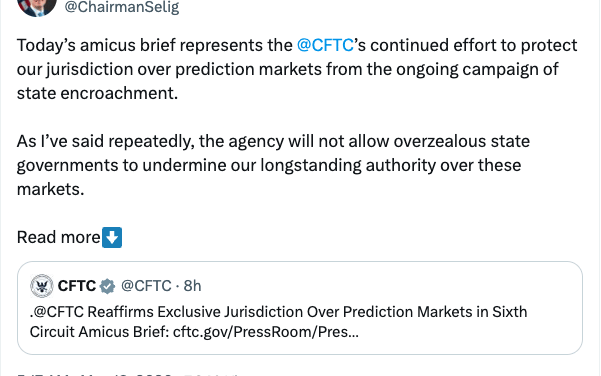
The US Commodity Futures Trading Commission has backed Kalshi in the company’s legal fight against the state of Ohio, asking an appeals court to affirm that the regulator has jurisdiction over prediction markets.The CFTC filed an amicus brief in the Sixth Circuit Court of Appeals on Tuesday, accusing Ohio of “jurisdictional overreach” after state authorities told Kalshi last year to stop offering sports event contracts in the state, calling them unlicensed sports gambling.Kalshi sued Ohio authorities in October, seeking to have a federal court stop the Ohio Casino Control Commission and the state attorney general from taking action, but the court denied the request in March, leading Kalshi to appeal the decision.“The federal district court in Ohio took an improperly narrow view of the Commission’s jurisdiction, and we are asking the Court of Appeals to correct that error,” CFTC Chairman Mike Selig said in a statement. “As I’ve said repeatedly, the CFTC will not allow overzealous state governments to undermine the agency’s longstanding authority over these markets.”The dispute is one of many similar cases determining whether states have the power to restrict federally regulated prediction markets and has implications for major prediction market platforms such as Kalshi and Polymarket. The CFTC’s latest amicus brief is its second backing a prediction market after it filed one in the Ninth Circuit Appeals Court in February supporting Crypto.com in a legal battle against regulators in Nevada.In its brief, the CFTC argued that “Ohio’s jurisdictional overreach into the Commission’s sphere threatens regulatory upheaval,” as the agency oversees event contracts trading as swaps or binary options on designated contract markets (DCMs).Source: Mike Selig“If States can restrict event contracts on sports, the Commission’s longstanding jurisdiction over these other event contracts could be imperiled too,” it wrote. “The Court should enforce the Commission’s exclusive jurisdiction and hold that Ohio cannot regulate event contracts traded on DCMs.” Related: Prediction market battle gets closer to Supreme CourtThe CFTC’s brief comes after it sued five states to assert its jurisdiction over prediction markets, launching action against regulators in Wisconsin, New York, Arizona, Connecticut and Illinois.The states had either sent cease-and-desist letters or had sued the prediction markets Kalshi, Polymarket, Crypto.com, Robinhood, and Coinbase, all of which are CFTC-regulated DCMs, over their offering of sports event contracts.“States cannot circumvent the clear directive of Congress,” Selig said last month after the CFTC sued Wisconsin. “Our message to Wisconsin is the same as to New York, Arizona, and others: if you interfere with the operation of federal law in regulating financial markets, we will sue you.”Magazine: Should users be allowed to bet on war and death in prediction markets?

Čítaj viac

Senators file over 100 amendments to crypto bill ahead of markup

Members of the US Senate Banking Committee have filed more than 100 amendments to a crypto market structure bill set for markup on Thursday, with the proposed changes mostly related to stablecoins, software developers and ethics. According to a list obtained by POLITICO, Democratic senators have proposed dozens of changes, while Republicans are seeking slight adjustments to the bill. It is not clear what the specific details of each amendment are, but some concern issues the committee has been seeking to solve for months, including stablecoin yield, crypto software developer protections and ethics provisions.The list offers insight into the issues the committee will likely debate at the bill’s markup on Thursday as it seeks to advance the measure to the Senate floor. The Senate Banking Committee indefinitely delayed a previous markup in January after major crypto lobbyist Coinbase withdrew support for the bill.The legislation aims to divide how US market regulators oversee crypto, with the House passing a version of it in July called the CLARITY Act. Crypto and banking lobbyists, along with lawmakers, have fought over provisions on stablecoins and whether government officials should be barred from involvement in crypto.Further restrictions on offering stablecoin yields have been the bill’s most contentious provision, with banking and crypto lobbyists failing to reach an agreement after months of negotiations.A version of the bill released on Monday banned third-party platforms like crypto exchanges from offering yield on stablecoins in a way that is “functionally equivalent” to the payment of interest on an interest-bearing bank deposit.The list shows Democratic Senators Jack Reed and Tina Smith introducing an amendment to “strengthen [the] prohibition on interest/yield by using a ‘substantially similar’ test rather than an ‘equivalence’ test.”An excerpt of the leaked list showing amendments for debate by Senator Jack Reed, with one supported by Senator Tina Smith. Source: POLITICOAnother planned amendment from Democratic Senator Chris Van Hollen pitches an ethics provision that Democrats and some Republicans have supported, which would bar the president, vice president, senior officials, members of Congress and their families from owning, promoting or being affiliated with crypto.Related: Seven Democrats seen as ‘key’ to advancing CLARITY Act: GalaxyDemocratic Senator Catherine Cortez Masto also plans an amendment protecting software developers by “creating a safe harbor from criminal liability for not registering as a money transmitter,” a provision that is supported by many crypto groups.Other amendments concern sanctions, institutions engaging in crypto, and one from Democratic Senator Andy Kim that seeks to reestablish the Justice Department’s National Cryptocurrency Enforcement Team, which the department dismantled in April last year.Republicans have a majority on the Banking Committee and in the Senate, but some party members, such as Senator Thom Tillis, have said they won’t support the bill without certain provisions.Republicans also control the Senate, but will need some Democrats onside to pass it with a three-fifths majority to end any potential debate on the bill.Magazine: Will the CLARITY Act be good — or bad — for DeFi?

Čítaj viac

England central banker says global stablecoin rules will ‘wrestle’ with US

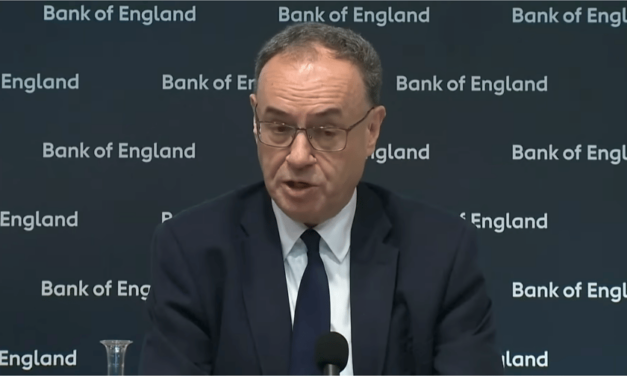
Bank of England Governor Andrew Bailey said international regulators will have to “wrestle” with the US over global rules for stablecoins, which are largely denominated in and backed by US dollars.“If ​we want stablecoins to be part of the architecture of payments globally […] they’re ‌only ⁠going to work if we have international standards,” Bailey said at a conference on Friday, according to Reuters. “Frankly, that, I think, is going to be a coming wrestle with the [US] administration,” he added.US President Donald Trump has the goal of attracting the crypto industry to the US and has promoted the use of stablecoins through the GENIUS Act, which gave a regulatory framework to stablecoin issuers.Other regulators are looking into greater oversight and control of stablecoins compared to the US, seeing them as a lighter-regulated alternative to the banking system that could impose systemic risks.The stablecoin market is currently valued at more than $317 billion, according to CoinGecko, with the largest stablecoins by market capitalization dominated by tokens pegged to the US dollar, most of which use US Treasury bills and US dollars as backing assets.Bailey, who chairs the Financial Stability Board, an international body that aims to coordinate regulation, said he sees stablecoins as a potential threat to financial stability.Andrew Bailey at a press conference in February after a meeting of the Bank of England’s Monetary Policy Committee on interest rates. Source: YouTubeBailey added that he was concerned some stablecoins could not be readily converted to cash without the use of a crypto exchange, which could limit their convertibility in changing market conditions.He said if stablecoins are widely used for cross-border payments, then the US dollar tokens that are hard to convert could flow to other countries, like the UK, which is planning to have strong laws around converting stablecoins.“We know ​what would happen if there was a run on a stablecoin; they’d all turn ​up here,” Bailey said.Related: US Senator questions Mark Zuckerberg on Meta’s stablecoin plansUS banking groups have raised similar concerns about stablecoins with Congress and have pushed for a Senate crypto market structure bill to include a ban on third-party platforms, such as crypto exchanges, offering yield payments on stablecoins.Crypto and banking groups failed to come to an agreement on the ban after months of negotiations, and the latest version of the bill, released earlier this month, prohibits stablecoin rewards on idle balances while allowing crypto platforms to “offer other forms of customer rewards.”The Senate Banking Committee, which indefinitely postponed a vote on advancing the bill in January, has scheduled a markup of the bill on Thursday.Magazine: How crypto laws changed in 2025 — and how they’ll change in 2026

Čítaj viac

Získaj BONUS 8 € v Bitcoinoch

nakup bitcoin z karty

Registrácia Binance

Burza Binance

Aktuálne kurzy