
Autor Cointelegraph By Jameson Lopp

A detailed guide on how to lose all your Bitcoin investments

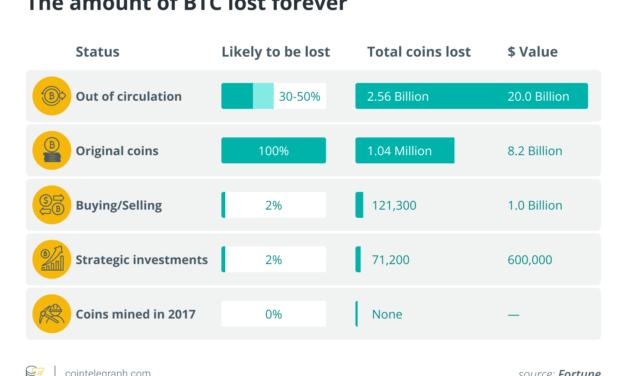
Let’s say you want to lose your Bitcoin (BTC) totally, irretrievably and forever. Hey, it’s not our place to wonder why. Maybe it’s part of some elaborate performance art piece, like the guy who destroyed all his possessions or perhaps you’ve always been big fans of electronic music outfit The KLF, who famously burned 1 million pounds on a remote Scottish island. Or, your reason might be more mundane and you simply don’t want your soon-to-be-divorced spouse to get their share of the investment you both know you own.Whatever your reason, we’re not here to judge. And, while we’re usually in the business of helping people protect their coins, it’s easy enough to reverse engineer security to help you lose them in the fastest and easiest way possible. Brag about your BitcoinIf you’ve got it and wish to lose it, flaunt it. Want to get rid of that Rolex weighing down your wrist? Pair it with a t-shirt, flash it about in a crowded bar and then take a walk through a bad part of town after dark — you’ll soon find yourself relieved of your timepiece.It’s the same with Bitcoin. You want the world to know you’re a Bitcoiner and, ideally, that you’ve stacked enough sats for it to be worthwhile stealing them. So tell them. Add laser eyes to your social media profiles, keep tweeting those diamond hands and don’t forget about the offline world, either. Be sure to boast about your mastery of Bitcoin to all your friends, family and, most importantly, new acquaintances. You never know who will be tempted to start probing your defenses in order to relieve you of your investment. Related: I spy with my laser eye: A Twitter phenomenon to make Bitcoin mainstream?Keep it on-exchangeIn the early Wild West days of Bitcoin, losing your coin was child’s play, as there was no shortage of disreputable exchanges that would help you lose your investment. If you kept your coins in a hosted wallet, it was only a matter of time before the exchange went bust like Mt. Gox, got hacked, lost coins by engaging in fractional reserve banking or the owners absconded (or died) with your keys.The exchange market has matured significantly in recent years, with enhanced security measures such as two-factor authentication and even published proof-of-reserves and proof-of-custody. Don’t be disheartened: As long as you entrust your keys to a third party, anything could happen — and probably will. Exchanges still go bust with reassuring regularity. Even more encouragingly, governments are now actively targeting Bitcoiners’ wealth. And, not just traditional authoritarians like China and Russia, the Canadian government recently instructed financial institutions — including cryptocurrency custodians — to freeze the accounts of anyone who donates even a small amount to the “trucker protests.” Deputy PM Chrystia Freeland: “The names of both individuals and entities as well as crypto wallets have been shared by the RCMP with financial institutions and accounts have been frozen and more accounts will be frozen.” pic.twitter.com/iA69DbRJl1— True North (@TrueNorthCentre) February 17, 2022Even if you have a strong password and 2FA protecting your exchange account, you never know what other vulnerability might be exploited to gain access and drain it. If you’ve got your coins on-exchange, relax: They’re in unsafe hands.Related: Bitcoin has become nothing but the new Che Guevara T-shirtWrite it down Things get a little trickier if you’ve decided to self-custody your Bitcoin offline in a secure hardware wallet. Or do they? After all, when you hold the keys yourself, the power to lose your coins is completely in your hands. Why wait for an exchange to go bust when you can start adopting security “worst practice” today?The secret to making your wallet insecure lies in your seed phrase, the string of words you use to generate your private key. The simplest way to lose your coins is to memorize your seed phrase and then delete or destroy any record of it. A few months on, hardly anyone has a hope of recalling every word in the correct order. But, what if you’re cursed with an eidetic memory? Easy: Write it down. Even better, do it twice in physical pen-and-paper form, ideally kept near your hardware wallet. And, for good measure, record it in a cloud-based document where anyone with a will can access it through a brute-force attack. This is particularly effective if you regularly remind people you hold wealth in Bitcoin.Disinherit the next generationThis one is for those who like playing the long game. You know the phrase “you can’t take it with you?” Well, with Bitcoin, you can. If you haven’t considered inheritance planning, then your entire investment will likely go to the grave with you, joining the estimated 3.7 million Bitcoin (around 18% of the coins there will ever be) that has already been lost forever.Of course, this requires you to reverse the principles above: If you really want to cheat your children out of their inheritance, you need to make it as difficult for them to gain access to your keys as any attacker. So, if that’s the way you want to go, don’t tell your heirs, don’t write down your seed phrase, and do get a hardware wallet. Even better, cut your 24-word seed phrase into many pieces and store them in many hidden holes around the world with no recovery instructions whatsoever. Your heirs won’t thank you at all.Whatever you do, just make sure your Bitcoin storage and security providers don’t have a specific and robust protocol for inheritance planning. You can rest easy in the knowledge that not even the Devil himself will get your wealth when you pass on.If, for some reason, you do want to protect your Bitcoin, just ignore everything I’ve written. Even better, do the opposite. But, all you’d be doing is securing your investment in the only censorship-resistant and inflation-proof store of value ever invented. And, why would you want to go and do something as dull as that?This article does not contain investment advice or recommendations. Every investment and trading move involves risk, and readers should conduct their own research when making a decision.The views, thoughts and opinions expressed here are the author’s alone and do not necessarily reflect or represent the views and opinions of Cointelegraph.Jameson Lopp has been actively building in the Bitcoin space since 2015 and has become one of the most respected voices in the Bitcoin developer community. He was previously an engineer at BitGo, developing its high-grade multisig custody service before joining Casa, a company providing secure wallets and plug-in-play infrastructure solutions for Bitcoin.

Čítaj viac


Bitcoin’s last security challenge: Simplicity

It’s been just 13 years since Bitcoin’s (BTC) “Mayflower moment,” when a tiny handful of intrepid travelers chose to turn their back on the Fiat Empire and strike out to a new land of financial self-sovereignty. But, whereas it took 150 years for the American colonists to grow sufficient in number to throw off the yoke of unrepresentative government, the Republic of Bitcoin has gone from Pilgrims to Revolutionary Army in little over a decade.What sort of people are these new Bitcoiners? How do their character, demographics and technical knowledge differ from earlier adopters? Is “Generation Bitcoin” sufficiently prepared to protect their investment against current and future security threats? And, most importantly, what are the challenges that the rapidly growing community must urgently address to secure the success of our revolution? Diversifying demographicsWho are today’s Bitcoiners? While we don’t know precisely, we can see some high-level trends. These changes can be charted in a number of ways. First, there’s unempirical but still valuable anecdotal evidence such as more diversity among attendees at industry events and more women in senior industry roles. Related: 10 women who used crypto to make a difference in 2021Then, there’s publicly available data, such as the number of corporations holding Bitcoin on their balance sheet. Years ago, pioneers like MicroStrategy would have been mocked. Today, a growing range of public and private businesses (as well as countries) hold part of their treasuries in Bitcoin, and a wave of miners have gone public. Most importantly, the available data on private individuals shows that the old stereotypes are also changing fast. In the United Kingdom, for example, the proportion of investors over 55 holding crypto jumped from just 7 to 22 percent between 2019 and 2020. Similarly, recent consumer research by Gemini found that over half of “crypto-curious” consumers are women and among these, a quarter are over 55.Sure, Bitcoin adoption has some room to grow before it will match the demographic diversity of the wider population but it’s clear that today’s investors are vastly different from Bitcoin’s “Mayflower Generation.” While that’s to be welcomed, it also means that their technical sophistication — including their security consciousness and skills — is much more mixed. The big question is: Are they prepared for the threats they face?Changing threats?The colonial rebels were lucky in their choice of enemy: A divided government headed by a king some 3,000 miles across the ocean. In today’s digital world, we are used to much more diverse, insidious and fast-moving threats than lumbering national parliaments. Yet, in my most recently conducted poll of 1,600 Bitcoiners, the second most-cited threat was government seizure.It’s easy to see why more than a quarter of respondents thought this was the case. For one thing, there are the highly publicized crypto crackdowns in jurisdictions like China. The United States has also confiscated citizens’ assets such as gold during the Great Depression. The risk of government seizure is more than simply theoretical.But, as I often point out — and as a plurality of respondents agreed — the most significant threat to users’ Bitcoin is actually accidental loss. Even so, the risk landscape for Bitcoin is significantly more complex than other forms of digital security, Bitcoiners must contend with governments as well as their own forgetfulness.Related: Lost Bitcoin may be a ‘donation,’ but is it hindering adoption?While it’s true that the security landscape is complex, the real threat to users’ coins (and its solution) is actually quite simple and can be described in a single word: usability. Making security simpleThis security challenge-solution was perfectly encapsulated in a recent Reddit post: “People who use the internet are not ‘internet enthusiasts’ they don’t care about learning about the tech, they just want to use the internet in a seamless and easy way. When crypto goes mainstream it’ll be exactly the same as that for 99.9% of all users.”For Bitcoin’s early pilgrims, simplicity was never an issue — they embraced digital asset security best practices like self-custody and multisignature security from the very beginning. Now, we have a far more diverse array of Bitcoiners, a far smaller proportion of whom know how to keep their coins safe, even if they do understand the threats they face.Related: Deterring adoption? Balancing security and innovation in cryptoI don’t need to spell out what this means: More people will put their investment at risk by keeping their coins on-exchange or adopting relaxed security practices such as storing passwords and seed phrases online. These threaten individuals’ investment, of course, but even more worrying is what large-scale losses — whether through theft, confiscation or accident — would do for confidence and participation in the revolution.This is in spite of the fact that self-custody combined with multisig is the single most effective way of safeguarding against every conceivable risk from malicious attack to absentmindedness. The technology exists and is proven. The only problem is making it easy and intuitive for every Bitcoiner to use. There is a disconnect between Bitcoin’s central tenets of decentralization, self-sovereignty and user education with how well our industry is helping people achieve them. Users who don’t hold their keys don’t own their Bitcoin, but users are encouraged to cede control over their Bitcoin, resulting in coins being concentrated in a few exchanges and susceptible to attack.The answer is clearly for the industry to dedicate much more effort to user education, right? Well, yes and no. In terms of general principles — about the importance of self-custody and why you should secure your Bitcoin like it’s an order of magnitude more than the current market valuation — there’s certainly much more to be done. Related: Mass adoption of blockchain tech is possible, and education is the keyBut, why make the specifics of protecting your Bitcoin something you have to learn? Every digital security expert knows humans are the weakest link in any chain and the more complex security systems are, the more they are ignored. So, the real question is not whether Bitcoin’s new adopters are sufficiently skilled to protect themselves from the threats they face. Rather, we should ask when our industry will do what it ought to have done right from its early days, and make multisig self-custody so simple, frictionless and intuitive that there’s no learning curve at all. Answer that riddle, and we’ll have safeguarded the revolution for every generation to come. This article does not contain investment advice or recommendations. Every investment and trading move involves risk, and readers should conduct their own research when making a decision.The views, thoughts and opinions expressed here are the author’s alone and do not necessarily reflect or represent the views and opinions of Cointelegraph.Jameson Lopp has been actively building in the Bitcoin space since 2015 and has become one of the most respected voices in the Bitcoin developer community. He was previously an engineer at BitGo, developing its high-grade, multisig custody service before joining Casa, a company providing secure wallets and plug-in-play infrastructure solutions for Bitcoin.

Čítaj viac

Získaj BONUS 8 € v Bitcoinoch

nakup bitcoin z karty

Registrácia Binance

Burza Binance

Aktuálne kurzy