Autor Cointelegraph By Helen Partz

Russia’s Sber eyes USDT loans, questions digital ruble demand

Russia’s largest bank, Sber, plans to expand its crypto-backed lending to accept Tether’s USDt stablecoin and Ether as collateral alongside Bitcoin, according to a senior executive.Sber will adapt its existing products and gradually expand its offerings as Russia’s new crypto law takes effect, Deputy Chairman Anatoly Popov said, according to a Friday TASS report. The bank plans to add the assets as collateral after the Bank of Russia permits them for public trading, he said.The plans come as Russia rolls out a regulated crypto market under a law signed by president Vladimir Putin on Aug. 4, with core provisions taking effect Sept. 1.The law gives the Bank of Russia authority to determine which crypto assets can trade on regulated exchanges. The central bank proposed Bitcoin, Ether and USDT for regulated exchange trading on Aug. 11, saying they met requirements including market capitalization, trading volume and at least five years of price history on overseas markets.Sber has taken a more cautious view of the digital ruble, Russia’s central bank digital currency (CBDC), ahead of its wider rollout on Sept. 1. Sber’s chief financial officer Taras Skvortsov reportedly said that the bank sees little evidence of broad demand for the CBDC.“I don’t see any clear interest in this instrument, apart from the central bank’s,” Skvortsov said, adding that neither retail nor corporate clients nor financial institutions are actively pushing for the CBDC.Related: Stablecoins not credible for payments at scale, BIS chief saysCointelegraph is committed to independent, transparent journalism. This news article is produced in accordance with Cointelegraph’s Editorial Policy and aims to provide accurate and timely information. Readers are encouraged to verify information independently.

Čítaj viac

Real Trump Coins denies launching GOLD token, blames ‘bad actors’

Real Trump Coins has denied launching, promoting or authorizing the Trump Digital GOLD token that briefly appeared across its online presence before collapsing, blaming the promotion on “third-party bad actors.”The denial came after the Real Trump Coins X account promoted the Solana-based token on Saturday and directed users to RealTrumpCoins.com, where GOLD was also advertised. The X posts were later deleted, while the account now links to a separate domain, TrumpCoins.com.“Trump Coins has not authorized and will not launch, promote, or authorize any digital token,” Real Trump Coins said in an X post on Saturday, adding that it was working with authorities to investigate the matter.The statement follows a highly concentrated GOLD launch, with Lookonchain reporting that the developer and newly created wallets controlled 82.45% of its supply. According to the blockchain analytics platform, 15 wallets linked to the team sold their holdings for about $330,000, making an estimated $312,000 profit.The involvement of both the X account and RealTrumpCoins.com confused crypto observers, with X user Rune questioning how both the account and the domain could have been compromised.While the Real Trump Coins X account bio linked to TrumpCoins.com, the account was still directing customers to RealTrumpCoins.com as recently as Aug. 25 in a post that remained online at the time of publication.The Real Trump Coins X account directed customers to RealTrumpCoins.com on Aug. 25. Source: Real Trump CoinsAt the time of publication, RealTrumpCoins.com still displayed the GOLD promotion. Trump also continued to follow the Real Trump Coins X account, one of 53 accounts he followed on the platform.Related: Trump cost investors $4.7B through crypto ‘schemes’: Public CitizenCointelegraph is committed to independent, transparent journalism. This news article is produced in accordance with Cointelegraph’s Editorial Policy and aims to provide accurate and timely information. Readers are encouraged to verify information independently.

Čítaj viac
Trump-promoted brand touts GOLD before token collapse

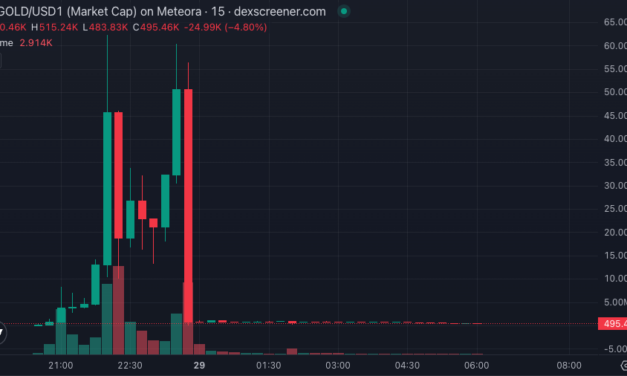
A Solana-based token promoted by a Trump-linked coin brand collapsed within hours of its launch, raising questions over who was behind it and its unusual trading activity.Real Trump Coins, a brand US President Donald Trump publicly promoted in 2024, touted the “Trump Digital GOLD” token on X before deleting related posts on Saturday, according to blockchain analytics platform Lookonchain.The Real Trump Coins website continued promoting GOLD as of publication, advertising a 4% trading fee and pledging to use 99% of trading fees to buy back the token in an effort to make it a top-10 crypto asset by market capitalization.The launch has left crypto observers questioning GOLD’s legitimacy, with some suggesting the Real Trump Coins website and its Trump-followed X account may have been compromised.GOLD token wallets sell amid 82% supply concentrationThe token surfaced early Saturday when the Real Trump Coins X account, which Trump’s official account follows, announced the GOLD launch and directed users to RealTrumpCoins.com to buy the token.Lookonchain flagged the launch shortly afterward, noting that the developer held 600 million GOLD while 15 newly created wallets spent $18,657 to acquire another 224.5 million tokens. “The team currently controls 82.45% of the total supply,” Lookonchain said, advising users to be cautious.Lookonchain later reported that the 15 wallets, which it linked to the team, sold all 224.5 million GOLD for 3,178 Solana (SOL), worth about $330,000. GOLD subsequently lost nearly all of its value, with its market capitalization falling from about $50 million to $500,000 at the time of publication, according to DEX Screener.Source: DEX Screener“GOLD just rugged!” Lookonchain said, estimating that the wallets made a $312,000 profit, or roughly 17 times their initial investment.What is Real Trump Coins?Trump publicly promoted RealTrumpCoins.com in September 2024 when announcing his silver medallions, describing the website as the exclusive place to buy them. The site says the products are not manufactured, distributed or sold by the Trump Organization.The sudden GOLD promotion and subsequent deletion of related X posts fueled speculation that the brand’s X accounts and website had been compromised. Several crypto outlets have since described GOLD as an apparent scam or rug pull, while unverified reports have linked the suspected compromise to Iranian hackers.US President Donald Trump promoted the Real Trump Coins brand in September 2024. Source: Truth SocialThe GOLD episode adds to scrutiny of Trump-linked crypto ventures as the president pushes Congress to advance legislation that would reshape US oversight of the industry.Related: Trump cost investors $4.7B through crypto ‘schemes’: Public CitizenTrump urged lawmakers on Aug. 19 to pass a “fair version” of the CLARITY Act, proposed legislation that would establish a regulatory framework for crypto assets and clarify whether tokens fall under securities or commodities rules.Trump and his family have backed or launched several crypto ventures, including the Official Trump (TRUMP) memecoin and World Liberty Financial. The ventures have drawn conflict-of-interest concerns as his administration shapes crypto policy, while the White House has denied any impropriety.Magazine: Who is legally liable when an AI agent goes rogue?

Čítaj viac

Stablecoins not credible for payments at scale, BIS chief says

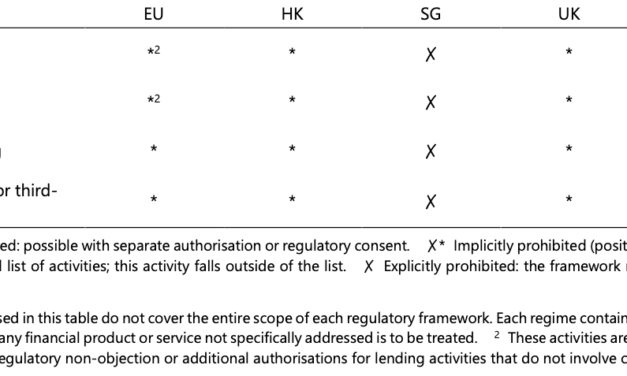
The Bank for International Settlements is renewing its criticism of stablecoins, questioning their credibility as everyday money as governments worldwide build regulatory frameworks around the tokens.BIS General Manager Pablo Hernández de Cos, a candidate to succeed European Central Bank President Christine Lagarde next year, argued that stablecoins do not credibly function as a means of payment at scale. He said tokenized bank deposits offer a stronger alternative, Reuters reported on Friday.“Tokenised deposits offer a more direct path to harness tokenisation while preserving the monetary system’s foundations,” de Cos said.The comments come as regulators worldwide grapple with stablecoin adoption, while a new study from the BIS-linked Financial Stability Institute (FSI) shows significant differences in how major markets regulate stablecoin issuers.Stablecoins could lower government borrowing costsHernández de Cos acknowledged that stablecoins could lower government borrowing costs, an argument also made by US Treasury Secretary Scott Bessent.But the effect could cut both ways for consumers. If customers move bank deposits into stablecoins, banks could face higher funding costs and pass those expenses on to households and businesses through higher borrowing rates, Hernández de Cos said.Related: Visa works with Upbit parent on stablecoin payments, AI commerceHe also pointed to limited interoperability between stablecoin platforms and difficulties consistently applying anti-money laundering controls. Growing use of US dollar-pegged stablecoins outside the US could also undermine monetary sovereignty and weaken domestic monetary policy, he said.Stablecoin issuers face different rules worldwideThe FSI study, published on Thursday, compared stablecoin regulations in the US, European Union, United Kingdom, Hong Kong and Singapore, finding substantial differences in which entities may issue stablecoins and what other business activities they can conduct.The US and Singapore take relatively restrictive approaches toward non-bank issuers. Under the US GENIUS Act, lending, staking, proprietary trading and custody of third-party crypto assets generally fall outside the activities permitted for payment stablecoin issuers.Stablecoin issuer rules across major markets. Source: BISHong Kong, the UK and EU take a less restrictive approach, allowing some additional activities with separate authorization, regulatory consent or other applicable permissions.The researchers also found that restrictions across all five jurisdictions apply to the issuing entity rather than the wider corporate group, meaning other group members can conduct activities that the stablecoin issuer itself cannot.Magazine: Korean bank taps Ripple for payments, Pakistan opens crypto licensing: Asia Express

Čítaj viac

Bitcoin ETFs end 9-day inflow streak as BTC dips below $78K

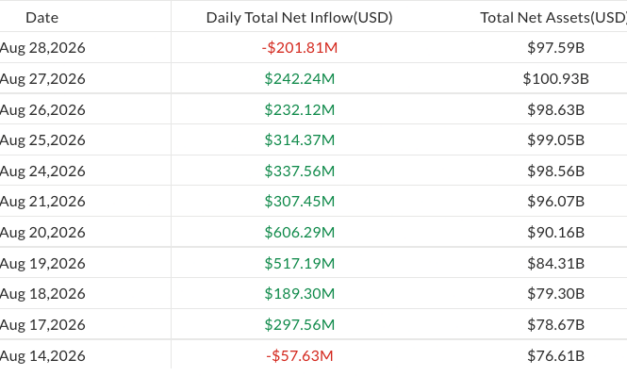
US-listed spot Bitcoin exchange-traded funds (ETFs) ended a nine-day inflow streak as Bitcoin fell below $78,000, while several altcoin ETF categories continued to see inflows.Bitcoin ETFs recorded $201.8 million in net outflows on Friday, ending nine consecutive trading sessions of inflows, according to SoSoValue data.The reversal followed more than $3 billion of net inflows during the nine-session run, while August flows remained positive at $3.3 billion with one US trading session left in the month. Total net assets fell to $97.6 billion after topping $100 billion on Thursday.Daily flows into US spot Bitcoin ETFs since Aug. 14, in USD. Source: SoSoValueThe Bitcoin ETF reversal contrasts with continued inflows into Ether and XRP funds, while Solana ETFs have reached new asset milestones.ARK 21Shares leads Bitcoin ETF outflowsThe ARK 21Shares Bitcoin ETF (ARKB) led Friday’s withdrawals with $114.9 million in net outflows, followed by the Bitwise Bitcoin ETF (BITB) with $49.7 million, according to Farside Investors data.BlackRock’s iShares Bitcoin Trust ETF (IBIT), the largest US spot Bitcoin ETF by assets, recorded $33.4 million in outflows.US spot Bitcoin ETF flows on Friday. Source: Farside InvestorsMorgan Stanley’s Bitcoin Trust (MSBT) was the only fund to record inflows Friday, adding $9.3 million.Ether, XRP ETFs buck Bitcoin outflowsEther and XRP ETFs continued to see inflows Friday despite the reversal in Bitcoin funds, adding $102.2 million and $26.2 million, respectively, according to SoSoValue data. The funds last recorded net outflows on Aug. 11 and Aug. 5, respectively.Solana ETFs have also maintained positive momentum. Bloomberg ETF analyst Eric Balchunas said Friday that the category had attracted $1.7 billion in cumulative flows without a sustained stretch of outflows.Related: Solana validators approve proposal to accelerate SOL disinflationBitwise’s Solana ETF also became the first fund in the category to cross the $1 billion mark, according to the analyst.Balchunas called the performance “impressive” despite what he described as a “nightmare downturn” in the first half of the year.Magazine: Bitget CEO isn’t buying the Bitcoin rally — She’s waiting for $50K

Čítaj viac

Získaj BONUS 8 € v Bitcoinoch

nakup bitcoin z karty

Registrácia Binance

Burza Binance

Aktuálne kurzy