Autor Cointelegraph By Gareth Jenkinson

Another depeg — Acala trace report reveals 3B aUSD erroneously minted

High-profile security incidents continue to be a theme in 2022 as the Acala Network joined a long list of stricken platforms to fall prey to exploits.Acala’s aUSD token, which acts as the native stablecoin for the Polkadot and Kusama blockchains, saw its value plummet 99% after a misconfiguration of the iBTC/aUSD liquidity pool was exploited after its launch on Aug. 14. Initial estimates from Acala noted that 1.2 billion aUSD were minted without the necessary collateral – seeing the token’s value depeg from its 1:1 USD ratio to a bottom of $.01.Acala put its network in maintenance mode to freeze funds and eventually managed to recoup a significant portion of the uncollateralized tokens. The Acala community proposed and voted on a referendum to identify and destroy the erroneously minted tokens to return its USD peg to parity at $1.A community governance referendum has been proposed and passed. At block 1652829 in approx. 35 minutes, 1,292,860,248 total erroneously minted aUSD will be returned to the honzon protocol and will be burned.Details in thread below:— Acala (@AcalaNetwork) August 16, 20221,288,561,129 aUSD minted on 16 specific accounts were returned to the network’s honzon protocol to be burnt. Another 4,299,119 erroneously minted aUSD remaining in the iBTC/aUSD reward pool were also destroyed.While the cryptocurrency community considers whether the Acala Network took the right decision to essentially freeze its network, the stablecoin was able to be re-pegged in a short turnaround with the community playing its role in the chosen path to undo the exploit.1/ We’re aware of the issue concerning the aUSD depeg, the iBTC / aUSD pool included.Interlay is following Acala’s investigation into this issue and also looking to see if and in what manner iBTC and user’s funds are affected.— Interlay #iBTC (@InterlayHQ) August 14, 2022

Interlay, a service that allows users to wrap Bitcoin to iBTC and then use it across decentralized finance (DeFi) platforms, was drawn into the situation as the iBTC/aUSD pool was chiefly affected by the exploit. Cointelegraph reached out to Interlay to ascertain the details of the incident and lessons to be taken forward. Acala, on the other hand, refused to comment.While investigations are still ongoing, the theory is that the misconfiguration in the iBTC/aUSD allowed an attacker to mint an erroneous amount of aUSD. This then led to fears that the attacker would buy iBTC with the illicit aUSD tokens and convert that to BTC – which would have nullified the Acala Network’s ability to recoup the tokens and restore its peg. Interlay co-founder Alexei Zamyatin told Cointelegraph that their protocol had not been compromised by the attack despite having direct exposure to the affected liquidity pools:”Acala did use iBTC in the affected pools alongside other, non-Interlay assets, but the incident has not jeopardized Interlay as a network in any way. All system operations have been and remain fully functional.”The company’s incident trace report is being constantly updated to provide more information regarding the 16 addresses that received erroneously minted rewards.2nd batch trace results + summary below. A total 3.022B aUSD error mints were claimed by 16 addresses. Acala referendum #21 burned ~1.292B. 1.682B aUSD error mints in iBTC/aUSD LP tokens, obtained after the incident happened, remain on 16 Acala addresses. https://t.co/8MTBinhrVP— Acala (@AcalaNetwork) August 17, 2022

According to the update, more than 3 billion aUSD were minted and claimed by the 17 flagged liquidity provider addresses. Following the Acala community referendum, some 1.29 billion were burnt while another 1.6 billion aUSD error mints remain on these 16 addresses on the Acala parachain.

Čítaj viac
USDT market cap up by $2 billion following Tornado Cash debacle

The market capitalization of Tether (USDT) tokens has increased by nearly $2 billion since the U.S. Treasury Department imposed sanctions on cryptocurrency mixer Tornado Cash.The Office of Foreign Asset Control essentially barred Americans from using Tornado Cash on Aug. 8, blacklisting 44 USD Coin (USDC) and Ether (ETH) addresses connected to the service to a list of Specially Designated Nationals and Blocked Persons (SDNs).OFAC alleges that Tornado Cash was used by individuals and criminal organizations to launder over $7 billion worth of cryptocurrency since 2019. Funds linked to North Korean Lazarus Group hackers are also believed to have been mixed through Tornado Cash.Circle, the issuer of stablecoin USDC, went as far as freezing assets linked to the 44 addresses flagged by OFAC. The move by Circle was warranted, given the potential ramifications of continuing to interact with the addresses. Penalties for noncompliance range from fines of $50,000 to $10,000,000 and 10 to 30 years imprisonment. Circle froze 75,000 USDC worth of funds linked to the accounts in question in an effort to be fully compliant with the Treasury ruling.Interestingly, the market cap for USDC has declined by some $2 billion from highs of around $55 billion over the past month to its current capitalization of around $53 billion. The USDC decline has been noted by various cryptocurrency market participants on social media, with a correlation being drawn between the decline of the USDC market cap and the increase in the capitalization of USDT.One user on Twitter suggested that users transferred around $1.6 billion worth of USDC to USDT following the Tornado Cash sanctions:Investors transferred over $1.6 billion from #USDC to #USDT after Tornado Cash was blocked pic.twitter.com/nQ9y6xHXi8— The London Crypto ™️ (@TheLondonCrypto) August 16, 2022Paolo Ardoino, the chief technology officer of Tether and cryptocurrency exchange Bitfinex, also teased the “flipping” of USDC-USDT on Twitter. Both USDC and USDT have the ability to freeze funds through Ethereum smart contract functionality — yet the former was the only issuer to announce asset freezes on the blacklisted addresses.Why no one is talking about it? pic.twitter.com/SEAChZZeLO— Paolo Ardoino (@paoloardoino) August 14, 2022

Cointelegraph has reached out to Tether to ascertain whether it intends or is expected to freeze USDT held by the blacklisted addresses linked to Tornado Cash. Both Circle and Tether have also assuaged the wider cryptocurrency community that both stablecoin platforms would support Ethereum’s upcoming Merge to its proof-of-stake Beacon Chain, which is touted to take place in September.

Čítaj viac

S&P Global downgrades Coinbase credit rating for weak Q2 earnings, competitive pressures

Major American cryptocurrency exchange Coinbase saw its long-term issuer credit rating downgraded from BB+ to BB status by rating agency S&P Global following its latest earnings report this year.The agency confirmed the downgrade in a note on Aug. 11, pointing toward Coinbase’s weaker performance in the second quarter of 2022 as a driving factor. Intensified competitive risk in the cryptocurrency exchange sector was also highlighted, with Coinbase losing market share to competitors this year.“The negative outlook reflects uncertainties about the duration of the crypto market downturn and the company’s ability to operate efficiently by managing operating expenses prudently.”The downgrade also reflected the potential for ‘further market share deterioration’ driven by the competitive landscape and regulatory risk. The rating agency noted that total trading volume at Coinbase declined 30% quarter on quarter, while total cryptocurrency spot trading volume across all venues declined only 3%, leading to a lower market share. The note conceded that spot trading has become more concentrated among market-makers and high-frequency trading firms, of which Coinbase has a far smaller market share.The ongoing cryptocurrency bear market has also left its mark, with S&P Global highlighting total assets on Coinbase declining 63% to $96 billion from the first quarter, which has been driven by weakened cryptocurrency values and net outflows from institutional clients.Related: Coinbase posts $1.1B loss in Q2 on ‘fast and furious’ crypto downturnBinance’s move to do away with its Bitcoin trading fees around the world also led the rating agency to believe that Coinbase could be forced to review its own fee structures which remains a major revenue source for the company:“We believe higher trading fees at Coinbase compared with peers, combined with such aggressive pricing actions by competitors, could increase the risk of fee compression in its retail channel (which generated about 80% of the company’s total revenues in the first half of 2022).”Regulatory pressures are also a concern, with Coinbase under the scrutiny of ongoing investigations into its staking programs and classification of various listed cryptocurrency tokens. A former Coinbase employee was also charged with securities fraud by the U.S. SEC in July 2022, putting the exchange further under the microscope.Despite the downgrade, S&P Global expects Coinbase to maintain ‘low overall risk’ despite macro factors that have exacerbated the recent cryptocurrency market downturn.

Čítaj viac

Cross-chains in the crosshairs: Hacks call for better defense mechanisms

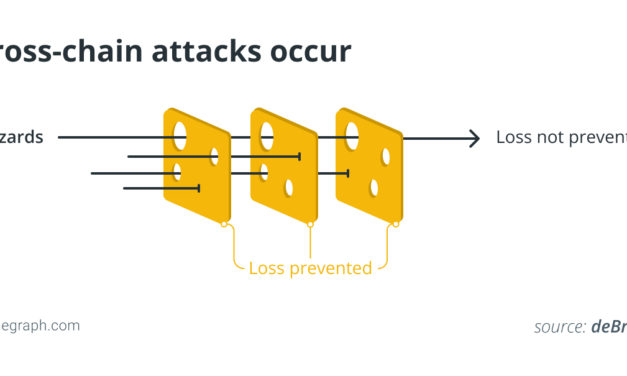
2022 has been a lucrative year for hackers preying on the nascent Web3 and decentralized finance (DeFi) spaces, with more than $2 billion worth of cryptocurrency fleeced in several high-profile hacks to date. Cross-chain protocols have been particularly hard hit, with Axie Infinity’s $650 million Ronin Bridge hack accounting for a significant portion of stolen funds this year.The pillaging continued into the second half of 2022 as cross-chain platform Nomad saw $190 million drained from wallets. The Solana ecosystem was the next target, with hackers gaining access to the private keys of some 8000 wallets that resulted in $5 million worth of Solana (SOL) and Solana Program Library (SPL) tokens being pilfered.deBridge Finance managed to sidestep an attempted phishing attack on Monday, Aug. 8, unpacking the methods used by what the firm suspects are a wide-ranging attack vector used by North Korean Lazarus Group hackers. Just a few days later, Curve Finance suffered an exploit that saw hackers reroute users to a counterfeit webpage that resulted in the theft of $600,000 worth of USD Coin (USDC).Multiple points of failureThe team at deBridge Finance offered some pertinent insights into the prevalence of these attacks in correspondence with Cointelegraph, given that a number of their team members have previously worked for a prominent anti-virus company.Co-founder Alex Smirnov highlighted the driving factor behind the targeting of cross-chain protocols, given their role as liquidity aggregators that fulfill cross-chain value transfer requests. Most of these protocols look to aggregate as much liquidity as possible through liquidity mining and other incentives, which has inevitably become a honey-pot for nefarious actors:“By locking a large amount of liquidity and inadvertently providing a diverse set of available attack methods, bridges are making themselves a target for hackers.”Smirnov added that bridging protocols are middleware that relies on the security models of all the supported blockchains from which they aggregate, which drastically increases the potential attack surface. This makes it possible to perform an attack in one chain to draw liquidity from others.Related: Is there a secure future for cross-chain bridges? Smirnov added that the Web3 and cross-chain space is in a period of nascence, with an iterative process of development seeing teams learn from others’ mistakes. Drawing parallels to the first two years in the DeFi space where exploits were rife, the deBridge co-founder conceded that this was a natural teething process:“The cross-chain space is extremely young even within the context of Web3, so we’re seeing this same process play out. Cross-chain has tremendous potential and it is inevitable that more capital flows in, and hackers allocate more time and resources to finding attack vectors.”The Curve Finance DNS hijacking incident also illustrates the variety of attack methods available to nefarious actors. Bitfinex CTO Paolo Ardoino told Cointelegraph the industry needs to be on guard to all security threats:“This attack demonstrates once again that the ingenuity of hackers presents a near and ever-present danger to our industry. The fact that a hacker is able to change the DNS entry for the protocol, forwarding users to a fake clone and approving a malicious contract says a lot for the vigilance that must be exercised.”Stemming the tideWith exploits becoming rife, projects will no doubt be considering ways to mitigate these risks. The answer is far from clear-cut, given the array of avenues attackers have at their disposal. Smirnov likes to use a ‘swiss cheese model’ when conceptualizing the security of bridging protocols, with the only way to execute an attack is if a number of “holes” momentarily line up.“In order to make the level of risk negligible, the size of the hole on each layer should be aimed to be as minimal as possible, and the number of layers should be maximized.”Again this is a complicated task given the moving parts involved in cross-chain platforms. Building reliable multi-level security models requires understanding the diversity of risks associated with cross-chain protocols and risks of supported chains.Chief threats include vulnerabilities with the consensus algorithm and codebase of supported chains, 51% attacks and blockchain reorganizations. Risks to the validation layers could include collusion of validators and compromised infrastructure. Software development risks are also another consideration with vulnerabilities or bugs in smart contracts and bridge validation nodes key areas of concern. Lastly, deBridge notes protocol management risks such as compromised protocol authority keys as another security consideration.“All these risks are quickly compounded. Projects should take a multi-faceted approach, and in addition to security audits and bug bounty campaigns, lay various security measures and validations into the protocol design itself.”Social engineering, more commonly referred to as phishing attacks, is another point to consider. While the deBridge team managed to thwart this type of attack, it still remains one of the most prevalent threats to the wider ecosystem. Education and strict internal security policies are vital to avoid falling prey to these cunning attempts to steal credentials and hijack systems.

Čítaj viac

1inch plugs into KuCoin Wallet to improve token swaps

Cryptocurrency exchange KuCoin will introduce native token swap functionality to its in-house wallet after integrating decentralized finance (DeFi) market maker 1inch’s application programming interface.1inch’s Pathfinder algorithm will increase the functionality of KuCoin Wallet, the exchange’s recently launched decentralized wallet platform, which features cross-chain trading, DeFi and nonfungible token (NFT) support.The algorithm will aggregate liquidity from over 250 sources from automated market makers (AMM) and proactive market makers (PMM) across the DeFi ecosystem. 1inch plugs into liquidity sources running on nine different blockchain networks, providing a wide range of tradable asset pairs.Related: DeFi market has room for growth in Korea: 1inch co-founder — KBW 2022The partnership will also afford KuCoin Wallet users access to 1inch’s Limit Order Protocol functionality. These orders are filled at a predetermined price once it is reached. This includes gasless limit orders for ETH, RFQ and other tokens that require permits rather than transaction approval.KuCoin Wallet head Jeff Haul noted that 1inch has established itself as a leader in the DeFi aggregator space and its functionality should improve KuCoin Wallet’s offering to its users:“Swap is a high-frequency feature of the wallet and 1inch is one of the most popular DEXes in the Web3 industry, so we’re working together through native integration to provide a smooth and cost-effective trading experience for our users.”KuCoin rolled out its browser-based self-custodial wallet in June 2022 and hinted at imminent support of DeFi, NFT and GameFi support. The original NFT functionality was powered by KuCoin’s proprietary NFT marketplace Windvane. The exchange earmarked a $150 million pre-series B fundraising round in 2022 to bankroll the development of Web3, DeFi and NFT services and offerings within its ecosystem.1inch continues to expand its footprint across the cryptocurrency ecosystem, sealing a pivotal partnership with South Korea’s burgeoning metaverse blockchain Klaytn in August 202.

Čítaj viac

Získaj BONUS 8 € v Bitcoinoch

nakup bitcoin z karty

Registrácia Binance

Burza Binance

Aktuálne kurzy