Autor Cointelegraph By Gareth Jenkinson

Post offices adopting NFTs leads to a philately renaissance

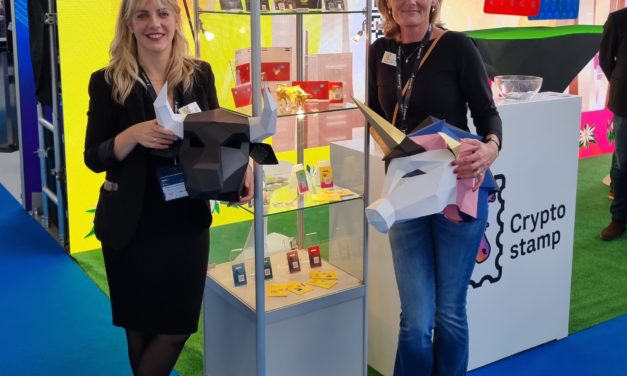
Philately? If you are a millennial, there is a good chance you used Google to find out that there is a word dedicated to collecting and studying postage stamps.This same search also paints the picture of a hobby in decline, as younger generations are increasingly preoccupied with their screens and the constant stream of dopamine hits served up by TikTok, Instagram, Twitter and other popular social media platforms.Two European postal services have looked to capitalize on the popularity of nonfungible tokens (NFTs) in recent years to reinvigorate the philately sector. Cointelegraph caught up with Netherlands’ PostNL and the Austrian Post Office (PostAG) at the Blockchain Expo in Amsterdam to delve into their collaborative effort that has successfully married post stamps with NFTs.PostAG philately head Patricia Liebermann and PostNL product manager Sacha van Hoorn are a vivacious duo that have kindled a working friendship that seems to be the backbone of the NFT-powered renaissance of post stamp collecting in both countries.Austrian Post Office (PostAG) Philately head Patricia Liebermann and PostNL product manager Sacha van Hoorn at the Crypto Stamp stand during the Blockchain Expo in Amsterdam.PostAG first explored the use of NFT post stamps in 2019 with real-world stamps issued with a digital twin NFT originally minted on the Ethereum blockchain. Over the next two years, Austria’s post office continued the project with near-field communication (NFC) chip functionality introduced in 2021 to further the functionality, verifiability and security of post stamps.Reflecting on the dimming interest in philately, Liebermann unpacked the initial idea and its quick uptake some three years ago:“In 2019, we invented the idea of having a physical stamp combined with an NFT, it was mind-blowing, and we were overwhelmed with all that feedback. And that’s why we said, okay, there is a target group out there who is interested in this new way of collecting.”Van Hoorn’s efforts to continue innovating PostNL’s post stamp offerings had already explored the use of augmented reality and artificial intelligence on stamps, but PostAG’s NFTs exploits led her to reach out to her Austrian counterpart. Knowing that development would take a significant amount of time and resources, a collaboration was formed:“So we actually decided to contact the Austrians because they were the first, and we really wanted to have their experience and their knowledge and ask them, how did you do it?”The partnership has culminated in a joint launch of a new edition of Crypto Stamps which is being labeled as a first-ever joint crypto stamp issuance. It is also the first edition of PostNL NFT stamps, with the stamps issued in a variety of respective colors of the Netherland and Austrian flags. The stamps also feature the respective countries’ national flowers, with tulips and edelweiss in the background of the PostNL and PostAG stamps.PostAG and PostNL Crypto Stamps on display at the RAI convention centre in Amsterdam.The physical stamps are produced by Austrian firm Varius Card, whose managing director Michael Dorner unpacked the latest security features in conversation with Cointelegraph. The fourth edition of the Crypto Stamps features invisible UV rays and forensic security. The NFC chips also provide cryptographic proof of any given stamp’s authenticity.Dorner also regaled recent conversations he had with older generation Austrians that were avid stamp users who were introduced to NFTs through PostAG’s Crypto Stamps. Unfamiliar with the digital collectibles, some grandparents inevitably asked their grandchildren to help them come to grips with the digital twin of their real world stamps.“They called up their grandchildren and said, ‘Do you know what an NFT is?’ and the grandchild says, ‘yes, what do you have?’ Suddenly they sat down together for dinner, they checked the crypto stamps and the kids were like, ‘Granddad, let’s check what color you have.’”All three individuals believe that the NFT-paired post stamps are leading to a philately renaissance, with Dorner describing the shift as the next generation of collectors:“Two generations with two completely different aspects come together, and they talk. And there’s you have this new community, you have this ‘collectors 3.0’. Like the young collectors, we all suddenly just started getting interested in stamps again.”These positive sentiments are also backed up by the popularity of each launch, with Dorner and Liebermann highlighting that all previous NFT-paired collections were completely sold out. While not giving an approximate number, Dorner estimated that 150,000 to 250,000 post stamps with NFT pairs had been sold since 2019 — suggesting the initiative could be one of the most successful NFT projects in the world. The latest edition of Crypto Stamps is minted on the Polygon blockchain.

Čítaj viac
UNICEF Giga NFTs to connect schools in developing countries to internet

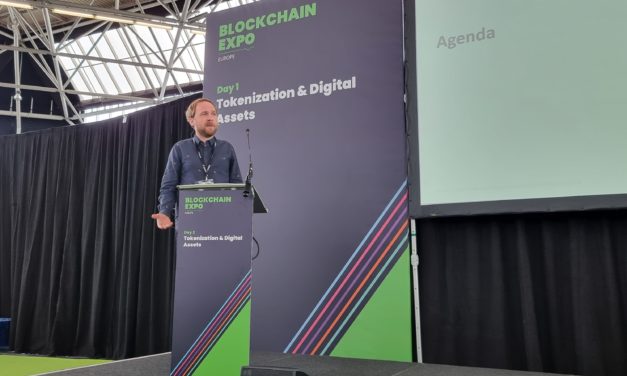
Developed countries often take for granted the ubiquity of the internet. But the reality is that some 2.9 billion people still don’t have connectivity to the world wide web.Data provided by UNICEF highlights that the majority of this internet-less mass of people reside in undeveloped countries, and children continue to be disadvantaged by the lack of internet connectivity at local schools.A UNICEF-led initiative is tackling this dilemma in a novel way through a joint venture with the International Telecommunication Union that led to the creation of Giga in 2019. Gerben Kijne, blockchain product manager at Giga, outlined the firm’s Project Connect initiative at the Blockchain Expo in Amsterdam. Giga has made strides in connecting schools to the internet in developing countries around the world.Gerben Kijne speaks about Giga’s Project Connect and its Patchwork Kingdoms NFT fundraising experiment at the Blockchain Expo in Amsterdam.The first step in this process was mapping schools and their connectivity through Project Connect. Giga uses machine learning to scan satellite images to identify schools on an open-source map. To date, it has pinpointed over 1.1 million schools across 49 countries and connectivity data for a third of these schools.Having identified a huge number of schools in need of internet accessibility, the next step in the process was creating a novel fundraising initiative tapping into the world of blockchain, cryptocurrencies and NFTs.Speaking to Cointelegraph after his keynote address at the RAI Convention Centre in Amsterdam, Kijne unpacked Giga’s Patchwork Kingdoms initiative. With NFTs surging in popularity over the past couple of years, Giga looked to make the most of the craze through its own NFT-led fundraising experiment in March 2022.Giga teamed up with Dutch artist Nadieh Bremer to launch a collection of 1000 procedurally generated NFTs minted on the Ethereum blockchain. The NFTs were produced using Giga’s school data to represent those with and without internet connectivity.The NFT public sale raised around 240 Ether (ETH) in totality, valued at $700,000, which went directly to connecting schools to the internet. Kijne conceded that the value raised was secondary to the exploration of a different kind of philanthropic fundraising.“I think NFTs also provide a really interesting use case. One of the things that we’re starting to look into is what does philanthropy look like for the next generation of people? Because if you go to UNICEF now and you donate, I don’t even know what you get, probably like a ‘thank you email’ or something.”Kijne believes that NFTs can provide a closer connection to donations, highlighting their use to track the impact of donations through the ownership of a specific school’s NFT and monitor when the funds raised are ‘cashed in’ to pay for internet connectivity.Many learnings were taken out of the NFT-based fundraising initiative. As Kijne reflected, building a community before the launch may well have helped boost support. As has been seen in the NFT space, community members play a role, but opportunistic NFT investors are always present and looking for a chance to profit from new launches.“I think quite a few people that sort of joined us, they formed one of two camps. We have the people we were aiming for, Giga supporters. Many bought their first NFT ever. Then the other group is people who are thinking, ‘Oh, a UNICEF NFT! Let me get on that.’”Despite that fact, the project was deemed a success and provides an intriguing use case for blockchain-based NFTs as a means of transparent, community-building fundraising. The public sale in March 2022 sold out in three hours and raised $550,000. The additional 20 percent of funds raised came from secondary sales on OpenSea.

Čítaj viac

Blockchain tech driving institutional-grade solutions: Blockchain Expo Europe

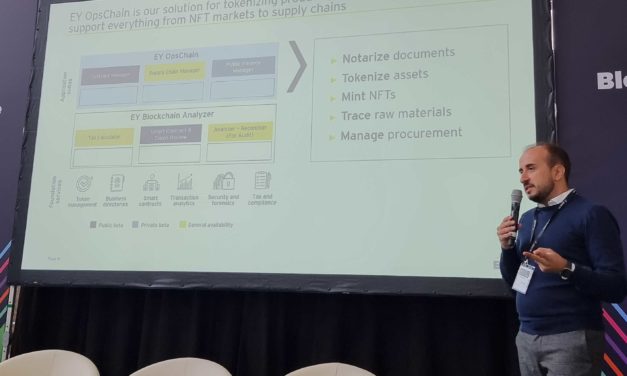
Blockchain is no longer a buzzword being thrown around by mainstream institutions as meaningful and fully-working pilots and programs come to the fore at Blockchain Expo Europe 2022 in Amsterdam.Before the Covid-19 pandemic, a number of mainstream companies from various industries started to explore ways blockchain technology could be used to improve processes and products.After two years of social distancing and working from home, the time to harvest the fruits of sewn seeds has arrived, as evidenced by some intriguing updates from major corporations utilizing blockchain technology.The world of business consulting, healthcare and pharmaceuticals and the energy sector are all delivering working, blockchain-powered solutions that have seemingly proved the broad spectrum of utility promised by the burgeoning technology.Cointelegraph was on the ground for the event and managed to touch base with a number of speakers who showcased how their firms were using the technology to drive innovation.EY, the global business consulting firm, has been working hard to build enterprise-grade blockchain capabilities over the past three years. Federico De Poli, who heads up the global development of the EY OpsChain functionality, outlined how the firm had spent over $100 million over the past three years building a fulling working product solution.Federico de Poli at Blockchain Expo Amsterdam.Driving enterprise adoption has been key, helping clients navigate a new environment, building privacy tools focused on safety and helping companies run business processes on the Ethereum blockchain.As De Poli explained, the company’s proprietary EY Opschain and EY Blockchain Analyzer are two main tools using blockchain technology. “Opschain products is our business suite of products. We have traceability which is our most used tool which is being used in production by several clients in different industries. We have a contract manager which is being used in a first trial – it’s a tool which helps us do digital contracting between parties.”EY’s public finance manager also allows governments to track the expenditure of funds, proving the widespread useability of blockchain solutions.Healthcare and pharmaceutical firms also attended the RAI Amsterdam Convention center. Alex Popa, associate director of Blockchain for Pharma Supply Excellence, MSD (Merck), outlined a pilot that was aimed at addressing problems with multi-faceted healthcare networks. Alex Popa at Blockchain Expo Amsterdam.Plagued by expensive, inefficient and vulnerable systems, blockchain technology provides practical solutions to these problems. MSD has operated a pilot to combat a vexing industry issue, counterfeit drugs, using Hyperledger Fabric which allowed patients in Hong Kong to verify medicines’ authenticity from their source.Jessica Lee, head of Blockchain for Johnson & Johnson’s Janssen Commercial North America, also showcased a piloted use case for a value-based health care system to share data privately, securely and transparently using blockchain technology.Sabine Brink, blockchain lead at Shell, gave a compelling presentation focused on digital innovation in the energy sector. A key takeaway was the growing use of blockchain technology to drive transparency in energy.Sabine Brink at Blockchain Expo Amsterdam.The firm is engaged in several blockchain-powered projects deployed on public blockchains to address a long-standing propensity for the energy sector to work in silos. A key highlight was Shell’s work supporting Avelia, a sustainable, blockchain-powered aviation fuel tracing aimed at decarbonizing air travel.Outlining that 90 percent of airline emissions are attributable to business travel, Avelia acts as sustainability as a service product for corporate flyers and airlines to book and claim sustainable aviation fuel.”Energy is becoming distributed and decentralized, and it’s hard to imagine it’s being orchestrated in a centralized way. There is no other way to get it done on a global scale, and blockchain has a huge role.”Conversations with conference delegates and speakers highlighted the apparent strides made in developing working blockchain solutions across industries. The technology has driven innovation across industries, and mainstream companies are doing their part to drive new use cases and solutions for blockchain-based systems.

Čítaj viac

ETHW confirms contract vulnerability exploit, dismisses replay attack claims

Post-Ethereum Merge proof-of-work (PoW) chain ETHW has moved to quell claims that it had suffered an on-chain replay attack over the weekend.Smart contract auditing firm BlockSec flagged what it described as a replay attack that took place on Sept. 16, in which attackers harvested ETHW tokens by replaying the call data of Ethereum’s proof-of-stake (PoS) chain on the forked Ethereum PoW chain.According to BlockSec, the root cause of the exploit was due to the fact that the Omni cross-chain bridge on the ETHW chain used old chainID and was not correctly verifying the correct chainId of the cross-chain message.Ethereum’s Mainnet and test networks use two identifiers for different uses, namely, a network ID and a chain ID (chainID). Peer-to-peer messages between nodes make use of network ID, while transaction signatures make use of chainID. EIP-155 introduced chainID as a means to prevent replay attacks between the ETH and ETC blockchains.1/ Alert | BlockSec detected that exploiters are replaying the message (calldata) of the PoS chain on @EthereumPow. The root cause of the exploitation is that the bridge doesn’t correctly verify the actual chainid (which is maintained by itself) of the cross-chain message.— BlockSec (@BlockSecTeam) September 18, 2022BlockSec was the first analytics service to flag the replay attack and notified ETHW, which in turn quickly rebuffed initial claims that a replay attack had been carried out on-chain. ETHW made attempts to notify Omni Bridge of the exploit at the contract level:Had tried every way to contact Omni Bridge yesterday.Bridges need to correctly verify the actual ChainID of the cross-chain messages.Again this is not a transaction replay on the chain level, it is a calldata replay due to the flaw of the specific contract. https://t.co/bHbYR4b2AW pic.twitter.com/NZDn61cslJ— EthereumPoW (ETHW) Official #ETHW #ETHPoW (@EthereumPoW) September 18, 2022

Analysis of the attack revealed that the exploiter started by transferring 200 WETH through the Omni bridge of the Gnosis chain before replaying the same message on the PoW chain, netting an extra 200ETHW. This resulted in the balance of the chain contract deployed on the PoW chain being drained.Related: Cross-chains in the crosshairs: Hacks call for better defense mechanismsBlockSec’s analysis of the Omni bridge source code showed that the logic to verify chainId was present, but the verified chainID used in the contract was pulled from a value stored in the storage named unitStorage. The team explained that this was not the correct chainId collected through the CHAINID opcode, which was proposed by EIP-1344 and exacerbated by the resulting fork after the Ethereum Merge:“This is probably due to the fact that the code is quite old (using Solidity 0.4.24). The code works fine all the time until the fork of the PoW chain.”This allowed attackers to harvest ETHW and potentially other tokens owned by the bridge on the PoW chain and go on to trade these on marketplaces listing the relevant tokens. Cointelegraph has reached out BlockSec to ascertain the value extracted during the exploit.Following Ethereum’s successful Merge event which saw the smart contract blockchain transition from PoW to PoS, a group of miners decided to continue the PoW chain through a hard fork. 

Čítaj viac

The Ethereum Merge is completed: Here's what's next

The Ethereum blockchain has successfully completed its shift away from proof-of-work to proof-of-stake (PoS) consensus following the merge of the Mainnet and the Beacon Chain.The Merge took place on Sep.15 as the network shifted to PoS seamlessly, seeing hardware-based miners replaced by validators that stake Ether (ETH) to process transactions, add new blocks and maintain the network.The most pertinent question in the cryptocurrency space is, what happens next? The Ethereum Foundation has always worked on a long roadmap of development milestones, and The Merge is no different.Happy birthday beacon chain!Here’s an updated roadmap diagram for where Ethereum protocol development is at and what’s coming in what order.(I’m sure this is missing a lot, as all diagrams are, but it covers a lot of the important stuff!) pic.twitter.com/puWP7hwDlx— vitalik.eth (@VitalikButerin) December 2, 2021Ethereum’s co-founder Vitalik Buterin previously outlined a five-step, gradual process that will bring the smart contract blockchain to what he described as the ‘Endgame’ of Ethereum’s development. [embedded content]The end goal would see the network capable of high block frequency and block size as well as the ability to process thousands of transactions per second while remaining sufficiently trustless and censorship-resistant. The MergeThe Merge was the first step in this five-part process, which has since been elaborated upon by a number of Ethereum developers, ecosystem participants and commentators. The key change of the Merge is the drastic reduction in power consumption, reducing Ethereum’s energy usage by 99%.Hours before the Merge took place, Buterin quoted Ethereum researcher Justin Drake’s estimate that the event would also reduce global electricity consumption by 0.2%.”The merge will reduce worldwide electricity consumption by 0.2%” – @drakefjustin— vitalik.eth (@VitalikButerin) September 15, 2022

The second important change brought about by the shift to PoS is the reduced issuance of ETH through rewards to validators for their work maintaining the network, making ETH become a deflationary asset. The Surge2023 is earmarked as the year that Ethereum will implement sharding, an important step in increasing the scalability of the blockchain’s ability to store and access data. The Ethereum Foundation describes sharding as the process of separating a database horizontally to spread the network’s workload. Ethereum will use sharding in synergy with layer-2 rollups by splitting the large amount of data across the network. This is envisaged to reduce network congestion and increase transactions per second. It’s the decentralized alternative to making a database bigger, alleviating the need for validators to store all of the network’s data themselves which would require powerful hardware.It also means that the average user could run an Ethereum node or clients on personal devices such as PCs and mobile devices, making the network more robust due to its increased decentralization.The Verge, Purge and SplurgeThe last three steps in Ethereum’s ongoing development following the Merge are set to take place over the next few years.The verge is the third part of Ethereum’s ongoing roadmap outlined by Buterin. Without getting too technical, this step will involve the introduction of verkle trees, which will optimize data storage and node size.As Buterin explained in a deep dive in June 2021, verkle trees serve a similar function to merkle trees, which total all transactions in a block and produce proof of the entire set of data for a user looking to verify its authenticity:“The key property that Verkle trees provide, however, is that they are much more efficient in proof size.”The cryptography is slightly more complicated, but Buterin highlighted that the reduction in data size of proof would be sufficient to make stateless clients viable.The Purge will involve removing spare historical data in an effort to alleviate network congestion by purging superfluous data. This will essentially reduce the amount of data needed to be stored by a validator, with Buterin touting this step to allow the network to handle around 100,000 transactions per second.What else should I know?As Cointelegraph previously explored, stakers looking to become full validators of the Ethereum blockchain have to commit 32 ETH in order to do so. A common misconception was that these stakers might remove their staked ETH once the Merge was complete.To ensure network stability, validators will only be able to withdraw their staked ETH once the Shanghai upgrade takes place, which is earmarked to take place in the next 12 months. Validators can also receive fees for processing transactions (miner extractable value) – which are credited to their non-staking validator account. 

Čítaj viac

Získaj BONUS 8 € v Bitcoinoch

nakup bitcoin z karty

Registrácia Binance

Burza Binance

Aktuálne kurzy