Autor Cointelegraph By Gareth Jenkinson

Report: On-chain data points to crypto consolidation in Q3

A third quarter industry report from DappRadar citing on-chain metrics suggests cryptocurrency markets are showing signs of recovery from ongoing bearing market conditions.A number of factors played their part in a busy third quarter of 2022, with Ethereum’s Merge marking a successful shift to proof-of-stake having a notable influence on layer 2 activity before the event. The report also highlights a slight recovery in the overall cryptocurrency market capitalization, which still sits below the $1 trillion mark.Third-quarter data reflected an 8.5% increase in the total crypto market cap from July to the end of September 2022. The decentralized finance space also showed signs of consolidation, with the total value locked (TVL) in the space increasing by 2.9% in the third quarter to $69 billion. Ethereum continues to account for the bulk of TVL, with $48 billion locked in smart contracts.DappRadar also highlights a 12% increase in unique active wallets across the cryptocurrency ecosystem quarter-on-quarter, adding up to 1.8 million. The blockchain gaming sector contributed significantly, with unique wallet addresses increasing by 8% from August to September.ImmutableX saw its unique active wallets grow by 30% during the same time period and recorded an 87% growth in nonfungible tokenNFT trading volume from the previous quarter while Polygon followed a similar trajectory, seeing its unique active wallets increase by 17% to 148,000.The number of nonfungible token (NFT) trades increased by 11% from the second quarter of 2022 while Ethereum’s NFT trading volume was down by a large margin of 76%. The NFT trading volume totaled $2.71 billion during the third quarter, which still marks a significant 67% drop from Q2 2022.Related: Blockchain gamers surge as users attempt ‘stacking crypto’ — DappRadarYuga Labs-owned NFT projects dominated the market in September, with Otherside, Bored Ape Yacht Club, Mutant Ape Yacht Club, and CryptoPunks accounting for 46.21% of the entire NFT market cap.The theft of cryptocurrency assets was also highlighted once again, with blockchain bridges still being targeted. DappRadar listed the $190 million Nomad exploit in August as a significant contributor to the $461 million worth of crypto assets stolen in Q3. Algorithmic market maker Wintermute also succumbed to a $160 million exploit during the same period.The DappRadar report also highlights the effect of wider macroeconomic factors on the global economy. As central banks look to manage inflation to stave off recessionary effects by raising interest rates:“Current macroeconomic conditions significantly influence the crypto market, making it impossible to foresee a worldwide expansion of cryptocurrencies without a general recovery in conventional financial markets.”This slightly gloomy outlook was countered by a number of positive events during the third quarter of 2022. The European Union’s approval of the Markets in Crypto-Assets (MiCA) regulatory plan indicates that governments are looking to manage the industry carefully.Similarly, the White House published the “First-Ever Comprehensive Framework for Responsible Development of Digital Assets” in Septe 2022 in a bid to protect investors that indicates that cryptocurrencies have become a fully-established industry.

Čítaj viac
Man and Machine: Nansen’s analytics slowly labeling worldwide wallets

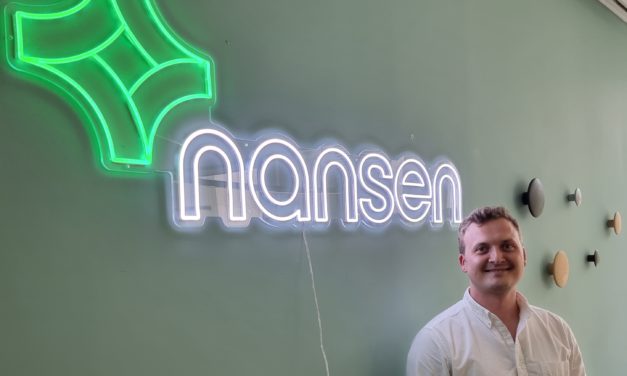
Public blockchains can be accessed and read by anyone but creating meaningful insights from this data is no mean feat. Millions of transactions are recorded across a variety of chains and layer-2 protocols, creating petabytes of data daily.Services like Google transformed the early internet, accomplishing a significant engineering task by structuring and curating millions of websites to serve simple user queries. A handful of blockchain analytics platforms are looking to do the same, with Nansen distinguishing itself by processing on-chain data into a growing database of wallet labels.Cointelegraph visited the Singapore office of the growing firm during Token2049 for a one-on-one with co-founder and CEO Alex Svanevik. Occupying a dedicated space in a co-working environment, the office was a buzz with employees that were in town from the company’s hubs in Lisbon, Miami, London and Bangkok.Svanevik’s background is rooted in artificial intelligence. Graduating from the University of Edinburgh in 2010, the Norwegian’s dissertation focused on building models based on how children learn mathematics. His first foray into the world of work involved the establishment of a business-focused AI consultancy before moving into management consulting.Nansen CEO and co-founder Alex Svanevik chats to Cointelegraph at their office in Singapore during Token2049 in September 2022.A stint as a data scientist for a media company preceded his eventual move into the world of cryptocurrencies, as Svanevik was introduced to Ethereum in 2017. His first job for a cryptocurrency firm bankrolled by a $15 million initial coin offering lasted about a year, as the company became one of many to boom and bust post-2017.Svanevik, Lars Krogvig and Evgeny Medvedev then teamed up to create Nansen AI, eyeing a gap in the market for an on-chain analytics tool aimed at investors:“On the one hand, you had the free tools that all crypto investors had access to like Coinmarketcap and Etherscan and then on the other extreme, you had very expensive tools that were used exclusively by enterprises like Chainalysis.”Nansen was formed in late 2019 to provide high-caliber analytics tools to investors delivering blockchain data and insights in real-time. Svanevik admitted that the platform originally attracted sophisticated cryptocurrency traders with large holdings but has since evolved to have a 50/50 split of retail and institutional users: “We started with what you might call the ‘DeGens’ right before DeFi summer. A lot of them were using Nansen to navigate DeFi summer, which DeFi pools should you allocate your capital to, which tokens should you buy and so on.”The ongoing cryptocurrency bear market, which is mirrored by traditional stock markets, leads Svanevik to believe that their sector will trend toward greater institutional use over the next two years. Individual investors may take a break from crypto and cut back on analytics services, but continued institutional investment efforts will demand data-driven insights:“There’s a lot of companies, funds, operators, blockchain and crypto projects where the businesses that raise money are doing fine from a financial perspective. They’re not just going to wind down their operations because crypto tanks 70% you know, they still need to have really high quality analytics and information.” Labeling wallets Nansen has slowly garnered a reputation for its wallet labeling efforts across the cryptocurrency ecosystem. Again, this hardware and labor-intensive endeavor is a testament to the platform’s joint AI and human efforts.Svanevik estimated that Nansen scans nearly a petabyte of data daily from the variety of chains it keeps tabs on. This also accounts for nearly 20% of the company’s running costs, with Svanevik describing Nansen as “Google Cloud maximalists,” with the computing service their infrastructure platform of choice since inception.Recent: What remains in the NFT market now that the dust has settled?This speaks to the fact that despite public blockchains being available to all and sundry, there is inherent value in bringing order to data and gleaning valuable information from it. This is where Svanevik drew parallels to the platform and what Google did with the wider internet:“If you think about Google as a search engine, every website is public, right? But this is a huge engineering task to actually structure, curate and serve up the relevant websites for your query. I think Nansen is somewhat analogous to that. But, we also have proprietary data that we enrich the public data with, which is kind of one of the things we’re known for.”Nansen has over 130 million addresses that it has labeled with additional information that is directly accessible from blockchains. This allows the average user to find out which addresses are held by notable entities like Binance, Alameda, Celsius and Hodlnaut, as Svanevik highlighted.When asked if the labeling feature was a focal point from the outset of Nansen’s existence, Svanevik noted that the first iteration of the platform was a database in which a user could look up addresses and get wallet labels:“We realized that that alone is not very helpful. You need to combine it with the transactional data and you need to have some kind of user interface, something that’s valuable.”The evolution of Nansen’s platform was a result of combining “man and machine” into processes and an architecture to compile the information. A network effect led to compounding returns, as identified wallets that have been labeled often lead to the identification of other wallets interacting with them. Ninety-nine percent of this work is still done by AI, while Nansen’s research team plays a role in connecting the dots for the remaining 1%.The labeling of wallets and individuals has also been a point of much debate in the wider cryptocurrency ecosystem. Privacy is an inherent value touted by blockchain technology, but the transparency of public blockchains means that analytics tools can now identify who is in control of specific assets and wallets.Svanevik said that Nansen is mainly focused on labeling projects and corporations rather than individuals, save for those that are deemed to be notable public figures:“We don’t really put a lot of effort into tagging individuals. If we do, it’s typically because they’re noteworthy. They’re founders of projects, imagine, you know, Do Kwon or Vitalik, these are notable public figures. And we think it’s in the public interest to have them labeled.”The Nansen co-founder also believes that the labeling of wallets belonging to major exchanges, institutions and individuals has led to people becoming more privacy-aware. Curating, compiling and serving up information in a convenient way is the goal, which in itself raises some ideological considerations:“There is a fundamental dilemma with transparency and privacy blockchain, and something that people should think about and be mindful of.”“Bad labels” vs “Good labels”Nansen is one of a handful of well-known analytics firms that is bringing sense and order to blockchain data. Distinguishing the product offering of these similar firms, Svanevik highlighted platforms like Chainalysis and its focus on tracking illicit use of cryptocurrency as a key difference from what Nansen focuses on:“So, Chainalysis tends to focus on illicit use of funds. What you might consider ‘bad labels.’ This is sanctioned, this is a scam, and so on. Whereas Nansen tends to focus on ‘good labels.’ This is a smart money address that you might want to follow because they made good investment decisions in the past, that this is a fund you might want to know about and so on.”Given that 99% of cryptocurrency transactions are above board, Nansen chose to focus on crypto-native investors and operators while market participants like Chainalysis, Elliptic and PRM Labs cater more toward public institutions and government agencies.Nevertheless, Nansen has played its part in analyzing major cryptocurrency events, including its role in tracing token movements linked to major firms during the infamous Terra crash in April 2022:“Luna is one example where we had the labeled Terra data and we had Ethereum data to complement it because of the wrapping of Luna and the curve pools which actually triggered the collapse of Terra USD. But, also things like Hodlnaut and their involvement in it and our ability to look into that.”Nansen’s tools and its recently launched research department helped journalists at Tech in Asia to piece together questionable practices by Hodlnaut, one of a number of cryptocurrency lending firms that shuttered in the wake of the Terra collapse in 2022.Settled in SingaporeCointelegraph’s in-depth conversation with Svanevik concluded with his take on Singapore as a cryptocurrency hub of Asia. Token2049 attracted thousands of attendees and certainly left the impression that the island nation, with its towering skyscrapers and futuristic buildings, is a center for the ecosystem.Svanevik believes Singapore is in a unique position to be one of the world’s crypto hubs for a few different reasons. First and foremost, the country is “a place where finance meets tech,” which is in contrast to its closest Asian contender, Hong Kong, which Svanevik highlights as more finance-oriented.Recent: Music NFTs a powerful tool to transform an audience into a communityRegulators in Singapore are also aware of this fact and having participated as a panelist at a recent Monetary Authority of Singapore event, Svanevik highlighted tight controls having both positive and negative effects:“In the time I’ve lived here, they have become more strict. They are not with open arms, inviting in everyone who does anything with crypto. So it is quite difficult to get a license here. There’s a long queue, they’ve received quite a fair amount of criticism for that.”While it’s a tough environment to set up shop, the Nansen CEO believes it puts the country in a good position to be a respected jurisdiction to operate out of.

Čítaj viac

Kim Kardashian pays SEC $1.26 million to settle EthereumMax charge

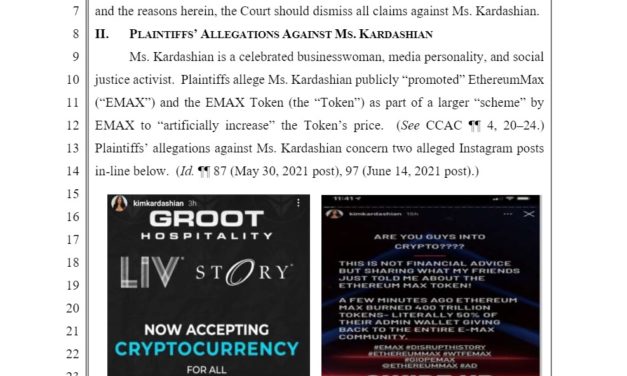
American socialite Kim Kardashian will pay $1.26 million in penalties for her involvement in the promotion of a cryptocurrency scheme called EthereumMax (EMAX).The United States Securities and Exchange Commission (SEC) announced the charges against Kardashian on Oct. 3 for “touting on social media a crypto asset security offered and sold by EthereumMax” without disclosing the payment received for her promotional involvement.Kardashian has agreed to settle the charges and pay $1.26 million in penalties, disgorgement and interest and is set to cooperate with further investigations by the SEC into the EthereumMax project.The announcement noted that Kardashian failed to disclose a $250,000 payment she had received to publish a post on her Instagram profile promoting EMAX tokens with a link to the project’s website.The order by the SEC finds that Kardashian violated the anti-touting provision of federal securities laws. This has been the case with other prominent cryptocurrency securities violations involving the SEC in the past. Kardashian neither admitted or denied the SEC’s findings but agreed to settle the charges. This was broken down into $260,000 in disgorgement as well as a $1 million penalty. Kardashian has also agreed to not promote any cryptocurrency assets until 2025.Today @SECGov, we charged Kim Kardashian for unlawfully touting a crypto security.This case is a reminder that, when celebrities / influencers endorse investment opps, including crypto asset securities, it doesn’t mean those investment products are right for all investors.— Gary Gensler (@GaryGensler) October 3, 2022SEC chairman Gary Gensler also used the order to advise the general public to do their due diligence when investing in cryptocurrency assets, while reminding celebrities and influencers of their obligation to disclose payments relating to promotions of securities. “This case is a reminder that, when celebrities or influencers endorse investment opportunities, including crypto asset securities, it doesn’t mean that those investment products are right for all investors. We encourage investors to consider an investment’s potential risks and opportunities in light of their own financial goals.”Kardashian’s legal team also filed a motion to set aside a class-action complaint aimed at the businesswoman and other American celebrities in August 2022. Kardashian and a handful of other prominent American social media influencers were served with a class-action complaint in January 2022 over claims they misled investors through the social media promotion EthereumMax.Kardashian posted Instagram stories promoting the project in June 2021, with the likes of boxing great Floyd Mayweather also embroiled in the lawsuit after promoting the Ethereum-based token in the build-up to a celebrity boxing bout against YouTuber Logan Paul during the same period.Fans could purchase pay-per-view tickets with the token, which surged after the promotion by Kardashian and other influencers. The value of EthereumMax dropped significantly afterward, leaving many out of pocket.The original court filing that listed Kardashian, Mayweather and eight others claimed that company executives had collaborated with celebrity promoters to make misleading statements about the token and their control of the majority of tokens. Steve Gentile and Giovanni Perone were listed as co-founders of the project.

Čítaj viac

F1's Daniel Ricciardo cruises into crypto at Token2049

McLaren’s Australian driver Daniel Ricciardo sat down with Cointelegraph during the Token2049 conference in Singapore, discussing his recent involvement in crypto ahead of the 2022 Singapore Grand Prix. Alongside OKX CMO Haider Rafique, the duo delved into a new partnership between McLaren Racing and the crypto exchange, exploring a variety of entertaining marketing moves between the two brands.Ricciardo featured in a new OKX advert launched earlier this year standing alongside the McLaren MCL36 F1 racing car while his “spirit animal” honey badger sat in the cockpit of the vehicle. The tongue-in-cheek advert highlights the relatively unknown status of the cryptocurrency world, which continues to seek avenues to drive wider adoption of the space.This was a fun one with @okx. I wanted to take home the honey badger pic.twitter.com/pToUqgiBgK— Daniel Ricciardo (@danielricciardo) September 28, 2022As the first point of order, Ricciardo admitted that he’d first explored the world of cryptocurrencies in 2021 and told Cointelegraph that friends had first piqued his curiosity.“Last year I first got involved, I got my OKX wallet and it was really through a lot of curiosity. A lot of my friends were into it and then through the relationship with the team I got on board and I’m learning every day,” he explained. Formula 1 drivers are known for their propensity to push the boundaries in various aspects of their life and Ricciardo joked that his foray into crypto accelerated fairly quickly. The 33-year-old said he was trying to increase his knowledge of the space and saw the value of diversification that cryptocurrency markets offer.“I was actually starting to get pretty involved to a point where a few people on my team were like ‘alright you spending a bit too much time on here.’ It’s great and I am certainly curious in terms of diversification and trying to understand more about the space.”OKX meanwhile has explored creative marketing efforts through the multi-year partnership with McLaren, announcing a livery takeover for the next two stops on the F1 calendar. Bold, orange OKX branding is front and center for the Singapore and Japan Grand Prix races and Ricciardo believes the efforts will draw more fans into the world of cryptocurrencies.Behold the MCL36 in #FutureMode. To celebrate our partnership with @OKX we’ll be racing at the #SingaporeGP and the #JapaneseGP in a bespoke livery. — McLaren (@McLarenF1) September 27, 2022

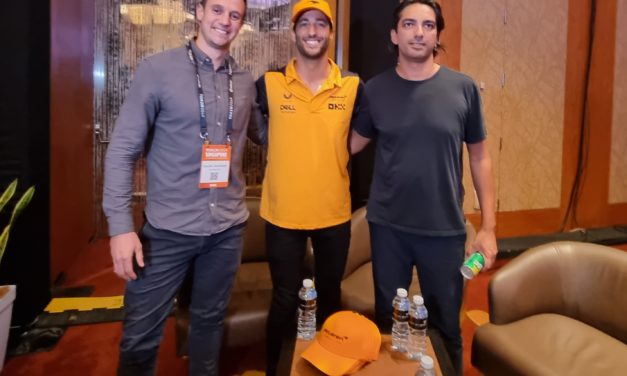
Ricciardo said the new livery in Singapore and Japan is about “fan engagement” and bringing them on board. “OKX is at the forefront, like we are with Formula 1, trying to innovate and be forward-thinking. It’s cool, I think this it’s the first time this has been done with a livery takeover,” he saidCointelegraph’s Gareth Jenkinson alongside F1 driver Daniel Ricciardo and OKX CMO Haider Rafique at Token2049 in Singapore.Rafique highlighted synergies between the cryptocurrency industry and Formula 1, with the “velocity of innovation” from the sport in parallel with the speed at which the blockchain and cryptocurrency ecosystem has continued to develop:“Ultimately the fun that we are all having comes from being creative together. Just with this livery the two design teams worked really closely together and we’re just so excited we got to work with the McLaren F1 team, with Daniel and now we have this amazing design that we’re excited for the world to see.”Formula 1 marks its return to the Singapore street circuit for the first time since 2019. The build-up to the race has coincided with the Token2049 conference, with the street circuit slowly being pieced together until full road closures took effect on Sept. 29. Before Covid-19, Ricciardo had enjoyed success at the track and hopes to emulate his previous podium finishes in the city:“It’s good to be back, 2019 was the last time and I’ve always loved street circuits and before it’s all up you’re on the track trying to figure it all out because it does look different when it’s not all put together. I’m really happy to be back, I’ve had some podiums here in the past so let’s just say I am coming in hot.”Formula 1 continues to attract marketing and advertising deals with the biggest firms in the world of cryptocurrencies. OKX was the latest cryptocurrency exchange and trading platform to pen a deal with a major team, signing up as the primary partner of McLaren in May 2022.

Čítaj viac

Pantera CEO bullish on DeFi, Web3 and NFTs as Token2049 gets underway

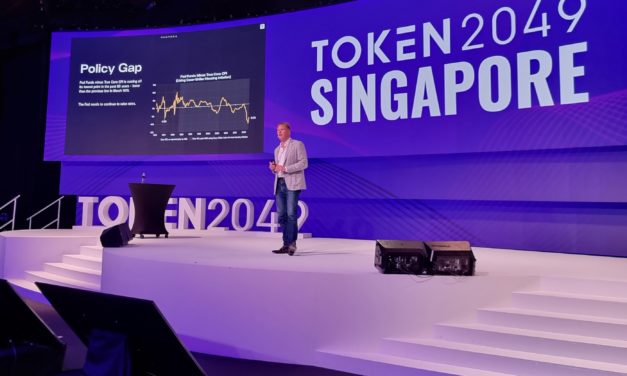
Pantera CEO Dan Morehead highlighted the potential growth and value of Decentralized Finance (DeFi), Web3 functionality, nonfungible tokens (NFTs) and Metaverse applications in his opening keynote speech at Token2049 in Singapore.Thousands of attendees converged on Wednesday at the Marina Bay Sands Convention Center for the start of the two-day conference which features prominent speakers from the cryptocurrency and blockchain ecosystem.Pantera, a blockchain-focused investment fund with $4.5 billion of assets under management, said it continues to see value in emerging crypto use cases. Morehead drew parallels to the early 2000s when emerging technology companies like Amazon, Apple, and Google began to attract major investments after years of dominance by Microsoft in the stock markets.Pantera Capital CEO and founder Dan Morehead.Morehead highlighted that while Bitcoin (BTC) and Ethereum (ETH) dominated investors’ cryptocurrency portfolios over the past decade, he argued that new projects and use cases could promise even greater returns on investment.“We’re almost at the point where half of the entire market are things that aren’t the two main blockchains and I’m still wildly bullish on Bitcoin and Ethereum. But I just think these projects are going to perform even better and should be in someone’s portfolio.”DeFi, Web3, NFTs and Metaverse projects hold the most promise according to Morehead. The Pantera CEO also mused over the state of DeFi, which endured a tough few months following the Terra/Luna collapse and the contagion of now-defunct lending firms. Related: Pantera to close Blockchain Fund soon after raising $1.3B — double the targetMorehead suggested that DeFi’s current command of a $20 billion market cap in comparison to the traditional finance system’s $3 trillion means there is plenty of room for growth in the sector. The CEO was also bullish about Web3 given its focus on giving users control of their data, as well as platforms owned or governed by communities rather than centralized entities.“The existing internet is all about extracting value out of you. There are also some sketchy governance issues in big tech. I’m excited for a world where people create and add value and all these networks actually own their data.”Morehead went as far as describing Web3 as the most inevitable trade he’s seen, highlighting the potential for decentralized versions of existing projects to hand value back to creators and users.The Pantera CEO concluded his presentation by underlying his belief that the current cryptocurrency market cycle is different from previous years given strong fundamentals, pointing to some 200 million people that use blockchain-based platforms and cryptocurrencies, which could increase to one billion in the next three years.

Čítaj viac

Získaj BONUS 8 € v Bitcoinoch

nakup bitcoin z karty

Registrácia Binance

Burza Binance

Aktuálne kurzy