Autor Cointelegraph By Felix Ng

Bitget CEO suspects North Korea behind $352M hack, citing IP clues

Bitget CEO Gracy Chen said North Korean hackers may be behind the exchange’s $351.6 million security breach on Thursday, citing preliminary findings linking IP addresses to VPN services used by a North Korean group. Speaking during a live Q&A following the incident on X, Chen said security investigators had flagged similarities with previous North Korean attacks. She said the exchange did not believe the breach was an inside job. “We’ve identified some IP addresses that match the VPN choices by a certain DPRK group,” Chen said, referring to the Democratic People’s Republic of Korea.North Korean hackers were linked to an estimated $2.02 billion in crypto theft in 2025, including the roughly $1.5 billion Bybit exchange hack, which the FBI attributed to North Korea. Bitget CEO Gracy Chen hosts a live broadcast on X hours after the hack. Source: Bitget“The pattern looks very much like what the North Korean team did before,” she said.Chen also disclosed that hackers breached Bitget’s systems and transferred funds directly, rather than forging user withdrawal requests.“They did not forge user withdrawal requests, nor did they obtain our private keys of the cold wallet and any hot, warm wallet,” she said. Chen said investigators were still determining which systems were compromised and how the attackers gained access.Related: Bitget confirms $352M security breach, suspends withdrawalsThe comments come after Bitget reported unauthorized transfers affecting portions of its hot and warm wallet infrastructure on Thursday. Withdrawals remain suspended at the time of publication.During the Q&A, Chen also said some stolen funds had been recovered, without specifying an amount. She said the exchange was working with blockchain foundations and other partners on recovery efforts.Magazine: Asia dominates Crypto Adoption Index, Bitget’s $351M hack: Asia ExpressCointelegraph is committed to independent, transparent journalism. This news article is produced in accordance with Cointelegraph’s Editorial Policy and aims to provide accurate and timely information. Readers are encouraged to verify information independently.

Čítaj viac

Bitcoin’s ‘last resort’ quantum-safe solution just got 79% cheaper: StarkWare

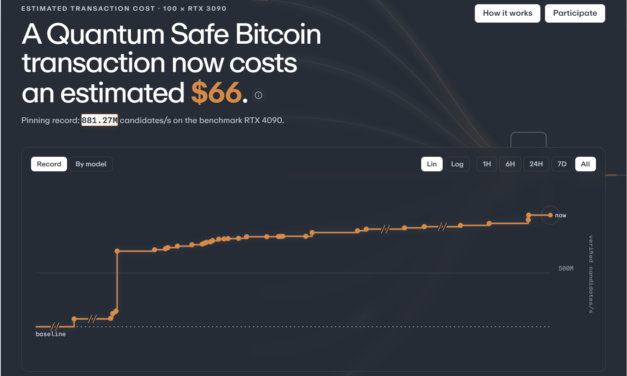
The estimated computational cost to prepare a quantum-resistant Bitcoin transaction has fallen below $67 after a week of optimization, down from the roughly $320 spent on the first such mainnet transaction in August, according to StarkWare. The results came after participants in the Quantum-Safe Bitcoin Optimization Challenge found ways to push down the GPU computation needed to build a quantum-safe Bitcoin transaction. The reduction could make the experimental defense (which doesn’t require changes to the network’s consensus rules) against future quantum attacks more practical for Bitcoin holders. However, the latest optimizations have only been demonstrated in benchmark tests. “A construction that costs a few hundred dollars per transaction is a demo. One that costs $67 is closer to something a holder with a large unexposed balance might reach for in an emergency,” StarkWare wrote in its Sept. 23 update. The dashboard now shows the estimated cost has dropped to $66. Quantum-Safe Bitcoin an “emergency” solutionStarkWare researcher Avihu Levy published the Quantum-Safe Bitcoin (QSB) design in April, outlining a way to add hash-based protection against quantum attacks without changing Bitcoin’s consensus rules. At the time, he described it as a “last resort measure” due to costs, complexity and limited applicability, while continuing to advocate for protocol-level changes. The estimated cost fell by another dollar since publication. Source: YukonAccording to StarkWare, the first QSB transaction was mined and confirmed on Aug. 26, with engineering work from Tomer Giladi and direct submission through MARA’s Slipstream service. Preparing it required approximately 3,100 GPU-hours across roughly 100 GPUs, at a compute cost of about $320, excluding Bitcoin network fees.Related: Crypto’s first quantum attack will look like unexplained breach: Quantus founderTo find ways to bring that cost down, StarkWare, Yukon Research and Eigen Labs launched the QSB challenge on Sept. 16, inviting developers, researchers and AI agents to make the transaction-building software faster and more efficient. In its latest update, StarkWare said the challenge produced 62 accepted improvements across two computational tasks needed to prepare a QSB transaction. According to StarkWare, this ended up cutting the estimated computing cost by about 79%, based on benchmark tests.The development comes amid increasing concern that a sufficiently powerful quantum computer could break the elliptic-curve digital signatures used by Bitcoin, potentially allowing attackers to steal coins whose public keys are exposed. Researchers are developing quantum-resistant protections, including QSB. However, StarkWare said it still favors a soft fork — a change to Bitcoin’s consensus rules — as a better “long-term answer” for broad quantum protection on Bitcoin.Magazine: A quantum roadmap would push Bitcoin much higher: Charles Edwards

Čítaj viac

Kalshi says CFTC hasn’t contacted it over ‘unusual’ $5B trading activity

Prediction markets operator Kalshi said it has not been contacted by the Commodity Futures Trading Commission and does not believe there is any formal examination, after a report that the regulator was reviewing a flurry of trading activity in its Ether perpetual futures market. On Tuesday, The Wall Street Journal reported that the CFTC is examining a pattern of rapid trades clustered around $5,500, citing a person familiar with the matter. The trading pattern has prompted allegations of wash trading. The scrutiny comes as Kalshi has reported rapid growth in its perpetual futures business. A week after launching its perpetual futures markets in May, the company told CNBC that trading volume had surpassed $1 billion.Elisabeth Diana, head of communications at Kalshi, described the discourse as “rumors seeded by competitors.” “We have not been contacted by the CFTC and don’t believe there is any formal examination,” Diana told Cointelegraph. “As we’ve said, these data patterns are typical of liquidity incentive programs and common in financial markets. Don’t believe everything you read on X.”Cluster of trades on Ether perpetual futuresThe trades took place in one of Kalshi’s markets for perpetual futures, where users speculate on the price of an asset without buying it; in this case, the price of Ether. The trades of roughly $5,500 each accounted for over $5 billion in Ether perp volume over the past month, according to the Journal. The Journal also reported that Kalshi offered some traders opportunities to buy equity in the company if they met trading-volume targets, citing people familiar with the arrangements. It also said the company waived trading fees and provided monthly cash payments to encourage large traders to provide liquidity. In a blog post on Wednesday, Kalshi attributed the repeated trade sizes to programs that pay market makers to keep buy and sell orders available at specified sizes and at a set price range. It said those payments reward the availability of orders, not the volume of trades executed. The post did not directly address the equity-purchase opportunity tied to trading volume targets as reported by the Journal. Kalshi denies wash trading claimsMarket makers help financial markets function by continuously quoting prices at which they are willing to buy and sell an asset, giving other traders ready counterparties to trade with. Market makers can profit from the difference between their buying and selling prices, but risk losses if prices move against them. Traders who accept their quoted prices are known as takers.Related: Kalshi joins Coinbase with own filing for US stock perpetual futuresKalshi said traders could profit when prices changed on other exchanges by buying or selling at a market maker’s outdated price. “The fixed size trades are entirely consistent with a single maker putting up resting orders of a fixed size and getting traded against by many takers,” Kalshi said.It said the trades involved hundreds of distinct traders taking a market maker’s orders, with the takers “pretty consistently right” and the maker “pretty consistently wrong.”“This is a sign of genuine economic activity rather than wash (where you’d expect volume to increase without either side taking a profit/loss),” Kalshi said. Magazine: Winners and losers of the SEC’s new tokenized stocks rules

Čítaj viac

Stablecoin cross-border flows surge 78%, defying crypto bear market

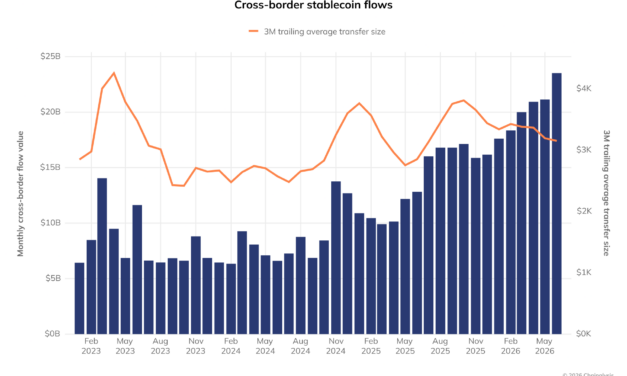
Crypto’s downturn over the last year has done little to slow stablecoins at the border, with cross-border stablecoin flows rising 77.5% in the year to June 2026 as the broader market lost more than a third of its value, according to new research from Chainalysis. In its newly released 2026 Global Crypto Adoption Index, Chainalysis said cross-border stablecoin flows rose 77.5% to $220.3 billion in the 12 months ending June 2026, from $124.2 billion in the previous 12-month period, despite total crypto market capitalization falling 37% to $2.1 trillion over the same period. “The bear market hit the price-sensitive half of crypto and left the payments half alone,” Chainalysis said.The growth points to increasing crypto demand beyond speculative trading. Stablecoins, which are designed to maintain a stable value, often against fiat currency, have gained a foothold in mainstream finance. The US signed the GENIUS Act into law in July 2025, while the European Union’s MiCA rules and Hong Kong’s issuer licensing regime have brought stablecoins further within formal financial oversight.Chainalysis said growth came from cross-border transfers averaging around $3,000, which is consistent with everyday use cases such as supplier payments, sending money home or moving savings out of volatile currencies. “Activity has become consistent, routed through wallets in a steady rhythm rather than in bursts,” Philip Gradwell, vice president of economics at Tether, told Chainalysis. “That is the signature of trade and business activity, not speculation.”Source: ChainalysisTianwei Liu, co-founder and CEO of StraitsX, told Cointelegraph that in Asia, fragmented currencies and payment systems have created demand for stablecoin settlement. “That demand is also extending into everyday spending, with stablecoins sitting behind payment methods people already use,” Liu said.However, outside of Asia, stablecoins address different needs, he said, including dollar access, remittances and protection against inflation or capital controls, such as across Latin America, Africa and the Middle East.  Related: Stablecoin growth could boost dollar dominance, US Treasury demand: BoE officialChainalysis tracked 4,708 new cross-border corridors during the reporting period, carrying a combined $2.64 billion. Each corridor represents a route between an originating and receiving country.Flows remained heavily concentrated in the top quarter of corridors, which accounted for 96.1% of measurable cross-border stablecoin value. The remaining three quarters carried $8.66 billion, up from $260 million in the previous period. Vincent Chok, co-founder and CEO of First Digital, told Cointelegraph that while traditional payment structure remains effective for established corridors, it becomes fragmented as businesses move money between markets with different banking systems, currencies and settlement hours. Stablecoins offer another option, he said, but it is still restrained by regulatory clarity, reliable redemption, access to local currencies and interoperability with existing financial systems. “Onchain settlement is fast, but it doesn’t solve the off-chain parts: converting to local currency, meeting compliance requirements, and moving funds through existing banking rails,” Chok said.Meanwhile, traditional remittance companies have expanded their stablecoin offerings this year.Western Union launched a stablecoin wallet and Visa-linked card across 37 markets in August, allowing users to hold and spend its branded US dollar-backed stablecoin. MoneyGram announced a similar card initiative in September, initially targeting Colombia, with additional markets planned later this year. Magazine: Kyle Samani predicts SOL flippening, claims ‘no one’ uses ETH

Čítaj viac

Získaj BONUS 8 € v Bitcoinoch

nakup bitcoin z karty

Registrácia Binance

Burza Binance

Aktuálne kurzy