Autor Cointelegraph By Felix Ng

FBI issues public warning over fake crypto apps

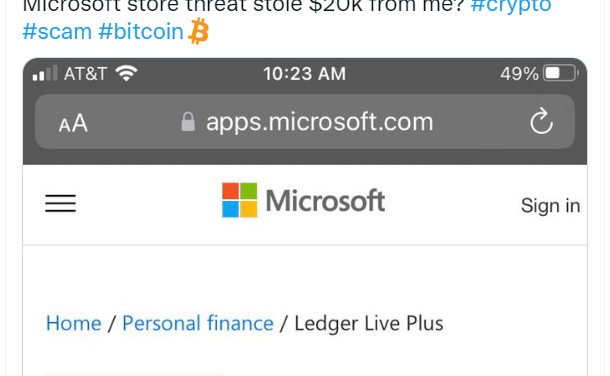
The Federal Bureau of Investigation (FBI) has issued a public warning about fraudulent cryptocurrency apps, which have swindled U.S. investors out of an estimated $42.7 million so far. According to an advisory published on July 18 by the securities and intelligence agency, cybercriminals have created apps using the same logos and identifying information as legitimate crypto companies to defraud investors. The FBI noted that 244 people had already fallen victim to these fake apps. One case saw cyber criminals convincing victims to download an app that used the same logo as an actual U.S. financial institution, encouraging them to deposit cryptocurrency into wallets purportedly related to their accounts. When victims attempted to withdraw from the app, they would be asked to pay taxes on their withdrawals. However, this was just another ruse to part more funds from victims, as even if they made the payments, the withdrawals would continue to be unavailable.Around $3.7 million was defrauded from 28 victims between December 2021 and May 2022, said the FBI. Another similar operation saw cybercriminals operating under the company name “YiBit”, defrauding at least four victims of around $5.5 million between October 2021 and May 2022, using a similar method of deceit. A third case involved criminals operating under the name “Supay” in November 2021. They defrauded two victims by encouraging them to deposit cryptocurrency into their wallets on the app, which would then be frozen unless more funds were deposited. Warnings about fraudulent apps have also made the rounds on crypto Twitter. One user said a friend recently fell victim to a scam that started on the online messenger service Whatsapp which encouraged the victim to download a fake crypto app and load funds into the app’s wallet. A week later, the crypto app vanished. Don’t get scammed. I recently had a friend fall for a #WhatsApp scam where they had her download a fake #crypto app, put some money in, and about a week later the app is gone and is NOWHERE to be found. Luckily she didn’t follow “instructions” and add more.— Sarvasatvananda (Aaron) (@crypto_or_die) July 17, 2022Another user says they have fallen victim to a fake Ledger Live crypto wallet app, reportedly called “Ledger Live Plus,” in the Microsoft app store. The user claims the fraudulent app has already stolen $20,000 from him. Earlier this year, cybersecurity firm ESET uncovered a “sophisticated scheme” that would distribute Trojan applications disguised as popular cryptocurrency wallets. These applications would then attempt to steal crypto assets from their victims. Related: More than $4.7M stolen in Uniswap fake token phishing attackLast year, a scam cryptocurrency app dressed up as a mobile Trezor app on Apple’s App Store reportedly led to one user losing $600,000 in Bitcoin at the time. A report from the United States Federal Trade Commission (FTC) in June 2022 found that as much as $1 billion in crypto has been lost to scammers since 2021, with nearly half of all crypto-related scams originating from social media platforms. The FBI has recommended crypto investors be wary of unsolicited requests to download investment apps, verify an app (and the company) is legitimate, and treat apps with limited and/or broken functionality “with skepticism.”

Čítaj viac


Jed McCaleb empties XRP wallet after eight-year selloff

Former Ripple Labs founder Jed McCaleb has finally ended the eight-year dump of his XRP holdings, leaving only 46.7 XRP left sitting in his famed “~tacostand” wallet. According to blockchain explorer XRP Scan, the former Ripple founder executed his last outgoing XRP transfer of 1.1 million XRP (worth $394,742.18) at 6:31 am (UTC) on July 17. Hours later, the account listed an “ACCOUNT DELETE” transaction, meaning the account will no longer exist on XRP’s ledger.The transaction marks the end of a 9 billion XRP sell-off initiated by McCaleb after leaving Ripple Labs to co-found rival payment protocol Stellar in 2014. The amount McCaleb has released over the last eight years represents around 18.6% of the total circulating supply of XRP and has been taken as welcome news by the crypto community.The moment we have all waited for is finally upon us. @JedMcCaleb has finally emptied his taco stand. His dumping of $XRP is now over after many years. Party time!!! https://t.co/lS9kfCf98A— Rob XRP ☀️ (@robxrp1) July 18, 2022XRP proponent “XRP whale” proclaimed to his 57,500 followers on Twitter that with the final sell-off, one can finally own more XRP than McCaleb. BREAKING: Recently Jed McCaleb has sold off his remaining 5M $XRP. You now own more XRP then him#XRP — XRP whale (57.5k Followers) (@realXRPwhale) July 17, 2022

On Friday, a satirical article from “The Crypto Town Crier” led some to believe that McCaleb decided to hold onto his last five million XRP “just in case it moons.”“McCaleb, who has sold multiple billions of XRP since leaving Ripple in 2014, said he woke up in a cold sweat Thursday night and realized he just couldn’t let the last of his holdings go,” wrote the authors behind the satire piece. The Crypto Town Crier is a satirical news site with the tagline “Where truth matters more than accuracy.” Related: Price analysis 7/15: BTC, ETH, BNB, XRP, ADA, SOL, DOGE, DOT, SHIB, AVAXThe price of XRP is currently sitting at 0.3564, up 0.82% over the last 24 hours. The asset is down almost 90% from its January 2018 all-time high of $3.40. Ripple Labs has been embroiled in a lawsuit filed by the Securities and Exchange Commission (SEC) since late 2020, with the latter alleging Ripple and its executives had offered XRP as unlicensed security to investors.Last week, the SEC suffered a blow in its case against Ripple after a U.S. judge ruled that the SEC must produce internal documents relating to the “Hinman speech,” which could be a pivotal piece of evidence in support of Ripple’s defense. Should Ripple be successful in arguing that XRP is not a security, some believe this ruling could set a precedent for other similar crypto token issuers while boosting XRP prices.

Čítaj viac

Bitcoin hodling activity resembles previous market bottoms: Glassnode

The majority of Bitcoin has been “hodled” for at least three months in behavior bearing a striking resemblance to previous Bitcoin market bottoms, says blockchain analytics firm Glassnode.In a July 16 tweet, Glassnode noted that more than 80% of the total U.S. dollar (USD)-denominated wealth invested in Bitcoin has not been touched for at least three months. This signifies that the “majority of BTC coin supply is dormant” and that hodlers are “increasingly unwilling to spend at lower prices,” said the firm.Over 80% of the total USD denominated wealth invested in #Bitcoin has been HODLed for at least 3-months.This signifies that the majority of the $BTC coin supply is dormant, and HODLers are increasingly unwilling to spend at lower prices.Live Chart: https://t.co/lRtBe69Phz pic.twitter.com/NIQzwkXQDv— glassnode (@glassnode) July 16, 2022Bitcoin’s price is $21,013 at the time of writing, down almost 70% from its all-time high of $69,044 in November 2021. The current price puts around 45% of Bitcoin holders with an on-paper loss, according to crypto intelligence firm IntoTheBlock. According to the Glassnode chart, other times that saw similar levels of Bitcoin hodling were during the end of the bear markets of 2012, 2015, and 2018. Last week, Coinbase’s head of institutional research, David Duong, wrote in a July 12 report titled “The Elusive Bottom” that on-chain data suggests that recent BTC selling has been carried out “almost exclusively” by short-term speculators. Long-term BTC holders “have not been selling into the market weakness,” he added.“These holders own a highly concentrated ~77% of the total supply, which is down slightly from 80% to start the year but still quite high,” he explained before adding:“We see this is a positive sentiment indicator as we believe these holders are less likely to sell BTC during turbulent periods.”Earlier in the month, Glassnode analysts noted that the Bitcoin market had seen an almost complete purge of “tourists,” noting that activity on the network is at levels concurrent with the deepest part of the bear market in 2018 and 2019. Related: Bitcoin ready to attack key trendline, says data as BTC price holds $20KGlassnode revealed that the number of active addresses and entities had seen a downtrend since November 2021, implying new and existing investors alike are not interacting with the network.Additionally, the number of non-zero BTC addresses has reached an all-time high of 42,530,652, according to the firm.

Čítaj viac

Celo network back online after almost 24-hour outage

Proof-of-stake-based blockchain Celo has been suffering from an on-and-off network outage lasting 24 hours, though the blockchain appears to be up and running again now. Celo is an open-source blockchain that enables users with phone numbers to make payments with crypto by using their phone numbers as a proxy for public keys. Celo updated its Twitter followers after the network came back online, noting it was the network’s first outage since the mainnet launch on April 22, 2020, and that it has begun a “thorough and expedited technical analysis” to get to the bottom of the issue. The protocol made the initial announcement that the network had stalled on July 14 at 12:04 am (UTC) at block 14,035,019, assuring that “all funds are safe.” It resumed around nine hours later for several minutes before pausing again at block 14,035,045. As at the time of writing, the network appears to be up and running again following an upgrade of its validator nodes to version 1.5.8, according to a Celo block explorer. Update: Celo validators have resolved the network’s first outage since mainnet launch on April 22, 2020. A thorough and expedited technical analysis is ongoing and details will be readily shared with the Celo community.— Celo (@CeloOrg) July 15, 2022On the protocol’s Discord channel, one of the network’s validators with the username “Dee” said they saw the latest outage as “part of the growing pains” of the network but that they remained confident in the fundamentals as it was the first network halt in over two years. “Even Visa had some network outage over the past two years despite being a market leader in payments for over 60 years.”The Celo protocol’s whitepaper claims that it enables users to send payments “as easy as sending a text message.” The network touts an average block time of five seconds, is Ethereum Virtual Machine Compatible, and supports smart contracts and decentralized applications. Related: Celo Foundation proposes to deploy Uniswap v3 on its native blockchainThe Celo network is also the protocol behind three stablecoins — Celo Dollars (cUSD), Celo Euros (cEUR) and Celo Reals (cREAL) as well as its native token Celo (CELO).Earlier this week, the Helium network suffered a four-hour outage due to validator outages from a software update, causing delayed transaction finality.On June 1, the Solana network suffered yet another outage, causing block production to halt for four and a half hours. It was one of seven network outages over the last 12 months.

Čítaj viac

Celsius vows to return from bankruptcy but expert fears repeat of Mt Gox

Crypto lending platform Celsius confirmed on July 13 that it has initiated Chapter 11 bankruptcy proceedings in the Southern District Court of New York.The announcement was shared on the company’s Twitter and shared with account holders via email on July 13, with a vow to “emerge from Chapter 11 positioned for success in the cryptocurrency industry.”According to Investopedia, a Chapter 11 bankruptcy allows a company to stay in business and restructure its obligations. Companies that have successfully reorganized under Chapter 11 include American Airlines, Delta, General Motors, Hertz, and Marvel according to an updated FAQ by Celsius.Danny Talwar, head of tax at crypto accounting software firm Koinly shared his concerns with Cointelegraph that the proceedings could mean investors and customers of Celsius may not see their funds returned for the “foreseeable future,” similar to the fallout from the Mt Gox hack in 2014 which is still ongoing. “This could be Mt Gox 2.0. Court proceedings may drag out the process of Celsius customers receiving any of their deposits back well into the future.”“For context, Mt Gox was the largest exchange for Bitcoin from 2010 until its collapse in 2014, losing over 850,000BTC in deposits,” explained Talwar. “Customers are still awaiting the release of funds from the exchange now (in 2022), with court proceedings in multiple jurisdictions globally and in Japan.”Celsius in a statement on July 13 said it aims to use $167 million in cash-on-hand to continue “certain operations” during the restructuring process and said it intends to eventually “restore activity across the platform” and “return value to customers.” However, customer withdrawals are set to remain paused “at this time.” Members of the Celsius board said the move to bankruptcy follows a “difficult but necessary” decision last month to pause withdrawals, swaps and transfers on the platform. Celsius co-founder and CEO Alex Mashinsky added in a statement that it is the “right decision for our community and company.” “We have a strong and experienced team in place to lead Celsius through this process. I am confident that when we look back at the history of Celsius, we will see this as a defining moment, where acting with resolve and confidence served the community and strengthened the future of the company.”Moments ago, @CelsiusNetwork filed voluntary petitions for Chapter 11 protection and announced that the company initiated a financial restructuring. https://t.co/vf5wsT6TMp— Celsius (@CelsiusNetwork) July 14, 2022Through “first day” motions, the company said it intends to pay employees and continue their benefits. The company says it will also continue to service existing loans with maturity dates, margin calls, and interest payments to continue as they have in the past.Celsius has also appointed a new director to guide it through the restructuring process, including David Barse, a “pioneer” in distressed investing who is the founder and CEO of index company XOUT Capital.Related: Vermont becomes the sixth US state to launch investigation against CelsiusThough some in the community have taken the news as a negative for Celsius, Talwar argues that crypto investors should not panic, as a Chapter 11 bankruptcy filing will mean Celsius will commit to making their investors whole “and not just disappear.” “Chapter 11 bankruptcy allows Celsius to restructure their debts and assets through the court system […] Crypto-investors should not panic as filing for chapter 11 bankruptcy provides some certainty for the market.”Earlier in the day, Celsius closed off the last of its decentralized finance (DeFi) debts owed to Compound, Aave, and Maker, reducing its initial debt of $820 million to just $0.013 over the course of a month.Talwar said repayment of its debts just ahead of filing for bankruptcy may have been required in order for “all remaining customer funds and collateral to be taken stock of.”

Čítaj viac

Získaj BONUS 8 € v Bitcoinoch

nakup bitcoin z karty

Registrácia Binance

Burza Binance

Aktuálne kurzy