Autor Cointelegraph By Felix Ng

3 ways scammers will try to fool you over Ethereum’s Merge

Scammers are likely to use excitement around the Ethereum Merge to launch new scams aimed at newbie crypto users, PolySwam CEO Steve Bassi has warned. The Ethereum Merge is expected to take place within the next 24 hours.Speaking to Cointelegraph, Steve Bassi, founder, and CEO of PolySwarm said these scams could come in the form of fake ETH 2.0 tokens, fraudulent mining pools, and fake airdrops. PolySwam is a decentralized cybersecurity marketplace that connects cybersecurity experts to projects and companies through the use of bounties. Fraudulent staking pools The Ethereum upgrade marks the transition from the current proof-of-work (PoW) consensus mechanism to proof-of-stake (PoS). Bassi said that for many Ether (ETH) holders, joining a staking pool will be their only way of reaping yield from staking rewards if they don’t have the 32 ETH required to become an independent validator. “Staking is a pretty new concept for most of the crypto community and unless you’ve got 32 ETH lying around you’re going to have to join one of the staking pools to make a yield off your ETH.”Bassi however warned that pooled staking providers “carry their own risk” as it often requires users to deposit and give up control of their ETH. Bassi said that upstart staking providers, which “may offer very attractive terms” could perform “sudden rug pulls” that would affect those participating in the pool.“This risk exists today with DeFi platforms/pools and tokens, but the Merge will give scammers a new character universe to work with.”Upgrade scamOne of the more imminent threats involves scammers attempting to trick users into signing fraudulent transactions or parting with their private keys under the guise of migrating to the new Ethereum chain. Bassi reiterated that the upgrade to proof-of-stake should be transparent, and a user should not need to do anything to migrate or preserve their ETH-based tokens, noting: “We’ll likely see scammers try to get users to sign fraudulent transactions and/or leak private keys based on some false pretense that the user needs to do something to migrate chains.”Fake airdropsAnother likely attack vector will come in the form of “fake airdrops,” added Bassi — convincing users to sign transaction messages or visit phishing sites in order to receive a bogus airdrop. “The ETH Merge will be a good excuse for these scammers to masquerade as well-known, economically valuable, projects promising airdrops.”“Those airdrops will likely redirect users to a phishing site where they may be fleeced out of their ETH, private keys, and/or crafted transaction signing attempts.”The Ethereum Foundation has called the upcoming Merge the “most significant upgrade in the history of Ethereum” and has urged users to be on “high alert” for scams trying to take advantage of users during the transition. It has repeatedly warned there is no such thing as an ETH2 or ETH 2.0 coin.Related: Vitalik Buterin impersonators ramp up ETH phishing ahead of The MergeThe upgrade is expected by most onlookers to be a success, given the experience in the previous testnets, however, Bassi said there could still be a chance that scammers or hackers have found a way to game the system. “We don’t really know if a group of scammers/hackers out there has already developed an attack or DDoS technique against the chain which can be used post-Merge when ETH 2.0 has the full economic value of ETH 1.0 moved over.”“If there were such an attack it’s likely to only temporarily affect the chain and, possibly, the market as there a lot of smart eyes watching behavior post-Merge. However, an attacker will likely be looking for the opportunity to monetize any discoveries.”

Čítaj viac


Institutional investors headed for a tipping point on crypto — Apollo Capital

Henrik Andersson, CIO of crypto asset fund manager Apollo Capital believes institutions may soon “flip” on their conservative stance towards crypto. Speaking to Cointelegraph, the Melbourne-based crypto fund manager said that while institutional interest in crypto has been slow in picking up, particularly in Australia, there are a lot of players that are waiting for the right moment to strike. Andersson admitted that major institutional investors in Australia, particularly retirement funds (or superannuation funds) have yet to warm up to the digital asset space. “It’s still early days. So yes, speaking to a lot of family offices in Australia and smaller boutique institutions. The big industry super funds are not there yet.”“From their point of view its still a lot of education going on. So it will still take some time, I believe,” he added. Apollo Capital is a fund manager focused on providing family office and institutional investors access to crypto investment opportunities. One of its latest launched funds is the Apollo Capital Frontier Fund, which is focused on nonfungible token (NFT) infrastructure, decentralized finance (DeFi) and multi-chain infrastructure. Asked what needs to happen for institutional sentiment to change, Andersson believes this will “flip” when big players start making more substantial moves in the space. “No one wants to be the first into something like this. Because if you’re the first one and things go wrong, then there’s a career risk. That will flip at some point to the opposite,” explained Andersson. “At some point, when prices go up, then people don’t want to miss out. And if others are making investments, then it will become a career risk not to be invested.”In Australia, several large banking institutions such as ANZ, NAB and Commonwealth Bank (CBA) have already been making forays into the digital asset space.“We’ve seen several of the major banks here in Australia, taking an interest in digital assets. So that’s really, really good to see,” he said.CBA was notably the first major bank in the country to announce crypto services through its mobile banking app last year, but later put its plans on hold noting it was still waiting on regulatory clarity from the new government. Others have pushed forward with stablecoin and tokenized asset trading.Related: Fidelity will ‘shift’ retail customers into crypto soon — Galaxy CEOInternationally, large banking conglomerates such as Singapore’s DBS Bank are continuing to grow its digital assets business despite the bear market, while major investment banks have also been beefing up its coverage of the crypto space. “You have all the major investment banks in the world writing research reports on the crypto space. Everyone from Goldman Sachs to Morgan Stanley, Citigroup, JP Morgan and others. So there’s definitely still a lot of interest in the space from those kinds of institutional players,” he explained.“So while it seems like its going very slowly now, you know, once the sentiment changes, we see the first players making investments that can change very, very quickly.”Earlier this week, Irfan Ahmad, the Asia Pacific digital lead for the bank’s crypto unit State Street Digital told Sydney Morning Herald that despite the current crypto winter, institutional investors have maintained their interest in blockchain and digital assets.

Čítaj viac

Ripple adviser teases ’more CBDC announcements in the next few weeks’

Ripple may soon unveil positive developments in its central bank digital currency (CBDC) projects, following hints from Ripple CBDC adviser Antony Welfare of more announcements to come. Crypto influencer Sentosumosaba shared on Twitter on Tuesday that Ripple was in the midst of several CBDC pilot programs, including one in Bhutan and the other in Palau. Ripple’s senior adviser Welfare, who handles CBDC Europe and global partnerships, responded on the same thread, teasing there could be “more CBDC announcements” in the “next few weeks.”Thanks @sentosumosaba for the mention – make sure you follow me for more CBDC announcements in the next few weeks — Antony Welfare (@AntonyWelfare) September 6, 2022The company has become increasingly active in the development of central bank digital currencies since piloting a private version of the XRP Ledger in March 2021, providing a platform for central banks to securely issue CBDCs.Just last week, Ripple was identified as one of the initial participants of a “Technical Sandbox Program” launched by United States-based think tank Digital Dollar Project, aimed at exploring the potential technical and business ramifications of a CBDC in the United States. Ripple also joined the European think tank Digital Euro Association as a supporting partner in February to jointly drive the development and growth of CBDCs and the Digital Euro. In September 2021, Ripple Labs announced it was partnering with the Royal Monetary Authority of Bhutan to pilot a CBDC in the south-central Asia kingdom to issue and manage a digital ngultrum aimed at improving cross-border payments.Part One: Learn more about the @ripple #CBDC solution which is built on a private ledger which is based upon XRP Ledger technology—a proven blockchain that has transacted over 70 million times over the course of 10 years #xrpl pic.twitter.com/HL6lhYhLDJ— Antony Welfare (@AntonyWelfare) September 5, 2022

Two months later, the blockchain company formed a partnership with the Republic of Palau to help the Pacific island develop its own climate-friendly digital currency, though it said it would act more like a USD-backed stablecoin than as a CBDC. Related: Ripple’s plan to tokenize Colombian land stalls amid new administrationIn June, the blockchain company also launched its first online CBDC hackathon called “Ripple CBDC Innovate.” The competition attracted 483 participants to build CBDC-focused applications that either improve interoperability of CBDCs and digital assets, make it easier for retail use and interaction, or bring banking to underserved populations. According to the CBDC Innovate website, the first stage finalists are set to be announced on Sept. 8, who will then move to the second phase of the competition. Part Two: Learn more about the @ripple #CBDC solution: built on a private ledger, which is based upon XRP Ledger technology—a proven #blockchain which has closed over 70 million blocks over the course of 10 years #xrpl #cbdcs #futurepayments pic.twitter.com/ks53QzMg26— Antony Welfare (@AntonyWelfare) September 6, 2022

Čítaj viac

Mainstream media on the Merge: Risky move or climate nirvana?

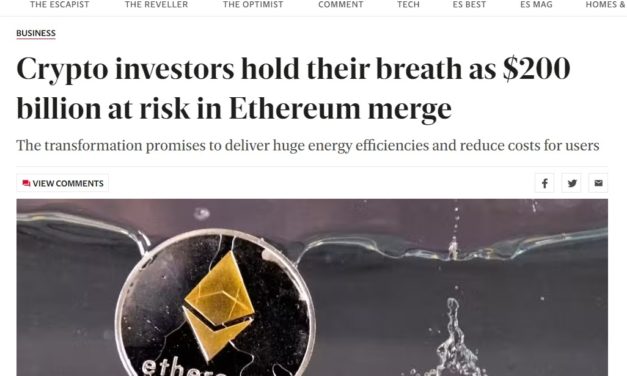
Mainstream outlets are starting to pick up on the significance of next week’s Ethereum Merge, describing it as a “major overhaul” that could either accelerate crypto adoption or send disastrous shockwaves across the market should it fail. The Merge has been in the making since the original Ethereum white paper and involves moving from an electricity-intensive proof-of-work (PoW) consensus mechanism to an efficient proof-of-stake (PoS) without any significant disruptions to the blockchain.American business publication Forbes called the no-downtime upgrade akin to “[changing] the engine of a spaceship mid-flight,” and Swan Bitcoin CEO Cory Klippsten made a similar comment to the Wall Street Journal, stating the upgrade is like “trying to fix an airplane in mid-flight.”Some outlets stressed the upgrade could be fraught with risk, sharing concerns that one wrong move could “prove disastrous” for the future of the network and the decentralized applications (DApps) on the Ethereum blockchain.Source: Evening StandardBritish newspaper the Evening Standard suggested crypto traders have been “holding their breath” ahead of the upcoming Merge, as a failed upgrade could put the entire cryptocurrency ecosystem “at risk.” The Ethereum network is responsible for the majority of the $150 billion stablecoin market cap, and around $33 billion in total value locked by Ethereum-based decentralized applications (DApps), according to Defillama. Dr. Anna Becker, CEO, and co-founder of EndoTech told the Standard that it will be “quite troublesome for the industry to survive” if something were to go wrong which leads to a halt of the blockchain. “Ethereum is the infrastructure for many companies to manage their blockchains, so if something goes wrong we have the halt of the industry […] it will be quite troublesome for the industry to survive this period.”The Washington Posts suggested that as the proof-of-stake mechanism is “less battle-tested” than proof-of-work, the security of whic has been proven over more than a decade, “new vulnerabilities could be found.”Source: Australian Broadcasting CorporationJournalist John Quiggin from the Australian national broadcaster ABC added in his reporting that given that the new model has only been tested on “experimental blockchains,” there is a chance the Ethereum experiment “could fail,” — potentially if larger ETH stakers find a way to manipulate the system. One point that has seen consensus among outlets is that the Ethereum upgrade will make the blockchain vastly more environmentally friendly than before — reducing energy consumption by more than 99% according to the Ethereum Foundation. Some argue that this could place pressure on other proof-of-work cryptocurrencies such as Bitcoin to eventually follow suit. “At a time when the world is desperately trying to reduce energy consumption, Bitcoin uses more energy each year than medium-sized nations such as Argentina,” said Quiggin, adding: “If the Ethereum switch succeeds, Bitcoin and other cryptocurrencies will be under immense pressure to deal with this problem.”Quiggin noted that last year, electric car manufacturer Tesla announced it will no longer be accepting Bitcoin for payments until at least half of the cryptocurrency is mined using renewable energy, while the New York Legislature passed a bill earlier this year to scrutinize Bitcoin miners using carbon-based power.Related: Hive Blockchain explores new mineable coins ahead of Ethereum merge“One thing is clear: as the need to slash global emissions becomes ever more pressing, cryptocurrencies will run out of excuses for their egregious energy use,” he concluded. Ether (ETH) is currently the second largest cryptocurrency by market cap, sitting at $187.5 billion, compared to Bitcoin (BTC)’s $360 billion market cap, according to CoinMarketCap.Source: Forbes

Čítaj viac

Not quite to the moon: Aussies offered NFT that could send them to space

Australians may not ever see their nonfungible tokens (NFTs) take them “to the moon,” but they might be able to get to the next best place — the edge of space.Crypto Competitions, an Australia-based Web3 sweepstakes startup, has recently signed a partnership with stratospheric exploration company World View, offering its NFT holders a 1-in-7,000 chance to win a priority seat in a World View space flight in 2024. Speaking to Cointelegraph, Harls Cannard, managing director of Crypto Competitions, said the sweepstakes was a way to celebrate the launch of his Web3-powered marketplace, which uses NFTs and prizes as an incentive to join its discount rewards program. “Everyone in crypto talks about like, when are we going to get a Lambo, and when are we going to the moon?”Canard said he thought the space flight was a “great way to launch,” even if it wasn’t necessarily sending someone “to the moon.” Source: Crypto CompetitionsHe explained that his Web3 company wanted to use blockchain to power its space flight sweepstakes project as the technology allows the draw to be “safe, secure and transparent.”“Because in a lot of lotteries and systems like this, you never actually know your odds of winning. You can’t verify your details to know if your name is actually in that barrel or in that draw. So we’re creating more of a trustworthy and transparent system of generating winners.”Crypto Competitions’ model bears resemblance to traditional NFT lotteries which uses an NFT to represent a sweepstake “ticket.”However, it puts a unique spin on the sweepstakes process, as it employs a gradual elimination process to determine a final winner. “We start with 7,000 NFTs that have been purchased. Then we begin to remove people that have entered […] On the final day, there might be 10 people left with 10 NFTs in the draw.”Canard explained that at each step, eliminated NFT holders or new buyers would be encouraged to participate in the secondary sales market for the surviving NFTs.“We’re creating secondary resale market value for the actual NFT.”Canard said his hopes for the company’s space flight project will showcase the capabilities of its blockchain technology.“I’ve been doing this in the Web2 space for the last four years and I’ve seen a massive gap in the market in Australia and internationally and so that’s why.”Related: Iconic brands including Nike, Gucci have made $260M off NFT salesCrypto Competitions is a Web3 company that offers a membership platform that gives members access to discounts, coupons, and rewards in over ten countries. Canard said in the future, he plans for the adjacent NFT sweepstakes product to include prizes such as Bored Ape Yacht Club NFTs and more “life-changing” giveaways and experiences.

Čítaj viac

Získaj BONUS 8 € v Bitcoinoch

nakup bitcoin z karty

Registrácia Binance

Burza Binance

Aktuálne kurzy