Autor Cointelegraph By Felix Ng

Base’s social bet left it trailing in prediction markets and perps: Pollak

Base creator Jesse Pollak says he is stepping back from leading the Base App after admitting he made a “wrong bet” on social, leaving the chain to fall behind on prediction markets and perpetual futures. In a post to X on Wednesday, Pollak said he had bet that creator, content and messaging apps would drive adoption, but instead the market “disintegrated completely.” “We realized how our focus on social had meant that base had fallen behind in key areas that were now increasingly critical — we had perps (shoutout avantis!) and prediction markets (shoutout limitless!), but both were well behind scaled competitors.”Dune Analytics data shows Base-native prediction market Limitless accounted for just 0.5% of total monthly notional volume across prediction markets in July. Perpetual decentralized exchange (DEX) Avantis ranked 18th by reported 30-day notional trading volume, according to DefiLlama.Pollak’s comments give further insight into the reversal of Base’s growth strategy earlier this year. While Base initially focused on social products such as Farcaster, Zora and miniapps to bring crypto to “a billion people,” Pollak said financial applications are the way forward for the network, with a focus on trading, payments and AI agents. Limitless Exchange’s monthly notional volume is only a fraction of its larger competitors. Source: Dune AnalyticsPollak added he will be returning leadership of the Base App to Coinbase, under Jordan Fish, known on X as “Cobie,” while he focuses on the Base blockchain. Coinbase CEO: “We messed up” on content coinsPollak’s post came just days after Coinbase CEO Brian Armstrong acknowledged content coins “didn’t work,” prompting the company to pivot earlier this year. “We messed up, time to turn the page,” Armstrong said on Monday. In February, Base sunset its Creator Rewards program and Farcaster-powered social feed as part of a strategic shift to tradable assets. Related: Moonbeam to pivot from Polkadot to Base, unveils AI agent frameworkThe Creator Rewards program launched in July 2025 and was intended to make the Ethereum layer-2 Base a more social ecosystem, where activity and engagement translate into earnings. Meanwhile, Pollak admitted the Base App was an “imperfect Farcaster client.” Base’s work on stablecoins, AI agents Last week, Base activated its B20 token standard on the mainnet, introducing a native framework for stablecoins, tokenized real-world assets (RWAs) and other fungible tokens.  In May, Base launched Base MCP (Model Context Protocol), a tool that lets users manage their crypto directly from an AI model’s chat interface and interact with crypto protocols such as Morpho, Moonwell, Uniswap, Aerodrome, Avantis, Bankr and Virtuals.In April, Base said it was upgrading key systems in preparation for an AI agent economy as part of its 2026 roadmap. It highlighted real-world asset (RWA) tokenization, stablecoins, and prediction markets as being key growth areas in 2026.  “We’re going to build base into the blockchain for global finance and do everything we can to be the place that the world’s money settles over the next century,” Pollak said on Wednesday.  Magazine: Is Robinhood Chain’s success bullish or bearish for ETH the asset?

Čítaj viac
Kalshi says CFTC, Michigan orders leave it in ‘impossible position’

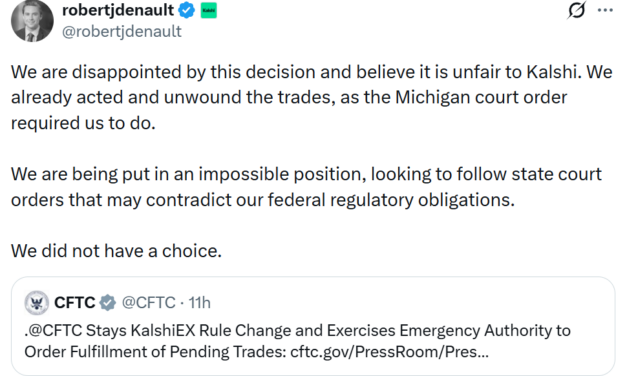
Kalshi says it is being put in an “impossible position” after the US commodities regulator on Tuesday said it was blocking the prediction market platform from canceling trades in Michigan, contradicting a recent state court order.On June 29, Kalshi was ordered by Ingham County Circuit Court Judge Rosemarie Aquilina to cease offering sports betting contracts to Michigan users while a lawsuit over whether Kalshi violated the state’s sports betting laws plays out. The Commodity Futures Trading Commission ordered Kalshi on Tuesday not to comply with the state order and continue operating.“We are disappointed by this decision and believe it is unfair to Kalshi,” Robert DeNault, the company’s head of enforcement and legal counsel said in a statement on X. “We already acted and unwound the trades, as the Michigan court order required us to do. We are being put in an impossible position, looking to follow state court orders that may contradict our federal regulatory obligations. We did not have a choice.” Source: Robert DeNaultThe conflicting orders highlight an unresolved regulatory divide between the CFTC and nearly two dozen state regulators over which authorities have jurisdiction over prediction markets. The CFTC said Michigan was the first state to attempt to interfere with executed derivatives transactions. “Canceling trades that have already been executed is an unprecedented step that risks a cascading effect on the entire marketplace and undermines the certainty in contracting that is a necessary component of a functioning market,” said Selig. “The Commission will not allow states or state courts to bully registered entities into violating the Commodity Exchange Act and CFTC regulations.” A Kalshi spokesperson said it was reviewing the CFTC’s order and considering its next steps, according to Reuters. Related: OpenAI quietly adds Kalshi World Cup odds to ChatGPT: ReportSpeaking on Fox Business on Friday, CFTC Chair Michael Selig said it is “critical” that the regulator maintains its regulatory authority over prediction markets. “We’ve sued nine states now, and we’ll continue to sue any state that attempts to impose criminal or civil fines against CFTC-registered exchanges.”Magazine: Strategy became a symbol of the dot-com crash: Could history repeat?Cointelegraph is committed to independent, transparent journalism. This news article is produced in accordance with Cointelegraph’s Editorial Policy and aims to provide accurate and timely information. Readers are encouraged to verify information independently.

Čítaj viac

US freezes $131M in Iran-linked crypto as Middle East tensions rise

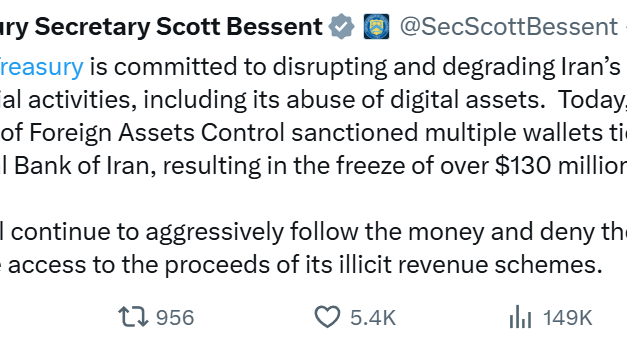
US Treasury Secretary Scott Bessent confirmed the US government ordered the freezing of more than $130 million in cryptocurrency held in wallets linked to Iran on Tuesday, as hostilities ramped up in the Middle East. Earlier on Tuesday, blockchain investigator Specter pointed to onchain data showing Tether froze four Tron wallets holding $131 million worth of USDt (USDT). Bessent confirmed on X that the wallets were tied to the Central Bank of Iran. “US Treasury is committed to disrupting and degrading Iran’s illicit financial activities, including its abuse of digital assets,” Bessent said Tuesday. “We will continue to aggressively follow the money and deny the Iranian regime access to the proceeds of its illicit revenue schemes.”The asset freeze comes amid a collapse in the ceasefire between the US and Iran. The US said it has renewed its blockade of Iranian ports, while the US military’s Central Command announced a new wave of strikes on Iran. Meanwhile, Iran’s military claimed on Tuesday that it carried out drone strikes against US military facilities at Jordan’s Al Azraq Air Base. Source: Scott BessentThe move follows a similar freeze in April, when stablecoin issuer Tether confirmed it had frozen more than $344 million in USDT at the request of US authorities. In May, Bessent said the US has seized around $1 billion in Iranian crypto assets as part of the US financial pressure campaign against Iran known as Operation Economic Fury, which launched in March 2025. Related: Iran-linked entities moved $3.8B through CoinEx, TRM says “Through Economic Fury, the Treasury Department is disrupting the foreign procurement networks that support the Iranian military’s efforts to acquire weapons,” Bessent said in a statement in June.  “Treasury has frozen the Iranian regime’s assets, severely disrupted its economy, and dismantled the Iranian war machine. Treasury will not tolerate any support of the Iranian military.” Magazine: Thai scammer’s $122M wallet, Japan embraces crypto credit: Asia ExpressCointelegraph is committed to independent, transparent journalism. This news article is produced in accordance with Cointelegraph’s Editorial Policy and aims to provide accurate and timely information. Readers are encouraged to verify information independently.

Čítaj viac

Bitmine generated $46M from Ethereum staking last quarter

Bitmine Immersion Technologies recorded $45.7 million in revenue from Ether staking and validation last quarter, following the launch of its institutional-grade Ethereum staking platform in March. Staking revenue accounted for 98% of total revenue for the three months ended May 31, far outpacing the $624,000 from self-mining Bitcoin (BTC) and the $168,000 from consulting services, according to Bitmine’s latest 10-Q filing. On Monday, Bitmine said it had staked 85% of its ETH holdings, equating to around 4.9 million Ether (ETH). “Bitmine has staked more ETH than other entities in the world. At scale (when Bitmine’s ETH is fully staked by MAVAN and its staking partners), the projected ETH staking reward is $284 million on an annualized basis,” said Tom Lee, chairman of Bitmine. The latest quarterly results show how Bitmine’s pivot to Ethereum has reshaped its revenue mix. A year ago, Bitmine recorded just $2 million in total revenue for the quarter ended May 31, 2025, primarily from machine leasing. The results also reflect the March launch of MAVAN, an institutional-grade Ethereum staking platform that operates validator infrastructure for its own holdings and external clients. Related: Ethereum backers launch nonprofit to lead institutional adoption efforts MAVAN, short for “Made in America VAlidator Network,” followed the acquisition of Australia-based non-custodial validator operator Pier Two Holdings. It was originally developed to support Bitmine’s own Ethereum treasury; its scope expanded to serve institutional investors, custodians and ecosystem partners.  Lee calls Robinhood Chain a “breakaway success”On Monday, Lee highlighted the success of the newly launched Robinhood Chain, with dollar volumes exceeding $1 billion since its July 1 launch. “Robinhood Chain now has more trading volume than any other decentralized exchange (DEX), demonstrating the outstanding utility and product market fit for Ethereum, which is the underlying chain,” he said. “Robinhood Chain uses ETH as the native gas token. And transaction fees are denominated in ETH and the finality is settled on Ethereum. Robinhood’s 27 million users are paying crypto fees denominated in ETH. In other words, everyday users are starting to see ETH as money,” he added. Magazine: Strategy became a symbol of the dot-com crash: Could history repeat?

Čítaj viac

Over 95% of Coinbase’s code is now written with AI

Artificial intelligence now helps write more than 95% of Coinbase’s code, offering new insight into the crypto exchange’s AI strategy following its decision to cut 14% of its workforce earlier this year. Coinbase cut 700 staff in May. In an email to employees, Coinbase CEO Brian Armstrong said AI has “dramatically” changed the pace of work and there was a need to “return to the speed and focus of our startup founding, with AI at our core.” “Effectively, 100% of our employees are using AI on a daily basis here,” Coinbase’s head of platform, Rob Witoff, told Cointelegraph. “And close to 100% of our code, probably somewhere between 95% and 100%, is written by or with LLMs today.”The figure is more than double Coinbase’s February estimate, when the company said 40% of its code was written with AI, reflecting the accelerating pace of AI adoption across tech and crypto companies.  Rob Witoff talks about Coinbase’s adoption of AI. Source: CointelegraphWitoff, however, said there is a “wide spectrum” in how it is used and the degree to which it is relied on. While writing core cryptography mainly relies on human input, prototyping is fully automated and core systems sit somewhere in the middle, he said. “For example, when we’re writing core cryptography, we have industry-leading cryptographers that are meticulously researching and reviewing one line at a time.”“We’re using AI quite a bit to test and make sure the code we’ve written is working the way it should, there’s no vulnerabilities, we’re verifying the math, but that’s a much more manual part than where we’re building internal prototypes, which is now effectively a 100% automated.”Smaller teams with “tastemakers”The shift has allowed Coinbase to reorganize around smaller, more senior teams, Witoff said, with two or three employees now capable of handling work that previously required 10 or more people. “There were a lot of junior development roles that were impacted,” he said of the May layoffs, though the cuts extended across the company, including marketing, legal, customer support and compliance roles. “For those smaller teams to work, for people to have the taste, the judgment, I think a lot about people having the battle scars so they know how to point agents in the right direction.”Witoff said that most Coinbase engineers now have five to 10 AI agents operating at any given time, with AI agents collectively performing the coding work of about 1,200 employees. By 2030, Coinbase could see AI agents doing the equivalent work of 100,000 employees, he said. Coinbase said its AI spend has remained “flat” despite growing token use. Source: Brian ArmstrongRelated: Robinhood says its AI agent feature will ‘soon’ be assisting crypto tradersCoinbase was part of a wave of companies to lay off staff this year amid a rise in enterprise AI. In March, crypto exchange Crypto.com cut 12% of its staff, impacting roles “that do not adapt in our new world.” In February, Block CEO Jack Dorsey said he was cutting 40% of Block’s workforce. “We’re already seeing that the intelligence tools we’re creating and using, paired with smaller and flatter teams, are enabling a new way of working which fundamentally changes what it means to build and run a company,” Dorsey said on X. Other crypto companies that cited AI-related efficiencies in this year’s layoffs included Kraken, Gemini, Messari and Dune. Magazine: Robinhood L2 sparks ETH optimism, Saylor ‘muddies waters.’ Hodler’s Digest, July 5-12, 2026

Čítaj viac

Získaj BONUS 8 € v Bitcoinoch

nakup bitcoin z karty

Registrácia Binance

Burza Binance

Aktuálne kurzy