Autor Cointelegraph By Felix Ng

CLARITY or not, crypto isn’t going back in the bottle: Bitwise

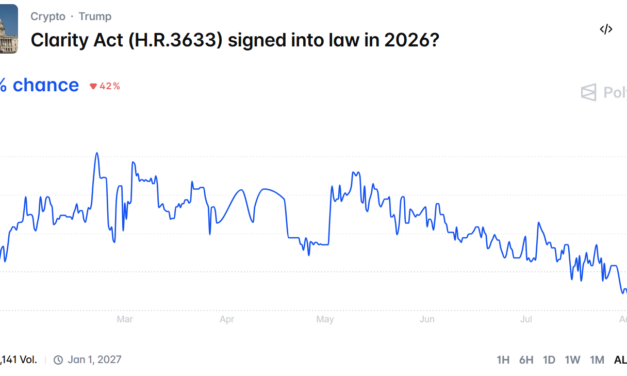
A failure to pass the CLARITY Act this week will put the bill in a “walking dead” state, but won’t stop the crypto industry’s march forward, according to Bitwise chief investment officer Matt Hougan. In a blog post on Wednesday, Hougan said while many, including himself, have called it the “make or break” week for the CLARITY Act, the reality is that the crypto industry has made too much progress to “go back in the bottle.” “The reality is that Washington is always late to major technology shifts, and it has rarely mattered as much as people feared,” said Hougan. His comments come as the Senate faces an Aug. 5 deadline to advance the landmark crypto market structure bill before its summer recess, with many concerned that failure to pass this week could see the bill pushed into the next year as lawmakers focus on the midterm elections in November. Prospects for CLARITY this year fadeMarket observers are increasingly pessimistic about the CLARITY Act’s passage this year. In July, Galaxy Research lowered its probability of the CLARITY Act passing in 2026 to 30%, while Polymarket currently shows a 23% chance of it being signed into law this year, down from 82% in February. On July 24, NYDIG global head of research Greg Cipolaro said the latest draft was more complete but still lacked sufficient bipartisan support.“The central investor takeaway is that Republicans have produced a substantially more complete bill, but not yet one with a credible path to 60 votes,” Cipolaro said.According to sources speaking to Punchbowl News, without signs of progress from the White House on a bipartisan ethics deal, and movement on illicit finance and stablecoin yield, Senate Democrats will deny cloture for the crypto bill. Polymarket odds for the CLARITY Act passing in 2026 are at 23%. Source: PolymarketHougan said failure to pass the bill will put it in a “walking dead” state, stalled, but not permanently defeated. He said there is some hope that the bill could pass in September, or even in December, when Congress returns for a lame duck session.“Congress often bundles multiple bills into a year-end “omnibus” package, forcing legislators to vote on a single bill that includes things they like and things they hate. Maybe the Clarity Act can pass that way.”“Crypto will be fine,” Bitwise’s Hougan saysIf the CLARITY Act fails to pass this year, Hougan said that the industry will fall back to the SEC-CFTC’s joint interpretation issued in March, which classifies Bitcoin and other assets as digital commodities and replaces the SEC’s 2019 staff guidance. SEC Chair Paul Atkins reinforced this last week, saying his agency is “ready, willing, and able to come out with rules that address the same issues as CLARITY and other aspects of the crypto market.” Related: CLARITY Act failure could send crypto valuations lower: BernsteinHowever, the rules issued by the two regulators aren’t as durable as legislation, and could be challenged in court or reversed by a future administration. Atkins even acknowledged this in March when the two agencies released the interpretation. Source: Cynthia Lummis“Only Congress can ensure that regulation in this area is future-proofed through comprehensive market structure legislation,” Atkins said.WisdomTree chief legal officer Ryan Louvar has argued that the absence of legislation would continue to impede the market, despite the regulators’ efforts.“A market cannot function well when its participants cannot tell in advance which agency’s rules apply to them,” Louvar said at a July congressional hearing.Hougan said “crypto will be fine” despite this, as it would still give the industry two and a half years to accelerate before a new administration could potentially install a new SEC.“Washington is dysfunctional. It seems crazy to me that we can’t get our act together to pass legislation that would improve investor protections and spark new innovation,” said Hougan.“But it’s not a referendum on crypto’s validity as a pillar of the global financial infrastructure. That ship has long since sailed. At this point, crypto has enough momentum that it will reshape finance for decades, regardless of what happens in the next few days.” Magazine: CLARITY hopes fade, BitMEX shuts as lawsuit looms: Hodler’s Digest, July 26 

Čítaj viac
Ethereum researchers want to rein in staking, critics say it could backfire

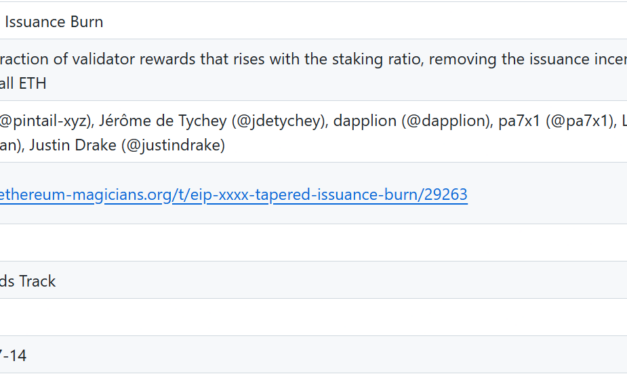
A group of six Ethereum researchers and developers, including Ethereum Foundation’s Justin Drake, has proposed changing the network’s issuance policy to cut validator rewards more sharply as the proportion of staked ETH rises. The draft, called the Tapered Issuance Burn and currently being assigned the provisional number EIP-8363, would burn an increasing fraction of validators’ consensus rewards as the amount of staked ETH approaches a fixed threshold of 60.25 million ETH (around 50% of the current ETH supply), at which point the deduction hits 100%. The changes would phase in over 18 months. Tapered Issuance Burn Ethereum Improvement Proposal. Source: GithubThe proposal has triggered backlash from developers, stakers and DeFi founders, who warn that the reward cuts could force out solo validators before larger institutions are affected, weaken institutional demand for ETH, and disrupt DeFi markets built around staking yield. One of the proposal’s authors, Jérôme de Tychey, said the changes are needed to address the rising share of Ether being staked, which passed 33% in April. The authors argue continued staking growth could concentrate ETH in large custodians and liquid staking providers, while unchecked issuance erodes Ether’s role as a neutral, trustless store of value. “Ever-growing issuance is a dilution tax on every holder: stake, or be diluted. At high ratios, LSTs and other staking derivatives displace raw ETH as the ecosystem’s working money, thus swapping the most neutral, trustless asset for intermediated claims on issuers,” he said.Although EIP-8363 remains an early draft, its publication just two days before a deadline for proposals targeting Ethereum’s Hegotá upgrade has also raised concerns about whether there is enough time to consider the impacts on Ethereum’s tokenomics.EIP-8363 authors’ argument to cut issuance The proposal’s authors argue that under the current curve, staking yield never drops below 1.5% even with all ETH in existence being staked. “The incentive to stake never switches off. Where does it stop? It doesn’t,” said de Tychey. With no changes, a worst-case scenario could see more than 55% of Ethereum supply locked in staking by 2028, he said. “Maximal neutrality & minimal dilution: those are the two fundamentals of a store of value. This EIP not only hardens both, it sets a bar no other blockchain clears.” The proposed policy would see issuance peak at 0.5% of ETH supply per year at its highest (around 20% of ETH is staked), declining to zero when the staking ratio of Ethereum hits the 60.25 million ETH threshold. Related: Ethereum treasury firms lean on staking as ETF pressure builds: Report“ETH supply growth will be bounded and more predictable. Combined with the EIP-1559 and Blob burn, the supply will more often decrease. Ethereum, the most mature of all the protocols, with a sustainable security budget, will also be the least dilutive of all protocols,” said de Tychey.The proposal’s broader direction has also received support from Grayscale. In May, Grayscale’s head of research Zach Pandl said limiting staking incentives would be “positive for the price of Ether over time.”Critics say it’s punishing Ethereum’s growthAave founder Stani Kulechov said reducing staking rewards would weaken institutional demand for ETH and borrowing activity across DeFi, arguing the proposal “doesn’t achieve the outcome it tries to achieve and is actually hurtful for Ethereum.” Another argument is that the proposal would impact solo validators as they have generally higher relative costs and are more susceptible to reward changes, leading to a more concentrated validator set. “This will self evidently push out solo stakers who aren’t subsidized by the EF or others,” said Mike Silagadze, CEO of Ether.Fi. “It will essentially guarantee that the only ones staking are large centralized entities with zero cost of capital where users passively hold their ETH.”De Tychey disputed this point, saying on the Ethereum Magicians forum that users of large staking providers must pay fees, making those services less attractive as rewards fall, though he acknowledged the research on this is still contested. The proposed network update will lower ETH issuance and inflation. Source: Zach PandlOthers pointed to the seemingly rushed timeline to consider the proposal, though this appears to be due to confusion over the upcoming deadline on Aug. 6. “This clearly doesn’t leave adequate time for community review of a monetary policy change of this magnitude,” said Greg Koumoutsos, a co-author of EIP-8148 and EIP-8205.Where the proposal currently standsThe Tapered Issuance Burn proposal has not been approved, scheduled or included in Hegotá.While there is an Aug. 6 deadline relating to this proposal, the deadline is for pull requests proposing additional EIPs for Hegotá, not a deadline for deciding which proposals will be included. Ethereum community organizer Trent Van Epps said the selection process could continue until Nov. 8, and that Hegotá is likely to reach mainnet in the second quarter of 2027.Magazine: The 100x obsession: Fundamentals grow in importance as crypto matures

Čítaj viac

Crypto firms are still seeking frontier AI access, only a select few have it

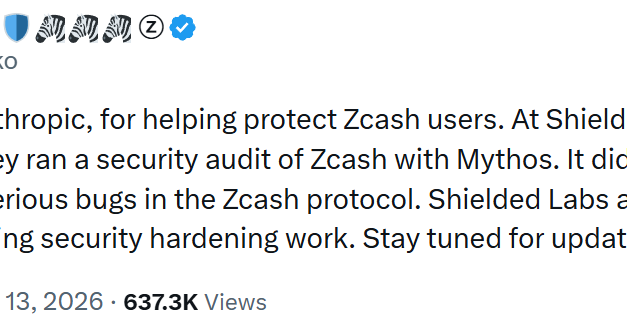
Crypto’s biggest players are still waiting to gain access to powerful new AI models to strengthen their code from attacks, but only a select few have been able to get it. US crypto exchange Coinbase said in June that it had secured access to Anthropic’s restricted Mythos model and Zcash’s Zooko Wilcox said Anthropic used the model to audit the Zcash protocol at the request of Shielded Labs, while other major crypto players are seemingly yet to get access.“That’s one advanced frontier model that hasn’t been made available to crypto just yet,” Binance’s chief security officer Jimmy Su told Cointelegraph. “We have been trying to make inroads there. We also talked to other crypto exchanges and our own investors to try to make some progress. But we haven’t gotten the most frontier AI model, like Mythos.” The uneven access creates a new security divide in an industry where exploits can put billions of dollars at risk. While model developers like Anthropic and OpenAI have chosen to restrict their most cyber-capable models from the public, there are concerns that increasingly powerful open-source alternatives mean crypto firms are left to deal with sophisticated AI-assisted attacks without the most capable tools to defend against them. Crypto executives say restricted access is initially necessaryAnthropic says Mythos 5 uses the same underlying model as its publicly available Fable 5, but without safeguards that restrict sensitive cybersecurity work. OpenAI operates a similar tiered system: verified defenders can use GPT-5.5 with “Trusted Access for Cyber”, while its more permissive GPT-5.5-Cyber model is reserved for a smaller group conducting authorized penetration testing.Crypto security executives interviewed by Cointelegraph said there is likely a need to initially restrict access to frontier cyber models, but said continuing to gate them becomes harder to justify once publicly available models approach the same capabilities. Source: Zooko WilcoxSu said Anthropic’s controlled rollout is a responsible approach because newly released models may benefit attackers faster than defenders. “If it enhances the attacker much faster than the defender, then it actually is harming the ecosystem,” he said, adding that a limited testing period could reduce the potential “blast radius.”Related: Can AI drain DeFi? Separating Claude Mythos hype from realityHowever, Su said this calculation changes when competing models become more powerful and widely available. “As other more powerful models are being released, the pressure will be on Anthropic to make it more widely available,” he said. The question would be whether defenders can deploy the frontier model as effectively as attackers once it becomes available, he said. The number of critical-severity CVEs has climbed after the launch of Claude Mythos Preview. Source: Epoch AISolana Foundation chief information security officer Michael Coates, who joined the foundation in July, also supported safeguards but argued that legitimate defenders need a faster route to them. “I fully understand guardrails for advanced models, but we need to streamline the verification programs, the acceptance programs, to give these models to legitimate defenders,” he said.“We need to make sure that the best models we can get are in the hands of defenders because attackers will have something capable enough.”Blockchain Capital’s Sean Cheetham also supported eventually opening up restrictions, and said that broader availability could ultimately favor defenders as legitimate security researchers greatly outnumber the small groups conducting sophisticated attacks. “If good people can multiply their defense scale… you’re much better off just opening it up and allowing them to defend themselves,” he said.Uneven access to frontier AI models Binance’s lack of access comes despite it being the biggest crypto exchange in the world by daily trading volume. The exchange holds a total of $137.8 billion in assets, according to DefiLlama. Crypto custodian Fireblocks, which secures trillions in assets annually, said in April it has sought access to Mythos and at the time, only used Anthropic’s publicly available model for pentesting, according to The Information, while Uniswap founder Hayden Adams in June slammed Fable 5’s safeguards that restrict prompts relating to cybersecurity. The Ethereum Foundation in July said it has been running “coordinated AI agents” to find bugs across its systems, but didn’t disclose which models were being used. Cointelegraph reached out to Ethereum Foundation, Fireblocks and Uniswap to confirm if they have since received access to frontier AI models. Source: Hayden DavisMeanwhile, some crypto-adjacent companies have gained access. FIS, which provides technology to banks and partnered with Circle in July last year to let banking clients offer domestic and cross-border payments in USDC, joined Project Glasswing last month. Project Glasswing is Anthropic’s gated program for giving vetted cyber defenders and organizations responsible for critical software infrastructure early access to its restricted Mythos models.HackerOne, which provides bug-bounty and security testing services to major crypto exchanges, among others, also said it joined Project Glasswing, though testing is confined to its own infrastructure, not its customers’ programs. Cointelegraph reached out to OpenAI and Anthropic about how many crypto companies have been given access to restricted models. AI-assisted hacking attempts on the riseOn Monday, Bitcoin swap service Boltz said it has chosen to halt its non-custodial bridge after seeing a steady rise in AI-assisted exploits over the past few months. “The pattern is clear: attackers now iterate faster than a team our size can find and patch.”  Last week, Bitcoin hardware wallet company Coinkite said a number of its Coldcard devices were exploited due to a flaw in its wallet seed generation, which turned out to be less random than expected. It speculated that the attacker had used AI to review previous versions of the firmware to find and exploit the flaw, despite it using “one of the best available AI models” to review its code just weeks before. Magazine: Fears of AI-driven DeFi hack epidemic overstated for now — but not for long

Čítaj viac

Boltz pauses service after wave of AI-assisted hacking attempts

Boltz, a non-custodial Bitcoin swap service, says it is disabling its service until further notice after a rise in AI-assisted hacking attempts over the last few months.In a post to X on Monday, Boltz said the decision came after seeing a steady increase in “automated AI-assisted probing” of its infrastructure this year. “Over the past months… we have dealt with several exploits. Each was contained, but the pattern is clear: attackers now iterate faster than a team our size can find and patch.” “After reviewing the results of our own recent security scans, we cannot responsibly re-enable Boltz swaps, especially as we are being actively targeted by what appear to be multiple resourceful groups while we race to deploy fixes.” Boltz’s operational pause highlights the difficulty that smaller development teams are facing, as attackers discover vulnerabilities and adapt exploits faster than they can respond.Source: Boltz“In the past few days alone we saw a drastic acceleration [of attacks] and we do not believe this asymmetry will reverse,” said Boltz. Solana’s security chief calls for automated defenseIn July, Solana Foundation’s new chief information security officer, Michael Coates, told Cointelegraph there is a need to switch to automated defenses in the age of AI. “We’re at a tipping point as an industry where humans cannot scale to meet these threats,” said Coates. “The only path forward we have is to have autonomous defense that operates at the speed of machines.” PayPerQ, a pay-per-prompt AI service that takes payment in Bitcoin and other cryptocurrencies, said it has also been dealing with a surge in exploits, possibly AI-powered. “We’ve been fighting off exploits every other week for several months, most of which we believe are AI-powered. It’s a very dangerous time out there.” No user funds at riskBoltz lets users perform non-custodial, trustless atomic swaps, moving Bitcoin and Bitcoin-denominated assets between the mainnet and different layers of Bitcoin such as Lightning Network and Liquid Network. Related: AI has not triggered DeFi ‘hackpocalypse,’ Dragonfly partner saysDefiLlama shows total value locked on Boltz at the time of writing is $180,860.Boltz said no user funds have ever been at risk, as all Boltz swaps use advanced cryptography and are non-custodial, which means users retain full control of their assets throughout the swap process. Boltz said its API will remain available to process refunds, and its support team will stay reachable. “What we are seeing is a major paradigm shift for Bitcoin services operating on an open source stack, and it needs careful analysis. Do not expect swap services to resume shortly.”Magazine: Fears of AI-driven DeFi hack epidemic overstated for now — but not for long 

Čítaj viac

Získaj BONUS 8 € v Bitcoinoch

nakup bitcoin z karty

Registrácia Binance

Burza Binance

Aktuálne kurzy