Autor Cointelegraph By Ezra Reguerra

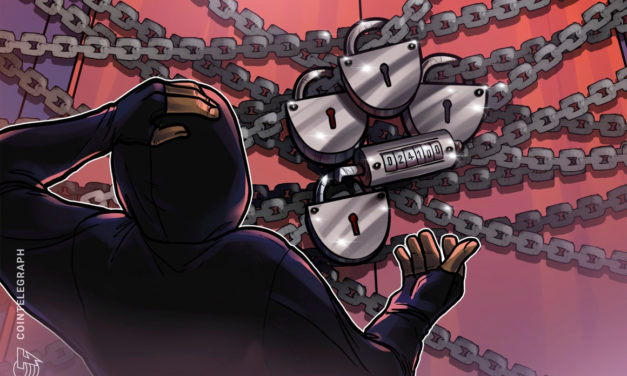
Hacker tries to exploit bridge protocol, fails miserably

Cross-chain bridges have increasingly become targeted by malicious entities. However, not all hackers can run away with millions in their exploit attempts. Some end up losing money from their own wallets. In a Twitter thread, Alex Shevchenko, the CEO of Aurora Labs, told the story of a hacker who attempted to exploit the Rainbow Bridge but ended up losing 5 Ether (ETH), worth around $8,000 at the time of writing. According to Shevchenko, the hacker has presented a falsified NEAR block to the Rainbow Bridge contract and submitted the required 5 ETH safe deposit. Thinking that the team would be slow to react during the weekend, the attacker timed the exploit attempt on a Saturday. Despite the hacker’s plan, the CEO highlighted that there were automated watchdogs in place that fought off the malicious transaction. Within 31 seconds, the attempt was suppressed, leading to the hacker losing their safety deposit. Because of the increasing exploit attempts, the CEO noted that their team is considering increasing the amount required for safe deposits. However, the idea was dumped to keep the team wants to stay committed to decentralization as possible. Shevchenko also left a message to the attacker. The CEO urged the hacker to try doing good for the community by working on bug bounties instead of stealing users’ money and having trouble trying to launder the stolen assets. Related: Hacker tastes own medicine as community gets back stolen NFTsOn June 7, Aurora Labs paid a bug bounty of $6 million to an ethical security hacker who pointed out a critical vulnerability to the Aurora team. The bug was promptly patched, and user funds were secured. If the whitehat hacker decided to exploit the network, over $200 million could have been lost. Meanwhile, the entities that executed the Ronin bridge hack have transferred the stolen funds into Bitcoin (BTC). Using privacy tools Blender and ChipMixer, the hackers are still trying to spread out the stolen funds in hopes of outmaneuvering the authorities.

Čítaj viac


Voyager creditors oppose $1.9M employee retention proposal

Voyager Digital Holdings’ committee of unsecured creditors has filed a motion to object to the firm’s proposal to keep its employees by paying them monetary awards for staying in the company. On August 2, Voyager Digital filed a motion to the United States Bankruptcy Court in the Southern District of New York to approve the Key Employee Retention Plan (KERP) that aims to distribute $1.9 million to 38 key employees who were deemed to be very crucial to the operations of the exchange. However, the exchange’s creditors disagreed with the proposal. In a motion filed on August 19, the creditors laid out their objections to the proposed KERP and its related relief grants. They wrote: “At a time when thousands of creditors struggle to pay basic personal expenses due to the Debtors’ flawed business model, the Debtors now seek to pay bonuses to their already well-compensated employees.”The creditors also argued that Voyager was unable to give enough reason to justify the retention plan. Additionally, the creditors said that there isn’t enough evidence given to show that the employees who were part of the retention plan are truly planning to resign. Apart from these, the filing made by creditors also noted that the current crypto winter allows the firm to hire from a pool of talent who are now available. “Given the recent reductions and layoffs across the industry, a bevy of recently-terminated professionals could fill their roles,” they wrote. Related: Investors lament potentially lost ‘millions’ on Voyager bankruptcyEarlier this month, billionaire Mark Cuban was sued for promoting Voyager products. A law firm filed a civil suit against Cuban and demanded a jury hearing for the case. The lawsuit alleged that Cuban used his experience to dupe investors into putting their life savings at Voyager. In July, the crypto exchange filed for bankruptcy, mentioning that the firm owes money to more than 100,000 creditors. According to the firm, this move is part of a recovery plan that aims to return value to its customers when implemented.

Čítaj viac

BendDAO contract drained overnight with 15 ETH left to pay lenders

Lending protocol BendDAO has run out of Wrapped Ether (wETH) in its contract. At the time of writing, the contract only has 15 WETH to pay lenders, and an estimated 15,000 Ether (ETH) left to be paid to lenders. Researcher NFTStatistics.eth dissected the issue in a Twitter thread, highlighting that NFT borrowers in the platform should now pay 100% interest on the ETH they borrowed. In addition, the debt positioned against the NFTs is also on the rise. Furthermore, the researcher noted that many of the NFTs that have been used as collateral and defaulted currently have no bids. In relation to this, there are more NFTs on the platform’s alert list, which are NFTs about to default and come to auction because of the falling NFT floor prices or rising debt and high-interest rates. gmWhile you were asleep the BendDAO bank run finally happened 15 wETH ($25,081) left in the wallet that had 18,000 ETH ($29,160,000) in it just 48 hours agoStill 14,500 wETH owed to lenders….Absolute shitshow pic.twitter.com/RKkdqVAVIf— Cirrus (@CirrusNFT) August 21, 2022According to the BendDAO co-founder, their team is working on a proposal to change parameters within the NFT lending platform. The update will take effect 24 hours after it gets approved through the voting process. Amid the crisis, a Twitter user took the opportunity to poke fun at the platform, pointing out that even the co-founder of BendDAO is also on the verge of getting liquidated by their own lending platform. Related: BTC to lose $21K despite miners’ capitulation exit? — 5 things to know in Bitcoin this weekLast week, analysts speculated that there might be an incoming series of NFT liquidations worth $55 million to recover loans on BendDAO. According to Double Studio founder DoubleQ, the situation could lead to a “death spiral” for the entire NFT market and the Bored Ape Yacht Club (BAYC) ecosystem. Meanwhile, the broader NFT world is not doing any better. At the moment, as floor prices of BAYC and Mutant Ape Yacht Club (MAYC) collections took a nosedive, the newly launched GameStop NFT marketplace has taken a hit, with its daily fee revenue dropping below $4,000.

Čítaj viac

Huobi explains what went wrong with HUSD after stablecoin is back on track

After recovering the HUSD stablecoin’s dollar peg, crypto exchange Huobi explained what had caused the short-term liquidity problem and assured users that it had been resolved. On Thursday, HUSD started to fall from its dollar value, trading at $0.92 at the start of the day and falling as low as $0.82 a few hours later. This alarmed community members, who speculated what mig happen if the stablecoin doesn’t recover its dollar peg. HUSD was once one of the safest stablecoins. Now it’s off its peg. If HUSD doesn’t return to $1, it’d be the first fully-reserved centralized stablecoin to fail. pic.twitter.com/9WmROQR6lD— John Paul Koning (@jp_koning) August 18, 2022In response to the concerns, the crypto exchange platform immediately announced that they had been in contact with the stablecoin issuer, Stable Universal Limited, and wer working to restore the stability. Before the day ended, the Ethereum-based stablecoin almost recovered its dollar peg, trading at $0.99 per HUSD, before going back to $1 on Friday. According to the HUSD team, the depeg was caused by a decision to close market maker accounts in some regions to comply with regulations. The team explained that the time difference in banking hours had created a gap that led to a liquidity problem, leading to HUSD falling from its peg. Huobi then assured its customers through an announcement that the issue had been completely taken care of and urged its users to pay close attention and be aware of any potential risks due to the market’s volatility. Related: Tether reserve attestations to be conducted by major European accounting firmMeanwhile, an exploit minting 1 billion Acala Dollar (aUSD) caused the stablecoin to depeg by 99%. In response to the attack, the Acala team froze the hacker’s wallet, raising questions over the platform’s decentralization claims. The team was eventually able to recover a large portion of the tokens that were not collateralized. In June, the USDD stablecoin also fell from its dollar peg as one of the funds that had capitalized on the TerraUSD (UST) depeg started to actively transfer huge amounts of USDD. However, the depeg did not last long as the Tron DAO Reserve mobilized 700 million USD Coin (USDC) to defend the peg.

Čítaj viac

Can exchanges create imaginary Bitcoin to dump price? Crypto platform exec answers

One of the most substantial value propositions of Bitcoin (BTC) is that no one can create more of it apart from its fixed supply. However, an executive from a crypto exchange made a bold claim that some exchanges can create and sell BTC that’s only in their system, not on the blockchain, to manipulate the market. In an interview with Cointelegraph, Serhii Zhdanov, the CEO of crypto exchange Exmo, shared his beliefs that market manipulation is still prevalent in the digital asset space and gave an example of how it can happen. According to the executive, if anyone wanted to dump the market, it’s possible to go to an offshore exchange that does not go through financial audits and ask for $100 million worth of BTC and use $10 million Tether (USDT) as collateral. He explained that: “The exchange just adds these funds to the account, creating these Bitcoins only in their system. They do not exist on the Bitcoin blockchain. The client or internal market-making team then sells these Bitcoins equivalent to $100 million dumping the Bitcoin price on all exchanges.”To get their profits, the market manipulators can then profit from arbitrage according to Zhdanov. “After the price is down, they buy the same amount of Bitcoin at a much lower price and make a profit,” he added. The CEO said that fighting and preventing these potential events require stronger regulatory policies that are as comprehensive as the stock market. Zhdanov highlighted that offshore exchanges must also be regulated in the same manner as tier one exchanges or have transactions between regulated and offshore exchanges be limited. With this, the executive believes that the market will be a better place for investors of all sizes. Related: Analyst claims that exchanges sell your Bitcoin, crypto trading platforms respondAdditionally, the executive pointed out that one of the barriers to mainstream crypto adoption is the money laundering concerns. According to the CEO, compliance and more comprehensive regulation will make these concerns go away. He said: “Crypto is a new thing that evolves quickly, it’s highly similar to traditional investment vehicles in essence. Therefore, I think there are many things we can borrow from the stock market, where regulations have been tested over a longer time.”Lastly, Zhdanov explained that at the moment, malicious entities like hackers are more attracted to targeting crypto rather than banks because of holes in security. The executive noted that security is also a key to a broader digital asset adoption.

Čítaj viac

Získaj BONUS 8 € v Bitcoinoch

nakup bitcoin z karty

Registrácia Binance

Burza Binance

Aktuálne kurzy