Autor Cointelegraph By Ezra Reguerra

SEBA Bank to provide Ethereum staking services to institutions

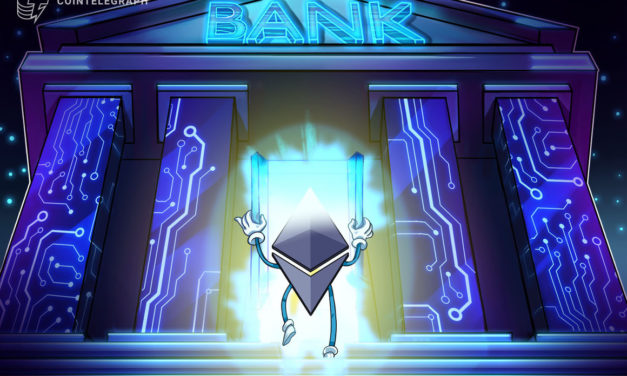
As the Ethereum network moves from proof-of-work (PoW) consensus to proof-of-stake (PoS), a digital asset platform initiated a service for institutions to dive into Ether (ETH) staking. In an announcement sent to Cointelegraph, Swiss digital asset banking platform SEBA Bank said that it has launched an Ethereum staking service for institutions that want to earn yields from staking on the Ethereum network. According to the firm, the move is a response to the growing institutional demand for decentralized finance (DeFi) services.According to Mathias Schütz, an executive at SEBA Bank, the firm believes that institutions can also play a role in securing the Ethereum network by staking ETH. Schütz explained that: “The launch of our Ethereum staking services will enable institutional investors to play a key role in securing the future of the network, via a trusted, secure and fully regulated counterparty.”The executive believes that the upcoming Merge is a very important milestone for the network in terms of security, scalability and sustainability. Schütz also added that launching ETH staking for institutions allows their firm to keep up with the rapidly evolving digital asset space. Related: Ethereum Merge: How will the PoS transition impact the ETH ecosystem?Apart from SEBA Bank, other firms have also started to offer staking services in anticipation of the Ethereum Merge. In June, crypto bank Anchorage Digital also announced its ETH staking service for institutional clients. Anchorage Digital co-founder Diogo Mónica said that institutional entry into ETH staking is a “win-win” situation for both the ecosystem and institutions.Meanwhile, Ethereum mining pool Ethermine created a new staking pool for users to stake ETH collectively and receive interest. Users can join the pool with a minimum of 0.1 ETH. However, the platform noted that lower holdings mean greater fees. At the moment, the platform offers a 4.43% annual interest rate for ETH staking.

Čítaj viac

Ethereum co-founder’s poll shows people want $100 lifetime .eth domains

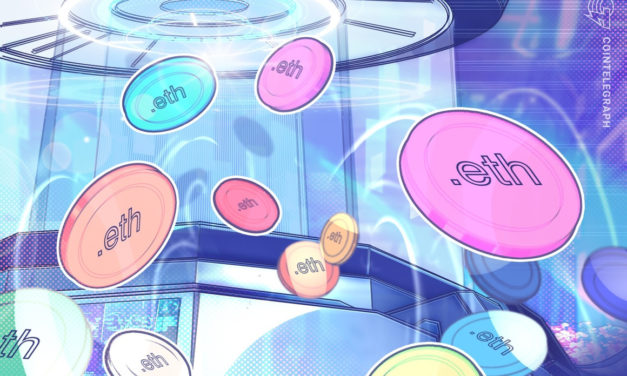
As Ethereum Name Service (ENS) domains became more popular, the conversation has steered toward .eth domain pricing and what is considered to be a “fair” price to guarantee ownership for 100 years. In a Twitter thread, Ethereum co-founder Vitalik Buterin asked the community what price they think is appropriate for registering and keeping ownership of a 5-letter .eth domain for 100 years. Buterin gave four options: under $100, $100–$999, $1000–$9999 and $10,000 or more. Almost 50% of the 91,130 votes chose the most economical option of paying under $100 for 100-year ownership of an .eth domain. One respondent said that the result is to be expected as people always want the cheapest way to get good returns. On the other hand, another community member argued that costs should be exponential with time. The user believed that $1 million is an appropriate cost for 100 years. The costs for traditional domain names vary depending on the name registered. Domain name providers like Namecheap and GoDaddy sell normal .com domains from $1 to $13 annually without any add-ons. After a year, the rates usually go higher as the promotional period comes to an end. However, premium domains can be more costly, ranging from $1,000 to $50,000 and beyond, depending on the domain name chosen. The most expensive sale of an ENS domain happened in October 2021 when paradigm.eth was sold for 420 Ether (ETH), worth $1.5 million at the time. The second-largest sale happened in July 2022, when 000.eth was purchased for 300 ETH, around $320,000 at the time of sale. Related: Ethereum Name Service registrations surge by 200% amid lower gas feesThe founder and lead developer of ENS, Nick Johnson, recently told Cointelegraph that the team did not realize how valuable ENS would become as more users started to mint .eth domains. Johnson believes that many people register ENS names because it “serves as their decentralized profile.” It gives people a way to identify themselves across various applications and platforms. 

Čítaj viac

ETH Merge: CoinGecko co-founder shares strategy for forked tokens

Many believe that after Ethereum transitions to proof-of-stake (PoS), a faction of Ether (ETH) miners will be creating a proof-of-work (PoW) fork of the network so that they can still keep mining. An executive believes that there are ways for ETH holders to take advantage of this upcoming event. In a Twitter thread, Bobby Ong, the co-founder of token information website CoinGecko, shared his strategies when it comes to the upcoming ETH Merge. According to Ong, ETH holders will soon be getting airdrops of ETH PoW tokens and shared some tips on how ETH holders can fully seize this opportunity. Ong noted that the easiest way to get the fork airdrops is to hold ETH at exchanges that support the forks. However, holding ETH in hardware wallets would also work and could make a trader eligible for all the forked tokens. To maximize the amount that holders can get, the executive also advised traders to bridge their tokens back to the ETH mainnet, unwrap their wrapped Ether (wETH) and remove their ETH liquidity from decentralized finance (DeFi) protocols. Related: What the fork? Ethereum’s potential forked ETHW token is trading under $100Despite these tips, Ong noted that while he may be eligible to get all of the forked tokens, he would not claim all of the airdrops as some of them could be scam attempts that would try to get access to his signature and keys. The executive also shared that his strategy for the forked tokens is to “sell them all immediately.” He wrote:“Almost all the fork tokens are now dead as they are created solely to keep miners temporarily occupied with mining and have no incentive to grow their community and usage.”Meanwhile, nonfungible token (NFT) marketplace OpenSea said that it will not be supporting forked NFTs in its platform. The popular NFT trading platform recently announced that it will only support NFTs on the upgraded PoS blockchain. Apart from OpenSea, blockchain oracle project Chainlink also expressed its support for the upgraded ETH network by announcing that PoW forks will not be supported by Chainlink. 

Čítaj viac

What would you ask Satoshi Nakamoto? Community answers

After more than 10 years since the inception of Bitcoin (BTC), its pseudonymous creator Satoshi Nakamoto still remains a mystery. Being an inspirational figure to the crypto space, Cointelegraph asked Twitter what questions they would have for Nakamoto if they had a chance to talk. From asking about their private keys and thoughts about Bitcoin mining to conspiracy theories about artificial intelligence trying to take control of humanity, the community members shared their most colorful questions for the Bitcoin creator. A Twitter user replied that they would have a conversation with Nakamoto about various topics from the economy to coding, up to their perspectives on the universe, life and health. The community member said that “a brilliant mind has to be heard on anything.”Another community member brought up the topic of Bitcoin mining. The Twitter user said that they would ask Nakamoto about their thoughts about less energy-intensive alternative blockchains and if they would consider it as a feasible replacement for Bitcoin. Meanwhile, another question poked at the BTC creator’s thoughts on his vision versus the current status. They tweeted: If the way Bitcoin is right now, is what he wanted it to be, or if Bitcoin has lost the way— MK O’Jay (@Mesakkasem) September 2, 2022One user brought up the topic of recovering lost Bitcoin. The Twitter user said that they would ask Nakamoto if there is any way to recover all those lost BTC. In a previous interview with Cointelegraph, Kim Grauer, an executive at analytics firm Chainalysis, said that around 3.7 million BTC, worth $75 billion at the time of writing, has been lost.Many believe that Bitcoin is a hedge against inflation due to its inherent feature of having a limited supply. This may be why another response raised the issue of the public’s understanding of money and scarcity. According to a community member, they would ask Nakamoto if they had ever anticipated that the masses would have little understanding of financial concepts and scarcity, suggesting that if people understood, they would be all over Bitcoin and ditching inflationary currencies. As the Twitter thread got more replies, the answers started to become more creative and dystopian. One user wrote that they would ask Nakamoto if they are an artificial intelligence life form that teleported from the future to build a decentralized computing infrastructure and “take control of humanity.” Apart from these, one of the most asked questions revolved around asking for the Bitcoin founder’s private keys. After all, Nakamoto’s wallet is believed to have around 1.1 million BTC, which is worth $22.5 billion at the current market price and was worth $77.6 billion at the currency’s all-time high. Related: 62% of wallets did not sell Bitcoin for a year amid the bear market: DataOne of the most prominent crypto projects that followed Bitcoin’s example is the smart contract platform Ethereum. Its native token, Ether (ETH), is currently the second most valuable crypto in terms of market capitalization. In July, Cointelegraph asked the community if they thought ETH has a chance ever to surpass BTC. While some believe that ETH has the potential to take the spot as the top dog in crypto, others believe that Bitcoin will always be the “king.” 

Čítaj viac

62% of wallets did not sell Bitcoin for a year amid the bear market: Data

Despite the uncertainties brought about by the bear market, on-chain metrics show that the majority of Bitcoin (BTC) traders have been using a very simple trading strategy for more than a year: hodling. According to data from the trading analysis platform TipRanks, while on-chain signals remain bearish for BTC, 62% of wallets have held BTC for one year and above. On the other hand, 32% of wallets are shown to have held for a month up to a year. Lastly, those who have been holding for less than a month are only 6%.Apart from holding, the site also showed its analysis of profitability in holding Bitcoin. According to the data, among the current holders, 48% are in profit while the same amount of holders is in losses. The data also highlighted that the remaining 4% are neither in profit nor in a loss. While Bitcoin’s price has experienced several dips as of late, almost a quarter of the circulating supply stayed in wallets. On Aug. 18, on-chain metrics showed that 24% of BTC supply remained untouched for a minimum of 5 years, suggesting that long-term holders have no intention to sell, especially during a bear market. Related: Bitcoin ‘liveliness’ lowest since 2021 amid new 5-year BTC hodl recordA recent survey done by market research platform Appinio showed that 55% of crypto investors held onto their crypto investments despite the massive sell-offs that happened recently within the crypto market. Among the survey participants, 40% believe that Bitcoin is still the best investment opportunity in the next 3 months. Meanwhile, Zach Burks, the founder of NFT marketplace Mintable has recently shared his crypto journey as well as his trading strategy. According to Burks, his goal is to keep on stacking Ether (ETH) until he can afford to purchase a mega yacht. The marketplace founder highlighted that he is still holding. 

Čítaj viac

Získaj BONUS 8 € v Bitcoinoch

nakup bitcoin z karty

Registrácia Binance

Burza Binance

Aktuálne kurzy