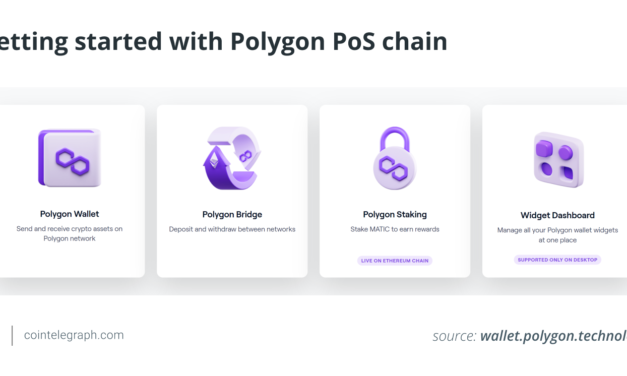
How to bridge tokens from other chains to the Polygon Network
Bridging assets could help solve issues like scalability, speed and high fees. Bridging means users can move their tokens between blockchain networks quickly and cost-effectively.The Polygon Bridge is used for cross-chain transactions between the Polygon (MATIC) and Ethereum (ETH) blockchains. It allows users to transfer ERC tokens and NFTs to the Polygon sidechain through smart contracts.This guide will show you how to bridge Polygon with other blockchains. However, given that Ethereum is the platform most often used for decentralized finance (DeFi), nonfungible tokens (NFTs) and the metaverse, we’ll be looking at how to bridge tokens from the Ethereum network to Polygon, an increasingly popular platform due to its efficient interoperability.How to use the Polygon bridge?The Polygon bridge is designed to connect different blockchains with fast and cheap transactions so that users can easily transfer tokens back and forth. It also enhances the Ethereum ecosystem through efficient tools that help build scalable decentralized applications (DApps).The Polygon Bridge allows users to move tokens from Ethereum ERC20 to Polygon Matic, Polygon’s native token, which is the cheapest way to bridge ETH to Polygon.Related: Polygon blockchain explained: A beginner’s guide to MATICHere’s how to bridge assets to Polygon There are two Polygon bridges: the proof-of-stake (PoS) Bridge, which is the official Matic Bridge, and the Plasma Bridge. Both bridges can be used to transfer tokens from Ethereum to Polygon and vice versa, but they are different in their approach to security methods.The PoS Bridge is the most popular and straightforward for transferring ETH and most ERC tokens. It uses the PoS consensus algorithm to secure its network. Deposits on the PoS Bridge are instantly secured, but withdrawals may take a while to confirm. A PoS Bridge withdrawal usually takes between 45 minutes and 3 hours, while the Plasma Bridge can take as long as seven days.The Plasma Bridge is more suitable for developers that require higher security. It uses the Ethereum Plasma scaling solution and supports the transfer of MATIC, ETH, ERC-20 and ERC-721 tokens.Related: Proof-of-stake vs. proof-of-work: Differences explainedHow to use the Matic Bridge to bridge tokensTo bridge tokens from Ethereum to Polygon, the first requirement is access to a compatible cryptocurrency wallet, such as MetaMask, but other options can also be used, as shown below. 1. Log in to the Polygon Web Wallet by clicking on the Polygon Bridge.2. Next, you need to connect your Ethereum wallet. In this example, Metamask is used, but other options, as mentioned in the image below, can also be employed.3. A digital signature is required to connect your MetaMask wallet to your Polygon wallet. Ensure the URL is correct before clicking on sign in to proceed to avoid any scamming attempt.4. To send your tokens from Ethereum to Polygon, go to the deposit tab and click on the required token you want to bridge. Enter the amount and click transfer. Read the notes on the following page and click continue. You will then be directed to agree to the estimated gas fees and click continue.5. You can review your transaction details, such as the token amount and the estimated transaction fee, on the following page before completing the operation. Then click continue to sign and approve the transfer. 6. Once confirmed, you can check the transaction status on Etherscan.You can also use Polygon Bridge Matic to run the inverse transaction to transfer MATIC to Ethereum. Similarly, you’ll need a compatible crypto wallet such as MetaMask.To transfer tokens from Polygon to Ethereum blockchain via the PoS Bridge, follow the following steps: You can view the status of the transaction on Etherscan. It might take up to three hours for the transaction to be verified by PoS validators and completed. Once validated, you will need to claim the tokens to the MetaMask wallet. Click continue to allow the withdrawal to complete.How to use the Plasma bridge on PolygonThe Plasma Bridge can help you transfer MATIC or other Polygon tokens to Ethereum. However, it only supports the transfer of ERC-20 and ERC-721 tokens, including ETH and MATIC. It uses the Ethereum Plasma scaling solution for higher security, which is why it’s the preferred tool by developers.To transfer Matic, for instance, from Polygon to Ethereum, any Ethereum wallet such as Metamask can be used. You need to add the Polygon network to your wallet before you can view your MATIC and start the process. It’s easy to add the Polygon network, just follow the instructions. For example, on Metamask, make sure that you’re connected to your MetaMask wallet. Then click the Switch to Polygon button on the top. A pop-up from your MetaMask extension with the Polygon network details will appear, then click approve.To see Matic on your Metamask wallet, you need to switch your MetaMask from the Ethereum Mainnet to the Polygon network. Just click on the switch network.To bridge MATIC to Ethereum using MetaMask, you can follow the following steps:Please note that the process involved in Step 5 is more burdensome than the PoS Bridge as you need to confirm three transactions manually for a Plasma Bridge transfer. The first will initiate your withdrawal from the Polygon wallet, which could take up to three hours.Ethereum gas fees have been a significant issue in the last couple of years since NFTs and DeFi have become popular due to network congestion. Layer-2 systems (L2s) are a secondary layer or protocol built on top of an existing blockchain system. Their main goal is to solve the transaction speed and scaling difficulties faced by the major cryptocurrency networks.Polygon to Ethereum bridge fees can be reduced by using tools like QuickSwap.QuickSwap is Polygon’s primary decentralized exchange (DEX) and functions as the core of the network.Any ERC-20 token with liquidity can be traded on QuickSwap, and fees are naturally paid in MATIC, offering considerable savings.
Čítaj viac