
Autor Cointelegraph By Elias Ahonen

Designing the metaverse: Location, location, location

When it comes to designing a metaverse map, it’s more about the vibe than practicality. From space pods to jungle islands and celebrity neighbors, users want to feel like they are someplace special.

What considerations go into designing a metaverse platform? Insiders explain that one key factor is that virtual worlds need to be created with features familiar to their human users — even if such elements, like beaches and nature preserves, offer no practical benefits in virtual reality. Old habits die hard, and people prefer spaces that are familiar and, ideally, neighboring a celebrity like Snoop Dogg.

Alexis Christodoulou, a 3D architect who has been creating virtual spaces for 10 years and NFTs for two, recently got the job to design 2117, a space-themed metaverse platform imagining the United Arab Emirate’s stated goal to colonize Mars in the year 2117.

“If I was told to just build a metaverse, I’d have had a proper nervous breakdown — starting with a space pod was intuitive.”

Outer space, like the metaverse itself, is a foreign environment for humans. Looking 100 years into the future, it is easy to imagine a creepy, inhuman, alien-like ship without many points of familiarity. Instead, Christodoulou has aimed to form the environment into one that appears comfortable, familiar and inviting. 

Blueprints for Victory 1, the imagined metaverse spaceship that is larger than the Empire State Building. Source: 2117

Noticing that his early design seemed a little cramped, “I started putting windows in the space pod and realized it was more comfortable” — a concept that sounds odd, given it is effectively a video game, but somehow makes intuitive sense.“We’re still so human and base everything on the real world because we haven’t spent long enough in the metaverse,” he reasons, explaining that real-world bias explains why people are likely to prefer secluded metaverse beaches or islands instead of properties closer to infrastructure, such as portals. “We still have real-world values in the metaverse, but that might change in 10 years,” Christodoulou predicts.

To begin the virtual future journey to Mars, users need to purchase a “citizenship card,” an NFT that gives users access to their pods. Like in any work of fantasy, there is an element of worldbuilding that needs to be created by which the designed space is made to follow a certain logic.

“How does the spaceship work? What is it carrying in order to facilitate its task of Mars colonization? What are the people doing on their way there?” Christodoulou asks himself, calling 2117 a “story-driven metaverse” with an ongoing and developing plot.

Christodoulou presenting the space pod at Dubai’s Museum of the Future in September 2022. Source: Elias Ahonen

What really is a metaverse?

But are metaverse platforms really just video games? For Christodoulou, a video game is something that is primarily task-driven, catering to the completion of defined quests where “community and social aspects are secondary” — for example, a shooting game where an online guild may train together to become better online marksmen. “The metaverse is somewhere you want to simply exist — you can choose to do quests, but it’s not required,” he says, explaining that instead of being a mere individual challenge, it is more of a collective journey through a developing story.

Sounds a lot like life itself.

Sara Popov, creative director at the Paxworld metaverse platform, agrees, explaining that a the metverse is “more of an experience than a game,” with the latter having clear objectives, while the former is more of a facilitating environment for whatever the “player” wants to do. 

Read also

Features
Capitalism’s Perestroika Moment: Bitcoin Rises as Economic Centralization Falls

Features
The Becoming of Bitcoin: A Narrative Untainted by Illusions of Truth

“World of Warcraft was one of the first metaverses,” she says, referring to an online multiplayer game set in a virtual world where players themselves could decide whether they wanted to fight monsters, trade, make friends or help new players. Whatever the differentiation, Popov clarifies that the process of metaverse design is very similar to that which can be found in a video game production.

Janek Borkowski, digital strategist at Paxworld, describes the metaverse as a “growing world that is not defined — without beginning, middle or end,” adding that he believes that a generational gap prevents many from understanding these new developments:

“If you talk to a younger person, they may understand video games differently than an older person.”

It is perhaps for this reason that Apple’s CEO Tim Cook recently explained that the company has avoided associating itself with the concept altogether, because “I’m really not sure the average person can tell you what the Metaverse is.”

Buying virtual land

To facilitate its development into a social community, Paxworld has three tiers of land — some of which is sold to individuals in order to give people a sense of ownership and to allow them to express themselves, that which is reserved for the community as “public space” to facilitate co-creation, and finally, land that is preserved in its “natural state” and acts in essence as a nature preserve and buffer.

Orange plots are already sold, and gray land is retained for later sale by Paxworld. The green areas are preserved. Source: Paxworld

We all know the mantra of “location, location, location” when it comes to real estate, but how does this translate to the metaverse, where the supply of virtual land can be understood as artificially limited and where commute times are effectively nonexistent?

Brian McClafferty, who is responsible for marketing Paxworld’s digital land, believes that it is important to keep variety in the types of land available because “we all have our preferences in the real world, too — some value waterfronts due to some subjective feeling,” he notes. The location, though digital, can inspire all kinds of thoughts, as users might soon start dreaming of digital boats. “What will you do with a boat in virtual reality? The same thing as reality: You will go on it and enjoy the view!” he explains, as if stating the obvious. If boats are not supported on a particular metaverse, enough popular demand and community requests are likely to bring them to reality.

Indeed, there are already people designing — and selling — metaverse yachts.

Congrats to the new owner of The Metaflower NFT Super Mega Yacht on making metaverse NFT history. This auction marks the highest price paid for a @TheSandboxGame NFT asset at 149 ETH ($650,000), and an exciting time for every member of the Fantasy Community. pic.twitter.com/Nl0278JbOT— Everyrealm (@Everyrealm) November 24, 2021

“People imagine this as a second life — maybe they can’t live in the house of their dreams in the real world, but in the virtual world, people can have a better virtual house than others,” he explains. “Why does someone pay more to be far from others on a metaverse beach? Maybe that’s how they’d want to live in the real world.”

In Paxworld, he explains that “algorithms say that those land plots closer to seas, hubs (sarais, as they are called in Paxworld) and highways cost more,” while those further away from defining features can be had for cheaper. 

Read also

Features
Decentralized social media: The next big thing in crypto?

Features
This is how to make — and lose — a fortune with NFTs

Another type of coveted metaverse land can be found around the plots of famous brands or celebrities, such as Snoop Dogg, who famously owns a large plot in The Sandbox. According to McClafferty, such notable land plots raise the value of nearby land due to buyers who want bragging rights by being “neighbors” with a celebrity, or companies looking to associate with the brand or person by way of proximity. Influencers who are trying to draw people to their land, on the other hand, may select such plots because they are perceived as being busier due to the attention.

It could be said that celebrity- and brand-affiliated metaverse plots serve as Web3 landmarks. Indeed Animoca Brands — a major investor in The Sandbox — has built its strategy around attracting users to virtual worlds through the use of familiar brands.

Read more: Billions and Billions: How Brands Take Blockchain From Niche to Normal

Building in the metaverse

“When we first started Paxworld, it wasn’t called a metaverse,” Popov recalls, describing the idea as a virtual space that would bring people together and foster communities while “bringing art and new aesthetics” into the mix.

This was meant to attract a more mature audience than more “gamified and playful” metaverse platforms, such as The Sandbox and Decentraland, she explains. Among architectural influences, she lists Bauhaus and minimalism as key elements to be combined with video chat functions.

This piece of Paxworld appears to be in a desert. Are those cherry blossom trees? Source: Paxworld

When designing items for metaverse platforms, Popov says that “whatever you design, expect people to use them differently than expected — such as tables being flipped in order to make walls.”

When it comes to metaverse architecture, there are two broad approaches: recreating models of reality and designing fantastical elements that would be difficult to implement due to the physical, financial and/or engineering constraints of the real world.

Subscribe
The most engaging reads in blockchain. Delivered once a
week.

While the 2117 spaceship concept would firmly fit into the latter, at least in 2022, it is worth noting the efforts made to make the space pod interiors appear familiar.

Historical accuracy is the opposite of imagined futures and is another example of how a metaverse can be constructed. In a metaverse world based on ancient Greece, for example, people can gain a historical appreciation that is far more immersive and interactive than by watching a mere documentary, allowing people, items and activities to come to life.

“When you are in a classroom listening, you learn 10%; if you read a textbook — maybe 20%. If you are taken into a metaverse to walk around, it’s entirely different.”

“We are seeing architects recreating 1:1 copies from real life, only with a metaverse twist of floating elements or movement,” she explains, saying that such additions remind the user that the environment is not real.

Amin Al Zarouni, CEO of 2177’s creator Bedu, presenting the interior design of the spaceship. Source: Elias Ahonen

“We’re not looking at static sculptures or Renaissance paintings in museums anymore — We’re looking at sculptures that are actually moving,” she explains, optimistically adding that the metaverse is allowing new generations to experience in upgraded and relatable ways, going as far as to compare the metaverse age to a new Renaissance. 

“It’s the golden age of the artist because it was during the Renaissance that art moved from churches to private homes. Now we’re seeing this next big evolution in art where we are seeing it in a new medium.”

Though “NFTs are one way in which art can be connected to the metaverse,” not everything needs to be an NFT. One does not need an NFT to display artwork in a metaverse world any more than one is needed to show a JPEG on a website — the NFT, in this case, is perhaps better understood as the artist-sanctioned “authenticity certificate,” and this is not necessarily always needed, especially if there is no intention to sell.

The role of blockchain

Blockchain, decentralization, cryptocurrency and NFTs are seen as an intrinsic part of an interoperable metaverse by many readers of Magazine. After all, digital ownership via NFTs is an important factor that will encourage users to create and profit from constructing their own corner of a world, or items that can be used in it. 

But big companies aren’t as keen, and Mark Zuckerberg, for one, does not seem to equate the two particularly closely, with his vision falling closer to a centralized virtual space rather than a decentralized world owned and controlled by users. 

The Sandbox is a good example of a blockchain-native metaverse platform. Where would you want your plot? Source: The Sandbox

But perhaps instead of being an essential component, decentralization and blockchain technology will merely be a component in part of the metaverse space. Much like laws vary wildly between countries in real life — some allow absolute ownership of land, whereas others only recognize temporary occupancy rights, for example — it perhaps makes sense that there will be different types of metaverse platforms, some operating on principles of anarchy, others on absolute rule — just like despite millennia wars and philosophic debate, the real world, too, maintains many different systems of government.

“If you want to go down the Web3 route and start handing ownership over to the users/citizens of these worlds, then I think you do need to consider using blockchain technology,” explains McClafferty, who concedes that a metaverse does not necessarily need a blockchain element. Similarly, we can make the argument that while augmented reality is a great tool to bring metaverses to life, it is a separate technology and does not define the movement.

Read also

Features
Why Animism Gives Japanese Characters a NiFTy Head Start on the Blockchain

Features
Blockchain games take on the mainstream: Here’s how they can win

Elias Ahonen
Elias Ahonen is a Finnish-Canadian author based in Dubai who has worked around the world operating a small blockchain consultancy after buying his first Bitcoins in 2013. His book ‘Blockland’ (link below) tells the story of the industry. He holds an MA in International & Comparative Law whose thesis deals with NFT & metaverse regulation.

Follow the author @eahonen

Čítaj viac
Get your money back: The weird world of crypto litigation

Want to sue a crypto project that ripped you off? That will be $1 million, thank you. Luckily, there are options for those who face the daunting prospect of spending a small yacht’s worth of money in lawyer fees for their chance at crypto justice.

In practice, the majority of victims of international blockchain scams find themselves with little hope of recovering their money. According to crypto law expert Jason Corbett, a normal court case to recover $10 million–$20 million dollars in the blockchain sector can easily cost between $600,000 and $1 million, with an average timeline of 2.5 years.

But there are a range of cheaper and better options to get a successful outcome — if you learn how to work with the system. Legal investment funds can finance your case for a share of the judgement — sort of like a VC firm for lawsuits.

“The vast majority of lawsuits — up to 95% — are privately settled before they go to court,” Corbett says.

Common blockchain disputes

Corbett has six years of experience in crypto law as a managing partner of international blockchain-specialized boutique law firm Silk Legal. Speaking with Magazine about his new crypto litigation financing project Nemesis, Corbett notes a clear “increase in disputes stemming from deals gone wrong, contractual breaches and bad actors over the past months” due to the bear market, which has seen many projects go sideways.

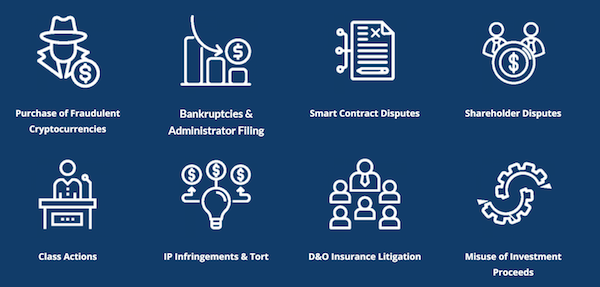
There are a variety of common disputes involving blockchain, from misuse of funds to smart contract failures, which are listed below.

Misuse of investment proceeds happens when “fundraising proceeds go to founders’ Lambos and villas” instead of legitimate business needs, he explains. While the occasional boat party networking or team-building event might be justifiable, salary packages are the main permissible routes by which invested capital can flow to the founders — even dividends can only be paid from profit, not incoming investments.

The sale of fraudulent crypto happens when a token is sold to investors based on false claims. A possible (though not tested in court) example is found with the automated market maker protocol SudoRare, which suddenly shut down and disappeared with investors’ money. Such cases can easily cross the threshold into criminal territory, according to Corbett. However, he admits that pursuing the culprits can be very difficult unless the scammers have been reliably identified.

Illegal securities offering. One way that investors in flopped tokens can attempt to claw back money is by claiming securities fraud, demonstrating that the offering was illegal in the first place, such as an unregistered securities offering masquerading as a utility token sale. “There are currently several U.S.-based class action lawsuits running against U.S. projects,” such as those against Bitconnect and Solana. Corbett explains that such claims fall under securities law, being civil claims as opposed to those brought by the likes of the SEC classifying projects like Ripple as securities.

Difficult organizations to sue. Another area that can present a legal minefield is DAOs, which are often “not registered anywhere and don’t have any kind of legal personality, and individuals are just working on their behalf.” Corbett warns that such arrangements can easily expose unsuspecting DAO workers to vicarious liability since the entity they believe they are acting on behalf of may not actually exist.

Even smart contract disputes can lead to the courtroom. “If two parties agree to act according to a certain trigger on a smart contract, but it somehow malfunctions, that can put a lot of liability on the coder or smart contract audit firm,” Corbett says. In such cases, the insurance policies of audit firms become critical.

There are many areas of law by which blockchain companies can find themselves in trouble. Source: Nemesis

When it comes to IP infringement, it is easy to imagine NFTs where copyrighted images are being minted and sold without permission. Even code, however, can be protected by copyright or patents, in which case implementing the code of other projects — or even forking certain tokens — may result in a serious claim. (This is obviously not the case with open-source software, which is why Uniswap’s code has been forked so often.)

High costs

Irena Heaver, a Dubai-based lawyer specializing in blockchain, explains that while the aggrieved party is responsible for funding civil lawsuits, criminal cases are pursued by the state. As criminal cases deal with criminal matters rather than mere torts or “mistakes,” like a breach of contract and can result in prison instead of monetary judgements, the bar is set much higher in regard to evidence.

As an ideal, a criminal conviction can happen only when all reasonable doubt is removed, whereas a civil judgement can be made on a balance of probabilities, meaning that one party is at fault more likely than not. It is also the state, instead of the victim, that decides whether to pursue a criminal case — something that happens infrequently when the alleged thieves are far overseas.

If the state isn’t going to fund it and you can’t afford to drop seven figures on the uncertain outcome of a court case, what can you do?

Alternative dispute resolution, involving either arbitration or mediation, is a cheaper option than formal courtroom proceedings. While arbitration is usually a binding process that can be viewed as “court lite,” mediation is a lower-cost private process in which a third party actively helps the parties come to a mutual understanding and agreement, Heaver explains. “I always recommend mediation,” she says, explaining that she has mediated dozens of crypto disputes where both parties have reached a satisfactory conclusion.

Sometimes conflicts can be amicably settled through cost-effective mediation. Source: Pexels

When a case does go to court, Heaver emphasizes that “the judge needs to understand what is going on,” which is far from self-explanatory when it comes to complex questions involving newfangled monkey-DeFi derivative crypto meta-chain utility tokens.

That means “judges rely on expert testimony, and we all know about the fake experts in this space.” These experts are selected and paid for by the parties themselves, and Heaver laments that “for the right amount of money, you can find an expert — whatever you want,” naturally requiring the other party to pay for their own expert to refute the other.

When there are a large number of potential claimants, class-action lawsuits can pool them together into a single case. These are often undertaken by law firms as entrepreneurial undertakings, where the law firm does not charge claimants, who instead agree to give the firm a share of any settlement or winnings. 

An example can be found in a class action against billionaire Mark Cuban, who Moskowitz Law Firm argues used his fame to “dupe millions of Americans into investing — in many cases, their life savings — into the deceptive Voyager platform and purchasing Voyager Earn Program Accounts, which are unregistered securities.”

Subscribe
The most engaging reads in blockchain. Delivered once a
week.

DeFinance

Another way to raise an army of lawyers without selling both kidneys is legal financing, also known as settlement funding or third-party litigation financing, which happens when a private investor gives a plaintiff money in return for a percentage of a legal settlement or judgement. This is effectively an outside investment toward a successful lawsuit, and the invested funds are generally directed toward funding the lawsuit in question.

“It’s about pairing someone with a risk appetite with a plaintiff who has a lawsuit but no funds,” explains Bill Tilley, managing partner of legal venture fund LegalTech Investor, who has been working in the legal financing industry for 15 years. Funds like his look into an average of 20 cases for each one they take on, with the full due-diligence process costing up to $100,000 before a decision can be made to fund. This involves not only determining that a case is likely to succeed but that the defendant can actually be made to pay.

“The big challenge in a crypto case is whether you can find and collect the money, even if you win the case — resources need to be spent to trace the money.” 

Determining the jurisdiction in which a case can be tried can also be a huge challenge in itself. In his own litigation funding research, Tilley has come across a perplexing trend of crypto-mystery. “We’ve looked at some crypto cases where just nailing down the jurisdiction is a nightmare — they’ll have multiple entities domiciled in multiple countries,” he recalls. Crypto law is not an easy industry to crack.

?Breaking:? In a lawsuit funded by Coinbase, crypto investors are suing the US Treasury to block the sanctions it issued which bar Americans from using Tornado Cash.— Mario Nawfal (@MarioNawfal) September 8, 2022

Enter Nemesis

For the past several years, Corbett has been planning to create a blockchain-specialized litigation fund. “There was no point launching this when everything was going up,” he says, but now with the bear market bringing increasingly disappointed investors to law offices around the world, things are looking up for crypto law. His litigation fund, Nemesis, has now gone live.

“The litigation funding industry is growing fast and becoming a financial solution for a handful of use cases. Part of its maturity is increasing competition on investments, which requires the funder to, in addition to providing capital, add value to the case. Therefore, there is a rise in domain focus funds,” he says.

“Like any investor, it is important to build a trustable relationship with the plaintiffs and make sure their expectations from the case are reasonable and their motivations are in the right place. It is also important to have legal teams, consultants and experts with a proven track record in the subject matter.

Jurisdiction plays a decisive role. “We can’t enforce judgements against people in certain countries, so we have to pass on matters like that,” he says, adding that the United States and the United Kingdom, where enforcement of court orders is relatively straightforward, are the biggest markets for blockchain law. “The British Virgin Islands are also interesting because a lot of blockchain projects have used those structures,” he notes. “The EU, U.S., U.K. and Australia have mature legal funding industries,” he says, adding that not all jurisdictions allow for cases to be financed by third parties.

An overview of Nemesis’ investment criteria. Source: Nemesis

Similarly to Tilley’s firm, Corbett says that his Nemesis team vets cases to select those which are most attractive from an investment perspective. “We look to earn either multiples or a percentage of the investment,” he says, explaining that much of the potential outcomes are determined by the defendant’s director’s insurance plans, which often become the payers of last resort. “If the opponent has no money, the action often goes by the wayside,” Corbett concludes.

In addition to making oodles of money, Tilley explains that legal funders “get the added benefit of helping some people that have been wronged that wouldn’t otherwise have had access to the justice system today.”

“We can be part of fixing the problem of the bad actors by holding them accountable — so crypto will be bigger, stronger and better 5 or 10 years from now.

Have an idea for a kickass story? Find me at eliasahonen@cointelegraph.com, or on Twitter

Read also

Columns
Wall Street disaster expert Bill Noble: Crypto spring is inevitable

Hodler’s
Putin gives Snowden citizenship, Interpol elicits help in Do Kwon search and FTX US buys Voyager: Hodler’s Digest, Sept. 25-Oct. 1

Elias Ahonen
Elias Ahonen is a Finnish-Canadian author based in Dubai who has worked around the world operating a small blockchain consultancy after buying his first Bitcoins in 2013. His book ‘Blockland’ (link below) tells the story of the industry. He holds an MA in International & Comparative Law whose thesis deals with NFT & metaverse regulation.

Follow the author @eahonen

Čítaj viac

Crazy outcomes when current laws applied to NFTs and the metaverse

NFTs can now serve as court documents… but they might also be unregistered securities, illegal loot boxes, or come with impossible tax demands. Nonfungible tokens (NFTs) are thought of by most people as just funny pictures that degens on the internet spend far too much money on for poorly understood reasons. But Jason Corbett, managing partner of global blockchain law firm Silk Legal, says new and innovative use cases are beginning to emerge.“We’ve seen recently the courts allowing the serving of court documents by way of an NFT,” Corbett says, referring to a recent decision by a United Kingdom court to allow notice of the case to be served by airdropping court documents as NFTs to wallets allegedly stolen from the claimant.A bunch of legal absurdities occurs when you apply existing laws to NFTs and the metaverse.This changes our conception of what NFTs are and what rights and responsibilities come with them. Following this precedent, the sending of NFTs can be understood as a type of electronic communication, with the caveat that it is generally public. The sending of NFTs is more comparable to attaching posters to the outer wall of one’s house versus discreetly sliding them into the mailbox.This comparison to publicly visible posters begs the question of whether this means that individuals controlling blockchain wallets hold responsibility for the NFTs they hold, in the same way as a homeowner would ultimately be responsible for removing obscene or otherwise illegal posters on their property, even if placed there against their will. Does this mean that, for example, the owners of wallets may in the future be responsible for monitoring them for any type of illegal content sent to them, and act quickly to dispose of them in some manner? That’s just scratching the surface.Metaverse Law MA thesis “ENCODED TERRITORY: The Blockchain-based Metaverse as a Special Environment of International Law” argues that the #Metaverse influences the balance of global power & demands special legal treatment @UniTurkuLaw @UniTurku#NFTs #BlockchainGaming #cryptolaw pic.twitter.com/GSvghv6Xoy— Elias Ahonen.eth (@eahonen) June 11, 2022“The blockchain Metaverse presents challenges to the international order due to the limited ability of states generally to intervene in metaverse-based actions,” I wrote in my Master’s in International & Comparative Law thesis, “The Blockchain-based Metaverse as a Special Environment of International Law.” One fascinating, and perhaps off-putting, matter that has continued to come up in my research is the lack of clarity and, at times, the absurdity of earthly legal matters when applied in, and to, the metaverse.NFTs and cryptocurrencies are a good place to begin exploring the subject, seeing they are effectively the building blocks and lifeblood of the metaverse. Both are, of course, tokens — one being nonfungible in the sense that they are unique “items,” with the other being fungible “energy” with which the metaverse operates. By metaverse, we of course refer to the blockchain-based version of it, not some corporate-controlled Fortnite version.Securities regulationsA variety of cryptocurrencies, often known as tokens or coins, began to appear in 2011 as theoretical alternatives to Bitcoin. Growing in prominence, they had their day in the spotlight during the initial coin offering (ICO) boom of 2017, during which hundreds of projects attempted to raise money by issuing tokens to investors. When hundreds of millions of dollars are being raised in an entirely new way, it’s not surprising that potential legal concerns are lurking around the corner. This was certainly the case with ICOs, which regularly ran afoul of securities laws and the related accredited investor laws, says Randall Johnson, a United States lawyer with 30 years of experience specializing in securities regulations and who advises various blockchain projects.What will be the law of the metaverse? . The legal and ethical dilemmas plaguing technology today will only grow more acute in the metaverse, writes Brian Harley. How will real-world laws apply?— Nathan (@shanzi73338680) August 28, 2022He explains that one of the key questions around whether a token can be classified as a security is whether “the general public would think it is an investment.” This means that white papers or presentations that boast that tokens are “already on exchanges” or, worse, openly describe them as “good investments” and use “to the moon” style boosterism, are painting targets on their backs. Another factor that almost always makes a token a security is “if it operates like a dividend-paying share in a company,” he explains.“A large part of regulator analysis on whether a token might be a security has to do with how it is advertised and promoted.”But how is the financial regulation of cryptocurrencies related to the metaverse and NFTs? It’s because NFTs are tokens just the same, and serious questions could arise regarding their status as securities.What some may view as art might look like little more than stock certificates emblazoned with digitally generated monkey pictures to regulators. Indeed, Johnson himself is co-founder of LiquidEarth, a platform that is turning title deeds into income-producing real estate from around the world into NFTs.His companies do not fractionalize the deeds because “then the NFT is by definition a security,” he asserts. The long-term goal is to create a “global real estate exchange” where one could seamlessly invest across borders, with the actual deeds held in trust.A non-fractionalized real estate NFT seems to steer clear of securities regulations. Source: LiquidEarthJames Woolley, chief marketing officer of Metavest Capital, agrees that while most NFTs do not resemble securities, others are likely to get caught in regulator’s nets.“There are variations of NFTs that will struggle to pass the Howey Test — fractionalized NFTs where there is a ‘lead role’ played by a marketplace or exchange will likely be more formally regulated by the Securities and Exchange Commission.”Woolley also mentions worrying speculation that the SEC under Gary Gensler, which has remained tight-lipped on the issue beyond declaring Bitcoin a commodity, has its aims on declaring “all other fungible and nonfungible tokens” as securities — a move that would do untold damage to the industry.Other experts worry that Web3 innovation has left appropriate regulations far behind.“Regulatory authorities worldwide are failing to keep up with the rapid technology developments in the Web3 and the metaverse space,” concludes Irina Heaver, partner of Keystone Law specializing in blockchain industry and general partner of VC investment firm Ikigai Ventures.Irina Heaver, (2nd from right) on a metaverse panel moderated by Elias Ahonen (left) in Dubai. Source: WOW SummitIn her work, Heaver describes regularly hearing concerns from regulators because innovative new crypto business models “inadvertently trigger existing regulations concerning banking, lending, capital formation and other activities which were traditionally the domain of large players, such as banks.” “Developers can code faster than any regulator can regulate.” Yes! We have no bananasOne example of possible triggering of securities regulations may be found in yield-bearing NFTs. Take for example CyberKongz, sometimes credited as the first NFT monkey collection, whose 999 “Genesis Kongz” “yields 10 $BANANA a day,” according to the site, in reference to the project’s cryptocurrency. At the project’s height, this meant that each monkey-holder earned the equivalent of over $700 per week. In this case, would it not be unreasonable for a regulator to consider each CyberKongz NFT the equivalent of a class-A share paying daily dividends on the project? It’s still a gray area, but the possibility is not entirely closed off.You may owe the government 30% of your bananas. Source: CyberKongzIf such a precedent is established, it could open a Pandora’s Box regarding what the extent of securities regulations could be.Suppose an artist creates an NFT series titled “An Artist’s Share” whose 100 unique works are then included in smart contracts designed to automatically pay the owner of each “Artist’s Share” a 0.1% payout of the given artist’s gross revenue from minting and royalties. Would this be a mere NFT, or would it be a security? According to Johnson’s definition, it would seem to fit the bill. Could simple airdrops of new art to existing collectors also fit the bill?Taxation quagmireEven where NFTs may not be securities, there are serious uncertainties regarding how and on what basis they can be taxed.Consider a hypothetical blockchain game, where a player can begin playing for a small cost of $20. With time, however, the theoretical value of their in-game items (NFTs) may grow. Does the mere playing of a metaverse game thus entail potentially hundreds of taxable events per day, leaving an unsuspecting player on the hook for preparing tax returns comparable to those of a medium business in complexity?Taxes are already a major headache for NFT and crypto owners due to vaguely applicable rules. Source: PexelsAn example of this can easily be found with Axie Infinity, which, at least until recently, had a massive player base in the Philippines. Mark Gorriceta, managing partner at Filipino law firm Gorriceta Africa Cauton & Saavedra, said that in the country, NFTs have become “mainstream due to the rise of play-to-earn games like Axie Infinity.”Cointelegraph previously reported on the country’s Finance Undersecretary Antonette Tionko commenting regarding the play-to-earn model that “whoever earns currency from it, it’s income you should report it.” However, this seemed to only refer to the act of actually selling in-game assets (NFTs) or in-game “points” (SLP and AXS tokens) for fiat currency or other tokens.What is left unclear is what happens if a player, for example, finds a rare in-game item whose external market value is $100,000. If they simply elect to use this item in a game, will simply having the rare item come into possession be seen as a capital gain?If not, would the situation change if they trade, exchange or somehow convert the item into something else within the game — such as using a “magic metaverse log” valued at $100,000 to manufacture in-game planks with which to build an in-game house to boost the character’s in-game building score? Just how many taxable events could an in-game activity like this entail?Consider a real-world example of finding a gold bar while walking on a beach — in some tax systems, you might be forced to pay tax on it that year, potentially meaning that the bar needs to be sold in order to raise the money necessary to pay taxes. Even in jurisdictions where no taxes are owed because simply keeping the gold bar results in no realized gains, things generally change as soon as the bar is bartered for a new car or luxury watch, even if no fiat money was involved. Even personally smelting the bar into personal-use jewelry could spark a taxable event.This, of course, opens a new can of worms entirely — tax authorities would need a system by which to actively evaluate the market value of various, often unique NFTs. Perhaps NFT appraisers will be one of the new metaverse jobs accounting firms around the world will soon be hiring for.Wealth taxes for NFT collectors?Speaking of the market value of NFTs, questions arise regarding various forms of wealth tax that are present in various European countries, such as Norway, where residents must annually pay 0.85% of the value of their net worth exceeding $170,000. This means that each year, Norwegians should estimate the total value of their NFTs, whether game items, art, metaverse real estate, ENS domain names, or good old monkey pictures. While a floor-level Bored Ape Yacht Club NFT worth $100,000 would incur $850 in annual taxes, how much does the owner of a monkey with rare features like laser eyes or gold skin need to dish out? What about subjectively desirable numbers such as Monkey #8888 or #69420? No one knows, but the Norwegian tax office will expect their due regardless.These “last sale” prices are one way to estimate NFT value, meaning these owners could owe big ETH to the tax man depending on where they live. Source: OpenSeaContinuing with the Axie Infinity example, the metaverse’s mode of operation introduces certain territorial absurdities when it comes to taxation. For example, the Philippines has territorial taxation, which means that, for example, an Australian citizen living in the country would need to pay taxes only on income they earn from the Philippines, while income from elsewhere remains effectively tax-free. This means that the hypothetical Australian playing Axie Infinity in the Philippines would need to know the tax residency of every person they are selling their NFTs to, especially considering such a large portion of the player base is indeed within the country. Determining the tax residency of NFT buyers is, of course, not practically possible in the open and decentralized markets as they exist today. This may become a serious issue in the future, for example, with countries that charge sales tax when goods or services are sold within the country.Meanwhile, in Australia, there are certain circumstances in which NFT owners may need to pay a 10% Goods and Services Tax, depending on if it’s a Personal Use Asset, a Capital Asset of a business or used as a part of a business.Though things are still at their early stages, Corbett says that in a few years, tax systems “will be reading what’s happening on blockchain,” referring to advanced versions of tools, such as token.tax, which will be used by both individuals and regulators. The surveillance of exchanges that serve as on- and -off ramps for fiat will also increase, allowing the tax man to uncover positions.“Tax authorities will start kind of cobbling together what the taxable crypto positions of nationals are.”Is it possible they will start combing through those immutable records back to today and apply laws and taxes retroactively to current NFT owners? Will there be a new generation of prison gangs forming around NFT affiliations — Apes Anonymous, anyone?In the upcoming FLIP Buzzwords webcast, we explore how the #metaverse impacts legal issues such as personal injuries, copyrights, patents, contracts, claims by users against companies, and claims against other users under crime and tort law. Register: https://t.co/zqBMCOg0nI pic.twitter.com/FHKvoiBOeH— LawSocietyNSW (@LawSocietyNSW) August 24, 2022Loot boxes and gamblingMany countries regulate gambling, which would likely include metaverse-based casinos. Some governments even place restrictions on the inclusion of purchasable loot boxes in video games, often citing a desire to prevent young people from gambling. This is likely to become a concern with play-to-earn games, where loot boxes might take the form of NFT minting.This raises wider questions over whether NFT minting itself could be considered a legal equivalent to loot boxes or gambling in general. This is because NFT minters often pay significant sums of money in hopes of getting a particularly rare or valuable version of the NFT being minted. Beyond loot boxes, one might be concerned whether the entire play-to-earn model, where players can be understood to bet money in various ways, might itself be classified as gambling with a broad brush. Woolley, however, is optimistic, explaining that in 2012, a U.S. federal judge ruled “ruled that poker is not gambling under federal law because it is primarily a game of skill, not chance,” a model he hopes will be applied to metaverse gaming. Despite this, the jury is still out on “whether games like Axie infinity and their successors can be considered gambling — it’s a question that hasn’t been formally answered.” The South Korean government has already banned such games due to gambling fears, but there are signs the ban may be reversed or amended. Have you encountered strange or bizarre legal questions relating to the metaverse? Feel free to contact the author at eliasahonen@cointelegraph.com to share your story.

Čítaj viac

Fake employees and social attacks: Crypto recruiting is a minefield

Hiring in the crypto world can be difficult. Web3 companies are often disorganized and lack HR departments. Developers sometimes want to remain anonymous — even to their potential employers. Some employees don’t exist at all, while others are secretly juggling three other remote gigs. Then there are those who pretend to be employees but are really just plotting to rug everyone.The job of a hiring manager is no easy one. This goes doubly so for the Web3 world, where expectations both from employers and employees can be drastically different compared to the Web2 corporate world.Magazine spoke to Declan Strain, managing partner of Dubai-based talent consultancy BlockDelta, which helps companies in the Web3 industry connect with workers of all levels. After 20 years as a recruiter, he became involved in the blockchain space in 2015 and set up his specialist consultancy in 2017.“A traditional recruiter won’t be as successful as someone who lives and breathes this space,” he says, referring to his efforts to “be part of the fabric of the metaverse” by attending events and making connections in person.Fake employees and remote workers you’ve never met are some of the issues in Web3 recruiting.The ICO craze of 2017 saw projects being organized by small groups of developers who often lived in different countries, perhaps never meeting together. Still clearly in a gray-market industry phase, new hires could not be easily recruited via job boards but were often found online via Twitter or in chat groups on apps like Telegram.“There was no due diligence, so projects were often hiring the wrong staff,” Strain laments, which can quickly get expensive considering the average blockchain developer earns $12,500 per month according to Dataconomy.Compared to more established industries, Strain describes many Web3 companies as still being particularly disorganized, without human-resource managers — let alone internal recruitment departments, which come standard for more established technology companies of comparable size. This often stems from the fast pace of the industry, where things simply change so fast that established procedures are not put in place. Job board Indeed.com reports that there are 118% more postings for blockchain jobs compared to last year, with a larger share of these being remote when compared to the software industry generally.He argues that in the wild west of a new industry that crosses borders seamlessly, it is “important to have a trusted recruiter to do due diligence in order to keep out bad actors.” What exactly does he mean by “bad actors?”PitfallsOne situation that companies can face when hiring a candidate, according to Strain, is that they will come across a nearly perfect hire who “ticks off all the boxes initially.” But despite initial appearances, they are unable to verifiably back up their previous work with, for example, a strong GitHub profile in the case of a developer. Once these applicants are hired, it can take “several weeks to find out that the new employee is not what they say they are,” with the project being delayed due to having to restart the hiring process again. Often, the over-inflating candidate is more than happy to deal with the embarrassment of being fired because “a one-month blockchain developer salary can go a long way in certain parts of the world.”Another common pitfall for Web3 companies, where most work is done remotely, is the hiring of full-time candidates who are “in reality juggling three to four jobs,” which are naturally left undisclosed to the new employer. Others are more honest, explaining that they already have a job but try “to convince them that they can take on a second, simultaneous full-time commitment.” While there may indeed be 168 hours in a week, one is advised to stay away from such candidates.Urgently seeking #GAMEFI Devs/CTO’s and additional candidates for our network of global clients. Please feel free to email jobs@blockdelta.com to initiate a confidential chat. #BlockDelta – #blockchain specialists since 2017.#crypto #nft $BTC $ETH #nftcommunity #gaming #tech pic.twitter.com/4xELetPR8G— BlockDelta (@block_delta) April 1, 2022A more complex version of this issue is when the person being interviewed merely pretends to be a candidate, being, in reality, the business developer for a team of subcontracted developers who work on a number of projects simultaneously, essentially operating as a consultancy while pretending to be a dedicated employee. “Say, a Vietnamese ‘employee’ with good English basically fronting as an individual but has a team working behind him,” explains Jason Corbett, managing partner of Silk Legal — a commercial law firm specializing in blockchain with offices in New York, Bangkok and Dubai. Such situations are especially troublesome from the perspective of trust and security “around who is controlling any kind of private keys.”“If you wanted to hire a consultancy, you’d go to a consultancy,” Strain stresses, explaining that such arrangements are a problem for a number of reasons, from data protection to competing deadlines where the employer may not end up getting the attention they expect. Strain describes such situations as surprisingly frequent. “These are most common in Asia, but it can happen anywhere,” he notes.Some companies have found they recruited someone they thought was an employee but was really a frontman for an entire team.Moving from bad to worse, there are truly malicious actors who “do their work but dig deeper to try to get what they want, whatever it is.” This could include infiltration by corporate spies or — worse — black-hat hackers who end up getting “access to things they shouldn’t have access to and initiate hacks,” which can have dire consequences for a blockchain company. While he does not have direct experience with competitors sending moles, hacks perpetrated by insiders are an unfortunately common occurrence.“One bad hire can ruin your project.”Corbett confirms this, saying he has “had clients that have been rugged by their external developers, and we are now dealing with legal issues and trying to enforce recovery on their behalf.” This is, however, difficult because there is little evidence regarding the hackers’ identity, as projects often fail to obtain proper KYC of new hires in the onboarding process.Hiring for Web3There is often a perception among applicants that people from western countries will earn higher salaries, which Strain admits can be true.In a decentralized online world, it’s sometimes difficult to know who you are hiring.(The controversial practice of location-based pay is said to be related to the cost of living, and big companies, from Apple to Meta, pay employees differently even depending on where in the U.S. they live.)This has led many candidates to lie about their nationality or country of residence, including one time when a candidate “appeared on video link as an Asian national with a strong accent who claimed to be from London with the name John Smith, clearly wearing a wig and fake beard.”Most interviews happen via Zoom, and it’s an immediate red flag if a candidate does not use video. “We had one candidate who point-blank refused, as he claimed he had facial reconstruction surgery the day before and was in no fit state to show his face,” Strain recounts, adding that this was not the only dubious point for the person in question.Another claimed to be in Poland but sounded South African, which he explained by having moved to Poland when he was two years old. Despite this, the 25-year-old said that he had not yet learned Polish and hung up the call when questioned further.Credible crypto“The big question is: Have they worked for a credible project before?” Strain says, explaining his hiring process.He describes “different classes” of blockchain workers, particularly developers. Those whose past projects can be described as well-known, respectable, official, corporate and top-level are easily the most desirable employees; however, “many candidates will have projects that aren’t exactly at the top of CoinMarketCap on their resume,” he says, referring the site ranking over 20,000 cryptocurrency projects by market capitalization. “You want to be careful about people who have been involved with pump-and-dumps, which, unfortunately, is a large portion of applicants — it can call their integrity into question and reflect badly on your project.”This does not mean that someone needs to have worked on Ethereum, Solana, BNB Chain or Polygon in order to be competitive — even projects in the top 400, which includes projects in the $50-million-market-cap range, can provide excellent experience. In many ways, the list functions like the Fortune 500 of crypto: Any high-level employee from such a company comes with a certain confidence-instilling pedigree.BlockDelta’s Strain, pictured attending a conference, stresses the importance for crypto-industry recruiters to intertwine themselves into the space. Source: BlockDeltaFor any recruiting agency, this is likely to go both ways — questionable projects want to hire staff, too. Strain says that at BlockDelta, “we make sure the entity we work with is registered and has the right structure,” adding that the company has turned down clients failing to meet their own threshold.Salaries in big crypto, like Big Tech, can be high. Blockchain developers with three to five years of experience on major projects and “with strong testimonials” command north of $300,000 per year. In what he calls the mid-range, $60,000–$70,000 is a starting point, and those with more experience, especially in managing a team, rake in $130,000–$140,000. Those rising to the role of chief technology officer can bring in half a million dollars, while chief marketing officers make roughly half that. When it comes to the top-20-ranked projects, salaries can rise substantially higher.11 HIGHEST PAYING JOBS IN BLOCKCHAINBlockchain and crypto are fast becoming one of the best industries for career prospects and opportunities at the moment. It can offer higher job security and salaries than many other industries ??‍?Is your profession listed? pic.twitter.com/Yr4aMM7PFd— Moralis Academy (@MoralisAcademy) October 23, 2020Unique aspects of the industryPerhaps uniquely to the industry due to its cypherpunk roots, Corbett notes that a notable portion of workers wants to be anonymous. The problem with this, according to him, is counterparty risk, which can amount to a “breach of basic fiduciary duties” on the part of the business, which would have little recourse if cheated by their anonymous worker. He laments that some teams have ignored his advice, hiring anonymous workers only to have them prove to be a significant liability.“You can get stuck in a situation where your community and investors are yelling at you because something’s happened, but you have no idea who you actually contracted.”“When people tell me they want to be anonymous, I tell them that’s nice, but this is the real world, and this is how it works,” Corbett says.Shafeeq Qureshi, managing partner of London-based financial industry recruitment agency Bright Mile, which now operates in the blockchain space, agrees that challenges in crypto hiring sometimes begin with the employer. “I have come across quite a few projects where the founders do not want to share their public profiles,” he notes, which presents certain difficulties considering many members of the workforce are not comfortable working for anonymous bosses. Qureshi has also found many less-than-reputable companies to have created fake employee profiles on LinkedIn — something he screens for before taking on clients because “both our time and credibility are at stake.”Hiring internationally via Zoom means employees often miss out on benefits and have to report their own taxes.Borderlessness is another remarkable factor in the blockchain industry, and that extends to the geographical distribution of the workforce. Strain surmises that “as long as a candidate is happy to work, normally, the project is happy to pay — working out payment structure is usually the main thing.”“I don’t hear companies saying that we can’t hire a person from a certain country — I think that’s a beautiful thing.”But it also means that it is not often possible for employers to support employees directly by way of country-specific benefits, such as medical insurance in places like the U.S., instead paying a fixed amount and leaving the employee to look after their own insurance. Luckily, there are solutions like Opolis, a DAO providing insurance for freelancers.This borderlessness also means that companies do not usually report directly to the tax authorities of an employee’s country, which, in many cases, leaves them with additional responsibility in filing income reports correctly. “I think most of them report their income to relevant authorities,” Strain says, though acknowledging that not doing so may be easier than with other industries.While some projects looking for personnel believe that the recent downturn has slowed hiring and brought wages down, Strain happily points out that “top candidates who lost their jobs recently from the larger heavyweight projects are getting snapped up very quickly,” adding that there is still plenty of hiring going on.

Čítaj viac

The ‘godfather of crypto’ risked lifetime in jail, laying foundation for Bitcoin

Widely credited as the inventor of digital cash, David Chaum is sometimes known as the “father of online anonymity” or the “godfather of cryptocurrency,” whose work inspired the near-mythical group called the Cypherpunks from which Bitcoin emerged. Beginning his studies in computer science in the late 1970s, when encryption was classified at the same level as nuclear technology, Chaum quickly realized that the technology would be crucial to ensure the continuation of privacy and democracy in the digital age. More recently, he founded xx Network, a privacy-focused blockchain whose connected xx Messenger Chaum hopes will withstand attacks even by quantum computers of the future.“The National Security Agency was taking the position that cryptography was born classified, even if you created it yourself — like nuclear weapons technology,” Chaum recalls. He was told around 1980 that conferences on the subject would naturally not be allowed and that “people who organize them would be prosecuted.” Cryptography, encryption, cypherpunks, xx Network, xx Messenger, xx Coin, privacy, quantum computing, Ecash, DigiCash, democracy, Hannu Nurmi — “I was risking spending the rest of my life in jail,” he says.David Chaum was 10 years ahead of the Cypherpunks in his understanding of cryptography and digital privacy.CyberwarEncryption has long been of vital importance in warfare, and the Allies breaking the cipher of the Enigma machine and decoding the Nazis’ secret messages changed the course of World War II.Afterward, the United States government regulated cryptography as a military munition alongside nuclear technology. The 1976 invention of public key encryption, which allowed information to be shared between two parties without a mutual encryption and decryption key, which could not be cracked or intercepted, took away governments’ monopoly on the technology. The cat was out of the bag, as they say.As a computer science graduate student at the University of California, Berkeley in 1977, Chaum, now 67, recalls how he “started thinking how important privacy would be for the upcoming digital world” and, by extension, for democracy. Privacy was the default state in those analog days, with surveillance such as listening to conversations, intercepting mail or searching for records requiring active and concentrated effort. With digitalization, surveillance no longer needed to be active, as data could be more easily searched, cross-referenced and stored for later use. Chaum came to the “fundamental realization that cryptography was the only way to protect privacy in cyberspace,” he recalls.“That’s when I realized it was important to organize a conference on cryptography,” he says with a laugh, fully recognizing the absurdity. The result was the International Association for Cryptologic Research, which continues to organize conferences several times a year. “I called it crypto — the conference was called Crypto 81,” he notes. The first cryptocurrency team, Ecash, circa 1994. Source: chaum.comHe was the first person to describe cryptographic money in his 1983 paper, “Blind signatures for untraceable payments,” which led to the creation of short-lived Ecash by his company DigiCash from 1995 to 1998, as well as the invention of blind signatures, a type of digital signature used in Bitcoin and other cryptocurrencies. It is notable that some cryptographers, such as Matthew D. Green, have aired grievances with the word “crypto” coming to stand for, and even being soiled by, cryptocurrency, thus disrespecting its original meaning of “encryption.” Chaum takes the opposite view. “It’s so exciting to me because it’s bringing what was an archaic, esoteric, highly technical, mathematical, possibly classified technology area into widespread appreciation, so on contrary, I’m happy” to see the word “crypto” get new life.“Crypto” means cryptography. Not that other thing. https://t.co/yaLOOCyx8d— Matthew Green (@matthew_d_green) November 23, 2017Backed by privacyAmong the most remarkable aspects of Chaum’s work is that his 1985 paper “Security without Identification: Transaction Systems to Make Big Brother Obsolete” is credited as providing the spark from a privacy-focused group in 1992 that began calling themselves the Cypherpunks.Princeton’s Arvind Narayanan wrote about the group:“[This movement], which originated in the late ’80s, took Chaum’s ideas and ran quite far with them in terms of rhetoric—in an explicitly subversive direction. For cypherpunks, crypto was at the core of a vision of how technology would cause sweeping social and political change, weakening the power of governments and established institutions… Anonymous digital cash, one of the key parts of Chaum’s proposal, by itself has political significance in that it offers an alternative to government-backed currencies.” After several unsuccessful attempts at digital cash by various members of the Cypherpunks, the Bitcoin white paper by Satoshi Nakamoto emerged in 2008. He was soon contacted by fellow member Hal Finney, who went on to receive the first Bitcoin transaction on Jan. 9, 2009. As such, Chaum is appropriately labeled the godfather of cryptocurrency.But Chaum wants to go further with private, uncrackable payments. In order to have real privacy in the modern age, Chaum explains that actions must be un-linkable both to the individual (vertical un-linkability) and to each other (horizontal un-linkability), meaning that individual actions must exist within a data vacuum of sorts. Unlike PayPal or credit cards, cryptocurrencies like Bitcoin and Ether are not directly linked to the real identities or IP addresses of users — the transactions themselves are, however, linked to each other, and publicly so.To have real privacy in payments, Chaum reasons, “you need to use a different pseudonym with each entity you interact with,” so as to ensure that nobody can keep a dossier on a particular anonymous identity. Taking the next step from privacy coins such as Monero and Zcash, Chaum’s xx Network is working on xx Coin to enable quantum-resistant private payments.”The difference between a bad electronic cash system and a well-developed digital cash will determine wether we will have a dictatorship or a real democracy.” Crypto pioneer David Chaum in 1996 #bitcoin pic.twitter.com/jiNh9TCqsf— BankSith Lord (@renegruner1) July 18, 2022A vision for governanceChaum is clear in his belief that “the only effective way to maintain any level of privacy is to control the information with your own keys” and goes on to explain that continuous government leaks suggest that any information entrusted with others can become public at any time. “All those leaks are forever, and they can be aggregated and amalgamated.”Unlike the criticism leveled at the Cypherpunks he inspired, Chaum denies being an ideologue, saying his views are based on practicality, as people need to have a credible assurance of privacy.Chaum argues that privacy, over the long term, is critical for a functional democracy because “you cannot be a citizen of a democracy without the ability to communicate freely,” bringing up a story about how when coffee was introduced in Europe around the time of the enlightenment, it was hated by kings as it encouraged people to spend their evenings discussing politics.Having a “private sphere of communication,” he argues, is the pivotal distinction between China and the West and that payments are a fundamental form of communication. A stable democracy, therefore, requires the ability to pay anonymously according to Chaum — something that has traditionally been the case with cash.“Did you know that every single banknote is traced from the teller desk to the ATM machine in China?” he notes. The Chinese government has introduced the digital yuan to get a panopticon-style view of every last payment.Despite all the attention on cryptocurrency, Chaum seems far more excited about blockchain as a mechanism of future governments. Armed with a confidently deep understanding of political history, he dives into a lecture.“We’ve had civilizations we know of for 6,000 years,” he begins, saying that they gained traction when they were able to exercise public policy but naturally became failed states and flipped to autocracy largely because of the difficulty of finding intelligent people to do the government’s work while resisting the temptation of corruption. “If democracy fails to govern effectively, it gets kicked out,” he says, somberly opining that the west appears to be heading toward such a phase.Join me in welcoming the xx messenger – truly a dream come true! A big thank you to all the hard work from the team at xx labs for making this vision a reality. https://t.co/zbIFxWEyu8— David Chaum (@chaumdotcom) January 26, 2022Citing University of Turku political scientist Hannu Nurmi, he reasons that direct democracy, a system in which voters vote on issues directly without the use of elected representatives and which was used in ancient Athens, is the only way to make democracy sustainable. Such a system became infeasible as societies grew beyond the city-state, but Chaum believes that the advent of smartphones and cryptography make the ancient system workable once again after 2,500 years.In practice, Chaum envisions the reemergence of Athenian democracy using a randomly selected sample of the population to vote on specific issues using their private keys in a way that he believes would root out the potential for corruption. A natural problem, however, would center around the media, which is immensely powerful in shaping political opinions of the would-be voters.“That type of democracy can scale to the complexity of modern civilization — no other system can,” Chaum asserts. “Nation states are proving to be somewhat dysfunctional — I’d much rather see a sort of global democracy if there was a way to make it fair in a poly-cultural and more diverse environment, which I think I’ve found.”It shows that blockchain outside of government is a very important step” toward such a new order, he says. Such ideas admittedly come across as rather grandiose and utopian in bringing back memories of a curious experiment in blockchain governance on a Thai island, but the name behind the vision commands one to envision where it could lead in 50 years’ time.Quantum threatsChaum is taken aback by the success of cryptocurrency’s proliferation since the publication of the Bitcoin white paper. “The fact that these economic instruments succeeded to be outside the control of governments is a profound thing,” he says. He is, however, no fanboy of the crypto order as it stands, seeing many shortcomings from privacy to vulnerability to quantum computing. “Bitcoin is not a digital currency — it’s something else right now,” he says.“Part of the reason I decided to launch my own project was that I sat in on an early Ethereum 2.0 meeting,” he recalls, coming to the view that “it was not likely to happen in a good way any time soon.” Chaum founded xx Network in 2016, which he describes as a quantum-secure blockchain. “The first phrase of Satoshi’s white paper is ‘a digital currency’ — that’s me, right?” he says referring to his invention of the concept itself. In his opinion, both Bitcoin and Ethereum “are a little jammed up” and fail to live up to the functional title of a “digital currency.” They also face an existential threat from quantum computing, which some believe could arrive by 2030.“There’s a bunch of ways you can use quantum computing to either steal money or damage the consensus unless both are hardened in this way,” he asserts, referring to the quantum-hardened nature of his xx Network.“The kind of encryption used by Bitcoin and Ethereum can be easily broken by a reasonably large quantum computer in seconds.” Many cryptocurrency enthusiasts believe that no such computer exists or is likely to come around anytime soon, but Chaum points out that “people who have machines that can break other people’s codes find a lot more advantage in keeping that a secret than in announcing it,” again using history to demonstrate his point with the fact that the Allies allowed German U-boats to sink passenger ships in order to prevent giving away that they had broken the Enigma Code. What so many people in the @xx_network community have been waiting for, is finally going to happen at the end of July… ??For those who don’t know xx network, it’s a privacy focused bc/ecosystem founded by THE cryptography OG David Chaum. Start here: https://t.co/aFxIaero9L— Philipp Weber (@PhilippWeber_) July 14, 2022Be calm and don’t panic just yet. According to The New Scientist, “calculations show [quantum computers] would need to be a million times larger than those that exist today” in order to crack Bitcoin. Cointelegraph recently reported on an MIT Tech Review report that asserts that such threats are many years away and a successful quantum attack “is akin to trying to make today’s best smartphones using vacuum tubes from the early 1900s,” according to physicist Sankar Das Sarma.If such a quantum capability did exist, it is difficult to imagine who could resist the temptation of declaring oneself Satoshi or his predecessor after effortlessly cracking the private keys to the estimated 1 million BTC mined by Nakamoto.Read more: 6 Questions for David Chaum6 Questions for David Chaum of XX Network

Čítaj viac

Získaj BONUS 8 € v Bitcoinoch

nakup bitcoin z karty

Registrácia Binance

Burza Binance

Aktuálne kurzy