Autor Cointelegraph By Dilip Kumar Patairya

Inside the MAS Sandbox: How Ripple is testing RLUSD for real trade settlements

Ripple’s role in Singapore’s BLOOM: A controlled step toward stablecoin integrationSingapore has strengthened its position as a leading hub for tokenized finance through Project BLOOM (Borderless, Liquid, Open, Online, Multi-currency).This collaborative initiative brings together a group of traditional banks, fintech firms and stablecoin providers to evaluate how digital settlement assets can be integrated into existing financial infrastructure.A notable partnership in the pilot involves Ripple and supply chain specialist Unloq. Together, they are exploring automated trade settlements using Ripple’s upcoming stablecoin, RLUSD, on the XRP Ledger.While Ripple’s inclusion may appear to signal a green light from Singaporean regulators, the reality is more measured. RLUSD is currently operating within a sandboxed environment, a structured testing phase focused on specific technical applications rather than a broad regulatory mandate.Distinguishing between this experimental validation and official licensure is essential to accurately assess the project’s current scope and future potential.What Ripple is actually testingRipple’s pilot project under the Monetary Authority of Singapore’s (MAS) BLOOM initiative is focused on a specific challenge: automating cross-border trade settlement through programmable digital money.The setup brings together three core elements:RLUSD as the settlement assetXRP Ledger as the transaction infrastructureUnloq’s SC+ system as the execution layer for trade finance workflowsRather than simply moving funds between parties, the system is designed to release payments automatically once specific commercial conditions have been met. These conditions may include shipment confirmation, document verification or financing triggers.RLUSD is being evaluated not just as a payment tool, but as an integrated part of a conditional settlement mechanism embedded directly into trade workflows.Did you know? Traditional trade finance still relies heavily on paper documents such as bills of lading, which can take days or even weeks to process. Programmable settlement systems aim to digitize and automate these workflows.What BLOOM is and what it is notThe MAS launched BLOOM in October 2025 to examine how tokenized money could improve settlement processes across borders and between institutions.The initiative extends well beyond any single participant. It includes banks such as DBS and UOB, infrastructure providers such as Partior, and stablecoin issuers including Circle. Ripple is just one participant in this broader ecosystem.Importantly, BLOOM is not a live production system. It functions as a sandbox-style environment that allows firms to test financial innovations under regulatory oversight.As a result, involvement in the initiative does not mean MAS has approved RLUSD as a universally accepted settlement asset. It simply indicates that MAS views the proposed use case as sufficiently promising to test in a controlled setting.Recognizing this distinction helps avoid a common misunderstanding. Participation in a regulatory sandbox reflects supervised experimentation, not formal regulatory endorsement.Why trade finance is a difficult test caseTrade finance is more complex than straightforward payments. A standard transaction typically involves multiple parties, including exporters, importers, banks, insurers and logistics providers, along with several layers of documentation and conditional obligations.Payments are rarely executed immediately. They are tied to specific events, such as:Traditional systems manage these interdependencies through manual procedures and intermediaries, often resulting in delays, errors and limited transparency.Ripple’s RLUSD pilot seeks to address this complexity by embedding payment logic directly into the settlement layer. Instead of handling documents separately before releasing payments, the process takes place within a single, unified execution framework.This approach sets the pilot apart from most stablecoin applications. It goes beyond simply speeding up money transfers. Instead, it focuses on synchronizing the movement of money with real-world commercial conditions in real time.Did you know? Stablecoins were initially popularized as a source of liquidity in crypto trading, but regulators are increasingly exploring their role in real-world financial infrastructure, including cross-border payments and settlement systems.Why MAS sandbox participation does not equal approvalRipple’s involvement in BLOOM coincides with a separate regulatory development. In December 2025, MAS expanded the range of payment activities permitted under the Major Payment Institution (MPI) license held by Ripple’s Singapore subsidiary.This licensing change allows Ripple to offer a broader range of regulated payment services in Singapore.Nevertheless, the BLOOM pilot remains separate. It is not intended to license Ripple’s products for widespread use, but rather to evaluate whether a specific settlement architecture works effectively in practice.The distinction can be outlined as follows:Confusing these two elements may overstate the regulatory significance of the pilot. BLOOM is designed to address technical and operational questions, not to select or endorse one settlement model over another.Singapore’s broader tokenization strategyRipple’s pilot is part of a broader MAS effort to explore tokenized financial infrastructure across multiple areas.In November 2025, MAS announced plans to issue tokenized MAS bills to primary dealers, with settlement facilitated through a wholesale central bank digital currency (CBDC). Around the same time, it also revised its guidance on tokenized capital market products to provide greater clarity on regulatory expectations.These steps point to a broader approach. Rather than supporting a single type of digital money, Singapore is testing a multi-asset settlement ecosystem that includes:Within this framework, RLUSD represents one possible settlement asset among several.How RLUSD compares with other stablecoin pilotsRipple’s approach differs from other stablecoin and tokenized money experiments currently underway in several important ways:What makes the RLUSD pilot distinctThree elements distinguish Ripple’s pilot: conditional settlement logic, integration with trade workflows and a multi-asset environment.Conditional settlement logic: Unlike most stablecoin pilots, RLUSD is being tested in a system where payments are contingent on real-world events. This adds a layer of programmability that extends well beyond basic transfers.Integration with trade workflows: The pilot embeds settlement directly into trade finance processes rather than treating it as a separate function. This has the potential to reduce fragmentation across documentation, financing and payment.Multi-asset environment: RLUSD is being evaluated alongside tokenized bank liabilities. This aligns with MAS’ broader objective of creating interoperable settlement assets rather than relying on a single dominant model.Collectively, these elements place RLUSD within a broader experiment in programmable financial infrastructure rather than limiting it to digital payments alone.Despite its potential, the pilot leaves several important questions unresolved:Can trade conditions be reliably digitized and verified in real time?Will smaller businesses actually benefit from improved access to financing?Can stablecoins and bank issued tokens coexist without fragmenting liquidity?How will regulatory oversight evolve if such systems move beyond the pilot stage?These questions underscore that the pilot is not a complete solution. Rather, it is an exploration of whether a new settlement model can function effectively at scale.Did you know? Smart contracts can reduce settlement risk by ensuring that funds move only when predefined conditions are met. This can help reduce disputes arising from mismatched documentation in international trade.Implications for stablecoins and settlement designThe BLOOM initiative suggests that the future of digital settlement may not be defined by any single asset type or infrastructure.Instead, regulators such as MAS appear to be examining a layered approach in which different forms of tokenized money serve distinct roles:Stablecoins for programmability and interoperabilityBank tokens for institutional liquidityCBDCs for sovereign settlement assuranceRipple’s RLUSD pilot adds to this ongoing experimentation, offering one possible model for how stablecoins could extend beyond simple payments into more sophisticated financial workflows.

Čítaj viac

Inside the 'fake police raid' that forced a $1M Bitcoin transfer

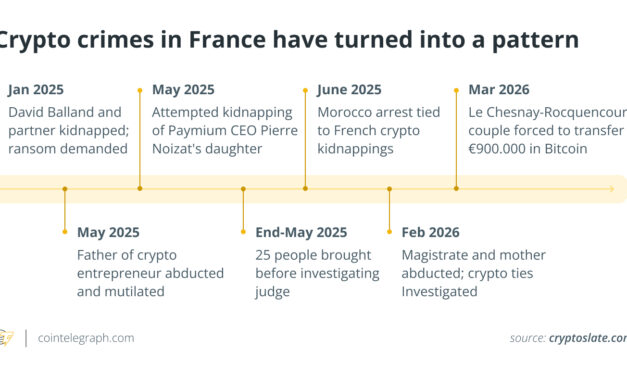
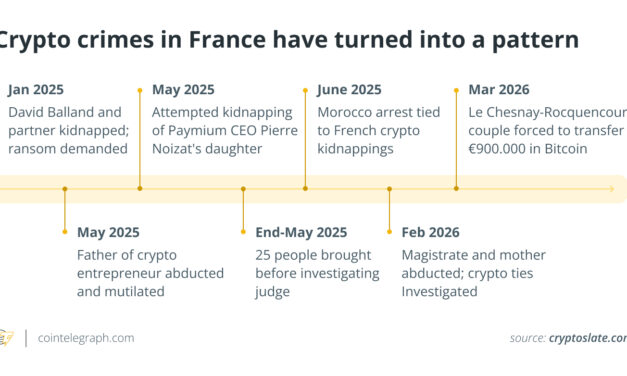
Key takeawaysCrypto security is expanding beyond digital threats, with criminals increasingly targeting individuals directly through physical coercion rather than trying to exploit blockchain vulnerabilities or hack wallets.The French case illustrates how attackers used a fake police raid and violence to force a Bitcoin transfer worth $1 million, bypassing encryption entirely by compelling the victim to authorize the transaction.Wrench attacks are rising, with criminals using threats or force instead of technical exploits. This highlights how human vulnerability can override even the most secure cryptographic systems.Impersonating authority figures such as police is highly effective because it combines fear, urgency and social conditioning, making victims more likely to comply without questioning the situation.Digital defenses are no longer the only front line in crypto security. While phishing and exchange hacks have long been major threats, a growing number of thefts now bypass code entirely and target crypto holders directly.A recent case in France highlights this shift. Attackers posing as police staged a “raid” and physically coerced a couple into transferring nearly $1 million in Bitcoin (BTC). This was not a failure of software, but a high-stakes robbery carried out through physical force.When the victim, not the wallet, becomes the targetThe incident occurred in Le Chesnay-Rocquencourt, a town near Paris, where a couple in their late 50s was allegedly assaulted inside their residence.Here is the chronology of the incident:Three individuals disguised as police officers gained entry to the home.The couple was threatened at knifepoint.The husband was forced to send Bitcoin to the attackers.Both victims sustained injuries, and the husband was physically restrained and tied up.The assailants fled the scene in a vehicle.French authorities are currently investigating the matter, with charges including armed robbery and organized criminal conspiracy.What distinguishes this case is not only the use of violence, but the specific strategy employed.Rather than attempting to crack encryption, the perpetrators bypassed it entirely by coercing the owner into authorizing the transfer.Why impersonating police officers is so effectivePosing as law enforcement officials is often effective because it taps into several psychological triggers:Authority: People are socially conditioned to obey police directives.Urgency: The appearance of an official raid creates the impression that immediate compliance is necessary.Fear: Any resistance can seem as though it may lead to criminal consequences.When criminals present themselves as police, victims often fail to question:The reason for their presence.The legitimacy of their demands.The authenticity of the entire situation.Under stress, the impulse to obey tends to overpower the instinct to verify or question what is happening.In crypto, this risk is even greater because a single approved transaction can move significant funds in seconds.Did you know? The term “wrench attack” became popular in the crypto space after an online comic joked that threatening someone physically is easier than breaking encryption. It reflects a real-world shift in which attackers bypass complex systems by targeting people rather than technology.From simulated police raid to coerced Bitcoin transferUnlike conventional robberies that target cash, jewelry or other tangible items, this assault specifically targeted digital cryptocurrency holdings.The attackers’ objective was straightforward: force the victim to carry out an immediate crypto transfer.This form of theft can be difficult to contain for several reasons: Stolen funds can be transferred anywhere in the world within minutes.Blockchain transactions are generally irreversible.Once transferred, funds can be moved quickly, which can make tracing and recovery more difficult.When the victim retains direct control over their wallet, criminals do not need to steal hardware or break through security. They only need to force the victim to approve and send the transaction personally.Understanding wrench attacks in the cryptocurrency spaceIt is often far easier to threaten a person with a wrench than to try to crack their encryption.Rather than attempting to hack a wallet, perpetrators may use:ThreatsPhysical violenceOther forms of coercionThese methods are used to force victims to reveal private keys or authorize the transfer of funds. Such attacks bypass even the strongest technical protections.No matter how strong the encryption is, human vulnerability can make that security irrelevant.Did you know? Some high-net-worth crypto holders now use “decoy wallets” with small balances. In a coercive situation, they can reveal these wallets instead of their main holdings, adding an extra layer of psychological and financial protection.Why these attacks are becoming more frequentSeveral underlying factors are driving this increase:Growth in self-custody: A rising number of users now hold their own private keys and manage their assets directly, making them more immediate and accessible targets.Visibility of high-value targets: Many cryptocurrency investors, company founders and executives maintain public profiles that make their wealth and identity relatively easy to identify.Advances in cybersecurity: As digital wallet security improves and remote hacking becomes more difficult, criminals are increasingly turning to the softer target, the human user.Instant global liquidity: Cryptocurrency enables near-instant transfers of value anywhere in the world without banks or intermediaries acting as gatekeepers.In 2025 alone, documented cases of verified wrench attacks reportedly rose sharply, increasing 75% from 2024. Europe, and France in particular, stood out as a growing hotspot for such incidents. Financial losses reached $40.9 million in 2025, marking a 44% annual increase. While kidnapping remained the primary threat vector, physical assaults surged by 250%.Why France has experienced a surgeFrance has recently recorded multiple high-profile violent crimes linked to cryptocurrency:Kidnappings carried out to extort cryptocurrency ransoms.Home invasions specifically targeting high-profile figures in the crypto industry.Coordinated operations by organized criminal groups aimed at stealing digital assets.These recurring incidents point to a shift in criminal behavior:More deliberate efforts to identify individuals who hold cryptocurrency.Increased surveillance of their physical locations and daily routines.A growing preference for direct physical targeting over purely digital methods.As cryptocurrency adoption continues to expand, public awareness of who owns it is also growing. Unfortunately, the physical risks associated with that visibility are rising as well.Why criminals increasingly choose coercion over hackingCrypto security has become increasingly strong. Hardware wallets, multisignature setups and cold storage solutions make remote hacking far more difficult.Coercion, however, changes the equation.Even the strongest technical protections may fail if a victim is coerced into unlocking their hardware device, revealing their credentials or authorizing a transaction.Coercive attacks bypass cryptographic defenses entirely, target points of human access and exploit natural human reactions.For perpetrators, this approach is often faster and more reliable than trying to break through technical defenses.Why Bitcoin remains particularly exposed in duress situationsBitcoin’s core architecture gives it considerable strength, but it also creates significant vulnerability when the owner is under coercion.Its key features include:The ability to transfer value immediatelyThe absence of any central entity capable of reversing transactionsPermissionless, worldwide accessibilityIn a situation where the holder is forced to transfer funds, these traits can result in:Assets being moved almost instantlyVirtually no realistic chance of recoveryAttackers rapidly moving funds across multiple addressesThe same qualities that give Bitcoin its independence and value also make stolen funds extremely difficult to recover once they are transferred under duress.Did you know? Private security firms have started offering specialized protection services for crypto investors, including travel risk assessments, home security audits and digital footprint reduction strategies aimed at preventing targeted attacks.How French authorities are respondingFrench law enforcement agencies are actively investigating the incident, with specialized organized crime units leading the effort.Potential criminal charges under review include:Although authorities are increasing enforcement in response to such incidents, these cases continue to present serious challenges because of:The rapid cross-border movement of stolen assetsThe pseudonymous and irreversible nature of cryptocurrency transactionsThe involvement of organized and professional criminal groupsKey security takeaways for cryptocurrency ownersThis incident underscores a major shift in the nature of cryptocurrency security threats.Protecting technical systems alone is no longer enough. Safeguarding wallets, private keys and physical devices must now be paired with strong personal security measures.Essential protective steps include:Never publicly reveal or discuss the extent of your cryptocurrency holdings.Keep your real-world identity separate from your wallet addresses and ownership.Use multisignature wallets so that no single individual or compromised key can authorize transfers.Distribute signing authority and key control across different geographic locations or trusted parties.

Čítaj viac

Inside the 'fake police raid' that forced a $1M Bitcoin transfer

Key takeawaysCrypto security is expanding beyond digital threats, with criminals increasingly targeting individuals directly through physical coercion rather than trying to exploit blockchain vulnerabilities or hack wallets.The French case illustrates how attackers used a fake police raid and violence to force a Bitcoin transfer worth $1 million, bypassing encryption entirely by compelling the victim to authorize the transaction.Wrench attacks are rising, with criminals using threats or force instead of technical exploits. This highlights how human vulnerability can override even the most secure cryptographic systems.Impersonating authority figures such as police is highly effective because it combines fear, urgency and social conditioning, making victims more likely to comply without questioning the situation.Digital defenses are no longer the only front line in crypto security. While phishing and exchange hacks have long been major threats, a growing number of thefts now bypass code entirely and target crypto holders directly.A recent case in France highlights this shift. Attackers posing as police staged a “raid” and physically coerced a couple into transferring nearly $1 million in Bitcoin (BTC). This was not a failure of software, but a high-stakes robbery carried out through physical force.When the victim, not the wallet, becomes the targetThe incident occurred in Le Chesnay-Rocquencourt, a town near Paris, where a couple in their late 50s was allegedly assaulted inside their residence.Here is the chronology of the incident:Three individuals disguised as police officers gained entry to the home.The couple was threatened at knifepoint.The husband was forced to send Bitcoin to the attackers.Both victims sustained injuries, and the husband was physically restrained and tied up.The assailants fled the scene in a vehicle.French authorities are currently investigating the matter, with charges including armed robbery and organized criminal conspiracy.What distinguishes this case is not only the use of violence, but the specific strategy employed.Rather than attempting to crack encryption, the perpetrators bypassed it entirely by coercing the owner into authorizing the transfer.Why impersonating police officers is so effectivePosing as law enforcement officials is often effective because it taps into several psychological triggers:Authority: People are socially conditioned to obey police directives.Urgency: The appearance of an official raid creates the impression that immediate compliance is necessary.Fear: Any resistance can seem as though it may lead to criminal consequences.When criminals present themselves as police, victims often fail to question:The reason for their presence.The legitimacy of their demands.The authenticity of the entire situation.Under stress, the impulse to obey tends to overpower the instinct to verify or question what is happening.In crypto, this risk is even greater because a single approved transaction can move significant funds in seconds.Did you know? The term “wrench attack” became popular in the crypto space after an online comic joked that threatening someone physically is easier than breaking encryption. It reflects a real-world shift in which attackers bypass complex systems by targeting people rather than technology.From simulated police raid to coerced Bitcoin transferUnlike conventional robberies that target cash, jewelry or other tangible items, this assault specifically targeted digital cryptocurrency holdings.The attackers’ objective was straightforward: force the victim to carry out an immediate crypto transfer.This form of theft can be difficult to contain for several reasons: Stolen funds can be transferred anywhere in the world within minutes.Blockchain transactions are generally irreversible.Once transferred, funds can be moved quickly, which can make tracing and recovery more difficult.When the victim retains direct control over their wallet, criminals do not need to steal hardware or break through security. They only need to force the victim to approve and send the transaction personally.Understanding wrench attacks in the cryptocurrency spaceIt is often far easier to threaten a person with a wrench than to try to crack their encryption.Rather than attempting to hack a wallet, perpetrators may use:ThreatsPhysical violenceOther forms of coercionThese methods are used to force victims to reveal private keys or authorize the transfer of funds. Such attacks bypass even the strongest technical protections.No matter how strong the encryption is, human vulnerability can make that security irrelevant.Did you know? Some high-net-worth crypto holders now use “decoy wallets” with small balances. In a coercive situation, they can reveal these wallets instead of their main holdings, adding an extra layer of psychological and financial protection.Why these attacks are becoming more frequentSeveral underlying factors are driving this increase:Growth in self-custody: A rising number of users now hold their own private keys and manage their assets directly, making them more immediate and accessible targets.Visibility of high-value targets: Many cryptocurrency investors, company founders and executives maintain public profiles that make their wealth and identity relatively easy to identify.Advances in cybersecurity: As digital wallet security improves and remote hacking becomes more difficult, criminals are increasingly turning to the softer target, the human user.Instant global liquidity: Cryptocurrency enables near-instant transfers of value anywhere in the world without banks or intermediaries acting as gatekeepers.In 2025 alone, documented cases of verified wrench attacks reportedly rose sharply, increasing 75% from 2024. Europe, and France in particular, stood out as a growing hotspot for such incidents. Financial losses reached $40.9 million in 2025, marking a 44% annual increase. While kidnapping remained the primary threat vector, physical assaults surged by 250%.Why France has experienced a surgeFrance has recently recorded multiple high-profile violent crimes linked to cryptocurrency:Kidnappings carried out to extort cryptocurrency ransoms.Home invasions specifically targeting high-profile figures in the crypto industry.Coordinated operations by organized criminal groups aimed at stealing digital assets.These recurring incidents point to a shift in criminal behavior:More deliberate efforts to identify individuals who hold cryptocurrency.Increased surveillance of their physical locations and daily routines.A growing preference for direct physical targeting over purely digital methods.As cryptocurrency adoption continues to expand, public awareness of who owns it is also growing. Unfortunately, the physical risks associated with that visibility are rising as well.Why criminals increasingly choose coercion over hackingCrypto security has become increasingly strong. Hardware wallets, multisignature setups and cold storage solutions make remote hacking far more difficult.Coercion, however, changes the equation.Even the strongest technical protections may fail if a victim is coerced into unlocking their hardware device, revealing their credentials or authorizing a transaction.Coercive attacks bypass cryptographic defenses entirely, target points of human access and exploit natural human reactions.For perpetrators, this approach is often faster and more reliable than trying to break through technical defenses.Why Bitcoin remains particularly exposed in duress situationsBitcoin’s core architecture gives it considerable strength, but it also creates significant vulnerability when the owner is under coercion.Its key features include:The ability to transfer value immediatelyThe absence of any central entity capable of reversing transactionsPermissionless, worldwide accessibilityIn a situation where the holder is forced to transfer funds, these traits can result in:Assets being moved almost instantlyVirtually no realistic chance of recoveryAttackers rapidly moving funds across multiple addressesThe same qualities that give Bitcoin its independence and value also make stolen funds extremely difficult to recover once they are transferred under duress.Did you know? Private security firms have started offering specialized protection services for crypto investors, including travel risk assessments, home security audits and digital footprint reduction strategies aimed at preventing targeted attacks.How French authorities are respondingFrench law enforcement agencies are actively investigating the incident, with specialized organized crime units leading the effort.Potential criminal charges under review include:Although authorities are increasing enforcement in response to such incidents, these cases continue to present serious challenges because of:The rapid cross-border movement of stolen assetsThe pseudonymous and irreversible nature of cryptocurrency transactionsThe involvement of organized and professional criminal groupsKey security takeaways for cryptocurrency ownersThis incident underscores a major shift in the nature of cryptocurrency security threats.Protecting technical systems alone is no longer enough. Safeguarding wallets, private keys and physical devices must now be paired with strong personal security measures.Essential protective steps include:Never publicly reveal or discuss the extent of your cryptocurrency holdings.Keep your real-world identity separate from your wallet addresses and ownership.Use multisignature wallets so that no single individual or compromised key can authorize transfers.Distribute signing authority and key control across different geographic locations or trusted parties.

Čítaj viac

What is Hooked Protocol, and how does it work?

Three main elements in the Hooked ecosystem are gamified learning, a mechanism for incentives and an integrated infrastructure of businesses. Hooked Protocol follows a three-pronged approach to incentivize Web3 adoption: Gamified learning Hooked Protocol has adopted an immersive and inquisitive Web3 education methodology. Hooked Academy Sensei enables users to converse with virtual tutors integrated with ChatGPT. There are virtual tutors with special characters who have the capability to interact like humans. Hooked Academy, meanwhile, provides 30-second meme videos to help users learn. These videos with artificial intelligence-powered characters make the learning process structured and engaging. Incentives To accelerate adoption, Hooked Protocol has a mechanism of incentives: Quiz-to-Earn: Participants take quizzes to learn about Web3 fundamentals and get rewarded with tokens. Proof-of-Work-and-Time (PoWT) Mining Game: Onboarders mine to earn using the PoWT mechanism, a consensus method bringing in a variable block time scalable with mining power. Social Referral: Users get compensated for recommending their Web3 social network to others. Stake and Swap: Users can hone their skills in Web3 concepts, such as staking, trading and transferring crypto tokens. Infrastructure for businesses Hooked Protocol has rolled out integrated infrastructure to provide Web3 onboarding solutions for business enterprises. Examples of such infrastructure include a login process with a decentralized identity, a user growth engine and a social network integrated interface. The Hooked Soulbound Token acts as the sole digital identity, granting community members access to the Web3 space. Users also get access to the Hooked Wallet, which enables them to maneuver and orient with Web3 transactions, such as transferring cryptocurrency tokens, swapping and staking. The protocol intends to build a blockchain infrastructure with rollup applicability, which will facilitate the consolidation of all ecosystem assets and data. Moving computational logic and data onto application rollups will make the protocol scalable.

Čítaj viac

Who invented NFTs?: A brief history of nonfungible tokens

As mentioned, the story took off with colored coins, which were created to represent and manage ownership of real-world assets on the blockchain. They were different from Bitcoin (BTC) because of the “nonfungible” element that provided them with a unique utility. Demonstrating a humongous leap in Bitcoin’s capabilities, colored coins were composed of tiny fractions of a Bitcoin, which could be as minuscule as a satoshi. Use cases of colored coins, such as the representation of property, coupons, or usage as digital collectibles, subscriptions, shares and access tokens, helped people realize the potential of blockchains for issuing assets. Bitcoin, however, was never intended to be used as a database for tokens, which meant that colored coins just remained at the concept level. However, the development did set off a series of experiments that culminated in NFTs. The first of the NFTs was “Quantum,” as mentioned before, an octagon-shaped animation. The arrival of Ethereum provided NFTs with the platform they required to flourish. A major project of this period that enabled the development of digital assets was The Counterparty platform built on Bitcoin. A spectrum of “Rare Pepes” NFTs was released on The Counterparty, initiating the use case of NFT as artwork. “Spells of Genesis,” created on Ethereum, was another big NFT project after The Counterparty.

Čítaj viac

Získaj BONUS 8 € v Bitcoinoch

nakup bitcoin z karty

Registrácia Binance

Burza Binance

Aktuálne kurzy