Autor Cointelegraph By David Attlee

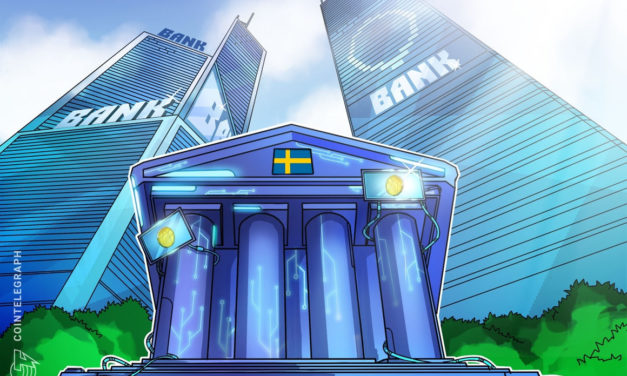
Sweden’s central bank completes second phase of e-krona testing

The Swedish central bank’s digital currency project, a proposed CBDC, known as the e-krona has successfully finished its second phase of trials. According to Riksbank, the nation’s central bank, the asset is now technically ready to be integrated into banking networks and facilitate transactions. During the second phase of the e-krona pilot project — which began in February 2021 — the CBDC was investigated on the matter of its technical ability to function within the country’s existing digital banking infrastructure. Participating banks included Handelsbanken and Tietoevry.The report indicated that the e-krona could indeed be successfully exchanged for fiat money and used in transactions, both online and offline. This phase of testing also brought legal clarity to the project in terms of whether the e-krona should be regarded as an “electronic form of cash.”As the project enters into Phase 3, a number of questions remain about the currency’s future. Riksbank did not officially confirm its intention to actually issue the e-krona to the nation’s citizens and has not yet indicated the legal framework upon which it might be based. Riksbank did, however, specify back in January 2021 that the project’s proof-of-concept was harnessing Corda, a distributed ledger technology from R3.National digital currencies remain a hot topic among financial authorities around the world. A recent Global CBDC Index from PwC showed that 80% of central banks are considering or have already launched a CBDC. The most developed CBDC at the moment, according to the report, is Nigeria’s “eNaira.” It received a score of 95 across both the retail and wholesale categories. PwC expects CBDC research, testing and implementation to intensify this year.

Čítaj viac


Unhosted is unwelcome: EU’s attack on noncustodial wallets is part of a larger trend

Last week, the European Parliament’s Committee on Economic and Monetary Affairs (ECON) and the Committee on Civil Liberties, Justice and Home Affairs (LIBE) voted in favor of a regulatory update that could compromise the exchange platforms’ ability to deal with noncustodial crypto wallets. Should the regulatory project make it to the legislation phase in the upcoming months, it would place severe disclosure requirements on transactions between noncustodial wallets and crypto exchanges in the European Union — a process whose signs are visible in other parts of the globe as well.What happenedOn Thursday, March 31, ECON and LIBE members voted on the Anti-Money Laundering (AML) regulatory package, which seeks to revise the current Transfer of Funds Regulation (TFR). The revised version of the TFR brings several legal threats to “unhosted,” or self-custodied, wallets. It would require crypto service providers to “verify the accuracy of [the] information concerning the originator or beneficiary behind the unhosted wallet” for every transaction made between a service provider (typically, a crypto exchange) and an unhosted wallet. It can be difficult, if not impossible, for crypto service providers to verify each “unhosted” counterpart. Hence, as crypto advocate Patrick Hansen from blockchain firm Unstoppable DeFi warned, to stay compliant and not compromise their legal position in the European market, some companies might want to block transactions with self-custodied wallets altogether if they face such surveillance and disclosure requirements. Smaller companies might find the potential costs of compliance too high and leave the market to established players, which would lead to further market centralization. The legislation would also oblige crypto companies to inform “competent AML authorities” ‘of any transfer worth 1,000 euros (about $1,010) or more made to or from an “unhosted” wallet, a surveillance threshold that is even lower than that of fiat banking operations. The next step for the legislation is the announcement at the plenary session of the EU Parliament, which, according to Hansen, could take place sometime in April. Should it remain unchallenged there, the legislation will make its way to the trialogue negotiations between the European Parliament, the European Commission and the Council of Europe. These negotiations could take months, but their conclusion will mark the draft becoming law. After that, the crypto industry would have from nine to 18 months to come in full compliance with the legislation. A part of a larger trend With its increased activity on the crypto regulation front, the European Union isn’t alone in its suspicion of noncustodial wallets. Apart from the local initiatives to impose tighter scrutiny on every crypto transaction, for example, in the Netherlands and Switzerland, U.S. regulators have set their sights on noncustodial wallets in recent years. In 2020, the U.S. Financial Crimes Enforcement Network (FinCEN) proposed a rule that would synchronize the recording and record-keeping requirements for digital assets to those of fiat transfer funds. In the proposed framework, any transactions to or from “unhosted” wallets exceeding $10,000 would require banks and money service businesses to verify the identity of the customer (including name and physical address) and to file this information with FinCEN.Following this, in 2021, the international Financial Action Task Force (FATF) drafted guidance with recommendations for virtual asset providers (VASPs) to classify the transfers to and from “unhosted” wallets as higher-risk transactions, with respective scrutiny and limitations to be applied. The new FATF guidance is also aimed at extending the scope of the Travel Rule to VASPs if a virtual asset transfer involves a self-custodied wallet. Both proposals faced harsh criticism from the crypto industry stakeholders and were eventually delayed. In January 2022, however, the Department of the Treasury reintroduced the proposal to tighten the grip over noncustodial wallets in its new regulatory plan. To resist or to adapt?“Seven years ago, I forecasted that these regulations were coming, it was just a matter of when and under what conditions,” Justin Newton, CEO of compliance solutions provider Netki, commented to Cointelegraph. The firm provides KYC/AML technology and develops remote identity verification solutions for blockchain businesses. Newton pointed out that both the FATF guidance and the legislation in Singapore emphasize both-ends transaction verification. U.S. President Joe Biden’s executive order on crypto highlights the consolidatory dynamic in crypto regulation, which will likely bring FinCEN’s unfinished business back into the spotlight at some point. “Sooner rather than later,” Newton added. He further commented:“The Biden Executive order specifically spoke about bringing U.S. regulations in line with global standards, and this EU proposal is in line with FATF guidance. The EU vote should trigger U.S. companies to start embracing KYC compliance to get ahead of impending regulations in the states.”Considering this, Newton believes that the regulators won’t leave the industry any room to ignore their demands. It might be more productive to seek a compromise on the matter, especially given that the problem has its technological solutions. The main threat to privacy isn’t a counterparty knowing who you are, but the fact that on-chain transaction transparency allows both the institutional third parties and curious individuals to track and de-anonymize your activity:“Fortunately, newer technologies such as Lightning see this level of on-chain transparency as a bug rather than a feature, and we can hope for better privacy for our crypto transactions than is available on most blockchains today.”What’s next?While the new rules around “unhosted” wallets will require crypto services providers to adapt, they might be less of a threat to the industry than some stakeholders currently believe. By integrating existing off-the-shelf compliance solutions that equally value privacy, crypto can relatively seamlessly embrace compliance while preserving financial freedoms. Newton said:“These new rules highlight the need to select compliance solutions that have the vision to see these new rules coming and have built their platforms to be prepared. Today, that means including noncustodial wallets in your Travel Rule solution. Tomorrow, it will be privacy coins and layer-2 networks such as Lightning. The taxman is coming as well, so any Compliance Communications Protocol should be prepared to support those new rules.”But behind any optimism, problems that can’t be resolved in a win-win fashion remain. In addition to small market players who may not necessarily be in a position to adopt high-end compliance solutions, the tightening scrutiny could undermine global financial inclusion. After all, what regulators call “unhosted” wallets is an essential tool for the underbanked and the financially underserved globally.

Čítaj viac

11 companies form Canadian Web3 Council to advocate for comprehensive crypto strategy

A group of financial technology firms has formed the Canadian Web3 Council, a non-profit trade association that will work with policymakers to advance Canada’s position at the forefront of the global digital economy. Bringing together exchange platforms, blockchain projects and tech investors, the association will work to advance blockchain-related policies that balance “innovation, consumer protection, and stability”. The open letter from Web3 Council announcing its launch came out on Tuesday, March 29. At the outset, the association consists of 11 members: Aquanow, Axiom Zen, Chainsafe Systems, Dapper Labs, Ether Capital, ETHGlobal, Figment, Informal Systems, Ledn, Wealthsimple and WonderFi Technologies. Related: Canadian PM candidate supports freedom to use Bitcoin as moneyThe statement opens with a concern that Canada could miss the boat of Web3, and the Council’s mission is to prevent this from happening:“Our goal is to create an environment to support the growth of this industry in Canada. […] Our immediate priority is to share our learnings with the Canadian public and advocate the government to devise transparent and effective policy solutions.” Explaining to Cointelegraph the company’s decision to join the Council, Phil Sham, CEO of Aquanow, highlighted the effectiveness of collective action in educating politicians: “It makes sense to partner with peers to share ideas and coordinate our engagement efforts.” Moreover, it is an important signal of the industry’s maturity and its ability to consolidate its voice, Sham believes:“Often, when people hear about digital assets or blockchains there can be a connotation of greed around token prices. However, if the industry, which often has some overlapping competitive vectors, can come together and collectively engage the public, then it says a lot about the community aspects of Web3.”Hatcher Lipton, Co-founder and COO at ChainSafe Systems, has also pointed out the importance of the industry-driven initiative: “There is the opportunity to develop a community-driven policy which puts Canada at the forefront of the Web3 movement”. Citing the examples of the EU and Switzerland, which already possess their thorough crypto strategies, the association’s statement calls for the creation of a Canadian regulatory framework, “a comprehensive national strategy“. In the upcoming months, the Council is planning to start a dialogue within the Canadian Web3 community and “shape its mission.”

Čítaj viac

With inflation going through the roof, Sudan’s central bank cautions citizens against using crypto

The Central Bank of Sudan (CBOS) cautioned the country’s citizens against dealing with “all types of cryptocurrencies” due to “the high risks” that they pose. This announcement came as a reaction to the increasing interest in digital assets among the country’s population, which has been facing three-digit inflation rates since the 2021 military coup. On March 27, the Sudan News Agency (SUNA) published a short announcement from the CBOS declaring that due to high risks, which include “financial crimes, electronic piracy and the risk of losing their value,” citizens are not advised to use cryptocurrencies of any sort. The CBOS also cited legal risks, as cryptocurrencies are not classified as money “or even private money and property” under Sudanese law. The Central Bank admitted that it has been noticing an uptick in crypto promotions on social media recently. As Alex Gladstein, chief strategy officer at the Human Rights Foundation, noted in a tweet, a formal ban on crypto might already be in the works. According to the analysis of law firm Freeman Law, Sudan’s current electronic payments legislation, enacted in 2007, does not cover cryptocurrencies.The rising interest in crypto, which unnerves Sudanese authorities, can be explained by the ongoing economic crisis. According to the country’s Central Bureau of Statistics, Sudan’s inflation rate averaged 359.09% in 2021, up from 163.26% in 2020. In February 2022, it slowed down to 258.40%. 

Čítaj viac

Bosnian court sides with Bitcoin miner in frozen bank account case

Italy’s second-largest bank UniCredit and the Bitcoin (BTC) mining farm Bitminer Factory have faced each other in the Bosnian city Banja Luka court, which decided that the bank improperly closed the company’s account and must compensate €131 million (about $144 million) to the plaintiff. As reported in La Repubblica on March 27, the court of Banja Luka held that a Bosnian branch of UniCredit didn’t have legitimate reasons to freeze the operations of Bitminer Factory Gradiska LLC’s account. The Bitminer Factory estimated its losses at €131 million, asserting that the closure of its accounts had “hindered its initial coin offering (ICO) in relation to a startup project in the cryptocurrency mining sector with renewable energy in Bosnia and Herzegovina.” The court accepted that number. In its defense, UniCredit cited an “inability to do business with digital currency suppliers and exchange platforms.” However, according to the court’s decision, this claim didn’t find any confirmation in the bank’s written policies. Related: Ukraine’s largest savings bank halts Bitcoin buys with hryvniaUniCredit has already filed an appeal, dubbing the allegations as unfounded: “It is not final, nor binding, nor enforceable. Ucbl’s eventual liability will only be determined upon the final outcome of all available procedural remedies and, in any event, not before the filing of a final and binding judgment by the court of appeal.”The previous controversy in its relations to the digital assets has happened In January 2022, when UniCredit had to officially refute its own tweet, stating that the did not inhibit its customers from crypto investments or have any intention of closing their accounts on that matter.

Čítaj viac

Získaj BONUS 8 € v Bitcoinoch

nakup bitcoin z karty

Registrácia Binance

Burza Binance

Aktuálne kurzy