Autor Cointelegraph By Cointelegraph

Kraken ‘plans’ regulated perp contracts as rivals are quick off the blocks

Kraken said late Friday that it expects to launch CFTC-regulated perpetual futures contracts in the US in the next 30 days, hours after the US Commodity Futures Trading Commission approved the instruments.The exchange said when it gains approval, the contracts will be listed on Bitnomial Exchange, a CFTC-regulated exchange recently acquired by Kraken’s parent company, Payward. Payward said on April 17 that it was acquiring crypto derivatives platform Bitnomial for as much as $550 million, aimed at providing Kraken Pro customers with access to Bitnomial’s perpetual futures offering.However, while Kraken’s announcement said that a filing had been submitted on Friday, no filing for a specific Bitcoin (BTC) perpetual contact was found among Bitnomial’s recent CFTC filings as of Sunday morning. “Today’s announcement sets in motion plans to bring that activity onshore through a CFTC-regulated venue,” the announcement said.“US clients will soon be able to trade perpetual futures on @KrakenPro,” read a company social media post on Saturday.Source: Kraken on X.comRequests for further information on the filing sent to two Kraken executives and Bitnomial’s chief regulatory officer were not immediately answered.To be sure, companies frequently file requests for confidential treatment of their applications. KalshiEX, which on Friday gained CFTC approval of trading of a BTC perpetual futures contract, had originally requested confidential treatment of that application in an undated letter to the CFTC.Related: CFTC seeks to reverse settlement deal with GeminiRace is on to gain perps lead in regulated US marketShortly after the CFTC approved BTC perp contracts on Friday morning, Coinbase Financial Markets was fast out of the blocks to offer US institutional clients access to global crypto options and perpetual futures markets through a regulated futures commission merchant, Deribit.Deribit, which Coinbase acquired in August 2025 as part of its expansion into crypto derivatives, is the largest crypto options exchange by open interest. CFTC approval notice for BTC perpetuals trading on Kalshi. Source: CFTCThe US Securities and Exchange Commission and CFTC said in September they would explore ways to bring perpetual futures trading onshore. In a joint statement, the agencies said perpetual contracts had been largely confined to offshore crypto markets due to regulatory and jurisdictional constraints.CFTC chair Michael Selig said on Friday “In my view, the question was never whether crypto asset perpetual contracts would exist. Instead, the question was whether they would exist under American oversight, American standards and American rule of law.”Also on Friday, CFTC staff issued guidance on 24/7 trading, clearing and settlement, saying crypto asset derivatives may be particularly well suited to round-the-clock markets.Magazine: HYPE chases $100 target, ETH could dump below $1800: Market Moves

Čítaj viac
Strategy takes Bitcoin buying breather ahead of Q1 earnings report

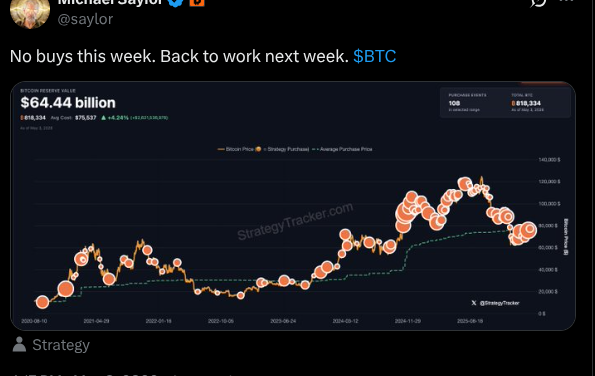
Strategy, the world’s biggest public Bitcoin holder, is taking a break from crypto purchases as the company readies its first quarter earnings report, slated for Tuesday.On Sunday, Executive Chairman Michael Saylor announced “No buys this week” in a post on X, where he has regularly provided a signal of planned purchases. In its most recent purchase, the Tysons Corner, Virginia-based company acquired 3,273 Bitcoin for $255 million between April 20 and 26, according to an 8-K filing with the US Securities and Exchange Commission on April 27.Source: Michael Saylor on XThe company now holds 818,334 BTC, bought at an average price of $77,906 per coin, raising Strategy’s cost basis to $75,537. The biggest crypto by market cap was last trading on Sunday at $78.787.08, according to CoinGecko data.Strategy’s purchases last month, along with US spot price exchange-traded fund inflows, helped stoke a 12% increase in BTC’s price during April.Related: Bitcoin preps highest weekly close since January as BTC price nears $79KQuarterly loss expected amid scrutiny over STRC dividend Wall Street analysts are expecting Tuesday’s earnings report to show a loss of $18.98 per share, mainly due to management’s mark-to-market Bitcoin accounting. That compares to the year-earlier period’s loss of $16.49, according to Yahoo Finance data. On Wednesday, Saylor is scheduled to speak at the Consensus industry conference in Miami Beach, Florida.The company’s reliance on STRC, Strategy’s perpetual preferred security, has raised concerns among some stock watchers, primarily because of the 11.5% dividend yield that the asset offers investors. Peter Schiff, chief economist and global strategist at Euro Pacific Asset Management, who has previously called Strategy a “Ponzi scheme,” on Sunday repeated his allegation, questioning the company’s ability to sustain the dividend. “Gambling that Bitcoin will rise by more than 11.5% a year does not change the Ponzi like structure of STRC,” he said in a post on X.Source: Peter Schiff on XConcern about the STRC dividend also came from Seeking Alpha blogger Joseph Parrish, who said in his April 28 post that the current cash reserves are insufficient to cover two years of STRC dividends, which will ultimately force continued sale of Strategy’s common stock and raises investor risk if Bitcoin underperforms.He rates the company stock, which trades under the MSTR ticker, as a “Hold,” citing increased leverage, uncertain catalysts, and challenging risk management despite a lower stock price. His opinion stands in contrast with other analysts, according to financial engine TipRanks, which shows a consensus of a “Strong Buy” rating on Strategy’s Nasdaq-listed shares.Related: ‘Historical average’ could push Bitcoin bottom at $57K level: AnalystCointelegraph is committed to independent, transparent journalism. This news article is produced in accordance with Cointelegraph’s Editorial Policy and aims to provide accurate and timely information. Readers are encouraged to verify information independently.

Čítaj viac

Wallets seized by OFAC may not be Iranian; other state actors instead: Analyst

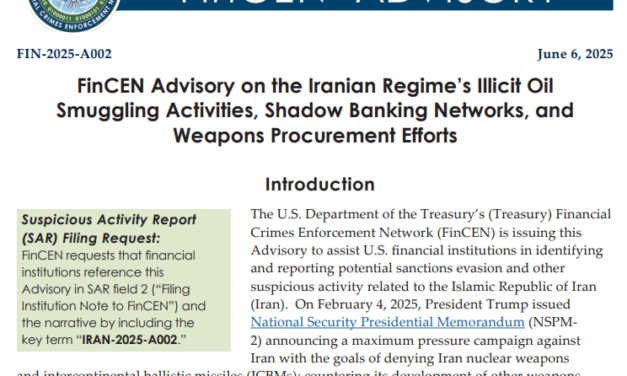
Multiple wallet addresses recently sanctioned by the US Treasury ‌Department for their ties to Iran may not be linked to the Islamic Republic, but to other state actors instead, analysis published Sunday suggests.That analysis, by blockchain intelligence firm Nominis, said that while the recent seizing of wallets holding more than $340 million by Treasury’s Office of Foreign Assets Control (OFAC) was a significant crypto enforcement event, some of those wallets’ characteristics lack a similarity to previously seized wallets linked Tehran.“While the use of cryptocurrency by the Islamic Revolutionary Guard Corps (IRGC) is well established, this case presents structural and behavioral characteristics that diverge meaningfully from previously observed patterns,” said Nominis CEO Snir Levi.He said that IRGC-linked wallets have shown some consistency in their operations, including that the funds are distributed across multiple wallets, individual wallet balances are kept relatively low — typically a few million US dollars, holdings aren’t retained for extended periods and activity is structured to minimize exposure to seizure or freezing mechanisms.“The behavioral divergence observed in this case raises a critical question: To what extent does the frozen $340 million reflect direct IRGC control, versus infrastructure that overlaps with broader, potentially foreign, financial networks,” Levi said.June 2025 FinCEN Advisory on Iranian Shadow Banking Networks. Source: US Department of the Treasury’s Financial Crimes Enforcement Network He said the implications for compliance teams could be that static typologies are no longer sufficient and behavioral analysis and clustering are critical for identifying risk.“Most importantly, this case highlights that even well-documented actors such as the IRGC and potentially Chinese state-actors are continuing to evolve their use of blockchain infrastructure,” the Nominis founder said.Related: Iran views BTC as strategic asset, but USDt still dominates oil tolls: BPIOperation Epic Fury targets crypto for maximum US economic pressureThe United States has seized nearly $500 million in Iranian cryptocurrency assets as part of Operation Epic Fury, a sweeping economic pressure campaign against Tehran, Treasury Secretary Scott Bessent said last Wednesday.“We are freezing bank accounts everywhere. More importantly, we are making people less willing to deal with the regime,” Bessent said during an appearance on Fox Business’s “Kudlow,” adding that retirement funds and overseas real estate held by Iranian officials are also being targeted.Source: Treasury Secretary Scott Bessent, verified X accountThe $500 million figure cited is much higher than the $344 million in seized crypto assets previously disclosed. A week earlier, Bessent announced that OFAC had sanctioned several crypto wallets tied to Iran, with stablecoin issuer Tether confirming it had frozen more than $344 million in USDt (USDT) at the request of US authorities.Bessent said Operation Economic Fury has taken a toll on Iran’s economy. One of the country’s largest banks collapsed in December, and its currency has fallen 60 to 70% against the US dollar. “They’re in the middle of a currency crisis,” he said.Magazine: Will the CLARITY Act be good — or bad — for DeFi?Cointelegraph is committed to independent, transparent journalism. This news article is produced in accordance with Cointelegraph’s Editorial Policy and aims to provide accurate and timely information. Readers are encouraged to verify information independently.

Čítaj viac

Získaj BONUS 8 € v Bitcoinoch

nakup bitcoin z karty

Registrácia Binance

Burza Binance

Aktuálne kurzy