Autor Cointelegraph By Cointelegraph

SecondFi targets two-week recovery after Cardano wallet exploit

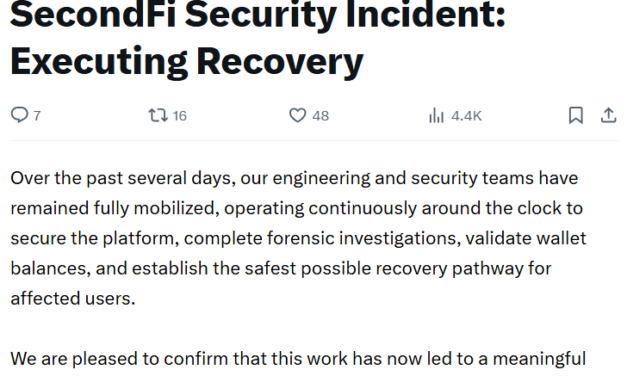
Cardano wallet SecondFi has identified a recovery path for users affected by Tuesday’s exploit and expects to begin returning assets in about two weeks, following testing and security reviews.According to a Saturday statement by Phillip Pon, CEO of SecondFi developer Emurgo, the company completed forensic investigations and established a recovery pathway for affected users. Pon said the coming week would be spent building the solution, followed by another week of testing before assets begin to be returned.Pon urged users to refrain from migrating assets or taking actions outside official guidance, saying the recovery process was designed around existing wallet states and that independent action could complicate the secure return of funds.SecondFi developer Emurgo shared an update on the wallet’s recovery efforts. Source: EmurgoSecondFi disclosed a security breach on Tuesday that affected approximately 16 million ADA, worth about $2.4 million at the time, across 374 addresses. SecondFi previously said it traced the incident to an address-level issue in its Cardano web wallet generation software that exposed users’ private keys.Related: Q2 2026 emerges as most-hacked quarter on record with 83 incidentsThe company also said it secured roughly 129 million ADA through emergency measures and transferred the funds to an independent third-party custodian, where they will remain until the verification and recovery process is complete.SecondFi has not yet published a comprehensive post-mortem detailing the vulnerability or how the exploit was carried out.SecondFi warns of recovery-related scamsIn a separate update on Saturday, SecondFi warned that malicious actors are circulating fraudulent messages impersonating the wallet while its recovery effort remains underway. The company said no recovery actions requiring user participation have begun and that it will never ask users for private keys, seed phrases, wallet credentials or direct wallet access.SecondFi said any messages instructing users to submit wallet information, migrate assets or take immediate action outside its verified communication channels should be treated as fraudulent. It added that users requiring assistance should submit a ticket through its official support portal while the recovery process continues.Magazine: AI is banking the unbanked in Africa… faster than cryptoCointelegraph is committed to independent, transparent journalism. This news article is produced in accordance with Cointelegraph’s Editorial Policy and aims to provide accurate and timely information. Readers are encouraged to verify information independently.

Čítaj viac
EU lawmakers urge assessing DeFi, staking, NFT regulation

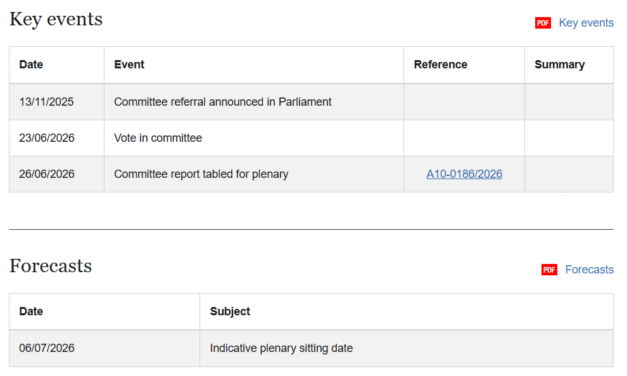
The European Parliament’s economic affairs committee has urged the European Commission to assess whether crypto lending and borrowing, staking, non-fungible tokens (NFTs) and decentralized finance (DeFi) should be regulated.The recommendations were part of a report tabled Friday for plenary vote. It also called for promoting tokenization across financial services, encouraging euro-denominated stablecoins and assessing whether additional crypto activities should be regulated under the European Union’s Markets in Crypto-Assets Regulation (MiCA).Drafted by Belgian Member of the European Parliament Johan Van Overtveldt, the report is an own-initiative resolution by the Committee on Economic and Monetary Affairs (ECON) that outlines recommendations for the Commission on digital asset regulation. It will next go before the European Parliament for a vote, expected July 7. If adopted, the resolution would become Parliament’s official position on digital assets policy but would not amend MiCA or create new legal obligations.The legislative timeline shows the committee’s approval of the report and its referral for a plenary vote. Source: European ParliamentRelated: European Parliament throws support behind digital euroEU warms up to regulated stablecoinsThe recommendations also reflect an evolving view of stablecoins among policymakers. Days after former Bank for International Settlements general manager and longtime crypto critic Agustín Carstens softened his stance on stablecoins, the report welcomed euro-denominated stablecoins under MiCA and encouraged their development to support the bloc’s payment sector.In 2023, Van Overtveldt called for tighter restrictions on cryptocurrencies following the banking turmoil surrounding Silicon Valley Bank, Signature Bank and Silvergate Bank. The crisis was also closely tied to stablecoins, as USDC issuer Circle held roughly $3.3 billion of its reserves at Silicon Valley Bank when it collapsed, briefly causing USDC to lose its dollar peg.Van Overtveldt likened cryptocurrencies to drugs during the 2023 banking crisis. Source:Johan Van OvertveldtThe report argued that euro-denominated stablecoins could complement tokenized commercial bank deposits and wholesale central bank digital currencies while enabling faster and cheaper cross-border payments. It also said broader adoption could strengthen the competitiveness of EU financial markets and the international role of the euro.The stance also aligns with ECON’s broader vision for Europe’s digital money ecosystem. On Tuesday, the committee backed legislation for a digital euro, with lawmakers arguing that public and private forms of digital money should coexist rather than compete.Related: Poland president vetoes MiCA bill again as crypto companies look to license abroadLawmakers look beyond MiCA’s current scope Van Overtveldt first presented a draft of the report in February before months of negotiations and amendments by ECON members. The earlier version largely focused on MiCA’s existing framework, including stablecoin classifications and legal certainty for multi-issued stablecoins.The committee-approved report urged consistent application of MiCA across the EU to preserve a level playing field for crypto firms. It also warned member states against introducing national requirements beyond MiCA that could fragment the bloc’s digital asset industry.The Commission is already reviewing MiCA. In May, the Commission launched a public consultation seeking feedback on whether the framework should be expanded to cover areas including DeFi, staking, lending, NFTs and tokenized financial assets, while also reopening debate over the regulation’s ban on interest-bearing stablecoins.Meanwhile, MiCA’s transitional period ends July 1, after which crypto asset service providers generally must hold authorization under the regulation to continue operating across the EU.Magazine: AI is banking the unbanked in Africa… faster than crypto

Čítaj viac

StanChart looks for 3 signs of BTC bottom, including Strategy’s Monday news

Standard Chartered analyst Geoff Kendrick on Friday told clients that he believes crypto asset prices have seen the low in the current cycle and he is looking for confirmation in three indicators: Strategy’s reporting that it bought more Bitcoin last week; crypto exchange-traded funds (ETF) saw positive inflows on Friday; and, oil prices continue to break lower.“We have now seen the low in crypto asset prices for the cycle. That would be USD59k for BTC (53% down from USD126k high),” Kendrick said in a brief note to clients on Friday. The biggest crypto was last trading on Sunday at about $63,704, according to CoinMarketCap data.Depending on how investors read Strategy chief Michael Saylor’s near-weekly tweet issued earlier on Sunday, The first sign that Kendrick is watching for may have come. “Still adding dots,” was Saylor’s message that accompanied the now-familiar dot, or bubble, chart that the Strategy executive frequently includes in his social media posts teasing forthcoming BTC purchases. Michael Saylor’s tweet on Sunday had more than a half a million views by mid-afternoon, ET. Source: Michael Saylor on X.comAs for the other indicators of a BTC bottom that StanChart’s global head of digital assets research cited, Bitcoin ETFs on Friday posted one-day net inflow of $85.84 million, with investors moving money into five of the funds while eight of the US-traded BTC ETFs had no net change, according to data tracked by SoSoValue.com. Crude oil futures fell on Friday for the second straight day, according to Yahoo Finance data.Kendrick closed his note with: “Winter is over. Welcome back to crypto Spring.“Related: Bitcoin sales are necessary for Strategy’s digital credit business, Saylor saysSurprise Bitcoin sale defended as “necessary“ defense of digital creditStrategy disclosed its first reported Bitcoin sale since 2022 in a June 1 filing with the US Securities and Exchange Commission, offloading 32 BTC in a move that appeared at odds with Saylor’s long-running “never sell your Bitcoin“ mantra. He defended that sale, saying the ability to sell the asset is necessary to continue issuing “digital credit.““If the company’s policy is that we won’t sell the Bitcoin, then the credit won’t have value and the equity won’t have value,” he told Cointelegraph at the BTC Prague conference. Cointelegraph’s Ciaran Lyons (left) and Strategy founder Michael Saylor (right) at BTC Prague. Source: CointelegraphSaylor said that Bitcoin treasury companies must retain the ability to sell holdings when necessary to support dividend-paying securities and other BTC-backed credit products. Magazine: Bitcoin, the ‘canary in the coal mine,’ XRP transaction demand falls 91.5%: Market Moves

Čítaj viac

Trump says Iran peace deal to be signed Sunday, contradicting Tehran

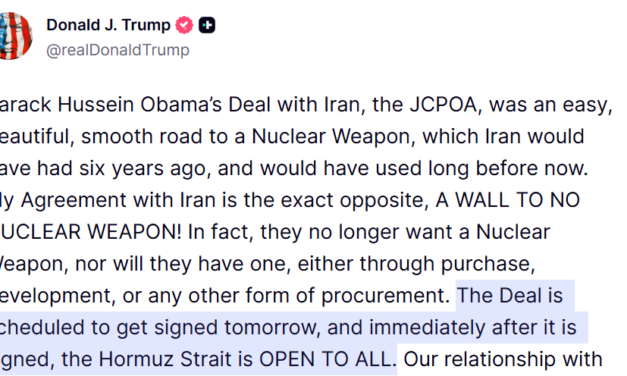
US President Donald Trump said a deal to end the fighting between the US and Iran is scheduled to be signed on Sunday, despite officials in Tehran previously casting doubt on the timeline. “The Deal is scheduled to get signed tomorrow, and immediately after it is signed, the Hormuz Strait is OPEN TO ALL,” said Trump on Truth Social on Saturday. Source: Donald TrumpPakistan, which is mediating talks between the US and Iran, also signaled an agreement could be reached within 24 hours. The deal, a memorandum of understanding, is expected to extend the ceasefire between the US and Iran for 60 days and reopen the Strait of Hormuz. The naval blockade has choked 20% of the world’s supply of oil and liquefied natural gas, which has led to higher global asset prices and a sentiment shock that has pressured crypto markets for months. “We are closer to a peace deal than ever before,” Pakistani Prime Minister Shehbaz Sharif said on X on Saturday. “With finalisation likely expected in the next 24 hours, Pakistan is preparing for the electronic signing of the peace deal immediately after, followed by technical level talks next week.” Iran has not confirmed the Sunday signing. Iranian Foreign Ministry spokesperson Esmaeil Baghaei told state media earlier that the memorandum wouldn’t be signed on Sunday, but could happen “in the coming days.” “We will have to wait and see about the exact date of the signing of the memorandum of understanding, although it will not be tomorrow,” Baghaei said.Analysts say peace deal will benefit cryptoCrypto analyst Michaël van de Poppe said a peace deal between Iran and the US will likely prompt a surge in Bitcoin, along with positive ETF flows. Spot Bitcoin exchange-traded funds (ETFs) recorded about $315.84 million in net outflows for the week ended Friday, marking the fifth consecutive week of outflows for the Bitcoin-linked crypto funds. Related: Bitcoin tags $63.2K as BTC price action ignores inflation, Iran Hormuz closure“Liquidity will pour back into risk-on assets as liquidity will seek for an opportunity and after SpaceX IPO was done, most likely this will go towards crypto,” he added. On Wednesday, CoinShares head of research James Butterfill told Cointelegraph the recent outflow from digital asset investment products was being primarily driven by geopolitics, with uncertainty around the Iran conflict weighing on the outlook for interest rates.Bitcoin was trading at $64,491 at the time of writing, up 1.5% over the past 24 hours. Magazine: Bitcoin, the ‘canary in the coal mine,’ XRP transaction demand falls 91.5%: Market Moves

Čítaj viac

Amazon warning triggered US crackdown on Anthropic AI models: Reports

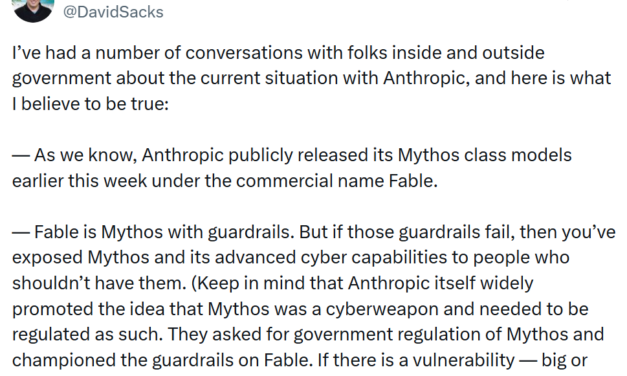
The Trump administration’s decision to cut foreign access to Anthropic’s most powerful AI models was reportedly triggered by calls from Amazon CEO Andy Jassy.According to a report from The Wall Street Journal, Jassy contacted senior government officials on Thursday after Amazon researchers discovered a way to prompt Anthropic’s Fable 5 model into returning information that could be used for cyberattacks. The call, along with warnings from at least five other firms, led to a frantic shuffle within the White House to gauge the threat and contact Anthropic CEO Dario Amodei, who reportedly pushed back on the administration’s concerns and requests to voluntarily pull the model. “In reaction, the Admin issued the export control. The Admin did this reluctantly,” said David Sacks, the co-chair of the President’s Council of Advisors on Science and Technology, on Saturday. “It’s been very surprised that Anthropic hasn’t wanted to cooperate with a reasonable safety request (ie fixing the jailbreak issue).”Source: David SacksThe episode sheds light on what led to the US directive that forced Anthropic to pull its new model from the public on Friday night. Anthropic Claude is estimated to have around 18,900 monthly active users. In a blog post on Friday, Anthropic said it believed the US directive was the result of a misunderstanding about the threat posed by a “non-universal jailbreak,” which came from an unnamed report. Amazon did not confirm if it spoke to government officials about Anthropic’s models. “As a leading cloud provider that serves a large number of private and public sector customers, it’s not uncommon for governments to seek ​our counsel on potential security risks,” a spokesperson said. “When they occur, we don’t share the details of these discussions.”Anthropic said it is working to restore access for its users. Related: Anthropic suspends access to Fable 5, Mythos 5, citing US directive“The Admin’s hope now is that Anthropic remediates the safety issue,” Sacks said, which would see the export control lifted, and Fable goes back into general release. “The Admin wants all of this to happen as soon as possible.”AI tokens surge after Anthropic crackdownThe episode has also demonstrated the US government’s ability to promptly switch off access to US-based AI models on command, leading to a rally in decentralized AI tokens on Friday and Saturday. The native token of Bittensor, a decentralized AI protocol that lets people build and monetize artificial intelligence models, which some refer to as “the Bitcoin of AI,” surged 23.9% over the past 24 hours.Venice Token (VVV), the native utility and privacy coin powering Venice AI, a decentralized, uncensored AI platform founded by Erik Voorhees, rose 16%.Near Protocol, a blockchain project building the infrastructure to support a decentralized AI agent economy, rose 6.2%. Source: Erik VoorheesMagazine: Bitcoin, the ‘canary in the coal mine,’ XRP transaction demand falls 91.5%: Market Moves

Čítaj viac

Získaj BONUS 8 € v Bitcoinoch

nakup bitcoin z karty

Registrácia Binance

Burza Binance

Aktuálne kurzy