Autor Cointelegraph By Cointelegraph

Bitcoin bounces off 21-month low, but leverage data signals caution: Was $57K the bottom?

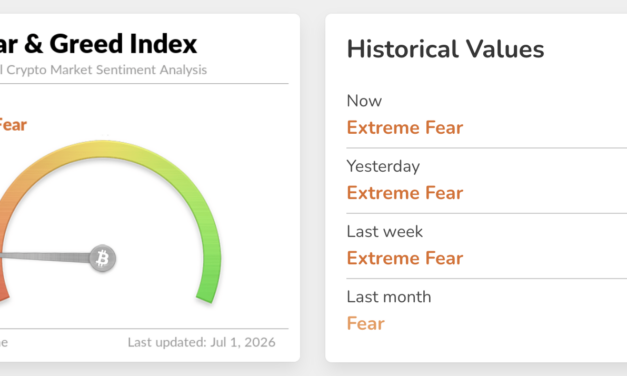
Bitcoin (BTC) traded as high as $60,200 on Wednesday, up about 2.7% over the past 24 hours after falling to a 21-month low of $57,737 earlier in the session. Ether (ETH) and Solana (SOL) also gained, up 3% and 4.85%, respectively. The bounce took place amid deep investor caution, with sentiment trackers gauging the balance of fear and greed in crypto markets currently reading around 11 out of 100, in “Extreme Fear” territory. Despite the rebound from the yearly low, Bitcoin remains down roughly a third since the start of the year. Crypto Fear & Greed Index. Source: Alternative.meBitcoin dip-buyers overshadowed by fear of future sellingInvestors’ cautious stance shows up differently depending on what data is analyzed. US spot Bitcoin exchange-traded funds (ETFs) have seen more money leave than enter in recent weeks, including a reported $4.5 billion total outflow in June, the largest since the funds launched. At the same time, onchain data shows that long-term holders added roughly 270,000 BTC over the past two weeks. That is generally read as a sign that some bigger investors see the recent decline as an opportunity rather than a reason to sell. Looking at the past few days, one useful gauge is the funding rate. That figure has stayed positive for three straight days, meaning bets on rising prices have remained crowded even as Bitcoin fell to new lows. When leverage builds up on one side of the market like this while price is weak, it can add to volatility, since more traders become exposed to being forced out of their positions if the market moves further against them. Bitcoin open interest, funding rate. Source: HyblockLiquidations continue to define the price actionA broader look at where leveraged positioning is concentrated, combining data from three major exchanges over the past week, shows the heaviest concentration of positioning is roughly between $57,000 and $60,500, which closely wraps around the range Bitcoin has traded in since late June. That concentration thins out noticeably above about $61,000 to $62,000, and again below about $55,000 to $56,000. Bitcoin liquidation heatmap, 3-day look back. Source: HyblockIn practical terms, most of the leverage that could be forced to unwind sits close to the current price rather than in a distant zone, so a decisive move beyond roughly $61,000 on the upside, or $56,000 on the downside, is where forced position closures would likely have the most room to accelerate a move.The view for the next 24 hours leans neutral and a genuine shift in positioning would likely need to show up as rising leveraged positioning alongside a rising Bitcoin price, a combination that has not yet appeared in the data.

Čítaj viac
Bitcoin faces critical test as bulls aim to hold $60K: Did BTC bottom?

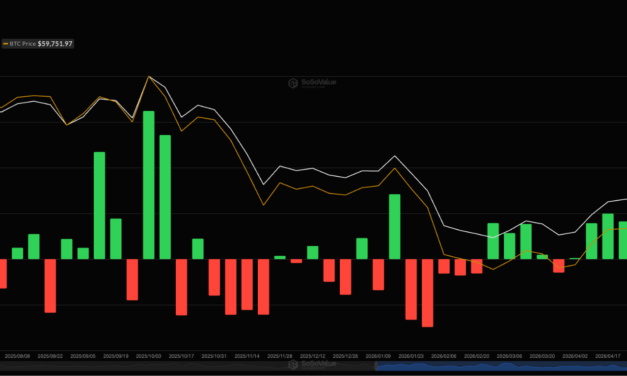
Bitcoin (BTC) trades at an important inflection point as retail investors are selling, big institutions are in a hold despite the discounted valuation and the market is paused at $60,300—awaiting the next significant move. The situation reveals two very different investor groups making opposite bets.Retail investors sell, TradFi watchesThe general mood is fearful, with the Crypto Fear & Greed Index sitting at 36 out of 100, indicating fear but not total panic. This number masks a sharp divide. In June alone, investors pulled $4.4 billion from US spot Bitcoin ETFs—the worst month this year. At the same time, Strategy continues to buy BTC, although the pace and size of its purchases have slowed. While ETF flows and Bitcoin treasury accumulation are not in a buying phase, a majority of corporate BTC treasuries have not reduced their existing positions.  Spot Bitcoin ETF net flows. Source: SoSoValue.comLeverage unwinds, but slowlyThe aggregate open interest in Bitcoin futures contracts across all exchanges is $19.92 billion. Two weeks ago, it was $20.1 billion. This unwinding—when traders close positions to reduce risk—is happening in an orderly way, not in a panic. The borrowing costs for holding long positions have dropped from 0.25% to 0.12%, suggesting that the worst of the forced selling is over. However, longs are still paying to hold their positions, meaning traders believe in a recovery but aren’t willing to bet their full account on it. The current danger zone is $58,800, Bitcoin’s low for the day. If the price breaks below this level, the next $500 million worth of traders holding long positions could be forced to close their trades, sending Bitcoin toward $56,000. That move may extend the selling pressure into next week.Bitcoin open interest, funding rate. Source: HyblockThe market is waiting, not actingWhen fresh capital flows into Bitcoin, volume spikes and the action shows up in the data. Right now, it doesn’t, as trading volume is down, and open interest changes are small. This suggests the market is in an indecisive phase where retail traders may be done selling, but nobody is confident enough to buy in size yet. That’s not surprising. Related: Bitcoin balances $60K tightrope as US stocks rebound on fresh Iran peace deal hopesMicroStrategy, which has accumulated Bitcoin for corporate reserves, did buy 3,600 Bitcoin in June for $236 million, betting on a recovery. But overall, institutions are holding rather than aggressively buying. This pause could break in either direction: lower (if one more wave of sellers emerges) or higher (if confidence returns).For Bitcoin to move meaningfully higher, it needs to reclaim $62,000. The risk is real: a macro news event at any point in the week, like the June employment report or the resumption of military action in Iran, could weigh on investor sentiment and tip BTC back under the $60,000 handle.

Čítaj viac

Ether treasury Sharplink buys $62.4M of ETH in 3 days

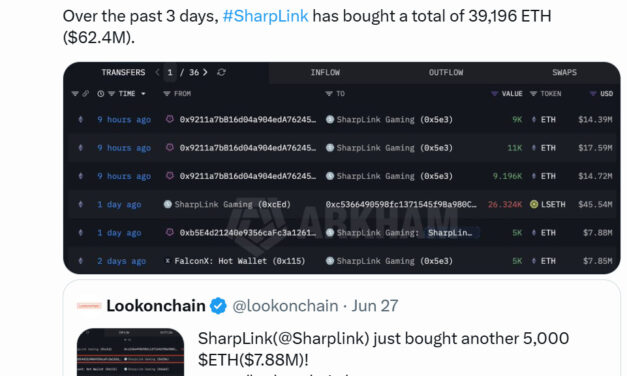
Crypto treasury company Sharplink, which resumed buying Ether last week after an eight-month pause, has bought a total of $62.4 million worth of Ether since Thursday. Onchain data from Arkham shows that after Sharplink bought 5,000 ETH on Thursday, it bought another 5,000 ETH (worth $7.9 million) on Friday, followed by 29,196 ETH (worth $46.7 million) across three over-the-counter transactions on Saturday. Source: LookonchainThe three-day buying spree adds to evidence that Sharplink has revived its active Ether accumulation strategy. The crypto treasury company was once a close competitor to Bitmine as the world’s largest ETH treasury company. Sharplink declined to comment on the reason and timing of the Ether purchase when first contacted on Thursday. Sharplink backs EthlabsHowever, the purchases came the same week that both Bitmine and Sharplink backed a new research and development nonprofit that aims to make Ethereum ready for institutional use. Sharplink said on Monday that the organization, Ethlabs, was formed to “ready Ethereum for the next phase of institutional adoption,” with the company joining Bitmine, Ethereum co-founder Joe Lubin and other Ethereum contributors in backing the initiative. Related: Sharplink, Forward Industries among crypto firms considered for Russell indexes“As stablecoins, tokenized real-world assets, funds and autonomous AI commerce move on-chain, they are converging on Ethereum as the neutral, credibly permissionless settlement layer for the global economy,” Sharplink said. “Ethlabs exists to ensure the network is ready to absorb that demand at scale.”Ether slumpThe purchases also come as the cryptocurrency is down 22.8% month-on-month, and nearly 50% compared to the start of the year, allowing Tether stablecoin USDt (USDT) to briefly surpass Ether in market capitalization last week. Meanwhile, US spot Ether ETFs recorded their seventh week of outflows last week, recording $12.9 million in net outflows, driven mainly by withdrawals from BlackRock’s iShares Ethereum Trust (ETHA). Magazine: Bitcoin slides to $58K, XRP hits $1 but onchain data promising: Market Moves

Čítaj viac

Binance posts over $400M in weekly net outflows as MiCA deadline nears

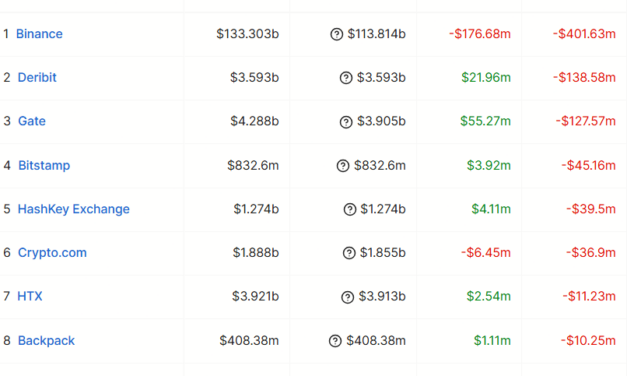
Binance recorded over $400 million in net outflows during the week beginning June 22, as the cryptocurrency exchange announced the withdrawal of its Markets in Crypto-Assets Regulation (MiCA) license application in Greece.According to DefiLlama data viewed by Cointelegraph on Sunday, Binance’s seven-day net outflows amount to 0.3% of its $133.3 billion in tracked assets. Excluding BNB, Binance’s native token, the outflows equal 0.35% of the exchange’s $113.8 billion in crypto assets.Binance led tracked exchanges in weekly net outflows. Source: DefiLlamaNet outflows accelerated on Wednesday, when Binance announced its withdrawal from Greece’s securities regulator, recording $1.96 billion in net outflows, followed by two more days of $2.52 billion and $1.46 billion.The scale of outflows is not unusual for Binance, which regularly records billions of dollars in daily inflows and outflows. The data also does not identify the geographic origin of the fund movements.The outflows came during the final week before the European Union’s MiCA transition deadline. Starting July 1, Binance will restrict onboarding and some services for affected EU users.Daily net flows in the billions of dollars are not unusual for Binance. Source: DefiLlamaMiCA winners are less clear than expectedSeveral rival exchanges have sought to attract Binance users ahead of the bloc’s deadline.OKX, one of the most vocal exchanges courting Binance users, recorded $285.5 million in net inflows over the same period, according to DefiLlama’s rankings based on exchanges’ proof of reserves. The exchange received MiCA authorization in Malta in January 2025.However, OKX was third in weekly net inflows, behind Bitget’s $710 million and Bitfinex’s $400 million. Neither exchange appears on the European Securities and Markets Authority’s (ESMA) interim MiCA register, which was last updated on Friday.Related: Spain regulator rules out extension for non-MiCA compliant crypto companiesBinance says Europe still mattersCryptoQuant analyst Maartunn recently told Cointelegraph that euro trading accounts for just 1% of Binance’s spot volume, which may limit potential MiCA-related setbacks for the exchange.However, Binance’s public messaging is that the company intends to continue pursuing a MiCA license, despite being on pace to miss the July 1 buzzer.“As for Binance and Europe, we take this market seriously. It’s a small part of our business, but an important one, and we’re committed to the EU and our customers there,” Yi He, a co-founder of the exchange, said on Friday.Meanwhile, Binance has started telling some EU users to move funds to self-custodial wallets or other exchanges. A Binance representative told Cointelegraph that the restrictions vary depending on users’ jurisdictions and that no action is required for users not served through a local registered entity.ESMA said in a June 23 statement that crypto service providers unlicensed by July 1 must take “immediate steps” to wind down EU activities, and limit services to actions to sell, transfer, relocate assets or close positions.Magazine: AI is banking the unbanked in Africa… faster than crypto

Čítaj viac

Grayscale's Pandl hopes Strategy sells $3B in Bitcoin to restore confidence

Zach Pandl, head of research at Grayscale, said he hopes Strategy will sell at least $3 billion in Bitcoin to cover most of the company’s cash obligations for the next two years.In a Saturday X post, Pandl argued that the move may restore market confidence in the company’s capital structure.Contrary to his hopes, Pandl said he expects a 50-basis-point increase to the dividend rate on Strategy’s preferred stock, STRC, adding roughly $100 million in annual obligations over two years. Pandl added that this scenario “probably does not help market confidence.”Strategy faces an annual preferred dividend obligation of approximately $1.2 billion, driven primarily by STRC.STRC is Strategy’s flagship “digital credit” preferred stock designed to trade near its $100 par value, but has been sliding for weeks. On Friday, it fell to as low as $71.25, a 28.75% discount to par. Strategy’s common stock MSTR fared little better and closed Friday at $82.31, down 26.86% throughout the trading week.Pandl said he expects Strategy to raise STRC’s dividend rate but hopes the company sells Bitcoin instead. Source: Zach PandlStrategy’s cash reserve under pressureStrategy is the world’s largest publicly-listed corporate Bitcoin holder, placing its 847,363 BTC stash and financing decisions under the industry’s microscope. According to Strategy’s latest 8-K filing with the US Securities and Exchange Commission, it acquired 520 Bitcoin for $34.9 million between June 15 and June 21.Blockchain analytics company CryptoQuant argued in a Tuesday report that Strategy should pause Bitcoin purchases and focus on replenishing its cash reserve, which is down 38% in 2026.Related: Bitcoin doesn’t need Ethereum-style yield, says Strategy’s Michael SaylorThe 8-K filing also revealed that Strategy increased its US dollar reserve by $300 million to $1.4 billion. This leaves the company with roughly 14 months of dividend coverage, down sharply from what was once a seven-year cushion.Strategy said on Monday that it plans to continue replenishing its cash reserves to support the credit quality of its “digital credit” securities.Alternatives to a Bitcoin saleCryptoQuant added that the company has no obligation to sell Bitcoin to support STRC’s price, because it can deploy other methods to defend its stock, such as raising the current 11.5% dividend yield.Bitcoin advocate Samson Mow argued in a Monday X post that STRC has a built-in “self-repairing mechanism.” Once the stock falls below its $100 reference price, Strategy halts new ATM issuance, cutting off the supply of fresh shares.At the same time, a lower price mechanically boosts the yield for new buyers relative to what they paid, which Mow said should draw in fresh demand and pull the price back toward par over time.Source: Samson MowMagazine: AI is banking the unbanked in Africa… faster than crypto

Čítaj viac

Získaj BONUS 8 € v Bitcoinoch

nakup bitcoin z karty

Registrácia Binance

Burza Binance

Aktuálne kurzy