
Autor Cointelegraph By Cointelegraph Research

Controlling 17% of BTC hash rate: Report on publicly listed mining firms

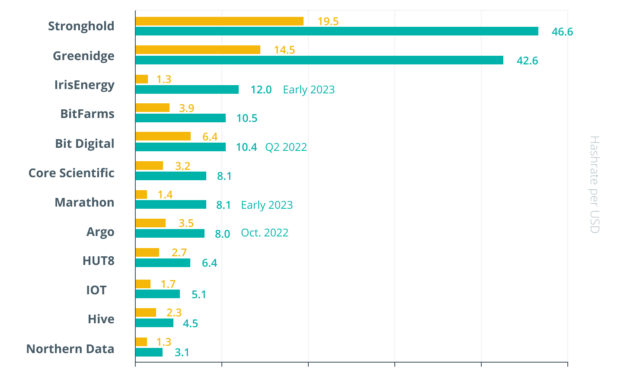
The Cointelegraph Research Terminal, the leading provider of premium databases and institutional-grade research on blockchain and digital assets, has added a new report to its expanding library. The latest paper looks at a particular group of players in the Bitcoin (BTC) mining industry. Published by crypto consulting firm Crypto Oxygen, the report highlights the current landscape of publicly listed crypto mining companies that control approximately 17% of the total hash rate of the entire Bitcoin network. The crypto mining industry is a quickly growing and evolving sector. In January this year, a United States-based company Core Scientific went public via a special purpose acquisition company (SPAC) merger, making it the largest publicly traded crypto mining company in revenue and hash rate. Core Scientific’s hash rate leads all public companies with 8.3 exahashes per second (Eh/s), and it mined 5,769 BTC in 2021, generating about $545 million in revenue. Coming in second and third in terms of revenue are Riot Blockchain and Hive Blockchain Technologies, earning $215 million and $195 million, respectively.Strategic, operational and financial breakdownHash rate and revenue are just a few ways to distinguish between companies, but they don’t paint the whole picture since some firms have revenue models separate from their core mining activity. The report dissects such key stats and offers a more detailed comparison, encompassing each company’s strategic, operational and financial performance.Download the full report, complete with charts and infographics from the Cointelegraph Research TerminalFor instance, the report compares each company’s operations via the current hash rate per U.S. dollar invested. This way, it becomes easier to see which company offers more investment value to investors, which, in this metric’s case, is Stronghold Digital Mining with 46.56 gigahashes per second (GH/s) to lead the pack.Aside from this, the report also provides a quick snapshot of each company’s operations, including each one’s operational key performance indicators (KPIs,) business model, data center locations, BTC holdings and other pertinent information. Specifically, major players like Marathon have lean setups and rely entirely on being hosted by external providers, while others like Stronghold own assets along with the full value chain, including the electrical infrastructure.Rather than just depending solely on financial reports and public statements, Crypto Oxygen has also further conducted a survey to include direct feedback from the analyzed companies in its research.SustainabilityA major concern of Bitcoin mining, in general, pertains to Environment, Social and Governance, or ESG. Sustainability has always been a central talking point concerning the crypto mining industry, and publicly listed companies are particularly subject to increased scrutiny. Yet, there seems to be a focus among the companies in the report on limiting the carbon footprint of their operations, despite the differences in approaches.Out of the 12 companies, eight are already carbon neutral or environmentally beneficial operations. Bitfarms, Hive, Iris Energy and Argo are four companies that rely exclusively on renewable energy sources. Northern Data, Core Scientific and Greenidge Generation use offset credits to reduce their carbon footprint. Marathon Digital Holdings and Hut 8 Mining are also already using carbon offset credits and target to be carbon neutral by the end of 2022, while 67% of Bit Digital’s energy source is from renewables.Indirect exposureInvesting in public crypto mining firms offers investors exposure in the crypto space, albeit not as direct as holding Bitcoin. The correlation between the mining companies’ stock prices to the price of BTC is underscored in the report, and the recent drop in the price of BTC exhibits that. It also shows that more significant BTC holdings tend to be a key driver in the downturn.Yet, the mining firms’ stock prices have declined disproportionately. What the 46-page report delivers is an analysis of each public mining firm’s performance and presents a detailed comparison of each one to help bring more clarity to the players involved in the developing space and the industry in general. For those interested in reading the full report, download it by visiting Cointelegraph Research Terminal.This article is for information purposes only and represents neither investment advice nor an investment analysis or an invitation to buy or sell financial instruments. Specifically, the document does not serve as a substitute for individual investment or other advice.

Čítaj viac
How blockchain games create entire economies on top of their gameplay: Report

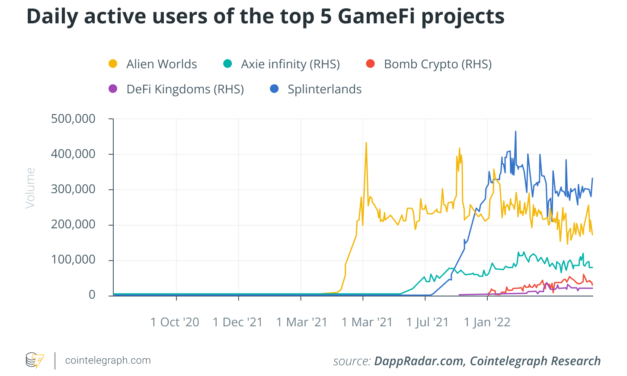
Axie Infinity turned its game into a billion-dollar economy that helped thousands of players in the Philippines and other low-income countries to weather the fallout from pandemic mitigation measures. The main ingredient for success: strong property rights. Players can take in-game material out of the game and trade on third-party marketplaces like OpenSea. The freedom to set prices and to easily trade unlocked a veritable tsunami of economic activity in and outside of the game.The 30-page report from Cointelegraph Research analyzes the top five titles and what changed since the days of Second Life and is produced in partnership with Galaxy Fight Club, The Sandbox, Planetarium, Immutable x, SolaDefy, Decentral Games, X World Games and Animoca brands. The making of a new economyThe report dives deep into the differences between virtual economies of the past, like Second Life or World of Warcraft, and modern blockchain-powered games such as Axie Infinity or DeFi Kingdom.Developing a well-functioning marketplace complete with an in-game currency and open standards for game material was simply beyond the scope of any development studio in the past. But, blockchains offer economic building blocks to game developers. The technology allows developers to launch a token within an hour or to define game materials as nonfungible tokens (NFTs). This gives users strong property rights and the ability to take their characters and items outside of the games onto third-party marketplaces or even other games at little additional development cost.Download the full report here – for free.With the addition of decentralized finance (DeFi) technology, players have financial opportunities they never had before, which led to the lightning-fast adoption of these games.The report then compares the top five blockchain game titles Alien Worlds, Axie Infinity, Bomb Crypto, DeFi Kingdom and Splinterlands. Each of these games has different gameplay and offers different incentives to players. Daily active users, transaction volume, deposited balances and gameplay — as well as tokenomics that are the economic incentives for the in-game currency — are each put into comparison.But, no report would be complete without covering the dark side of blockchain gaming. Environmental concerns, a sharp divide between the haves and the have-nots, the legality and tax implications are all valid concerns around these new economies. This is especially important as the sheer success makes these games increasingly attractive to players and game developers.GameFi titles were responsible for more than 35% of all Polygon transactions during peaks in 2021 and early 2022. But, without addressing the possible issues, the long-term viability of the whole blockchain game space is compromised, as critics and regulators will use these arguments to hinder development or make it harder for players to participate.Get ready, fight!The report has an optimistic conclusion about the future of blockchain gaming and the potential unlocked by economic freedom. Lower transaction costs, stronger property rights and open standards all work together to break open the planned economies of prior game markets. Blockchain technology opens a world of new opportunities for developers and players. If environmental and regulatory concerns can be addressed, 2022 will be the best year for GameFi yet.This article is for information purposes only and represents neither investment advice nor an investment analysis or an invitation to buy or sell financial instruments. Specifically, the document does not serve as a substitute for individual investment or other advice.

Čítaj viac
GameFi is showing signs of a mature landscape: Report

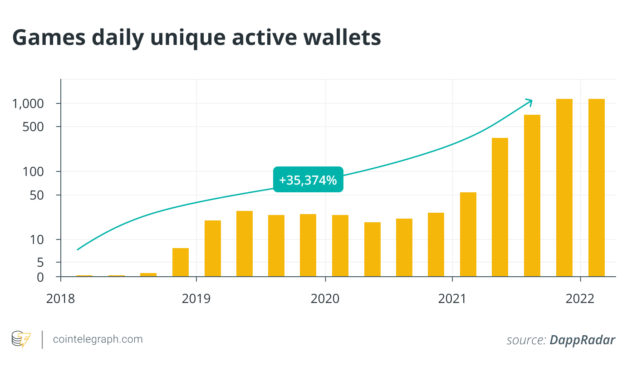
Blockchain games are set to overtake decentralized finance (DeFi) as the number one contributor to decentralized application (DApp) activity in terms of uniquely active wallets. A new 18-page report by DappRadar surveys the nascent ecosystem behind this rise. Although still dwarfed by the traditional gaming industry, blockchain games, sometimes dubbed GameFi, have seen an early spurt of exponential growth, according to the report’s data.“The evolution of blockchain games” report, which discusses play-to-earn (P2E) as a new paradigm for gaming, is available on the Cointelegraph Report Terminal to purchase. It details how the play-to-earn model gained traction in the COVID-19 pandemic when players from emerging economies were seeking new sources of income. In Q2 of 2021, which was notable for a quarter-over-quarter growth of 503%, Wax’s successful space mining game called Alien Worlds was one of the main profiters. Other key players in the space included Axie Infinity, Decentraland, Splinterland and Upland.The report projects that although resistance from the traditional gaming industry and mainstream media are still considerable due to negative press coverage, an improving understanding of blockchain technology could assuage those concerns. The researchers argue that increased public awareness of comparatively energy-frugal proof-of-stake (PoS) technology and the possibility of robust ownership of in-game assets could make GameFi fit for the mainstream in the long run. They conclude that “the horizon for blockchain games is opening up quickly.”DappRadar also breaks down the development of GameFi on different layer-1 ecosystems. Some games have grown large enough to sustain their own blockchains such as Axie Infinity with the Ronin blockchain, DeFi kingdoms with the Harmony Protocol or Splinterlands with Hive. Moving to dedicated chains may be a way for blockchain games to deal with scalability issues that still plague some projects. Download the full report complete with charts and infographics from the Cointelegraph Research TerminalFor example, Polygon, which was developed as a layer-2 solution to deal with Ethereum’s notorious scaling problems, has not been entirely able to withstand the transaction volume generated by GameFi. At the start of this year, it suffered heavily under the agriculture game Sunflower Farmers and saw transaction fees spike to 500 Gwei. Although such technical teething problems will concern developers in the space for some time, the overall conclusions of the report are positive.The accelerating influx of venture capital investments is one of the strong signs that the field is consolidating as an industry, the report argues. While only $70 million were raised by blockchain game companies in 2020, the sector attracted $4 billion in VC investment in 2021 and has already seen an influx of another $2 billion in the first quarter of 2022. With the rise of dedicated VC companies such as Hong Kong-based Animoca Brands, GameFi is likely to gather further momentum through dedicated infrastructure.An assessment of the interplay between DeFi, NFTs and the Metaverse completes the comprehensive analysis. The increasing interoperability, decentralization and democratization of games made possible through the symbiosis of these technologies promise an exciting future. The full contents of the report can be viewed here.This article is for information purposes only and represents neither investment advice nor an investment analysis or an invitation to buy or sell financial instruments. Specifically, the document does not serve as a substitute for individual investment or other advice.

Čítaj viac
Ethereum strives to migrate into a brighter future: Report

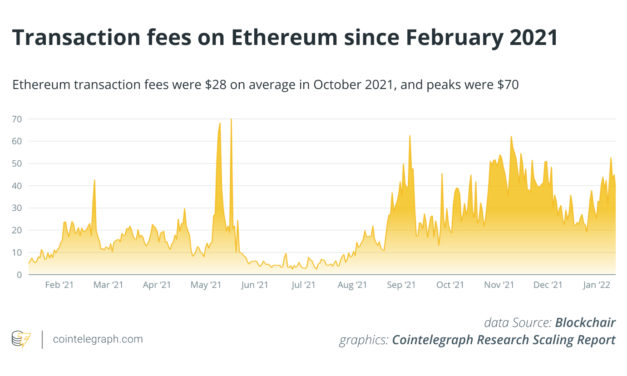
Ethereum 2.0 has been a highly anticipated development in the crypto industry. A recent Cointelegraph research report asks if Ethereum is still on track to defend its crown as the prime network backing the decentralized finance world.The report cuts through popular misconceptions investors may hold and offers a comparative analysis of Ethereum and its competitors. Meanwhile, the Ethereum foundation rebranded the Eth2 project at the start of this year. Is it trying to manage expectations or educate? New talk of consensus and execution layersIn a blog post in January, the Ethereum foundation stated that developers had been moving away from the Eth1-Eth2 terminology since late 2021. Instead, Eth1 will now be called the “execution layer” and Eth2 the “consensus layer.” This is not a minor twist toward more technical language. It is an attempt at expectation management due to common misconceptions.For people only superficially familiar with Ethereum, the name Eth2 might suggest there will be a single large update that magically fixes the problems and notoriously high gas fees by switching from an energy-intensive proof-of-work (PoW) consensus mechanism to proof-of-stake (PoS). However, this is a dangerous oversimplification.The free scaling report published by Cointelegraph Research provides a sound overview of Eth2. It gives detailed information on the planned technical updates and what they mean for Ethereum’s developers, competitors, and investors. The report is free to access on the Cointelegraph Report Terminal.Download the full report here, complete with charts and infographics.The complexity and risk of migrating a multi-billion dollar blockchain project from one consensus mechanism to another have meant that the roll-out of Eth2 has been slower than expected and the Ethereum foundation initially gave no definite timeline. In the meantime, up-and-coming competitors with scalable projects have been vying to take away market share from Ethereum.The report also assesses these challenges in detail. On 74 pages, it offers a comparative analysis of the major players such as Solana, Polkadot, Algorand and Radix which are trying to snatch the top spot in DeFi. Curated by our industry-leading team of researchers, it provides a balanced view of the big picture and manages to cut through the noise of social media and the daily press. Eth2 — Understanding a nuanced realityThe switch from Eth1 to Eth2 is better thought of as a carefully engineered series of upgrades that will slowly transition the blockchain to its envisioned future. Eth2’s main chain, the PoS Beacon chain, was already launched in December 2020. The merging of Eth1 with the Beacon chain is expected in Q2 or Q3 of 2022.Although to a casual observer this might mean that all of Ethereum’s problems will be solved, the update later this year is not likely to have a big impact on gas fees or the capacity of the network. While PoS will significantly reduce the energy consumption of Ethereum, improved scalability will only come once data sharding is introduced in 2023. Sharding was initially going to happen before the merge but has been delayed under the new timeline. The official rationale for this is that scalability is now a lesser priority because layer-2 solutions have become available.The new terminology of “consensus layer” and “execution layer” seeks to banish talk of a mythical point in time when Ethereum’s problems will instantaneously disappear. Associating Eth1 with the consensus layer and Eth2 strictly with the execution layer also shifts the focus from the third so-called data availability layer that would have been subject to the delayed data sharding update. With the merge scheduled for later this year, it may be tempting to think that the days of alternative decentralized finance (DeFi) blockchains are numbered. However, it is important for investors not to jump to conclusions prematurely. As Eth2 will not be an instantaneous magic fix, keeping track of the competitive landscape remains invaluable.This article is for information purposes only and represents neither investment advice nor an investment analysis or an invitation to buy or sell financial instruments. Specifically, the document does not serve as a substitute for individual investment or other advice.

Čítaj viac

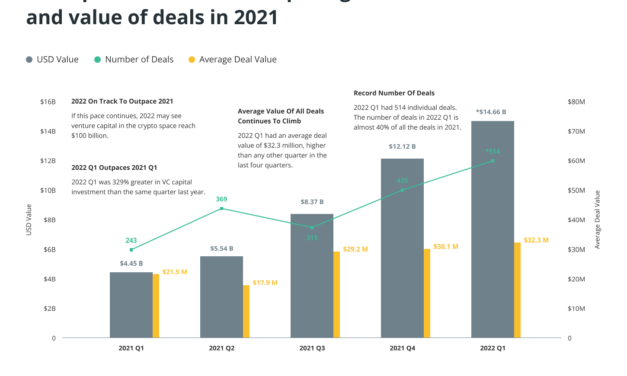
2022 Q1 venture capital activity in crypto set to outpace 2021

The first quarter of 2022 saw unprecedented growth in terms of venture-capital (VC) activity in different blockchain sectors. In 2021, VCs poured in over $30 billion into infrastructure, nonfungible tokens (NFTs), decentralized finance (DeFi), centralized finance (CeFi) and Web3. That set the bar pretty high if 2022 was going to beat it. In the first quarter of 2022, capital inflows from VCs were over $14.6 billion, or around 48% of all the capital investment by VCs last year. Over 500 individual deals were struck in the first three months throughout the five major sectors listed above in 2022. Cointelegraph Research studied and analyzed its database of deals, mergers and acquisitions (M&A) activity, investors and crypto companies to produce a 12-page report on the major VC activities in the crypto sphere. Leaving 2021 behindAnyone interested in cryptocurrencies, blockchain and the future of this industry should pay close attention to the contents of this report. By studying what the VCs are doing and knowing the players who are investing in projects and which platforms are being invested in, individuals can help stay on top and make informed decisions.It takes more than just great technology to have people use a product. History is filled with great products that just did not have the right mix of marketing, management or capital to bring a product successfully to market. VCs aim to resolve these issues by investing more than just the capital needed to get a project off the ground but also provide a network of contacts that can provide solutions to the correct marketing and strategic management mix. Download the full report here, complete with charts and infographics.The Cointelegraph Research Terminal, together with Keychain Ventures, brings you a report which dives into the first three months of 2022. The 12-page report by Cointelegraph Research analyzes the most active investors, M&A, largest deals and new funds in 2022 Q1. Record-breaking number and value of deals The first quarter of 2022 saw an unprecedented amount of capital inflows in the blockchain industry. Since the start of 2021, each quarter has continuously increased the total capital invested in this space, culminating in the 2022 Q1 that ushered in over $14.6 billion in VC investment. The average United States dollar value of each deal has also increased and now stands around $32.3 million for the last three months. The number of individual deals is also rising and broke the previous record, reaching over 500 in 2022 Q1. The increase is likely to continue to trend higher as the space is attracting new funds from Bain Capital and Sequoia Capital, long-time VCs in traditional markets. The industry also saw consolidation through acquisitions by long-time crypto players like OpenSea, Coinbase, Fireblocks, FTX and Blockchain.com. In all cases, these strategic purchases expand the reach of each of the firms’ core business offerings.The recently formed funds like Bain Capital and Haun Ventures are focused primarily on Web3 projects, which, interestingly enough, had the most involvement in 2022’s first quarter and overtook the DeFi sector — the usual leader. CeFi continues to be the least active in terms of the number of deals and capital inflows of all the different sectors. The most active investors are more evenly distributing their investments across two or three different sectors, which changed from the patterns seen in 2021. This potentially shows a maturing of VC strategy, but still, these equal allocations are across DeFi, Web3, NFTs and infrastructure, with much less being invested in CeFi. Active seed rounds, but Expansion rounds see the most capital interest Pre-Seed and Seed rounds had the most VC activity at 288 individual deals with over $2.1 billion. Watching the development in these rounds is promising for the entire industry, as each startup brings new applications for the blockchain and new competition for previously formed organizations. The Expansion rounds did not see as much activity but recorded over 2.5 times the capital inflows at almost $5.8 billion. These rounds help to encapsulate the overall growth potential and reach of the current blockchain projects, which most VCs are willing to pour money into as they are less risky than earlier stage investments like Series A rounds.Blockchain needs the right peopleOne issue intensifying with all this capital investment is the need for people and talent in the blockchain space. As more companies have plans to expand, create new products and diversify their organizations, employees with the right skills are becoming harder to find. Cointelegraph Research recently interviewed Keychain Ventures and Dragonfly Capital. In that conversation, many topics were discussed including the bottleneck of human capital, which will only get further strained as more investment pours into the industry.Quarterly VC reports from Cointelegraph Research Terminal and Keychain Ventures The report pulls from Cointelegraph Research Terminals’ expansive database along with analysis from Michael Tabone, an economist from Cointelegraph Research. Michael has an extensive background in economics, business, finance, cryptocurrency, blockchain technology and working with emerging technologies. Besides working for Cointelegraph Research, Michael is a Ph.D. candidate working on his dissertation, which is focused on the theory and application of DAOs.Keychain Ventures is a crypto investment firm that engages in investing different funds in the blockchain space. Keychain Ventures, along with Cointelegraph Research, will be presenting quarterly interviews with VC firms as well as crypto/blockchain projects which have recently gone through a funding round. These interviews will open up different viewpoints of investment practices from all parties. This article is for information purposes only and represents neither investment advice nor an investment analysis or an invitation to buy or sell financial instruments. Specifically, the document does not serve as a substitute for individual investment or other advice.

Čítaj viac

Získaj BONUS 8 € v Bitcoinoch

nakup bitcoin z karty

Registrácia Binance

Burza Binance

Aktuálne kurzy