
Autor Cointelegraph By Cointelegraph Research

Web3 dominates venture capital interest in blockchain industry in Q2 2022

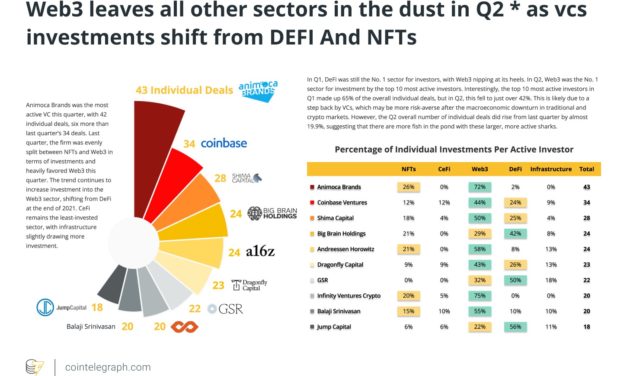
Cointelegraph Research brings an analysis of all the deals and trends from venture capital (VC) in the blockchain industry during the second quarter of 2022.When looking at the aggregate total amount invested into the crypto industry in the second quarter, it will tell one story. However, a deeper dive into the data tells another tale. From a high level, the $14.67 billion invested in Q2 is about flat with the $14.66 invested in Q1. But, the largest chunk of that investment was in April, before the last two months of a large slump in global markets, which made even the most bullish crypto investor admit the bear market has arrived. The good news is that even though this did happen, funds like Andreessen Horowitz (a16z) closed a $4.5 billion crypto fund, and investment continued to flow into different sectors of the crypto industry.Download the full report here, complete with charts and infographics.The Cointelegraph Research Terminal has a VC database that contains comprehensive details on deals, mergers and acquisition activity, investors, crypto companies, funds and more. Using this database, Cointelegraph Research analyzes the numbers to find the important trends in the industry. The report is just an overview of the highlights of the last quarter — not everything can fit into the 12-page quarterly report.The numbers can lieThe total dollar value of individual deals in the blockchain industry remained flat at $14.67 billion for Q2, just barely over Q1’s $14.66 billion. This can point to an inaccurate conclusion that there is no change in VC investment trends, and everything is on a massive exponential growth curve.The slump in traditional finance (TradFi) markets has been a headwind for the crypto markets. The risk-on to risk-off change has had a surprising impact on different sectors of the crypto sphere. These downward market pressures were only exacerbated by the collapse of Terra’s stablecoin, which brought down the overall market capitalization considerably. Macroeconomic forces have impacted venture capital firms to take a slight step back and approach projects with more caution and probably less capital allocation to reduce their risk exposure in the case of backing a bad project.The number of individual deals in the blockchain industry was over 620, up a hundred more than the previous quarter. But, the average value of each deal decreased by over 16% to $26.8 million, perhaps indicating more risk-averse behavior on the part of VC and investment firms. So, while the data shows signs of a slow down in investment inflows in the crypto space, the interest to help build the next generation of blockchain and crypto products appears to still be strong.Web3 becomes the sector of most interest for VCsOut of all the overarching sectors in the blockchain industry in decentralized finance (DeFi,) centralized finance (CeFi,) blockchain infrastructure, Web3 and nonfungible tokens (NFT,) DeFi was basically always king for VC capital inflows. That all changed in Q2, when Web3 garnered around 42% of all the individual deals, leaving DeFi in a far distant second at 16%. This trend was highlighted further when analyzing the most active investors, who made around 42% of all deal activity for Q2, a drop from 65% in Q1. Seven out of the top ten most active VCs chose Web3 as the sector of choice for investment. The push for active involvement of companies to pursue becoming part of the overall concept of the Metaverse is the driving force behind this new trend. In the next report, the Cointelegraph Research team will break down the Web3 sector into its different parts to see where VC interest is headed in the space.Metaverse investment takes the leadThe top ten deals ranged lower than in the previous quarter but also held a massive $2 billion deal with Epic Games to expand into combining sports experiences and the crypto-metaverse. The Metaverse and Web3 were a running theme in these large deals, and so was the CEO of FTX exchange, Sam Bankman-Fried, becoming something of a “lender of last resort” and providing funds for firms like BlockFi, which was negatively impacted by the recent downturn in the market.Animoca Brands ahead in the M&A gameMergers & acquisitions (M&A) can provide great strategic opportunities for companies, especially in times of turmoil. Animoca Brands seems to take these strategic opportunities seriously, acquiring three companies in the GameFi space and others in education and marketing. Two big names also were involved in the acquisitions — eBay and Napster. eBay acquired Known Origin — a nonfungible token (NFT) marketplace — to help expand its product offerings to customers. Algorand and Hivemind acquired Napster to promote the music NFT market to improve access for consumers and music creators.The report pulls from Cointelegraph Research Terminals’ expansive database along with analysis from Michael Tabone, a senior economist from Cointelegraph Research. Michael has an extensive background in economics, business, finance, cryptocurrency, blockchain technology and working with emerging technologies. Besides working for Cointelegraph Research, Michael is a Ph.D. candidate working on his dissertation, which is focused on the theory and application of decentralized autonomous organizations, or DAOs.Keychain Ventures is a crypto investment firm that engages in investing different funds in the blockchain space. Keychain Ventures, along with Cointelegraph Research, will be presenting quarterly interviews with VC firms as well as crypto/blockchain projects that have recently gone through a funding round. These interviews will open up different viewpoints of investment practices from all parties. This article is for information purposes only and represents neither investment advice nor an investment analysis nor an invitation to buy or sell financial instruments. Specifically, the document does not serve as a substitute for individual investment or other advice.

Čítaj viac
Fighting the crypto winter and token protocol inflation in 2022

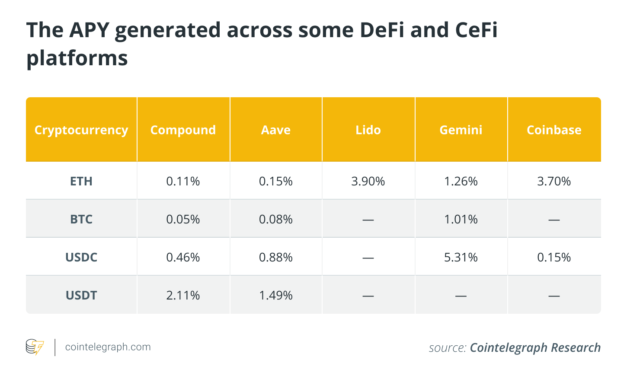
There is an old saying, “cash is king,” but if it is sitting in a bank account or, in the case of crypto — a wallet, it diminishes daily due to inflation. This is especially the case now as inflation in the United States breaks its 40-year record. While the dollar-cost-averaging (DCA) strategy allows an investor to minimize the effects of volatility by purchasing an unstable asset in time intervals, inflation still causes a decrease in a target asset’s value over time. For instance, Solana (SOL) has a pre-set protocol inflation rate of 8%, and if the yield is not generated through farming or utilizing decentralized finance (DeFi), one’s holdings are depreciating at a rate of 8% per year. However, despite the U.S. Dollar Index (DXY) increasing by 17.3% in a year, as of July 13, 2022, the hopes of receiving significant returns in the bull market are still pushing investors to engage with volatile assets.In the upcoming “Blockchain Adoption and Use Cases: Finding Solutions in Surprising Ways” report, Cointelegraph Research will dig deeper into different solutions that will help to resist inflation in the bear market.Download and purchase reports on the Cointelegraph Research Terminal.Crypto winter is a period where anxiety, panic and depression start to burden investors. However, many crypto cycles have proven that real value capture can be attained during a bear market. For many, the current sentiment is that “buying and hodling” combined with DCA may be one of the best investment strategies during a crypto winter. In most cases, investors abstain from outright investment and amass capital to purchase assets when the macro condition improves. However, timing the market is challenging and is only feasible for active daily traders. In contrast, the average retail investor carries higher risks and is more vulnerable to losses coming from rapid market changes.Where to go?In the midst of various calamities in the crypto universe, placing assets in staking nodes on-chain, locking in liquidity pools, or generating yield through centralized exchanges all come with a hefty amount of risk. Given those uncertainties, the big question remains whether it’s best to just buy and hodl.Anchor Protocol, Celsius and other yield platforms have recently demonstrated that if the foundation of yield generation is backed poorly by the tokenomics model or the platform’s investment decisions, too-good-to-be-true yields may be replaced by a wave of liquidations. Generating yield on idle digital assets via centralized or decentralized finance protocols with robust risk management, liquid rewards and yield offering that is not too aggressive is probably the least risky pathway for fighting inflation.Both DeFi and centralized finance (CeFi) protocols can offer varying levels of yields for identical digital assets. With DeFi protocols, the risk of lock-ups to generate marginal yield is yet another major factor, as it limits an investor’s ability to react quickly should the market adversely change. Moreover, strategies may carry additional risks. For instance, Lido liquid staking with stETH derivative contracts is vulnerable to price divergence from the underlying asset. Although CeFi such as Gemini and Coinbase, unlike multiple other such platforms, have demonstrated prudent user fund management with transparency, yield offerings on digital assets are insignificant. While staying within the risk management framework and not taking aggressive risks on the user’s funds is beneficial, the returns are relatively low. While keeping a buying discipline within the DCA framework and doing research are crucial, finding a low-risk solution generating substantial yields may be tricky. Meanwhile, a new crypto market cycle is set to bring developments that will hopefully bring novel solutions, attractive in both risk and returns. Cointelegraph Research evaluates multiple platforms and assesses the sustainability of current DeFi and CeFi yields in its upcoming report. This article is for information purposes only and represents neither investment advice nor an investment analysis or an invitation to buy or sell financial instruments. Specifically, the document does not serve as a substitute for individual investment or other advice.

Čítaj viac
Must staking and liquidity pool lock-ups change to see crypto mass adoption?

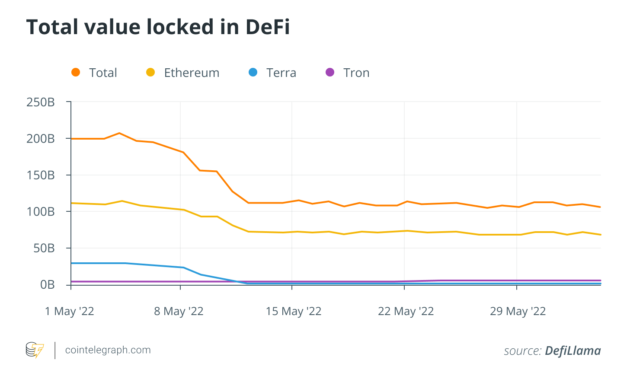
The recent downturn in the broader crypto landscape has highlighted several flaws inherent with proof-of-stake (PoS) networks and Web3 protocols. Mechanisms such as bonding/unbonding and lock-up periods were architecturally built into many PoS networks and liquidity pools with the intent of mitigating a total bank run and promoting decentralization. Yet, the inability to quickly withdraw funds has become a reason why many are losing money, including some of the most prominent crypto companies.At their most fundamental level, PoS networks like Polkadot, Solana and the ill-fated Terra rely on validators that verify transactions while securing the blockchain by keeping it decentralized. Similarly, liquidity providers from various protocols offer liquidity across the network and improve each respective cryptocurrency’s velocity — i.e., the rate at which the tokens are exchanged across the crypto rail.Download and purchase reports on the Cointelegraph Research Terminal.In its soon-to-be-released report “Web3: The Next Form of the Internet,” Cointelegraph Research discusses the issues faced by decentralized finance (DeFi) in light of the current economic background and assesses how the market will develop.The unstable stableThe Terra meltdown raised many questions about the sustainability of crypto lending protocols and, most importantly, the safety of the assets deposited by the platforms’ users. In particular, crypto lending protocol Anchor, the centerpiece of Terra’s ecosystem, struggled to handle the depeg of TerraUSD (UST), Terra’s algorithmic stablecoin. This resulted in users losing billions of dollars. Before the depeg, Anchor Protocol had more than $17 billion in total value locked. As of June 28, it stands at just under $1.8 million.The assets deposited in Anchor have a three-week lock-up period. As a result, many users could not exit their LUNA — which has since been renamed Luna Classic (LUNC) — and UST positions at higher prices to mitigate their losses during the crash. As Anchor Protocol collapsed, its team decided to burn the locked-up deposits, raising the liquidity outflow from the Terra ecosystem to $30 billion, subsequently causing a 36% decrease in the total TVL on Ethereum.While multiple factors led to Terra’s collapse — including UST withdrawals and volatile market conditions — it is clear that the inability to quickly remove funds from the platform represents a significant risk and entry barrier for some users.Dropping the CelsiusThe current bear market has already demonstrated that even curated investment decisions, carefully evaluated and made by the leading market players, are becoming akin to a gamble due to lock-up periods.Unfortunately, even the most thought-out, calculated investments are not immune to shocks. The token stETH is minted by Lido when Ether (ETH) is staked on its platform and allows users access to a token backed 1:1 by Ether that they can continue using in DeFi while their ETH is staked. Lending protocol Celsius put up 409,000 stETH as collateral on Aave, another lending protocol, to borrow $303.84 million in stablecoins. However, as stETH depegged from Ether and the price of ETH fell amid the market downturn, the value of the collateral started falling as well, which has raised suspicions that Celsius’ stETH has been liquidated and that the company is facing bankruptcy.Given that there is 481,000 stETH available on Curve, the second-largest DeFi lending protocol, the liquidation of this position would subsequently cause extreme token price volatility and a further stETH depeg. Thus, lock-up periods for lending protocols act not only as an additional risk factor for an individual investor but can sometimes trigger an unpredictable chain of events that impact the broader DeFi market.3AC in troubleThree Arrows Capital is also at risk, with the ETH price decline reportedly leading to the liquidation of 212,000 ETH used as collateral for its $183 million debt in stablecoins and putting the venture fund on the brink of bankruptcy.Moreover, the inability of lending protocols to negate the liquidations recently pushed Solend, the most prominent lending protocol on Solana, to intervene and propose taking over a whale’s wallet “so the liquidation can be executed OTC and avoid pushing Solana to its limits.” In particular, the liquidation of the $21-million position could cause cascading liquidations if the price of SOL were to drop too low. The initial vote was pushed through by another whale wallet, which contributed 95.1% of the total votes. Even though a second vote overturned this decision, the fact that the developers went against the core principles of decentralization, and revealed its lack thereof, alarmed many in the crypto community.Ultimately, a lack of flexibility with bonding/unbonding and locked liquidity farming pools may deter future contributors from joining Web3 unless they have a strong understanding of DeFi design and commensurate risk. This is exacerbated by the collapse of “too big to fail” protocols like Terra and uncertainty around hybrid venture capital firms/hedge funds like Three Arrows Capital. It may be time to evaluate some alternative solutions to lock-up periods to allow for sustainable yields and true mass adoption.This article is for information purposes only and represents neither investment advice nor an investment analysis or an invitation to buy or sell financial instruments. Specifically, the document does not serve as a substitute for individual investment or other advice.

Čítaj viac
Blockchain investments are disrupting the real estate industry: Report

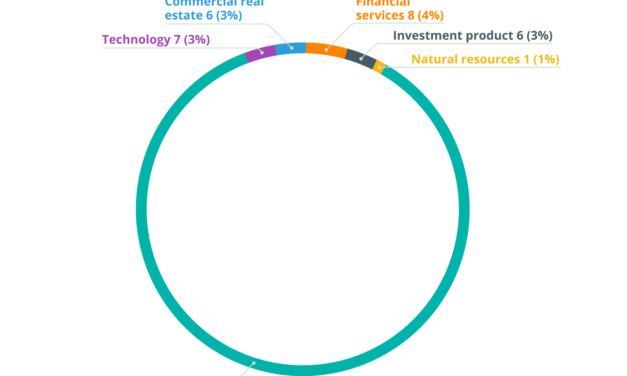
The Cointelegraph Research Terminal, the leading provider of premium databases and institutional-grade research on blockchain and digital assets, has added a new report to its expanding library from the industry leader in tokenization. This report from Security Token Market and sister company Security Token Advisors covers the rapidly emerging asset-backed real estate tokenization industry. This report has information on the developing shifts in the industry and is a must for any firm or business with a portfolio that encompasses real estate.The tokenized real estate industry is growing rapidly amid the current market frenzy. With investors looking for a more secure investment that utilizes emerging technology, the demand for blockchain-based investment opportunities backed by real-world assets is increasing. Real estate assets account for upwards of 40% of the pipeline for certain technology providers in the industry, likely making it the largest and most “urgent” sector when it comes to future security token offerings. Download the full report, complete with charts and infographics from the Cointelegraph Research TerminalTo understand what the 2022 landscape looks like, this report sheds light on notable developments and deals. This sector of tokenization offers investors access to high-performing fractionalized investments that can be purchased with cryptocurrency and traded via secondary markets.Emerging technology, disrupting a traditional market The existing tokenized real estate market can be broken into the following tranches: assets securitized on the blockchain, assets that are fully tokenized but not actively trading on secondary markets and assets that are fully tokenized and actively trading on secondary markets.Historyically, real estate has been one of the most illiquid asset classes, perhaps next to hedge funds and private equity. This comes as no surprise, as real estate often involves extensive planning requirements, cost constraints, property management, safety requirements and legal prowess. These variables can cost an investor months and years in time, alongside expenses like unavoidable fees depending on the size and scale of the project. Since the last Cointelegraph Research report, real estate still makes up 89% of the pie in the total securities market; however, the overall pie has grown. The number of commercial real estate deals grew from 2% a few months ago to 3% of the total number of security tokens being invested in. The tokenization of assets such as real estate allows for these historically illiquid investments to realize additional liquidity. By trading fractionalized portions of a property, investors can enjoy the yield generated by rent and operations without the legal and time-consuming hassles associated with paper-based real estate investing and management.Market capitalizationBoth residential and commercial real estate continue to increase in terms of capitalization over time. In June of 2021, there was a modest $65 million capitalization, but May of 2022 had $194 million in total monthly market capitalization. The aggregate market capitalization of all security tokens is over $16.4 billion, of which real estate is currently around 1.2%. This may seem small now, but it is the largest growing security token sector and should be something to watch closely.Research report authors Security Token Market has conducted extensive research for over four years. This coverage can be used to inform issuers, investors and trading firms at multiple stages in the tokenization process.Peter Gaffney is the head of research at Security Token Advisors, a full-suite consulting firm that facilitates the tokenization of assets on behalf of clients, where he develops the security token ecosystem that helps to connect organizations and services.Aneesh Shinkre works on the data science team at Security Token Market, where he statistically analyzes, visualizes and narrates the market performance of tokenized assets while also ensuring consistency of data systems to deliver in-depth research.Thor Wahlestedt also works on the data science team at Security Token Market. Thor manages Security Token Market’s data assets and infrastructure while covering the security token ecosystem via analyst reports and market summaries. This article is for information purposes only and represents neither investment advice nor an investment analysis or an invitation to buy or sell financial instruments. Specifically, the document does not serve as a substitute for individual investment or other advice.

Čítaj viac

Accepting Bitcoin for your business just like Tesla: Report

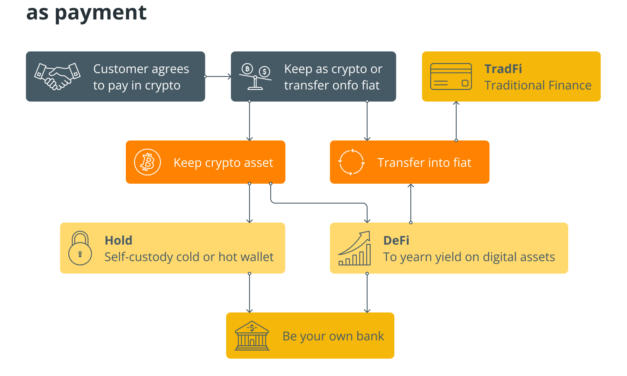
Tesla temporarily embracing Bitcoin (BTC) as a method of payment for its products was conceivably one of the catalysts that pushed asset prices to record highs last year and put the spotlight on crypto legitimacy — particularly in the realm of payments. Moreover, crypto enthusiasts had lauded the fact that Tesla even set up its own node to accept BTC and stated that it wouldn’t swap its holdings for fiat, implying high confidence in the crypto’s long-term prospects.But despite having backtracked and ceased its Bitcoin acceptance a few months after due to climate concerns, Tesla was only a cog in the adoption machine of 2021. Starbucks, Whole Foods and AMC Entertainment were just some of the other juggernauts that made their foray into crypto last year. However, what’s apparent is that headlines play favorites to household names. For other businesses that want to hop on the trend, it’s a question of how to start. Cointelegraph Research’s latest report provides answers. The 35-page paper goes over the booming trend in crypto acceptance and practical ways any business can integrate cryptocurrencies into their operations. Additionally, the report also looks at the future of crypto in payments, particularly concerning regulation, and a lot more.Why should businesses accept crypto?Cryptocurrencies are believed to be in a phase of hyper-adoption, and the 178% increase in the global crypto population is further evidence of that. For businesses, accommodating this growing demographic would mean an expansion of their potential client base. Receiving payments in crypto is also a lot cheaper when compared to TradFi methods, which may improve a company’s bottom line. Merchants could save up to 3.5% in fees — or more — if the payment method is in crypto rather than credit or debit cards.Download the full report here, complete with charts and infographicsChargebacks are also another drawback with TradFi payment methods, costing e-commerce merchants $125 billion in 2021. Chargebacks are a type of payment reversal where the merchant returns the sum of money to the customer due to a transaction dispute or if the customer returns the purchased product. However, chargebacks can also be outright fraud, as some customers may dispute a transaction to secure a refund despite having zero issues with the product or its delivery.The process of accepting cryptoWhether a company sets up its own node like Tesla or opts for a payments processor to facilitate the transaction, the way to do it is more or less the same but differs under the hood. For instance, certain payments processors can allow a merchant to receive crypto but would also enable real-time settlement in fiat. This effectively removes price volatility while giving the merchant the flexibility to accept digital assets. Of course, the downside is that it subjects the company to the often drawn-out procedures in TradFi. The other side to this is to accept the actual crypto-asset wholeheartedly, and there are various reasons for doing so. Long-term price appreciation is the most common argument, but companies can also hold on to crypto assets for rainy-day situations. Merchants can also earn additional revenue by utilizing the avenues available within the crypto space, such as locking cryptos in DeFi protocols to earn yield from staking or lending.Ultimately, the deciding factor on the channel to receive crypto assets will depend on the merchant. The factor that needs to be considered is whether the objective is to hold cryptocurrencies or tap into the growing crypto customer base — or maybe even both. Download the full report with more detailed information, complete with charts and infographics on the Cointelegraph Research Terminal.This article is for information purposes only and represents neither investment advice nor an investment analysis or an invitation to buy or sell financial instruments. Specifically, the document does not serve as a substitute for individual investment or other advice.

Čítaj viac

Získaj BONUS 8 € v Bitcoinoch

nakup bitcoin z karty

Registrácia Binance

Burza Binance

Aktuálne kurzy