Autor Cointelegraph By Cointelegraph Research

Blockchain venture capital funding down over 43% in July: Report

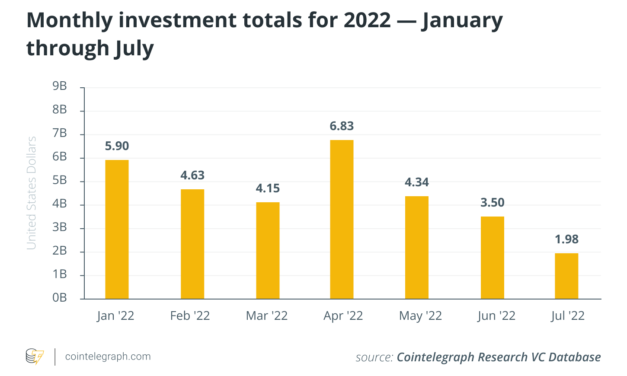
Typically a lagging indicator of the sector’s health, the explosion of venture funding in the blockchain sector in 2021 and the first half of 2022 appears to be cooling off after seven consecutive sectors of growth. According to Cointelegraph Research, inflows in the blockchain venture capital market have declined by 43% month-on-month in July 2022.The Web3 sector, including GameFi and the Metaverse, continues to command the lion’s share of investor interest. But, the decline in capital inflows should be viewed in context as the numbers are close to the same period in 2021 when the crypto market was in a bull run.Capital inflows nosedive in JulyEven the most bullish Bitcoin maximalists seem resigned to the bleak reality of a cold long winter as cryptocurrency prices crab along with the occasional bounce, at best. VCs are not immune to negative sentiment, confirming that crypto’s recent downturn is beginning to show in private funding. As revealed in the recently published Q2 Venture Capital Report by Cointelegraph Research, the average deal value in the venture capital industry has declined by 16% to $26.8 million in Q2, and the crypto VC train of 2021-2022 is likely running out of steam.The Cointelegraph Research Terminal VC database data that contains comprehensive details on deals, mergers and acquisition activity, investors, crypto companies, funds and more outlines that in July, the total number of deals declined 26% month-on-month, with average deal values continuing their downward trend. For access to reports and databases, visit the Cointelegraph Research TerminalOverall capital funding plummeted 43% in July to $1.98 billion from June’s $3.5 billion. It’s easy to view these figures negatively, but when compared to 2021, the VC market looks to be in a much healthier state. Total capital inflows throughout 2021 were $30.5 billion for the blockchain space. July saw 2022s total inflows surpass that figure with $31.3 billion in investments this year despite difficult macroeconomic conditions that caused the crypto market to see some bankruptcies and controversies like the Terra collapse in May.Web3 commands the most investor interestVCs shifted their investment strategy in Q2, favoring Web3 over decentralized finance (DeFi). This trend continued in July, with Web3 companies accounting for 44% of investments and 55% (78) of the 141 deals closed. Capital interest in DeFi continues to wane, with the sector accounting for 27% of the total funding and just 17% of the total deals completed in July. Additionally, GameFi took 20% of the 78 deals closed and the Metaverse companies accounted for 17%.Download and purchase this report on the Cointelegraph Research Terminal.For a full analysis of the blockchain VC sector in July, check out the recently launched monthly “Investor Insights” report from Cointelegraph Research. The research team breaks down the past month’s top market-moving events and the most critical data across the various sectors of the industry, including venture capital.July fundraising bonanzaJuly’s fundraising numbers strike a different tone from the steep decline in VC deals completed with five companies securing over $100 million in funding. Overall fundraising in July was $15.4 billion, amounting to a 61% increase from June’s $9.5 billion raised. Having previously backed several crypto and blockchain-related firms, Sequoia Capital China alone raised $9 billion in July, which shows bullish investor interest in the Chinese market despite China’s crackdown on tech companies. VC funding has already surpassed 2021Investor interest is shifting to Web3, with uncertainty in the DeFi space impacting investor sentiment. The crypto market downturn and an uncertain macroeconomic landscape are impacting private funding, but the outlook remains positive. With month-on-month declines in overall funding, deals, and deal values, VC market inflows remain on a par with Q2 2021, when the market was in a bull run.The article pulls from Cointelegraph Research Terminals’ expansive Venture Capital Database. This article is for information purposes only and represents neither investment advice nor an investment analysis or an invitation to buy or sell financial instruments. Specifically, the document does not serve as a substitute for individual investment or other advice.

Čítaj viac
Pushing Bitcoin to become more scalable with zero-knowledge proofs

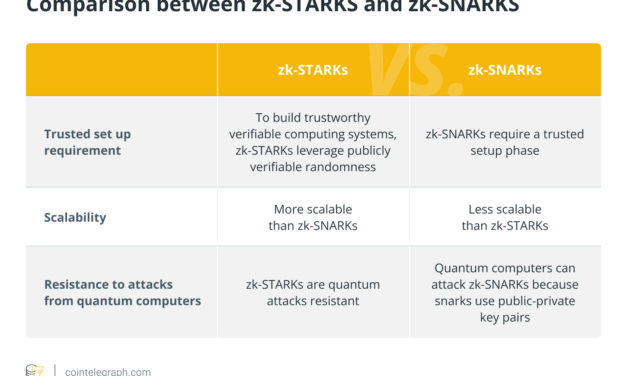
For all the good that Bitcoin brings to the table, it also possesses a commonly accepted issue in scalability. Bitcoin can only process a limited number of transactions per block and, as of Aug. 17, 2022, can handle about five transactions per second, which in comparison to most other blockchains is low. The factor limiting scalability lies in Bitcoin’s cryptographic algorithm.The Elliptic Curve Digital Signature Algorithm (ECDSA) is the essential cryptographic algorithm that powers Bitcoin and ensures that only the rightful owner can access and manage their funds. Currently, verification of the ECDSA, a Bitcoin signature allowing to carry out transactions and send Bitcoin (BTC), is not efficient and limits the scalability of the Bitcoin blockchain. A potential solution is using zero-knowledge proof (ZKP) technology, allowing higher degrees of privacy and security.A recent Starkware paper presents the method for efficiently verifying ECDSA from within the STARK ecosystem, potentially resolving the blockchain trilemma for Bitcoin — i.e., achieving scalability, security and decentralization simultaneously.Foundations of the technologyA ZKP is a cryptographic technique that enables the prover to confirm another person’s claim without supporting data. ZKPs are cryptographic protocols that keep third parties away from users’ privacy. ZKPs can also be a helpful building block for many cryptographic protocols, ensuring participants follow the protocol’s specifications. Privacy and scalability are enhanced with ZKPs because only certain data is revealed and transacted without disclosing all the information that needs to be proven.Based on the ZKP technology, STARKs, or Scalable Transparent Argument of Knowledge — invented by Starkware — is a type of cryptographic proof technology that makes it possible to communicate data with a third party — e.g., sign transactions without revealing the data. It also allows moving computations and storage of validated data off-chain, thus increasing scalability. STARKs is a quantum-resistant system based on hash functions used by Ethereum, not elliptic curves utilized by Bitcoin. Importantly, STARKs systems are considered more advanced than their predecessors, zk-SNARKs, and can resist attacks from quantum computers.EC-STARKs: The next step in Bitcoin’s scalability?Earlier, Starkware announced governance token issuance for its StarkNet — a decentralized permissionless STARK-based validity rollup that operates as an Ethereum layer-2 chain — to decentralize the network further and maintain STARK technology as a public good. However, Ethereum’s underlying storage cost constraints the scalability advantages of the technology. However, its application for the Bitcoin blockchain may present a better platform for decentralized applications in the near future.Related: zk-STARKs vs. zk-SNARKs explainedEC-STARKs are the next generation of this technology, aiming to increase Bitcoin’s scalability and security by replacing hash functions with elliptic curves — i.e., making already-existing scalability solutions for Ethereum to be compatible with Bitcoin. With EC-STARKs, one can run an off-chain protocol for Bitcoin and keep proofs in STARK. Simply put, Bitcoin can be emulated inside STARK, allowing highly sophisticated protocols to be built on Bitcoin-backed tokens with the same elliptic curve keys. Thus, utilizing this technology may not only increase the scalability of Bitcoin but serve as the gateway for developers to create DApps on Bitcoin, potentially creating a rival for Ethereum.

Čítaj viac

Fallout from crypto contagion subsides but no market reversal just yet

The blockchain industry showed some surprising resilience in July, which may point to a period of greater fundamental support for the crypto space overall in the short term. In looking at a wide variety of indicators, including Bitcoin’s (BTC) price action, open interest on Ether (ETH) and activity in GameFi, there are some strong signals to suggest that a bullish sentiment is returning to this space.Smooth sailing from now on is not a given, though. Cointelegraph Research’s latest Investor Insights analyzes key indicators from different sectors of the blockchain industry to navigate those potentially treacherous crypto waters. In the latest edition, Cointelegraph Research’s bearish-to-bullish index was a level C indicating a short-term cautionary time. While there are still mixed signals, the overall sentiment was leaning toward the bulls for July.Download and purchase this report on the Cointelegraph Research Terminal.Bitcoin and Ether show signs of strengthBitcoin closed July up 16.6% since the start of the month, a gain not seen since October 2021. BTC continues to range with a level of resistance around $24,000; however, the repeated approach and rejection are likely to break at some point if factors change, such as positive economic growth reports from the United States and elsewhere. At the same time, Ethereum saw an all-time high of unique active wallet addresses, 48% higher than previous records. Both indicators are bullish for the blockchain space.GameFi shows signs of lifeThe GameFi sector has been on a decline since the large market crash in the first half of 2022. However, July saw a 4.7% jump in new users across all of GameFi compared to June. Some highlights from this sector include the sale of digital real estate and the sale of a Genesis Land plot, which went for 550 Wrapped Ether (wETH). Nonfungible tokens (NFTs) that were part of the GameFi sector made up more than 36% of the $976 million of total NFTs value sold in July. This helps to paint the picture of activity and strength returning to some segments of the market.Venture capital investment declineThe venture capital investment totals have been on a decline for the past few months; however, July saw capital inflows down 43% from June, to around $1.9 billion. This suggests that what can be perceived as a bearish sentiment at first glance may warrant a pulled-back wider view.The reason is that these are levels of capital investment in the blockchain industry that have not been seen since the start of the 2021 bull run. This is also likely to subside moving through the second half of 2022 and into 2023, as the crypto contagion of failing blockchain companies seems to have fully played out.The Cointelegraph Research teamCointelegraph’s Research department comprises some of the best talents in the blockchain industry. Bringing together academic rigor and filtered through practical, hard-won experience, the researchers on the team are committed to bringing the most accurate, insightful content available on the market.Demelza Hays, Ph.D., is the director of research at Cointelegraph. Hays has compiled a team of subject matter experts from across the fields of finance, economics and technology to bring to the market the premier source for industry reports and insightful analysis. The team utilizes APIs from a variety of sources in order to provide accurate, useful information and analysis. With decades of combined experience in traditional finance, business, engineering, technology and research, the Cointelegraph Research team is perfectly positioned to put its combined talents to proper use with the Investor Insights Report. Disclaimer: The opinions expressed in the article are for general informational purposes only and are not intended to provide specific advice or recommendations for any individual or on any specific security or investment product.

Čítaj viac

Building the blockchain industry despite market drops and regulation threats

“The cryptocurrency market is the only truly free market that exists in the financial universe,” said Dan Tapiero, CEO of 10T Holdings, during a recent video discussion with Cointelegraph Research. A major concern of venture capital (VC) and investment firms as of late has been centered around regulation from different countries around the globe. While the theme of the discussion was on regulation, the conversation also touched upon how these different members of the crypto space see the future of the industry.Investors undaunted by regulationEach of the panel members brought their own perspective: Dan Tapiero’s 10T Holdings is a mid-stage private equity investment firm and has decades of experience. Smiyet Belrhiti is the managing partner for Keychain Ventures, which provides institutional investors exposure to the blockchain and Web3 ecosystems through funds and co-investment opportunities. The CEO of layer-1 protocol Devvio, Tom Anderson, brings the perspective of a crypto company that is getting ready for the potential regulations.[embedded content]The panel also discussed the current state of the crypto market, VC activity in the crypto space, trends during the second quarter of 2022 and what may be on the horizon in the future. Even with all the FUD looming over different parts of the blockchain industry, the panelists in the interview remained positive that regulation would either help the space in general or would be impractical in its enforcement.This article is for information purposes only and represents neither investment advice nor an investment analysis or an invitation to buy or sell financial instruments. Specifically, the document does not serve as a substitute for individual investment or other advice.

Čítaj viac

The battle between crypto bulls and bears shows hope for the future

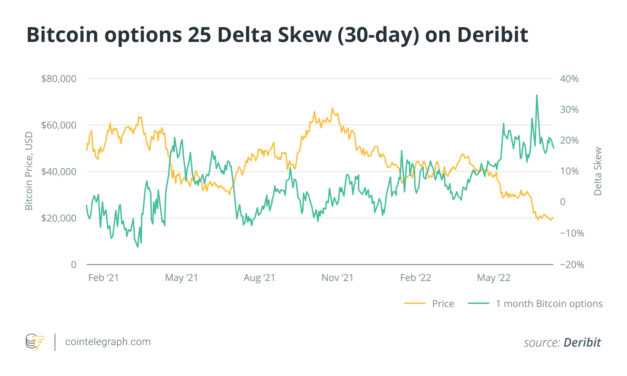
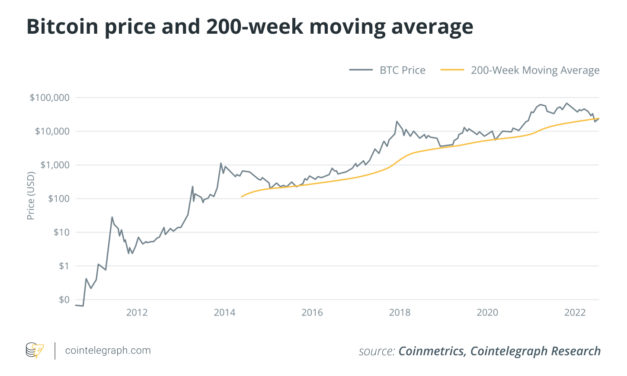
The blockchain space is seeing some areas of strength despite the perceived downturn in the market. The perpetual futures funding rates for Bitcoin (BTC) and Ether (ETH) have flipped back to positive on major exchanges, which shows bullish sentiment among derivatives traders. In addition, Bitcoin started trading below its cost basis, which has marked previous areas of market bottoms. In contrast, June saw decentralized finance (DeFi) experience a 33% decrease in total value locked and crypto stocks provide a -42.7% average month-over-month return. There is an ongoing battle between bullish and bearish sentiments in different areas of the market. To help cryptocurrency traders maneuver through the battlefield, Cointelegraph Research recently launched its monthly “Investor Insights Report.” In the report, the research team breaks down the past month’s top market-moving events and the most critical data across the various sectors of the industry. The researchers provide expert analysis and insights that can benefit serious blockchain market participants.Derivatives may provide a key indicator of changing sentimentsLeading up to June, there had been a strong bearish sentiment in the market. One indicator of bearish and bullish sentiment is the volatility skew of a market. The larger the skew range, the more volatile, while tighter ranges suggest less volatility — which implies more confidence in the market. On June 18, the Bitcoin options 25-delta skew peaked at 36%, the highest ever on record. Since then, some optimism has returned, sending the skew down to 17%. This signals a strong belief that the crypto market will rebound over the next few months.Premiums on long calls on Bitcoin and Ether indicate that traders are optimistic about the end of the year. However, solvency issues and the risk of contagion are still present in the market and the minds of investors and regulators. In sideways markets, traders can use strangles to generate returns if Bitcoin stays range-bound. Strangles involve selling puts and calls at different strike prices. The idea of a strangle is like the name implies: placing a put (an option to sell) and a call (an option to buy) below and above the current spot price. For example, if Bitcoin is at $20,000, first sell a put at $15,000 on the downside and a call at $30,000 on the upside. If they expire after a month, the premiums result in the gains minus the transaction fees.Download and purchase reports on the Cointelegraph Research Terminal.Currently, the options skew has a steep slope, with an implied volatility differential of up to 10% between the $17,000–$24,000 strike prices on Deribit and the Chicago Mercantile Exchange. This indicates a good setup for a risk reversal involving a short put at $17,000 and a long call at $24,000.Is bullish sentiment starting to push bears back? Bitcoin’s net unrealized loss has hit a three-year low, highlighting that its current market value is nearly 17% lower than that of its aggregate cost basis. Historically, global bottoms have formed when losses hit over 25%. The downsloping moving averages and the relative strength index in the oversold zone indicate that bears are in control.However, for the first time since March 2020, Bitcoin traded below its mining cost basis, a level that has historically marked global capitulations and bottoms in the price of Bitcoin. The net unrealized profit/loss indicator is more evidence that the bulls may potentially be overtaking the bears. From derivatives to the NFT sectorThe Investor Insights Report covers various other topics such as security tokens, DeFi, blockchain gaming, cryptocurrency mining, blockchain-related stocks, regulation and venture capital investments. The subject matter experts stay up-to-date on all the latest news and trends to cut through the weeds and provide essential insights into the blockchain industry.Each section of the report covers important elements impacting the topic. Subject matter experts cover the most important happenings that will have a significant impact, and the information is presented in a digestible format that serious participants in the crypto marketplace can use to get an overview, highlights and a forecast for what may be on the horizon. The newsletter is now available for subscription and features complete charts and detailed analyses. The Cointelegraph Research teamCointelegraph’s Research department comprises some of the best talents in the blockchain industry. Bringing together academic rigor and filtered through practical, hard-won experience, the researchers on the team are committed to bringing the most accurate, insightful content available on the market.Demelza Hays, Ph.D., is the director of research at Cointelegraph. Hays has compiled a team of subject matter experts from across the fields of finance, economics and technology to bring to the market the premier source for industry reports and insightful analysis. The team utilizes APIs from a variety of sources in order to provide accurate, useful information and analysis. With decades of combined experience in traditional finance, business, engineering, technology and research, the Cointelegraph Research team is perfectly positioned to put their combined talents to proper use with the Investor Insights Report. Disclaimer: The opinions expressed in the article are for general informational purposes only and are not intended to provide specific advice or recommendations for any individual or on any specific security or investment product.

Čítaj viac

Získaj BONUS 8 € v Bitcoinoch

nakup bitcoin z karty

Registrácia Binance

Burza Binance

Aktuálne kurzy