
Autor Cointelegraph by Christina Comben

MiCA cracks down on USDT in Europe… but no one else cares

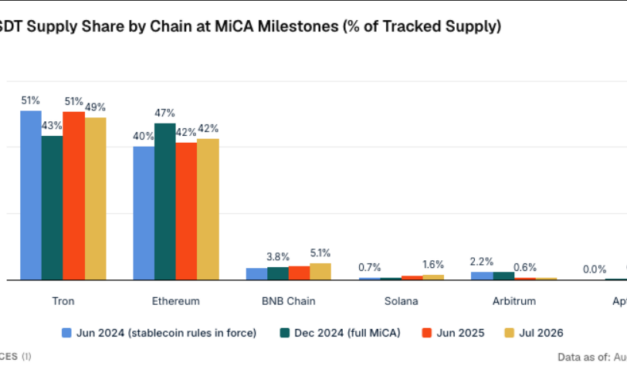
Europe’s crackdown on Tether’s USDT is entering a new phase.When Revolut told European users it would delist USDT after Aug. 31, it became another in a long line of European platforms restricting access to the world’s largest stablecoin as firms adapt to the requirements of the EU’s Markets in Crypto-Assets (MiCA) regulation.MiCA’s stablecoin rules have been phasing in since 2024, and the EU-wide transition period ended on July 1, putting further pressure on platforms to drop tokens that don’t meet the rules.Yet according to Artemis Analytics, Tether being squeezed out of a major market has shown little sign of triggering a major shift in USDT activity. Alex Weseley, research and data, tells Magazine:“The data does not indicate any noticeable change in USDT supply or demand attributable directly to MiCA coming into effect in Europe… MiCA didn’t trigger a major venue or chain migration.”So why is demand for Tether holding up so well?Stablecoins become financial infrastructureOne reason USDT demand is proving resilient is that dollar stablecoins are being used for more than trading or saving in other regions of the world. In Argentina, for example, a country long obsessed with stuffing dollars into mattresses and storing wealth outside the traditional financial system, stablecoin activity has continued to grow even though restrictions on accessing actual US dollars have eased.USDT supply share by chain at MiCA milestones. Source: Artemis.Lemon, an Argentine crypto and financial services platform, processed $9.3 billion in total volume in 2025, up 60% from the previous year. Transactional users grew 70% to nearly 1.8 million and stablecoin volume grew 45% year-on-year.Related: Why Argentina is blocking Polymarket despite its global growthThat suggests stablecoins are doing more than simply filling a gap created by restrictions on access to dollars; they’re becoming part of the way people move and spend money. Ignacio Gimenez, Lemon’s business and planning manager, tells Magazine:“The role of USDT and other dollar stablecoins is evolving. What we’re seeing is a shift from stablecoins as a store of value to stablecoins as financial infrastructure.”He says stablecoin activity is “increasingly driven by payments, cross-border transfers and global financial services rather than only by savings,” adding that Argentine users can pay in Brazil through PIX using pesos, receive dollars or euros from overseas and have them credited as USDC, or move between bank dollars and digital dollar balances.That makes stablecoin demand harder to measure by simply looking at which tokens are available on regulated exchanges.MiCA is changing the European gatewayLemon’s experience highlights a shift in user behavior in one of Latin America’s biggest economies, and there are signs that emerging markets are beginning to follow the trend. Artemis data shows the number of daily users on Binance Smart Chain rose from about 318,000 in June 2024 to 1.56 million by July 2026, while daily users on Tron increased 44% to around 908,000. These chains are favored by day to day stablecoin users for their low fees. Weseley says:“That looks like expanding global and emerging market usage rather than a Europe-specific migration, and there’s no clear MiCA-timed break in the chain data.”That doesn’t mean MiCA is irrelevant: it is certainly changing which stablecoins regulated European platforms can offer, and reshaping the stablecoin market inside the bloc. USDT daily active addresses by chain at MiCA milestones. Source: Artemis.Maksym Sakharov, chief executive and co-founder of WeFi, a crypto financial infrastructure company, says that regulation is primarily changing how users access dollar stablecoins, rather than removing the underlying demand, whether it’s for trading, payments, or cross-border transfers. He tells Magazine:“Users do not choose a stablecoin only because it is available on one regulated platform. They choose it because counterparties use it, liquidity is deep, and it works across many markets.” For some platforms, the shift began well before the MiCA deadline. Chief executive of OKX Europe, Erald Ghoos, says OKX has not offered USDT to European users for around two years, so the latest MiCA deadline did not make much material difference.Europe’s alternatives have a dollar problemPerhaps the bigger question in Europe is what European users will embrace instead. Dollar-denominated stablecoins have a powerful advantage since the crypto market has always treated the greenback as its primary benchmark.USDT transfer volume share by chain pre vs. post MiCA. Source: Artemis.While Ghoos doesn’t expect that to change globally any time soon, he says that institutional interest in euro-denominated stablecoins is picking up. He says:“What we are seeing from institutional players is interest in creating more EUR-denominated stablecoins, which is worth watching as it develops.” For retail users, euro-denominated stablecoins could also make practical sense by removing additional friction, like currency conversion, from transactions. But while MiCA may determine which products are available through regulated European gateways, it cannot change the dollar’s role in global crypto markets. Magazine: El Salvador’s Bitcoin experiment turns 5: ‘It was for us, not them’Cointelegraph publishes long-form journalism, analysis and narrative reporting produced by Cointelegraph’s in-house editorial team with subject-matter expertise. All articles are edited and reviewed by Cointelegraph editors in line with our editorial standards. Some articles contain affiliate links, from which Cointelegraph may earn a commission. These relationships do not influence which products we review or our editorial conclusions. Content published in here does not constitute financial, legal or investment advice. Readers should conduct their own research and consult qualified professionals where appropriate. Cointelegraph maintains full editorial independence.

Čítaj viac
Solana’s fee overhaul increases burn and makes resource hogs pay

Solana is preparing to change how it charges for computing resources on the network.Solana Improvement Document (SIMD-0553) would make its most resource-intensive users pay more while cutting the costs for simpler transactions. As a bonus, it would increase SOL’s burn rate in stages — and one day could even help make it deflationary.Cavey, a researcher at Solana infrastructure firm Temporal and author of the proposal, tells Magazine that fees currently don’t reflect the real costs:“If I submit a transaction that does nothing versus a transaction that burns 200 million CPU cycles, I’m charged the same amount.” This proposal would change that by tying fees more closely to the resources each transaction requests. Rather than going to validators, the resource fee would be burned, removing SOL from circulation. Of course, reducing validator income has not been welcomed by all. Contributor bji argues on github:“I like the aspect of this proposal that gives tx submitters extra incentive to be accurate with CU limits. Everything else I’m meh to negative on. ‘More burn’ should not be a goal. Validator incomes should not be arbitrarily reduced.”SIMD-0553 entered Solana’s new onchain governance process in early August and cleared its initial support phase on August 4. It is currently in the support and discussion phase, which typically lasts seven epochs, or roughly two weeks. If it’s approved, it would change the incentives around Solana’s cheap blockspace. So what’s the catch? Wasting resources becomes expensiveCavey says that Solana’s current fee structure creates a problem for developers.Core Solana devs have spent years making the network faster, but applications have almost no financial incentive to stop wasting resources — an inefficient transaction costs the same as an efficient one. Related: Ethereum, Solana led crypto hack losses in H1 2026: Blockaid“By installing this resource pricing right now, suddenly app developers have to optimize,” Cavey says.If the proposal is adopted, developers who reduce resource use could lower costs for end users and make their apps more attractive. Developers who consume more of Solana’s computing capacity would have to pay their fair share.Solana Improvement Document (SIMD-0553). Source: Solana Foundation GitHubCavey says the proposal is particularly aimed at computationally wasteful arbitrage, where searchers can submit huge numbers of transactions that mostly fail, while paying very little.In the past 30 days, he says, five of the traders with the highest failure rates submitted 11.5 million transactions, consuming 929 million compute units across 2,477 trades that generated $16,091 in profit, while paying just 78 SOL in fees.A resource fee would push arbitrage searchers toward more informed and reactive strategies.Stablecoin and token transfers could become roughly 20% cheaper, Cavey says. Temporal’s modeling also finds that vote transactions would cost around 12.3% less and oracle updates 16.9% less under the proposed model.The trade-off? Some trading activity would become considerably more expensive.Temporal estimates that a high-priority swap routed through DFlow would cost 9.72% more under the proposed terminal fee rate, while a mid-priority OKX swap would cost 301% more and a pump.fun swap with zero priority would cost 3150% more. That means some of the network’s heaviest users could see their transaction costs balloon, particularly traders using bots that submit large numbers of transactions. Don’t worry though, as the fee increase is off a low base. Cavey argues that even the most compute-intensive transactions would cost around $0.05 under the proposed model, compared with the $2 to $5 fees a user might pay to swap $100 on a centralized exchange.Who pays more, who pays less. Source: Temporal.xyzThe current proposal rejects a uniform increase to Solana’s existing 5,000-lamport fee, arguing that it would disproportionately hurt high-volume senders such as market makers while still failing to properly price resource usage.Other costs to consider“There have been a few people that have raised concerns about the parameters, but overall, everyone’s been very supportive,” Cavey says, citing validator income, higher costs for high-frequency users and increased complexity among the core issues.One contributor, mschneider, asks why fees should be based on the resources a transaction requests rather than what it actually uses. “Units used seems more natural,” he says.Cavey says there’s a reason the fee is based on the resources a transaction requests, rather than what it actually uses: it lets users know the cost upfront and allows validators to check they can afford it before processing the transaction. But it also means users can pay for resources they don’t end up using, giving developers an incentive to estimate their needs accurately. Validators could initially see a small reduction in base-fee revenue by around 4%. While Cavey says the parameter can be adjusted to offset that impact if needed, some contributors like bji remain unconvinced and believe validator income should take precedence over the additional burn.Related: MoneyGram expands crypto cash ramps to SolanaThe proposal also raises questions about complexity, with some contributors questioning whether the new fee model could make Solana harder to use. Cavey rejects the concern, saying most users will not have to calculate fees themselves because applications and exchanges generally handle it. Automated traders are already “sophisticated” enough to adapt to changes in Solana’s fee structure, he says.What about the SOL burn?SIMD-0553 would increase the amount of SOL burned by transaction fees, reducing more of the token from circulation rather than paying it to validators.According to the proposal, the current daily burn of around 648 SOL could rise to roughly 7,500 to 9,000 SOL at the proposed terminal fee rate, representing a roughly 12 to 14-fold increase if current resource demand remains unchanged. SIMD-0553 would increase the amount of SOL burned by transaction fees. Source: Temporal.xyzCavey says the higher burn could eventually push SOL into deflationary territory:“If Solana wins, there’s a chance that Solana could actually become a deflationary currency.”Burning the resource fee also reduces incentives for validators to include unnecessarily resource-intensive transactions.Solana currently issues roughly 60,000 SOL a day, so even a 9,000-SOL daily burn would not by itself make the token deflationary (although a separate proposal called SIMD-0550 would curb inflation faster than currently scheduled). Network activity would need to grow substantially before the burn outweighed new issuance. Cavey says that would be “a nice secondary effect” rather than the main objective.“The primary goal is to align core devs, developers, and app developers to make Solana faster. That is objective number one, and that is enough of a reason for this proposal, in my opinion.”Magazine: El Salvador’s Bitcoin experiment turns 5: ‘It was for us, not them’Cointelegraph publishes long-form journalism, analysis and narrative reporting produced by Cointelegraph’s in-house editorial team with subject-matter expertise. All articles are edited and reviewed by Cointelegraph editors in line with our editorial standards. Some articles contain affiliate links, from which Cointelegraph may earn a commission. These relationships do not influence which products we review or our editorial conclusions. Content published in here does not constitute financial, legal or investment advice. Readers should conduct their own research and consult qualified professionals where appropriate. Cointelegraph maintains full editorial independence.

Čítaj viac
El Salvador’s Bitcoin experiment turns 5: ‘It was for us, not them’

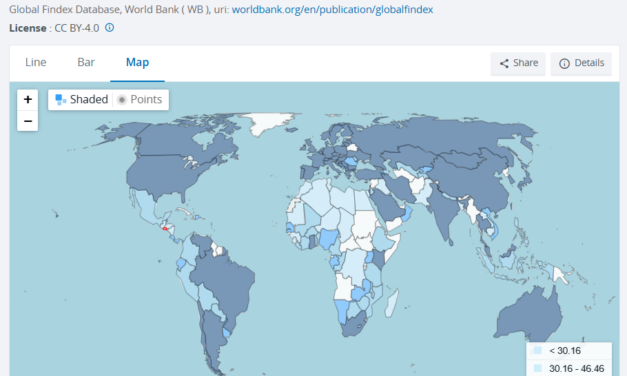
It’s been five years since El Salvador became the first country to adopt Bitcoin as legal tender. President Nayib Bukele announced the plan at the Bitcoin conference in Miami on June 5, 2021, to the jubilant cries and applause of the Bitcoin community, who hailed the tiny Central American nation as living proof that BTC could be sovereign money.Bukele sold the experiment as a way to bank the unbanked, slash remittance costs, and attract investment to the impoverished nation.But five years on, who did the experiment benefit, and what did it actually achieve? Dr. Tobias Boos, a senior scientist at the University of Vienna who leads a research project examining the political economy of Bitcoin in El Salvador, tells Magazine:“There is little doubt that the project was a failure if we take seriously the reasons Bukele gave for its adoption. Foreign direct investment in this sector didn’t increase, it did not effectively bank the unbanked, and it is not widely used for remittances.”Yet El Salvador’s Bitcoin bet undeniably changed the conversation around the world’s number-one cryptocurrency, and turned nation-state adoption from a theoretical possibility into a living, breathing reality. Whether it succeeded or failed depends on what you think El Salvador was trying to achieve.Five years into El Salvador’s Bitcoin betIn a video message played at Bitcoin 2021, Bukele said the adoption of Bitcoin would generate jobs in the short term and “help provide financial inclusion to thousands outside the formal economy.”Today, the evidence for mass adoption is difficult to square with that ambition.Research by Boos, Grigera and Schmid in 2025 found that the Salvadorans who adopted Bitcoin tended to be young, male, urban, more highly educated, and, perhaps more importantly, already banked. Boos concludes that, “Mass adoption by citizens did not occur.” El Salvador had one of the region’s lowest levels of banking access at the time, with just 35.9% of people over 15 holding a bank account in 2021, according to World Bank data. Account ownership at a financial institution (% of population ages 15+) – El Salvador. Source: World BankYet the government’s Chivo Bitcoin wallet did little to solve the problem: it could transfer funds to bank accounts, but didn’t remove the underlying barriers preventing unbanked Salvadorans from accessing the financial system in the first place.According to Boos and his colleagues, the same problem emerged with remittances, another pillar of Bukele’s pitch. In 2024, remittances accounted for around 24% of El Salvador’s gross domestic product, with the United States providing a full 98% of the total. But El Salvador adopted USD as its official currency more than 20 years ago, and having most remittances arrive from a country with the same currency removed one of the major cost reductions that Bitcoin could theoretically offer: currency conversion.Related: Bitcoin will never fall below $60K again: Nansen founderDespite the promise that Bitcoin could make these transfers cheaper, crypto wallets accounted for barely 1% of remittances by 2024, down from a peak of 1.7% in 2020-21.It suggests the government’s early efforts to stimulate adoption failed to translate into sustained use. Chivo offered users $30 in Bitcoin for signing up, but the National Bureau of Economic Research’s nationally representative research found that more than 60% of early Chivo users never made another transaction after spending their free BTC.Joe Nakamoto, a Bitcoin-focused journalist who has repeatedly reported from El Salvador, found a similar disconnect on the ground. In a recent video documenting one of his visits, he said he tested Bitcoin acceptance at 21 shops in a San Salvador mall, and found that only four accepted Bitcoin, and just one did so smoothly. He tells Magazine:“It’s very, very hard, borderline impossible to genuinely live on Bitcoin in El Salvador. Unless you’re just eating pupusas on the beach in El Zonte, and then going across to the other Bitcoin circular economies and finding workarounds.” When the IMF pulled the plugThe government has also faced international pressure to retreat from its Bitcoin experiment. In December 2024, it reached a $1.4 billion financing agreement with the International Monetary Fund, under which it agreed to scale back its involvement in Bitcoin. El Salvador’s experiment with Bitcoin as Legal Tender. Source: NBERThe deal was approved in February 2025, and in January, the government amended its Bitcoin law to make acceptance voluntary, require taxes to be paid in US dollars and limit public sector involvement in Bitcoin-related activities, effectively dismantling the most radical parts of Bukele’s experiment. While Bitcoin could still be used voluntarily, the state no longer compelled businesses to accept it or used it as part of the country’s public financial system.The IMF later found that Bitcoin had produced “no evidence” of a beneficial use case for the unbanked and had had minimal impact on financial inclusion. Boos says:“The ‘soft adoption,’ as we refer to it in one of our articles, never led to mass adoption for payments. I am not aware of any instances where tax payments were made using Bitcoin, and the infrastructure has largely remained unused.” What Bitcoin actually did achieveIf El Salvador failed to turn Bitcoin into everyday money, it still managed something no country had done before: it made nation-state Bitcoin adoption real. Before 2021, the idea of a government adopting Bitcoin was still largely hypothetical; El Salvador made it real. As Samson Mow, chief executive of Bitcoin infrastructure firm JAN3, tells Magazine:“The question in front of every president or finance minister shifted from whether a sovereign could hold Bitcoin to why it hadn’t.” The experiment also thrust El Salvador into the center of the global Bitcoin movement, with many prominent Bitcoiners, including Max Keiser and Stacy Herbert, making Bitcoin country their new home. Herbert later became director of El Salvador’s National Bitcoin Office, showing just how closely intertwined parts of the Bitcoin movement have become with the government. Related: IMF says tokenization could transform settlement and financial stabilityBitcoin Beach, the grassroots project in El Zonte that predated the national experiment, is still one of the clearest examples of a functioning Bitcoin economy, with local businesses, hotels and tourism operators continuing to accept Bitcoin, even after the government made acceptance voluntary. Nakamoto’s reporting has also documented several concrete success stories for everyday Salvadorans, including Mama Rosa, who saves Bitcoin from her pupusa stand, and Napo, who expanded from one taxi to a fleet. Bukele’s government even went further than simply holding BTC on its balance sheet or making it legal tender by promoting plans for Volcano Bonds and Bitcoin City.After repeated delays, the IMF agreement effectively kneecapped those projects’ progress, but the symbolic impact still matters. Mow explains:“Bitcoin gained a proof of concept, and El Salvador gained a global platform.” There’s also an important distinction between what El Salvador achieved for Bitcoin and what Bitcoin achieved for El Salvador. Boos argues that the symbolic significance has largely been “for” the international Bitcoin community, rather than evidence of economic success “in” El Salvador. Nakamoto says:“It looks more like a marketing campaign for foreigners than a genuine economic strategy for Salvadorans. It’s beautiful branding, pointed at people with the passports and the capital. Bukele is a razor-sharp operator. He knows exactly who’s watching and who’s clapping. The Bitcoin country strategy, it’s not for them. It breaks my heart to say it, but it’s for us.” The uncomfortable part: Bitcoin and BukelePerhaps the hardest question is what El Salvador’s Bitcoin experiment says about the relationship between Bitcoiners’ ideals of individual freedom and the government that imposed it.IMF Executive Board approves 40-month fund facility. Source: IMFBukele has concentrated power during his time in office, and the state of emergency introduced to combat gang violence in March 2022 remains in place more than four years later.Human Rights Watch says the government has continued to remove checks on executive power, and local and international human rights groups have documented mass arbitrary detention and due process violations under the state of emergency. But judging Bukele only through that lens risks missing why he remains so popular at home. El Salvador was once in the grip of powerful gangs, with many Salvadorans living with daily threats of extortion, violence and death. The official homicide rate fell from 53.1 per 100,000 people the year he took office, to just 1.3 per 100,000 in 2025.Bukele’s crackdown has transformed public security, and many Salvadorans view the trade-off between security and civil liberties very differently from critics abroad. Nakamoto says:“It’s a country that has serious scars. Bukele has saved the nation in many ways. He kicked out the gangs and also he has done wonderful things for Bitcoin in terms of putting it on the world map.” While Mow acknowledges the positive impact of Bukele’s gang crackdown, he says the broader implications of normalizing emergency powers cannot be ignored: “In the hands of someone with restraint, those same powers can accomplish real things, like El Salvador’s crackdown on the gangs. But it’s important to think ahead. What serves a leader with restraint today can just as easily serve one without restraint once there’s a change of guard.”For Bitcoiners, that leaves an uncomfortable tension. El Salvador’s Bitcoin experiment has become inseparable from the government that made it possible, and from a president whose record is far more complicated than the Bitcoin success story alone suggests. That may ultimately be the most difficult part of assessing El Salvador five years on: Bitcoin gave Bukele a global platform, and Bukele gave Bitcoin something it had never had before — a nation-state willing to put it at the center of its economic strategy.Magazine: Strategy became a symbol of the dot-com crash: Could history repeat?Cointelegraph publishes long-form journalism, analysis and narrative reporting produced by Cointelegraph’s in-house editorial team with subject-matter expertise. All articles are edited and reviewed by Cointelegraph editors in line with our editorial standards. Some articles contain affiliate links, from which Cointelegraph may earn a commission. These relationships do not influence which products we review or our editorial conclusions. Content published in here does not constitute financial, legal or investment advice. Readers should conduct their own research and consult qualified professionals where appropriate. Cointelegraph maintains full editorial independence.

Čítaj viac
Fierce backlash to Ethereum’s EIP-8363 staking proposal

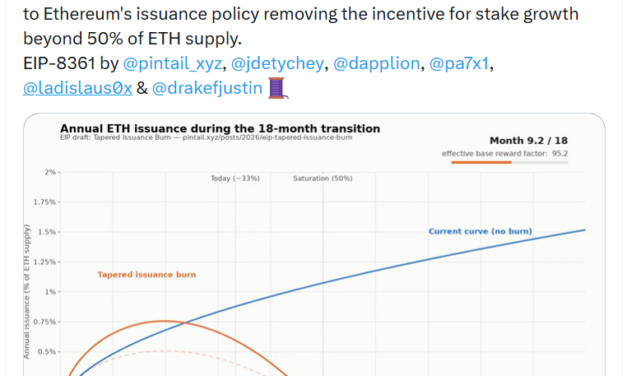
Ethereum researchers just wanted to reduce staking incentives. Instead, they sparked one of the biggest debates over the network’s economics since the Merge. Ethereum Improvement Proposal EIP-8363, or “Tapered Issuance Burn,” would gradually reduce staking rewards as more and more Ether is locked up to secure the network — eventually cutting new protocol issuance to zero once 50% of ETH’s supply is staked. Its authors, including Ethereum Foundation’s Justin Drake and Ethereum Community Conference (ETHCC) co-founder Jerome de Tychey, argue that Ethereum has reached the point where additional staking provides diminishing security returns, while diluting holders who choose not to stake.In other words: Ethereum should stop paying for security it no longer needs. There’s just one problem, a lot of people hate the idea.From DeFi builders to staking providers and institutional investors, critics argue it could weaken decentralization, disrupt Ethereum’s lending markets and undermine confidence in the network’s monetary policy. As Ether.fi founder Mike Silagadze puts it:“This is so disappointing on every level. […] This is bad for decentralization, this is bad for Ethereum adoption, and this is bad for the credibility of the network.” Dr. Steve Berryman, Bitwise’s head of client partnerships for Ethereum, tells Magazine:“Institutional adoption requires certainty and playing with the issuance at the margin would cause uncertainty and institutions hate uncertainty.” So is Ethereum really paying too much for security, or is EIP-8368 a solution in search of a problem?Is Ethereum over-staked?Ethereum currently has around 41.5 million ETH staked, earning 2.67%, and representing 34.07% of the entire supply, according to the Ethereum Validator Queue. EIP-8363, Tapered Issuance Burn. Source: Jerome de TycheyWhile more ETH locked up generally makes the network harder to attack, EIP-8368’s authors argue those security gains become increasingly marginal while Ethereum continues issuing rewards to validators. EIP-8363 would gradually remove that incentive, and the authors argue Ethereum should stop subsidizing additional staking once the network is sufficiently secure. Yet not everyone agrees that the problem even exists in the first place. It’s certainly true that the amount staked has increased substantially in 2026, up 15% since the start of the year.Berryman argues that market forces are already slowing participation without the need to change Ethereum’s issuance policy.“We will come to a natural ceiling probably by the end of this year,” he says, arguing that yields falling to around 2% are unlikely to attract significantly more ETH to be locked up in staking. “People need a certain amount of liquidity,” he says. Related: Ethereum Foundation adds SEAL 911 co-founder to board as privacy focus growsBerryman says recent growth has largely been driven by institutional entrants such as Bitmine and BlackRock, but argues that once those players complete their staking allocations, participation is likely to plateau again.Source: Validatorqueue.comEthereum commentator Leo Lanza, who also opposes the proposal, challenges the core assumption that issuance on Ethereum represents a meaningful “stealth tax” on non-stakers.Ethereum’s annual inflation remains below 1%, he says, arguing that even gold, widely viewed as the world’s premier monetary asset, expands its supply by roughly 1% to 2% annually:“The free market already solves this […] Let the market adjust.”Could the cure be worse than the disease?Supporters of EIP-8368 argue the change would curb unnecessary issuance and discourage staking from becoming overly concentrated among large custodians and liquid staking providers. But critics say the proposal risks creating bigger problems than it’s trying to solve.Greg Koumoutsos, technical research lead at the Lido Labs Foundation, says today’s staking ratio of around one-third of ETH supply does not appear unhealthy, though he agrees it is reasonable to think proactively about excessive staking. More importantly, he argues the proposal oversimplifies what Ethereum’s issuance is actually paying for:“Ethereum is not only paying for slashable ETH; it is paying for decentralization, operator diversity, censorship resistance, and network resilience.”Koumoutsos says lower issuance is not automatically a better security policy unless those broader trade-offs are also taken into account.Another factor to consider is that liquid staking is now deeply integrated into Ethereum’s DeFi ecosystem, and staking derivatives are widely used as collateral and in lending and yield strategies.“It will obviously kill a huge chunk of DeFi which is built around the staking ecosystem,” Silagadze argues.Stani Kulechov, founder of Aave, Ethereum’s largest decentralized lending protocol, says that reducing staking rewards risks undermining that broader ecosystem.“My concern is… those who are fine with ETH beta and yield might also sell ETH for other yielding assets […] Ethereum should not be punished for its growth.”Related: Ethereum, Solana led crypto hack losses in H1 2026: BlockaidSmaller validators will bear the costAnother concern with the proposal is that lowering staking rewards could actually increase concentration among the largest participants.“I stand firmly opposed to this EIP.” Source: Leo LanzaThat’s because independent validators do not benefit from the economies of scale that larger staking businesses, exchanges or institutional operators do. Lower protocol rewards could make solo staking uneconomical while larger organizations continue operating. Koumoutsos says:“A solo validator has real costs: some ideological solo stakers may remain, but many marginal solo validators will not, and fewer new ones will enter, if any.”He adds that centralized platforms also stake for reasons beyond yield, such as customer retention, regulatory positioning and product integration, which makes them less likely to reduce their participation. Koumoutsos also warns that even within delegated staking, lower rewards could favor centralized custodial products over onchain staking protocols, which face higher maintenance, governance and upgrade costs. A debate over more than stakingSupporters say lower issuance would strengthen Ether’s long-term monetary profile. But critics argue that continually adjusting Ethereum’s monetary policy undermines its claims to be predictable and reliable. Berryman argues institutions value predictability more than marginally higher yields, and that changing the curve creates yield governance risk. “Institutional investors will price accordingly,” he says.He also says institutions value staking not because the yield is especially high, but because it provides a predictable return while they hold ETH:“It’s not broken, why try and fix it?”Silagadze agrees, saying, “Any nation state or large institution looking at this will justifiably have a dramatic loss of confidence in the governance and stability of Ethereum.”The proposal’s rollout also drew criticism for being published just two days before the Aug. 6 deadline for proposals to be considered for the next Ethereum network upgrade.Silagadze says that a change with “far reaching implications for all of DeFi” should not have been published on such a short timeline.The fierce backlash has shown how difficult it has become to change Ethereum’s economics, especially when every adjustment creates winners and losers across staking, DeFi and institutional markets. Magazine: Ethereum’s much-hated staking ‘tax’ may already be obsoleteCointelegraph publishes long-form journalism, analysis and narrative reporting produced by Cointelegraph’s in-house editorial team with subject-matter expertise. All articles are edited and reviewed by Cointelegraph editors in line with our editorial standards. Some articles contain affiliate links, from which Cointelegraph may earn a commission. These relationships do not influence which products we review or our editorial conclusions. Content published in here does not constitute financial, legal or investment advice. Readers should conduct their own research and consult qualified professionals where appropriate. Cointelegraph maintains full editorial independence.

Čítaj viac
10 weirdest things ever tokenized… including farts

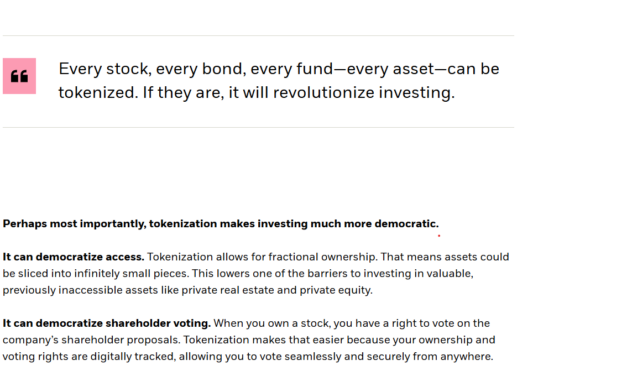
Brazil’s B3 stock exchange made headlines last month when its tokenized cows went viral.A farmer in southern Brazil was able to use 10 cows as collateral for a 100,000 Brazilian real ($19,600) loan by virtually herding them into a blockchain based holding pen, demonstrating how farmers can literally milk their assets to access credit.And it raises an obvious question: if cows can be tokenized, what can’t be?From dairy cows to a year’s worth of farts, here are 10 of the strangest things to be tokenized onchain.1. A year’s worth of fartsWhen BlackRock chief executive Larry Fink said every asset will eventually be tokenized, he probably wasn’t thinking about flatulence. Yet, that’s exactly what happened here.Every bit as appealing as, well, a year’s worth of farts, it has to be a contender for the strangest thingever to make it onchain.It was during the pandemic, when most people were baking bread or leveling up on Duolingo, that filmmaker Alex Ramírez-Mallis recorded his own farts and minted each one as a nonfungible token (NFT).They say farts are like children, and you only love your own. But the novelty factor meant that Ramírez-Mallis was able to sell his for 0.05 ETH each (about $85 at the time), proving that every asset has its price.2. CowsBetter known as a prime source of protein in Bitcoin circles, the idea of turning 10 Brazilian cows into tokenized cattle… er, tokenized collateral, is not the most obvious use case. The deal was structured by Brazilian investment fund Target FIDC, giving each cow a unique digital token linked to an encrypted digital identity.Larry Fink says every asset can be tokenized. Source: BlackRockThe first loan may have been worth just $19,600, but it was a proof of concept that shows the potential to eventually support around $80 million in livestock-backed financing across its farms. While it sounds somewhat bizarre on first glance, the agriculture industry generated around $4 trillion in global value added in 2023, so watch out for tokenized sheep, goats and chickens as collateral next.3. Whiskey barrelsWhen you think of sharing a whiskey, you probably have the liquid gold kind in mind, but whiskey barrels are a natural candidate for tokenization.Related: Tokenized RWAs get an agent-ready research layer with a new protocolThat’s because, like high-end art and collectibles, Scotch whisky typically increases in value as it matures — talk about lifting your spirits! Several projects are experimenting with putting whisky casks onchain so investors can buy whole units or fractional ownership of tokenized whisky stored in bonded warehouses. Just remember that if the market crashes, you can’t actually drink a digital JPEG of a barrel.4. RacehorsesRacehorse ownership has long been reserved for the ultra-wealthy, those with deep enough pockets to cover hundreds of thousands of dollars in breeding, training and upkeep, and a fancy hat to wear at the racetrack.But tokenization is beginning to chip away at those elitist barriers, dividing ownership of real thoroughbred racehorses into digital shares.Investors can buy a stake in an animal and share in any prize money, breeding income, or future sale proceeds, without purchasing an entire horse.Own part of a racehorse. Source: StablemansA word of caution for would-be investors in this style of asset, though, whether its watches or whiskeys or large four legged animals, from Chris Turner, co-founder of impact investment firm KULA:“Putting a collectible or luxury item on a blockchain doesn’t automatically make it more liquid or valuable if the legal rights, transfer process, and market structure remain unchanged.”5. UraniumIf your mind turns to treasuries and private credit when thinking about tokenized real-world assets (RWAs), it might be a shift to consider uranium, the radioactive metal better known for its role in nuclear power.But that’s what Tezos-backed metals.io is doing. Tezos co-founder Arthur Breitman says blockchain technology excels at building “reliable, auditable and cost-efficient financial rails for any asset,” but is particularly aligned with “technology-flavored commodities” like uranium.Breitman says trading volume between November 2024 and July 2026 was $21.5 million over approximately 18,200 trades and around 7,400 unique wallets.Related: RWAs become Hyperliquid’s largest trading categoryHe acknowledges that growth remains modest, telling Magazine that institutional players have shown interest but are “still shy about tokenized rails.” 6. Fishy revenueOne of the most unusual proposals tokenization platform Brickken received came from a Chilean fish-processing company that wanted to issue tokenized debt with returns tied to the value of the fish it sold. “The token represented the lender’s contractual claim, while the interest payable adjusted according to the company’s verified sales performance. In effect, it was a tokenized, revenue-linked debt instrument,” explains Edwin Mata, chief executive of Brickken.Mata argues that the idea highlights an important principle:“Almost any cash flow can support a tokenized financial instrument, provided the underlying rights and data can be independently verified.”In the end, the fish never made it onchain. The underlying fish sales still relied on audits, commercial reporting and legal agreements that couldn’t yet be automated, proving that, sometimes, the biggest obstacle to tokenization isn’t the blockchain; it’s the real world. 7. Music royaltiesMusic royalties have also found their way onchain, with one of the earliest high-profile examples in 2021, when DJ and producer 3LAU gave fans 50% of the streaming rights to his single Worst Case through his blockchain platform Royal.Then, in 2022, rapper Nas used Royal to sell streaming royalty rights to two of his songs, Ultra Black and Rare.While the idea of onchain royalties gained traction during the NFT boom, tokenized music royalties have yet to become a mainstream asset class. Maybe that’s because the streaming platforms pay peanuts. Nothing says “financial freedom” quite like owning 0.001% of a track and realizing it needs to be played five million times just to buy a cup of coffee. 8. Human SkinIf tokenizing farts and cattle wasn’t weird enough, what about parts of your own body? That’s exactly what Croatian tennis player Oleksandra Oliynykova did in 2021, when she auctioned the advertising rights to a 15-by-18-centimeter patch of skin on her right arm as an NFT. The winning bidder paid 3 Ether (around $5,400 at the time) for the right to choose which tattoo she would wear during tournaments for a year.Athletes have long sold sponsorship space on shirts, helmets and race cars. Oliynykova just took the idea one step further, giving a whole new meaning to having skin in the game.9. A Burned BanksyMost art collectors try to preserve masterpieces; crypto collectors set them on fire to make a point about “digital ownership.” In 2021, a group calling itself Burnt Banksy bought a Banksy print titled Morons (White) for around $95,000. They livestreamed themselves burning it, and then minted the destruction.If that leaves you scratching your head, there was method in the madness; the idea was that while the physical artwork no longer existed, ownership would live on forever through the blockchain. The NFT sold for around $382,000, sparking fierce debate over whether the group had destroyed a valuable work of art or simply transformed it into a new one. It was probably the first time in history someone made a 300% profit from a “fire sale.”10. The first tweetAlso in the year of our NFT Lord, 2021, Twitter co-founder Jack Dorsey tokenized his first-ever tweet — “just setting up my twttr” — and sold it as an NFT to crypto entrepreneur Sina Estavi for $2.9 million, quickly becoming a symbol of the NFT boom. The first-ever tweet sold for $2.9 million. Source: Jack DorseyOne year later, Estavi tried to resell it for $48 million, but only received bids worth a tiny fraction of the asking price, with the highest reported offer coming in at just $6,800.While anyone can still read the tweet on X, only one person owns the blockchain certificate tied to it. Whether that’s valuable or not remains an open question. As Mata says:“Tokenization can improve access, administration, settlement and transferability, but it cannot transform a poor investment into a good one.” Magazine: The 100x obsession: Fundamentals grow in importance as crypto maturesCointelegraph publishes long-form journalism, analysis and narrative reporting produced by Cointelegraph’s in-house editorial team with subject-matter expertise. All articles are edited and reviewed by Cointelegraph editors in line with our editorial standards. Some articles contain affiliate links, from which Cointelegraph may earn a commission. These relationships do not influence which products we review or our editorial conclusions. Content published in here does not constitute financial, legal or investment advice. Readers should conduct their own research and consult qualified professionals where appropriate. Cointelegraph maintains full editorial independence.

Čítaj viac
Získaj BONUS 8 € v Bitcoinoch

nakup bitcoin z karty

Registrácia Binance

Burza Binance

Aktuálne kurzy