
Autor Cointelegraph by Christina Comben

Recovery specialists crack $1B crypto wallet… but find just $10

When a client named Rusty contacted crypto recovery specialist Chris Brooks in 2021, he said he and two others had won 5,000 Bitcoin in a court case, worth around $53 million at the time.They immediately set up a Zoom call to discuss the case. “There were three guys on the call, and one of them holds up a phone. It has like $53 million in a Bitcoin address,” says Brooks, founder and chief executive of Crypto Asset Recovery.The men claimed they were able to withdraw as much as $300,000 a week but wanted to get the whole fortune out. If Brooks and his son, Charlie, flew to Georgia to help them crack the wallet, they would make them millionaires.Brooks and son bought plane tickets and went the next day. At lunch, Rusty, a 6-foot-3 Army veteran, revealed the wallet didn’t only contain 5000 BTC.“Rusty pulls out his phone, and he shows us a billion dollars in ETH. And that’s when I was like, okay, something very odd is going on here.”The men then drove about an hour to a strip mall owned by one of them, where they went into the back office and were handed notebooks containing dozens of recovery seeds. The pair spent the day opening wallets. They found about $10 in Bitcoin.Brooks never established whether the wallets they were given had previously held the BTC or ETH Rusty claimed to own. They were never reimbursed for the flight tickets either.Related: Do the Coldcard attacks mean all hardware wallets are now insecure?Brooks now suspects Rusty had fallen victim to scammers who convinced him he had a large crypto fortune when he didn’t. It was an early lesson for their crypto recovery business.Sometimes crypto is lost. Sometimes the wallet is lost. Sometimes the password is lost.And sometimes, it turns out, the money was never there in the first place.Losing your crypto doesn’t always mean it’s goneFor wallet recovery specialists, “lost crypto” can mean several very different things.They aren’t recovering Bitcoin from the blockchain; they’re recovering the information needed to access a wallet that already exists. While someone may have thrown away a hardware wallet, forgotten a password or part of their seed phrase, none of those things necessarily mean the underlying crypto has disappeared.Bruno Krauss, co-founder and chief technical officer of recovery firm ReWallet, tells Magazine:“If you have some missing words, then you can often recover them.”Bitcoin’s BIP39 seed phrase standard uses a list of 2,048 words, meaning that if someone knows most of the words, specialists can sometimes systematically search the remaining possibilities. The fewer pieces missing, the more manageable the puzzle.Password recovery can work in much the same way.Bitcoin’s BIP39 standard uses a list of 2,048 words. Source: GitHubKrauss says ReWallet once recovered a 20-character password protecting roughly $3 million after reverse-engineering a flawed password generator. Other cases depend less on technical exploits than on understanding how a particular person creates passwords.That means asking clients about personal preferences like favorite foods and places, children’s names and birthdays, personal milestones or memories.In one case, he says a customer was convinced she had used her children’s names, only to remember that the password was actually a phone number connected to a local delivery service:“She didn’t know why, but then she thought about it, and she realized, oh, okay, it was because on this day I got the package delivered to the store and I thought, okay, this would be a nice password.”Passphrases add another layer of complexityTom Bennet, a Bitcoin educator who has studied wallet security, says there is another particularly confusing category: the passphrase.A passphrase is an additional piece of information layered on top of a seed. Enter a different passphrase, and you don’t necessarily get an error message. You can simply get another valid wallet. He tells Magazine:“A wrong passphrase doesn’t throw an error; it succeeds and shows you a zero balance.”So you can have the correct seed phrase and enter it correctly, and still think your BTC has vanished.“Passphrases also don’t have any features to protect users from themselves; no list of 2,048 valid words, no checksum. So if you’ve forgotten a passphrase, it’s basically the same question again: how random was your passphrase? If it’s sufficiently random, there’s often no way to recover it.”With lost or broken hardware wallets, even having the broken device isn’t always much help. If the wallet’s backup seed phrase survives, the keys can generally be restored on another device.That’s why recovery specialists don’t necessarily need the original hardware, but enough information to reconstruct access to the keys.Related: Irish police open Bitcoin wallet years after keys were apparently lostRecovery can also mean fixing mistakes rather than recovering a lost wallet. Crypto sent to the wrong blockchain, like BNB to Ethereum, may sometimes be recoverable if the receiving wallet is under the user’s control. Brooks says Crypto Asset Recovery has been contracted to crack more than 3,000 wallets belonging to around 1,500 people, and has cracked passwords for about 63% of them. Sometimes you really have lost itThere is, however, a hard boundary. Bennet says:“If your seed is truly random and you lose it completely, your Bitcoin is gone.” That is one of the fundamental trade-offs of self-custody. A Bitcoin wallet does not have a bank-style recovery system or a central administrator who can verify your identity and restore your account.Lucien Bourdon, Bitcoin analyst at hardware wallet maker Trezor, puts it even more starkly. If the wallet backup is lost and the wallet containing the keys is inaccessible, “no recovery company can help.” He warns:“If they could, the wallet could be cracked, and self-custody would be fundamentally compromised.” Thanks to randomness, crypto wallets make guessing a private key effectively impossible. In the recent case of Bitcoin hardware wallet Coldcard, a firmware bug weakened seed randomness on some wallets, making the seeds brute-forceable without physical access.Weak random number generation is not a new problem. Source: Jameson LoppBut if a genuinely random seed or private key has been completely destroyed, the number of possibilities is simply too large.Krauss says recovery specialists can occasionally find technical paths into wallets that owners had assumed were permanently inaccessible, and that old wallet software, corrupted files, poorly generated passwords and hardware vulnerabilities can all create unusual opportunities:“Don’t give up on edge cases.” Recovery specialists can sometimes be scammers There is an uncomfortable irony in the recovery business.The person who may be able to help you regain access to your crypto needs the very information that gives someone access to it.A seed phrase isn’t like a password that can be changed after someone sees it. Anyone who possesses the necessary wallet backup can often control the funds.That makes choosing a recovery specialist a security decision in itself. Bourdon says:“If you decide to do it, do the homework. Look for firms with a real track record and reviews you can trace to actual customers. Check that they charge on success rather than up front. And move your funds to a fresh wallet with a new backup as soon as you’re back in.” He says users should also be wary of any unsolicited messages claiming that someone can recover their funds. Krauss says other warning signs include people pushing users onto WhatsApp or contacting them from personal email addresses like Gmail, demanding upfront payments or asking them to open accounts at an exchange.Recovery firms that charge a percentage of successfully recovered funds are not unusual; but paying money upfront to someone who promises to recover a wallet should set alarm bells ringing.Brooks learned another lesson from the Rusty case.While crypto recovery might sound like a technical job, a person who believes they are sitting on millions or billions of dollars can also be a security risk.Crypto Asset Recovery no longer flies out to meet clients in person as it did with Rusty. The company now handles cases remotely, with sensitive wallet information processed through automated and air-gapped systems. Brooks says around 71% of the wallets they crack contain less than $100, and the company doesn’t charge a fee for asset recovery under that amount.If there’s one thing he wishes crypto users knew about asset recovery, it’s this:“Learn what in the world a recovery seed is and why they’re important. That’s the simplest way to make sure you never have to talk to us.” Magazine: Mystery surrounds why an OG burned $1M in BitcoinCointelegraph publishes long-form journalism, analysis and narrative reporting produced by Cointelegraph’s in-house editorial team with subject-matter expertise. All articles are edited and reviewed by Cointelegraph editors in line with our editorial standards. Some articles contain affiliate links, from which Cointelegraph may earn a commission. These relationships do not influence which products we review or our editorial conclusions. Content published in here does not constitute financial, legal or investment advice. Readers should conduct their own research and consult qualified professionals where appropriate. Cointelegraph maintains full editorial independence.

Čítaj viac
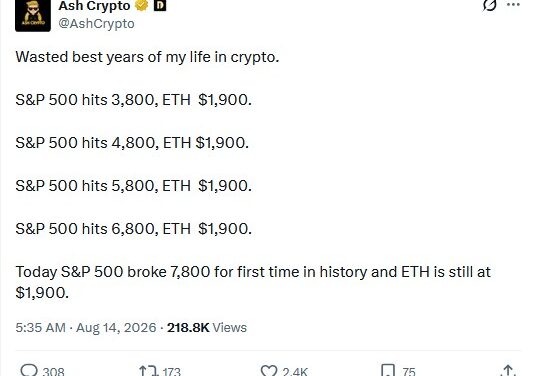
Does the Bitcoin rally mean we haven’t wasted our lives in crypto?

Sentiment in crypto has dived lower than a snailfish in the Mariana Trench in recent months. Miners are capitulating to AI, cold wallets are getting exploited, and you can hardly fire up LinkedIn without reading another message from a newly unemployed crypto journalist searching for new opportunities. Even for an industry that’s endured nation-state bans, exchange blowups, and years of regulatory pressure, morale has rarely felt this low. With business models failing and public interest dropping, many long term crypto fans have begun to question whether we’ve all wasted a decade of our lives on a pipe dream.Source: Ash CryptoUntil the price went up that is.Bitcoin has just seen its best August in years with a 26% return, while Ethereum gained 34%. President Trump even sang the praises of a decentralized offshore perpetual futures venue at the White House. Crypto’s finally getting interesting again. But a short term price rise doesn’t mean all our dreams have come true. For anyone who spent years advocating for sovereign F-you money outside the control of the state and centralized entities, a custodial ETF is not exactly a version of BTC that sticks it to the man. And there’s another problem with calling this a victory lap: many of the companies that helped build crypto’s foundations are no longer around to enjoy the latest pump.Take BitMEX, one of the industry’s first Bitcoin futures exchanges that pioneered the perpetual swap and 100x leverage for degens. It’s shutting down operations in September after 11 years. Former chief executive Stephan Lutz tells Magazine that BitMEX was a victim of its own success.“Every legitimate crypto exchange is using the perpetual swap… every legitimate crypto exchange uses the funding mechanism to bring longs and shorts together that the founders invented originally… That isn’t going away… It’s just not a differentiating factor anymore.”So what if crypto won — just not in the way we thought it would? Crypto’s impact means it wasn’t a waste of timeLutz doesn’t think crypto can simply disappear anymore because the technology has become too deeply embedded in traditional finance to be unwound. “From my point of view, we passed the point of no return,” he says. Utkarsh Ahuja, founder of Moonshot Capital, agrees that crypto proponents have not wasted their lives, and points to the industry’s impact on payment rails, settlement and tokenization. Stablecoins, he says, can have a “very, very lasting impact” as they become integrated into financial payment infrastructure, and “you can literally tokenize anything.” Related: 10 weirdest things ever tokenized… including fartsHe points to crypto’s spillover into energy, healthcare and AI, arguing that the technology is being widely used beyond the industry that created it. Decentralized finance has also made a meaningful impact on the world and is now closer to infrastructure, than an experiment. Wanja Oberhof, chief executive of Subsquid Labs, tells Magazine:“DeFi built the first financial system where you don’t have to trust the operator’s word: you can verify the ledger yourself, in real time, down to every transaction.” Settlement happens in minutes rather than days, he says, while markets run 24/7 and lending protocols can clear billions transparently:“No bank consortium ever shipped anything like it. DeFi removed the intermediary and kept the market.”But while DeFi’s infrastructure has greatly improved, Oberhof concedes the industry “over-promised on timelines and under-delivered on user experience.” He says the real win will come when the technology “disappears into products people use without thinking about it.”Institutions are adopting blockchain technology like crazy, and tokenized funds, stablecoins and blockchain-based settlement are no longer ideas confined to the hallways of crypto conferences.But crypto isn’t so much replacing the financial system as being absorbed by it.The crypto industry’s success is a key reason it no longer feels as exciting or impactful. The more TradFi becomes involved, the more boring crypto seems, especially when compared to the days when the Long Island Iced Tea Corp changed its name to Long Blockchain Corp back in December 2017 and the stock price surged 500%. (It was delisted two months later for misleading the market).Ether printed a God candle on Aug. 22. Source: Lark DavisRegulation has also made crypto much more legitimate but duller at the same time. The EU has implemented its Markets in Crypto Assets (MiCA). The US has gone from treating crypto largely as a regulatory headache to building a framework around it. Senators may even pass the CLARITY act one day.What did we lose along the way?Despite increasing legitimacy, the crypto industry has failed to deliver on many things it promised. Dentacoin failed to revolutionize the dental industry. Bitcoin did not stop all wars. Ethereum is not the default home for global finance (at least, not yet.) Ahuja says:“Has it delivered enough? Not yet, in my opinion. But has it changed our perception completely? Yes, it has.”The audience has changed too.Crypto is no longer some fringe hobby for a tiny band of libertarian cypherpunks and meme-weilding frog armies on Crypto Twitter. Around one in five American adults, or 19%, now says they have invested in, traded or used cryptocurrency, according to Pew Research Center. Broader ownership hasn’t made crypto easier to use. In fact, the explosion of assets and platforms has made the market harder to navigate. Users have to contemplate multiple networks, wallets, exchanges, bridges and onramps, creating the extra layers of friction that crypto was supposed to eliminate. One in five Americans has used crypto. Source: Pew Research CenterAhuja points to another irony: an asset class designed to be borderless is increasingly being shaped by national regulatory regimes, making it harder to move seamlessly across jurisdictions. One Dubai-based crypto user Magazine spoke with receives their salary every month into a large centralized crypto exchange. They say they lose money when converting USDT into local currency, and then have to pay a flat 75 AED fee (roughly 20 USD) just to withdraw. They say:“I wish I could receive a bank transfer instead.” And then there’s the most basic promise of all: self-custody, arguably the biggest paradox the industry faces because the more valuable Bitcoin becomes, the more dangerous it is to hold your own private keys — whether for fear of being bludgeoned to death by a wrench or having your cold wallet exploited by an AI agent. Arguably it’s this failure to deliver the future crypto once promised, that has made the bear market shutdowns and closures hit even harder.Related: MiCA is coming for DeFi vaults, but regulation will be difficultLayoffs are rampant throughout the industry. Projects that survived even the grizzly 2022 bear market have been shutting down this year, or being forced to reinvent themselves as the money and users pivot to AI — which is newer but has seen adoption crypto can only dream of so far.Lutz doesn’t see BitMEX’s fate as evidence that the technology failed; quite the opposite: the technology worked so well that everyone copied it, and the industry has moved from a race to invent the infrastructure to a brutal fight over market share. He says:“Now the differentiating factor is your aggressiveness in the competition, which is a completely different game. Some play that very well, others don’t.”Perhaps the companies and projects that built crypto were never going to be the ones that ultimately benefited most from its adoption. So have we wasted our lives?Well, the purists may not have gotten their sovereign money, the early companies may not have survived, and the average user may still be waiting to catch a break. But the technology is here, the infrastructure is becoming the rails, and the 20% daily candles sure are fun to watch.And one thing that’s always been true, when the price starts going up, the narratives change quickly to explain why it may keep going up forever.Magazine: Do the Coldcard attacks mean all hardware wallets are now insecure?Cointelegraph publishes long-form journalism, analysis and narrative reporting produced by Cointelegraph’s in-house editorial team with subject-matter expertise. All articles are edited and reviewed by Cointelegraph editors in line with our editorial standards. Some articles contain affiliate links, from which Cointelegraph may earn a commission. These relationships do not influence which products we review or our editorial conclusions. Content published in here does not constitute financial, legal or investment advice. Readers should conduct their own research and consult qualified professionals where appropriate. Cointelegraph maintains full editorial independence.

Čítaj viac
Mystery surrounds why an OG burned $1M in Bitcoin

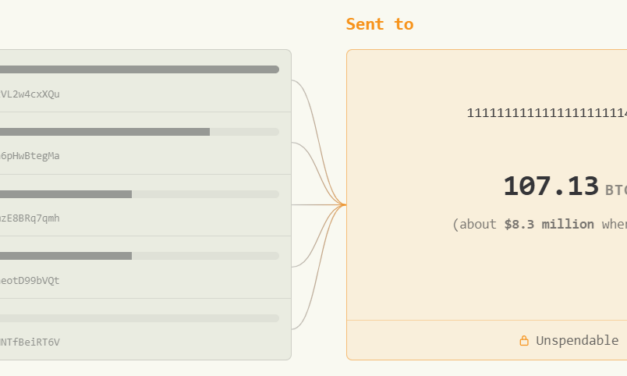
In March, someone moved $1 million worth of Bitcoin through a large crypto custodian. Three weeks later, almost exactly the same amount came back. Incredibly, less than two months after that, the Bitcoin was deliberately destroyed.The wallet had been dormant for almost 12 years before it suddenly sprang back to life. Bitcoin educator Bennet noted it sent 20.00010537 BTC to “a custodian of some kind” before receiving it back again (minus $3 or so). “The whole balance went out to what looks like an exchange hot wallet, and almost exactly the same amount came back three weeks later. Seven weeks after that, it was burned.” The mystery BTC transaction is part of a wider enigma surrounding 107 BTC burned in May, worth roughly $8.5 million at the time.New blockchain analysis shows that five wallets that ultimately destroyed their Bitcoin appear to have been controlled by the same person. It was likely an early Bitcoin holder who had funds on the collapsed Mt. Gox exchange.But why on earth would anyone deliberately destroy millions of dollars worth of Bitcoin?The BTC wallets behind the burnThe five addresses that eventually sent their Bitcoin to an unspendable address show “strong indicators of common ownership” according to Chainalysis.How to destroy Bitcoin. Source: Bennet.orgAll five wallets were initially funded on the same day in April 2014, and each subsequently sent almost the same dollar-equivalent amount of BTC to the same deposit address at a large centralized exchange.Related: Bitcoin faces true demand test above $83K as liquidity thickens: GlassnodeThe addresses also seem to have operated on a rotational basis: one would send Bitcoin to the exchange until its activity stopped, then another would take over with transactions of a “similar cadence and value.”Most of the funds, Chainalysis says, can be traced back to Mt. Gox, “suggesting the owner was an early adopter of Bitcoin.”That doesn’t necessarily mean the coins were withdrawn directly from Mt. Gox, since the exchange ceased trading in February 2014, and the five wallets were funded in April. Bennet says:“It’s entirely possible that the owner of these coins was one of the lucky ones who managed to get their coins off the exchange before it collapsed.”The custodian itself remains unidentified. Chainalysis confirms it’s a large centralized exchange but says it does not publicly disclose the names of services it identifies.Bennet’s analysis suggests the address behaves like a static customer deposit address at a large custodian.That’s because the address doesn’t maintain a balance, and the deposits are swept into transactions containing dozens of other inputs before being consolidated into an omnibus wallet.Once the Bitcoin enters the custodian’s system, the public blockchain can no longer tell us what happened to those coins. And that makes the wallet’s earlier activity even more intriguing.The $10,400 clueOne of the five addresses sent 19.6 BTC in 60 transactions to the custodian between 2022 and 2024.The Bitcoin amounts were vastly different, ranging from about 0.15 BTC to 0.62 BTC. But when measured in dollars, the transactions reveal extraordinary similarities.This address sent 19.6 BTC in 60 transactions to the same custodian. Source: Mempool.spaceDespite Bitcoin’s price more than quadrupling during the period, 58 of the 60 transfers were within 10% of approximately $10,400 when they were sent.So, while the owner wasn’t repeatedly sending the same amount of BTC, they were repeatedly sending almost the same dollar amount. Bennet says:“This suggests to me a planned liquidation strategy.” There is no way to prove this theory from the blockchain, since the BTC was mixed with large numbers of other coins once it reached the custodian, and the data doesn’t show whether the Bitcoin was sold, held or transferred elsewhere. Related: Bitget CEO isn’t buying the Bitcoin rally — She’s waiting for $50KInterestingly, “while payment size was constant,” Bennet says, “frequency was not — these $10k transfers came in clusters,” which could be more consistent with someone sending fixed-dollar amounts when required rather than following an automated schedule.The $1 million round tripWhile the $10,400 transactions offer a possible explanation for the wallet owner’s earlier relationship with the custodian, they do not help explain the $1 million round trip that happened in March.After sitting untouched for roughly 12 years, the wallet suddenly moved its entire balance of 20.00010537 BTC and received 20.00006037 BTC back, a difference of just 4,500 satoshis, or around $3.That weighs against the idea that the owner was simply trading the Bitcoin, since whatever happened inside the custodian, almost exactly the same amount came back.This address sent 20 BTC and received 20 BTC back. Source: Mempool.spaceThe returned Bitcoin was also split into three transactions of 7 BTC, 7 BTC and 6.00006037 BTC, sent over three consecutive days.Bennet says the round numbers are consistent with a daily withdrawal limit imposed by the custodian. Crucially, the Bitcoin didn’t simply end up in another wallet; it returned to the same address that had sent it.The transaction history also indicates that the same key holder controlled the coins before and after the round trip, Bennet says: spending the Bitcoin in March required the private key, while burning it in May required the same key again.That makes the sequence particularly difficult to explain as a conventional exchange transaction.So why did they do it?There are several possibilities, but none fits all of the evidence. The liquidation theory makes some sense of the earlier transactions, but it doesn’t explain why the owner would send roughly $1 million through the same infrastructure in March and then retrieve virtually all of it.Perhaps the owner was testing an old wallet or custody arrangement after 12 years of dormancy, moving the coins through a major custodian and successfully getting them back to show that an old key and custody setup still worked. But then, why destroy the Bitcoin afterward?Tax or compliance reasons could potentially explain why someone moved an old stash through a major custodian, but then, there is no evidence linking the transaction to a particular tax or regulatory event.There is also a privacy explanation. Sending Bitcoin through a custodian that sweeps deposits into an omnibus wallet makes the subsequent movement of those coins much harder to follow onchain. That’s certainly plausible but still provides no clues as to their ultimate destruction. Perhaps the Bitcoin burn itself was intended as some kind of statement. Yet beyond a few blockchain sleuths, the action almost went unnoticed. Burning Bitcoin is irreversible, so whoever controls the private keys chose to send the coins somewhere they can never be spent again, rather than simply leaving them untouched. Bennet says:“There’s also the possibility that a very wealthy individual without heirs decided to permanently burn their coins (thereby publicly reducing the total bitcoin supply), rather than just destroying their keys.” For now, even the firms best placed to analyze the blockchain are at a loss. Chainalysis concedes:“We don’t have a clear explanation for why the owner would move a long-dormant stash through a custodian, retrieve roughly the same amount, and then deliberately burn it.” While the blockchain can give us an unusually detailed record of what happened, it can’t tell us why. For now, at least, that remains the million-dollar question.Magazine: El Salvador’s Bitcoin experiment turns 5: ‘It was for us, not them’Cointelegraph publishes long-form journalism, analysis and narrative reporting produced by Cointelegraph’s in-house editorial team with subject-matter expertise. All articles are edited and reviewed by Cointelegraph editors in line with our editorial standards. Some articles contain affiliate links, from which Cointelegraph may earn a commission. These relationships do not influence which products we review or our editorial conclusions. Content published in here does not constitute financial, legal or investment advice. Readers should conduct their own research and consult qualified professionals where appropriate. Cointelegraph maintains full editorial independence.

Čítaj viac

SEC’s proposed crypto rules probably won’t spark new ICO boom

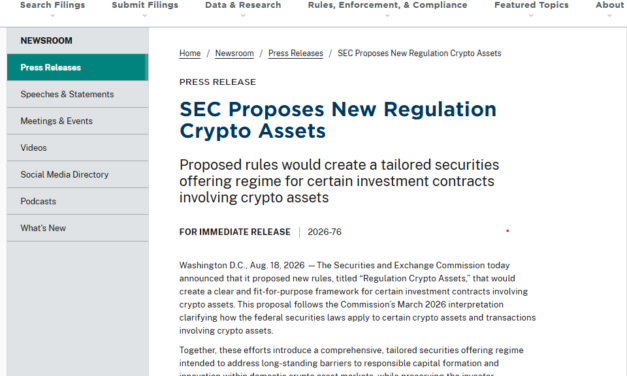
After what feels like a lifetime in the making, the SEC’s proposed new Regulation Crypto Assets rules could finally make public token sales easier in the United States.The proposal would allow qualifying issuers to raise up to $75 million during any 12-month period, and potentially allow projects to return to investors to raise more funds year after year as they build out their networks. That could create a new, staged model for token fundraising, and potentially make early allocations more attractive to investors betting on higher valuations later.But before you put the champagne on ice, it’s unlikely to bring back the freewheeling initial coin offering mania of 2017, according to Lee Reiners, a Duke University lecturing fellow and financial regulation expert. He tells Magazine: “My initial view is that the $75 million exemption could make public token offerings more feasible, but it is unlikely to produce a return to the ICO boom.” Could projects raise $75M every year? The Securities and Exchange Commission’s proposal, unveiled Aug. 18, creates two exemptions for certain investment contracts involving crypto assets. SEC Proposes New Regulation Crypto Assets. Source: SECThe first is a one-time exemption for startups for offerings of up to $5 million over four years, and the second is a larger fundraising exemption allowing up to $75 million in each 12-month period. Related: MiCA cracks down on USDT in Europe… but no one else caresThe latter is modeled in part on Regulation A and comes with disclosure and ongoing reporting requirements.Does the rolling nature of the $75 million limit mean a project could simply raise $75 million, build for a year, then come back for another $75 million?The answer appears to be yes.Drew Hinkes, partner at Winston & Strawn, tells Magazine the 12-month limitation would allow for “serial raises” of $75 million every 12 months, “provided they are actually distinct offerings.”So what’s the catch?Lilya Tessler, partner and leader of Sidley’s Global FinTech and Blockchain group, says that while “nothing prevents an issuer from relying on the exemption more than once,” each raise “isn’t automatic.”Subsequent raises would require filing a new offering statement and undergoing an SEC staff review, and issuers would have to keep filing annual and semiannual reports. They would also need to “disclose what the issuer raised under the exemption in the prior 12 months so the cap can be verified,” Tessler says. Still, the proposed rules offer a substantial upgrade from the status quo. A project seeking $225 million in total, for example, could potentially raise the funds in chunks and return to investors later with a more developed network — and a higher valuation.Could a cap create ICO-style FOMO?That raises another obvious question. Could the $75 million ceiling make early token allocations more sought-after, unleashing a frenzy of get-rich-quick-induced FOMO in the first round?Possibly. Reiners says that’s one potential outcome: “If investors expect a successful issuer to conduct later offerings at a higher valuation, an initial allocation may become more attractive precisely because it is limited.” However, that’s not dissimilar to how many token and equity sales are currently structured. SpaceX sold fewer than 5% of its total equity during the recent IPO. “Scarcity in both token sales and exempt securities offerings of traditional securities long predate this proposal — issuers have always been able to limit round sizes and can continue to do so,” says Tessler.Non accredited investors also won’t be able to go “all in” on any one token sale like they have in the past. Tessler says the SEC’s proposal limits them to buying “10% of the greater of their income or net worth,” regardless of which round they participate in.Related: White hat hacker recovers $2M from faulty 2016 ICO smart contractWhy this probably won’t be 2017 all over again There are other reasons not to expect 2017 to return — not least because a generation of crypto investors have been burned by the extravagant promises and terrible tokenomics of previous ICOs. Up to 90% of projects funded via ICOs between 2017 and 2019 ended up failing. Reiners points out that fundraising markets are “shaped by investor appetite, token economics, liquidity, custody, and the reputational damage left by the last ICO cycle.” The SEC estimates that around 130 offerings would use the two new exemptions each year, and around 475 issuers will potentially use the broader investment contract safe harbor. That’s less of a tsunami and more of a steady trickle.SEC proposed long-awaited regulation for primary token issuance. Source: Galaxy.But the SEC proposal is still very positive for token issuers trying to navigate a legal minefield around securities laws in the US — the kind Tezos and Telegram would have chewed their right arms off after their multimillion-dollar US securities-law battles. Rather than force issuers to self-evaluate whether their offerings fit within existing securities law frameworks, the SEC is proposing an explicit regulatory pathway for raising capital. As crypto lawyer Jake Chervinsky says, “not one day too soon.” What happens when the token starts trading?There are some potential minefield though. The SEC’s proposal says the investment contract associated with a crypto asset can continue to transfer to subsequent purchasers in secondary market transactions until the crypto asset separates from the issuer’s representations or promises.In other words, if the team selling a non-security token suggest that investors in the secondary market can reasonably expect to profit from essential managerial team efforts, then it could become subject to an investment contract.Related: ‘We refused to do an ICO’: The truth behind Canton’s tokenomicsHinkes sees that creating a potential problem:“If a transaction of a non-security covered crypto asset causes the transfer of the investment contract from cryptoasset seller to cryptoasset buyer, there is a risk that the sale of the crypto asset would be viewed as a securities transaction.” That could become a problem for exchanges and other trading venues.A new route for fundraising — but old risks remainSEC moves forward with Reg Crypto. Source: Jake ChervinskyThe potential for tokens to fall into a no man land between security and non-security also worries Reiners. He says that projects could learn how to operate within the new framework without addressing the underlying investor protection concerns:“A public offering exemption could become a vehicle for regulatory arbitrage […] A token issuer may satisfy the formal conditions for an exempt sale while continuing to market an asset whose value depends heavily on the issuer’s managerial efforts.”That would leave retail investors in the same grey area as a decade prior, exposed to “opaque disclosures, concentrated insider holdings, and aggressive promotion.”Magazine: Bitget CEO isn’t buying the Bitcoin rally — She’s waiting for $50KCointelegraph publishes long-form journalism, analysis and narrative reporting produced by Cointelegraph’s in-house editorial team with subject-matter expertise. All articles are edited and reviewed by Cointelegraph editors in line with our editorial standards. Some articles contain affiliate links, from which Cointelegraph may earn a commission. These relationships do not influence which products we review or our editorial conclusions. Content published in here does not constitute financial, legal or investment advice. Readers should conduct their own research and consult qualified professionals where appropriate. Cointelegraph maintains full editorial independence.

Čítaj viac
MiCA is coming for DeFi vaults, but regulation will be difficult

MiCA left crypto lending outside its original rulebook — but now Brussels is considering whether to bring it in.On May 20, 2026, the European Commission asked stakeholders to weigh in on areas left outside the original Markets in Crypto Assets (MiCA) framework. These include issues around decentralized finance (DeFi) and crypto lending and borrowing. One area of contention involves lending vaults, which can channel billions of dollars into onchain credit markets without looking like conventional lending. Their legal status currently depends on non binding interpretations that they fall outside of MiCA and EU fund rules. Yuriy Brisov, an EU digital assets lawyer and partner at Digital & Analogue Partners, tells Magazine the law pertaining to vaults at present is unclear:“EU law has no category called a ‘vault.’ A lawyer therefore defines it the way a regulator would qualify it: by function, not by label.” That’s just one of myriad regulatory problems, since vaults can perform the economic functions of lending while spreading other functions over smart contracts and multiple participants rather than a single company. If Brussels decides lending should come inside the regulatory perimeter, what does that mean for DeFi, and where does it leave the people and protocols behind these vaults? Morpho puts the problem into practiceDecentralized lending protocol Morpho’s lending infrastructure gives some clues as to why this question will be so hard to answer. The way its vaults are set up and managed does not neatly map on to any existing regulatory model.Targeted consultation on the review of Regulation on the Markets in Crypto Assets (MiCA). Source: European ComissionIts Vault V2 architecture divides responsibilities between an owner, curator, allocator and sentinel. The curator configures strategy and risk parameters, while the allocator executes allocations and the sentinel has powers intended to reduce risk. While none of this establishes any of these participants as providing a regulated lending service under MiCA, it does show why identifying the relevant “provider” is less straightforward than with a conventional lender.Related: Bitwise to launch onchain vaults via MorphoJonathan Galea, a partner at Cahill Gordon & Reindel, explored the issue in a recent client update on lending vaults and their position under EU financial regulation. His analysis looks at how vault structures can sit across MiCA, stablecoin rules and European fund law.Galea says policymakers should be careful about treating lending vaults as a single category, telling Magazine, “lending vaults solve more practical problems than they create.”He says lending vaults help direct fragmented liquidity into lending markets, while other vaults may buy and sell crypto assets and should be treated differently:“Bring ‘DeFi lending’ into the perimeter as a single label, and structures that deserve opposite answers risk ending up captured together.”That would be important if Brussels decides to regulate lending, since a broad category covering “DeFi lending” could capture structures with very different economic functions—and people exercising control over them.Who should actually be regulated?MiCA currently excludes crypto asset services that are provided in a “fully decentralized manner,” although it can apply where only part of an activity is performed in a decentralized way. Morpho’s Vault V2 architecture. Source: MorphoOne possible solution would be to make decentralization the dividing line, but Galea argues that could disadvantage newer protocols. He says:“Decentralization is a spectrum and a function of time: a test built on it would penalize newer, more novel protocols while entrenching mature incumbents that have had years to distribute control.”Brisov says the focus should instead be on the structure of the vault and the control people have over it:“The safer ground is structural: there is no undertaking, no appointed manager, the holder has a direct coded claim on the pool, and the user can exit before any parameter change takes effect.”He says if Brussels decides that lending and borrowing warrant regulation, they should be explicitly added to the list of regulated crypto asset services rather than broadening the definition of a crypto asset service provider itself.Related: ‘DeFi doesn’t exist anymore,’ just onchain finance: Andre CronjeCurve Finance founder Michael Egorov argues that the rules also need to account for the differences between decentralized lending and conventional finance. He says:“If DeFi lending is ever brought into the scope of regulation, it should be treated completely differently. DeFi doesn’t need some of the safeguards which traditional lending requires, and yet, at the same time, it may need others.”Egorov says regulation should be approached “really carefully,” and that a dedicated framework could improve safety and open DeFi lending to new users, while avoiding rules that some protocols cannot comply with because of how they’re built.The Commission’s consultation closes Sept. 30, and what follows could determine whether lending vaults remain outside MiCA or become subject to a new regulatory framework.For Brussels, the challenge is not simply whether to regulate DeFi lending; it’s how to write rules that distinguish between very different forms of onchain lending and the people (if any) that actually exercise control over them.Magazine: 200,000 fake AI ‘victims’ deployed to scam bait online fraudstersCointelegraph publishes long-form journalism, analysis and narrative reporting produced by Cointelegraph’s in-house editorial team with subject-matter expertise. All articles are edited and reviewed by Cointelegraph editors in line with our editorial standards. Some articles contain affiliate links, from which Cointelegraph may earn a commission. These relationships do not influence which products we review or our editorial conclusions. Content published in here does not constitute financial, legal or investment advice. Readers should conduct their own research and consult qualified professionals where appropriate. Cointelegraph maintains full editorial independence.

Čítaj viac

Získaj BONUS 8 € v Bitcoinoch

nakup bitcoin z karty

Registrácia Binance

Burza Binance

Aktuálne kurzy