Autor Cointelegraph by Christina Comben

The British Virgin Islands are a top crypto hub no one ever talks about: Here’s why

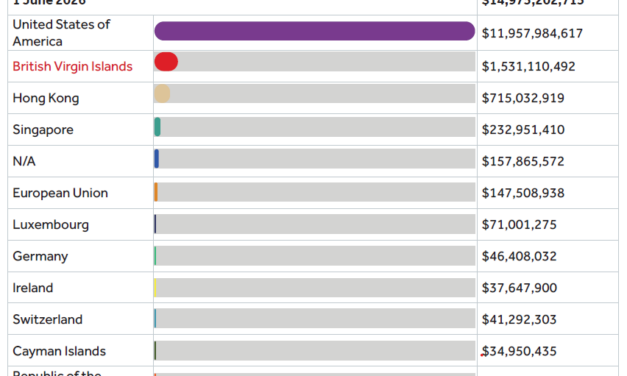
More than $1 out of every $10 of the world’s tokenized US Treasuries is issued by a company incorporated in the British Virgin Islands. That places the small Caribbean territory behind only the United States as a key jurisdiction for the rapidly growing asset class, according to BVI Finance.BVI Finance’s Destination Digital report in June found that BVI entities accounted for approximately $1.5 billion of the $14.98 billion global market for tokenized US Treasuries as of June 1.A growing list of digital asset firms now call the British Virgin Islands home, including Kraken’s parent company, Payward, Bitstamp (recently acquired by Robinhood), 1inch and Bitfinex. The territory boasts a stablecoin market cap of about $1.2 billion held in BVI-linked addresses and has roughly 28,000 stablecoin asset holders. More than 25 virtual asset service providers (VASPs) have been approved under the BVI’s VASP regime, and, according to Bernstein Research, the Islands host 305 tokenized securities — the highest count for any single jurisdiction in the RWA.xyz dataset.US tokenized securities distributed value by jurisdiction. Source: Destination DigitalThe statistics suggest the Virgin Islands has become one of the world’s top crypto hotspots, but the reality is a little more nuanced. Tokenized assets are designed to be borderless, and crypto projects often have the choice of which offshore jurisdiction to incorporate in.In most cases, digital asset companies aren’t physically relocating to the Virgin Islands; they’re simply using the territory to incorporate legal entities, such as token issuers, treasury vehicles, holding companies or special purpose vehicles (SPVs).Crypto companies aren’t just choosing BVI for tax reasonsAndrew Jowett, a partner at Appleby (BVI) Ltd who advises digital asset businesses on corporate structuring, told Cointelegraph that clients researching the BVI typically compare several jurisdictions, such as the Cayman Islands, United Arab Emirates, Singapore and Switzerland. Despite long-held assumptions about offshore Caribbean tax havens, tax neutrality is no longer the primary driver.Related: Dubai crypto market hits 50 licensed firms after new VARA approval “The overriding factor for choosing the BVI has been digital asset regulation and not tax,” Jowett said. The British overseas territory does have attractive tax policies, and imposes no corporate income tax or capital gains tax on BVI companies.But all the leading crypto hubs now have favorable crypto tax policies, meaning it’s no longer the deciding factor. The Cayman Islands imposes no corporate income tax or capital gains tax, and the UAE has zero personal income tax or federal corporate tax on qualifying free zone entities. “Tax neutrality is table stakes,” said Saeed Al-Marri, chief executive of digital asset infrastructure firm Ethra, which is incorporated in the BVI. He added that the BVI provides legal certainty and clarity, factors he said will determine which jurisdictions survive institutional adoption.LTP is an institutional digital asset infrastructure provider that operates regulated entities in the BVI, Hong Kong, Australia and the UAE. Its founder and chief executive, Jack Yang, told Cointelegraph that while favorable taxation is relevant for cross-border structures, it is secondary to legal and regulatory certainty as tokenization moves further into institutional finance.“A tax-neutral structure that cannot pass review by banks, custodians, auditors, investment committees, or regulators has limited practical value,” he said. Number of tokenized securities by jurisdiction. Source: Destination DigitalOrest Gavryliak, chief legal officer at decentralized exchange aggregator 1inch, which is incorporated in the BVI, said that more and more decentralized finance (DeFi) protocols are choosing jurisdictions that provide predictable rules, rather than simply the lowest tax burden.“Jurisdiction isn’t exactly becoming irrelevant, but its role is changing,” Gavryliak told Cointelegraph. “Protocols are increasingly weighing factors such as regulations, institutional credibility and long-term sustainability.”Crypto hubs now compete on legal infrastructure Jurisdictions vying to be “crypto hubs” like Singapore and the UAE increasingly compete via favorable legal infrastructure and licensing regimes, such as Singapore’s Payment Services Act and Dubai’s Virtual Assets Regulatory Authority (VARA) rulebooks.The BVI introduced the Virtual Assets Service Providers Act (VASP Act) in 2023, overseen by the BVI Financial Services Commission (FSC). Compared with many larger financial centers, it offers a speedy turnaround, responds to VASP applications within six weeks and aims to complete the review process within six months, according to BVI Finance and FSC guidance. Jowett said beyond favorable tax regimes, clients prioritize “ease of launch” and efficient corporate structuring, which has long been part of the BVI’s appeal. Companies can be set up quickly, the legal framework is flexible, and ongoing reporting is generally lighter than in onshore jurisdictions.Related: Cayman Islands Web3 foundations jump 70% as CARF reporting rules arriveThe Virgin Islands has also historically been favored because it offers more corporate confidentiality than many larger financial centers.While BVI companies are still subject to anti-money laundering (AML) and know-your-customer (KYC) requirements, beneficial ownership information is held by registered agents rather than a public register, which reduces disclosure requirements.British Virgin Islands. Source: Destination DigitalHowever, none of the companies interviewed by Cointelegraph cited tax neutrality or greater corporate confidentiality as deciding factors for incorporating in the BVI, pointing instead to legal certainty, regulatory clarity and corporate flexibility.Incorporating, not physically relocating to the Virgin IslandsYang told Cointelegraph that LTP does not employ full-time staff “on the ground.” Instead, the entity is overseen by its board and supported by staff from elsewhere in the LTP group. The same distinction can be seen elsewhere in the industry. Kraken’s parent company, Payward, is incorporated in the BVI, but the exchange’s operations are primarily based in the United States, while 1inch’s team and operations are spread across multiple jurisdictions. The BVI isn’t winning the race to attract glitzy headquarters or large-scale engineering teams. Instead, it has become the legal home for many digital asset businesses, while much of the work happens elsewhere. For jurisdictions competing to attract the industry, that just may be enough.Magazine: Singapore isn’t a ‘crypto hub’ — it’s something better: StraitsX CEO

Čítaj viac

Is Robinhood Chain’s success bullish or bearish for ETH the asset?

Robinhood Chain’s explosive launch this month has reignited one of Ethereum’s longest-running debates: Do successful layer-2 networks increase demand for ETH, the asset, or do the new entrants capture all of the value for themselves?The retail brokerage’s Arbitrum-based Ethereum L2 has become one of Ethereum’s busiest rollups since its launch on July 1. More than $141 million in Ether was bridged onto the chain in its first two weeks. DeFiLlama data shows more than half a million wallets now hold ETH on the network, and a memecoin frenzy saw Robinhood Chain surge past the Ethereum L1 and Coinbase’s Base L2 in 24-hour DEX trading volume.Ether has pumped on the news, gaining around 15% from $1,582 on July 1 to $1,825 by July 13, according to Coingecko data, following a wave of bullish comments. World Liberty Financial’s Eric Trump posted on July 11, “ETH is pumping hard! Great to see!” while Tom Lee, chairman of BitMine Immersion Technologies, argued the launch reinforces the thesis that “ETH is money,” pointing to the asset’s role as the chain’s native gas token and the L2’s finality on Ethereum’s mainnet. Ethereum investors have heard similar arguments before.Related: Robinhood L2 sparks ETH optimism, Saylor ‘muddies waters.’ Hodler’s Digest, July 5-12, 2026Arbitrum, Optimism and Base each drove waves of users and activity onto Ethereum’s L2 ecosystem, but failed to move the needle meaningfully in Ether’s price, as most of the economic activity remained on the rollups themselves. Robinhood Chain’s launch is arguably different. Unlike previous rollups built by crypto-native firms, the network was developed by a publicly listed retail brokerage with tens of millions of customers to support tokenized stocks and other real-world assets. Within days of launch, it already accounted for 6.9% of all tokenized stockholders, according to data from Token Terminal. Ether price response to Robinhood Chain’s launch. Source CoingeckoAnd, if Robinhood’s model succeeds, it could encourage banks, brokers and asset managers to build L2s of their own, and cement Ethereum as the default blockchain for TradFi. Deutsche Bank is already in the process of building a ZK-powered Ethereum L2 called DAMA 2, focused on institutional finance. Why Robinhood could be a turning pointEthereum’s L2 networks use rollup technology to process transactions away from Ethereum’s main chain and periodically settle them back to the network. Robinhood Chain uses Arbitrum technology and is compatible with Ethereum’s wider ecosystem.But what has caught the industry’s attention isn’t the technology itself, as much as who is using it.“It’s a real milestone,” Alex Gluchowski, founder and chief executive of Matter Labs, the developer behind Ethereum L2 zkSync, told Cointelegraph. “It shows Ethereum L2s have gone from something crypto-native teams experiment with to infrastructure a regulated, publicly listed company will run its business on.”Rather than building a blockchain from scratch, as Stripe has opted to do with Tempo, Robinhood chose to tailor an Ethereum rollup to its own needs “for privacy, compliance and performance, while still inheriting Ethereum’s security and connecting to its liquidity,” he added.Max Shannon, senior research analyst at Bitwise, told Cointelegraph that Robinhood Chain’s success is more significant than previous L2 deployments.“It represents the growth of the Ethereum ecosystem, particularly among major institutions,” he said. “It also arrives at a time when Ethereum has more broadly repositioned itself toward institutions through Eth Labs and Ethereum Institutional.”Does Robinhood Chain change the investment case for ETH?For Shannon, Robinhood’s launch strengthens the investment case for Ethereum because it reinforces the network’s position as the leading blockchain for institutional adoption.He said ETH has the “network characteristics” to become the reserve asset for a growing network of institutional L2s. But like many, he believes Ethereum’s tokenomics need to be improved so that increased network activity is reflected more clearly in demand for ETH.Ethereum has been criticized frequently for its decision to lower fees for L2s as a way to spark adoption and gain network effects. Ark Invest’s Lorenzo Valente posted on July 14 that Robinhood Chain had generated $816,000 in revenue since launch, with Arbitrum taking a 10% cut, but only 0.15% of the total being paid back to Ethereum. “If your thesis is ‘ETH is money,’ Robinhood building here is ultra bullish. More activity, more ETH collateral, more lindyness. If your thesis is ‘ETH is a revenue generating asset,’ this is the ultra-bear case.”GrowThePie said that Valente’s figures for Eth’s share of the revenue were off by a factor of four and argued “0.6% of revenue is the correct figure.” But even the higher figure is not a meaningful driver of revenue to the L1. Robinhood Chain generated more gas fees than any other L2 in the past week, but Ethereum only saw $4,400 of that. MatzeSource: Matze, GrowThePieGluchowski said ETH’s appreciation would not be based on fee revenue, but would likely come from becoming widely accepted money throughout the L2 ecosystems. “People might pay fees in stablecoins or never think about gas at all,” he said. “But as more value settles through Ethereum, ETH starts to look less like a fee token and more like a base monetary asset for this system.”Related: Robinhood says its AI agent feature will ‘soon’ be assisting crypto tradersEven ETH bears like Mike Dudas from 6th Man Ventures, have described Robinhood Chain as “the single most bullish thing I’ve seen in eth-land in years.” But after Dudas saw Valente’s post, he added the proviso that “Eth cooked unless ‘eth is money’ takes off or the price of l1 settlement increases.”The value accrual question remains While Robinhood’s success may have bolstered the case for Ethereum’s scaling strategy, it has yet to settle one of the network’s biggest unanswered questions: how does growing L2 activity ultimately translate into value for ETH?Shannon said that recent upgrades like Fusaka have improved Ethereum’s scaling capabilities, but despite transaction activity reaching record levels, demand has yet to translate into meaningfully higher fees or increased ETH burn.“Robinhood will not solve this problem,” Shannon said, and the collective growth of L2s will likely not either… It requires a wholesale change in developer mindset and in ETH’s token economics.”Another uncertainty is how much ETH institutional users will actually hold directly. As tokenized stocks and other RWAs increasingly trade against stablecoins, many users may rarely interact with ETH, even though it underpins the network behind the scenes. Robinhood may have shown that a major financial institution is willing to build on Ethereum’s infrastructure, but whether that ultimately translates into stronger demand for ETH remains to be seen.Magazine Ethereum’s much-hated staking ‘tax’ may already be obsolete

Čítaj viac

Strategy became a symbol of the dot-com crash: Could history repeat?

In March 2000, Strategy executive chairman Michael Saylor watched more than $6 billion disappear from his fortune in a single day.MicroStrategy’s shares had plummeted more than 60%, thrusting the thirty-five year old software entrepreneur into the center of the dot-com crash. The company later settled civil fraud charges with the US Securities and Exchange Commission over its accounting practices without admitting or denying wrongdoing. MicroStrategy did not cause the dot-com bubble to burst, but the saga was one of the era’s high-profile corporate blowups and the company became a symbol of the periods excesses and risks. Now, more than 25 years later, the Bitcoin true-believer once again finds himself in the eye of one of Wall Street’s most closely watched financial experiments. The company, now known simply as Strategy, holds 843,775 Bitcoin, more than any other public company. It has inspired dozens of listed firms to adopt Bitcoin treasury strategies of their own.But Strategy is no longer simply accumulating Bitcoin, it has developed a series of financial engineering strategies that divide investors and analysts. Some see it as a sophisticated corporate treasury model that can’t lose, while others believe the risks are piling up on top of one another.“The conversation shifts beyond simply acquiring Bitcoin to how those positions are financed, managed and, when necessary, traded or monetized,” Drew Forman, senior vice president and head of strategy at Talos, told Cointelegraph.From accumulation to managementOn June 29, Strategy unveiled a new capital framework allowing it to sell Bitcoin to fund preferred stock dividends, build its cash reserves and repurchase securities.The case against MicroStrategy in 2000. Source: SECFor a company that spent more than half a decade insisting its Bitcoin was to be accumulated rather than sold, the move caused alarm bells to ring.Related: Lyn Alden says Bitcoin needs no savior as Strategy sells $216M of BTCDays later, Strategy disclosed the sale of 3,588 Bitcoin, its largest disposal since adopting BTC as its primary treasury reserve asset in 2020.To Strategy evangelists, these changes reflect the natural evolution of a company managing a multi-billion-dollar Bitcoin treasury, rather than a sharp about-turn.Yet critics argue that Strategy’s growing reliance on preferred stock, dividend obligations and external financing has made the model more complex and interdependent, rather than more resilient. MicroStrategy’s road to BitcoinMicroStrategy was one of the fastest-growing software companies of the internet boom in the 1990s, selling business intelligence software to blue-chip clients including McDonald’s, Nike and eBay, and making Saylor one of America’s richest entrepreneurs. But on March 20, 2000, that momentum came to a sudden halt when MicroStrategy announced that it needed to restate its financial results for the fiscal years 1998 and 1999 due to accounting errors.The company’s stock nosedived, dropping from $260 per share to just $86 in a single session. It continued to plummet over the following weeks. On April 13, when MicroStrategy announced that it would also need to restate its 1997 financial results, the stock closed at $33 per share.That episode may have defined many executives’ careers, but Saylor spent the next two decades rebuilding the company largely outside the spotlight until the summer of 2020, when MicroStrategy announced that it would make Bitcoin its primary treasury reserve asset, and Saylor became its most vocal evangelist.MicroStrategy settled charges with the US Securities and Exchange Commission. Source: SECHe likened holding cash reserves during a time of unprecedented pandemic-era stimulus to holding “a melting ice cube.” The company bought its first $250 million Bitcoin on August 11.Few public companies held Bitcoin on their balance sheets at the time, and the move was widely viewed as a high-risk experiment rather than a blueprint for corporate finance. But Bitcoin’s price soon began to soar, bolstered by the excess liquidity, and Strategy’s valuation ballooned. Suddenly, Saylor’s controversial decision looked more like a stroke of genius and the company quickly became a leveraged proxy for Bitcoin on Wall Street. Related: Strategy’s MSTR may plunge 80% if it repeats this dot-com-era fractalDozens of listed firms adopted variations of its treasury strategy, and today, Strategy’s Bitcoin stack is worth more than $54 billion. But with BTC languishing far from its all-time high above $126,000 in October 2025, the company’s Bitcoin play has been repeatedly called into question. Bitcoin price is far from its all-time high. Source: CoingeckoSkeptics argue Strategy’s model only works if Bitcoin keeps appreciating and investors continue providing new capital. Some have even warned that, under prolonged market stress, those dynamics could contribute to a so-called death spiral in Strategy’s financial model.Different mechanism, same problemWhether Strategy represents a radical reinvention or history repeating itself depends largely on how investors interpret the risks.To some critics, the similarities with 2000 are less about accounting than Saylor’s willingness to build his company around a high-risk corporate model that few other chief executives would even contemplate.“Saylor is insane (not an insult, just a diagnosis) and is either a fool or a knave,” Aswath Damodaran, professor of finance at NYU Stern School of Business, told Cointelegraph in an email. “It hurts my brain cells just thinking about MSTR and I don’t have enough to waste on it.” David Trainer, chief executive of investment research firm New Constructs, also holds a hawkish view. He argued that while today’s Strategy looks very different from the company that collapsed during the dot-com era, investors are still being asked to place extraordinary faith in Saylor’s latest corporate experiment. “Different mechanism, same underlying problem: the equity is a leveraged wrapper around a volatile asset, with no fundamental earnings power supporting the valuation,” he said.He said that the dot-com blow-up was due to incorrect financial reporting. The SEC claimed in 2000 the company’s financial reports had “showed positive net income” when it should have “should have reported net losses from 1997 through the present.” While Saylor and two executives agreed to pay a $10 million fine to settle the case, they did not admit liability to any of the SEC’s allegations. “That was a […] mismanagement risk layered on a real (if over-hyped) software business,” he said. Today, the company’s books are “cleaner,” he argued, with the risks embedded in a capital structure built around financing ever-larger Bitcoin purchases rather than software.Strategy now runs a “large and growing balance of convertible debt and perpetual preferred stock,” he said, pointing to the $6.7 billion in convertible notes and $15.5 billion in preferred stock outstanding as of late May 2026, used specifically to buy more Bitcoin.“The software business is now a rounding error next to the balance sheet,” he said.Related: Grayscale’s Pandl says Strategy should sell $3B Bitcoin to restore confidenceAccording to Trainer, the bigger concern is not Bitcoin itself, but the premium investors are willing to pay for exposure through Strategy. If that premium disappears, one of the company’s key advantages disappears with it.“Once you’re structurally reliant on issuance and issuance becomes value-destructive, the company has to either sell Bitcoin, take on more expensive financing or simply stop growing,” Trainer said.Treasury management, not just HODLingForman said that investors should focus on how the company manages its increasingly sophisticated corporate treasury strategy.“Strategy’s position can’t be understood simply by looking at the size of its Bitcoin holdings,” Forman told Cointelegraph.He said Strategy’s willingness to sell Bitcoin is less a departure from Saylor’s long-held accumulation strategy than a practical reality of managing a corporate balance sheet. “I see it as a pragmatic evolution of a more complex treasury strategy,” he said.“The broader takeaway is that Bitcoin is increasingly being treated as an institutional asset class,” he added, stressing that rather than simply deciding whether to buy Bitcoin, companies will increasingly need to think about governance, liquidity management, execution and risk management.So, has Saylor rewritten his legacy?26 years after MicroStrategy’s accounting scandal, the questions surrounding Strategy have changed. Few critics question the integrity of the company’s financial reporting, but whether its increasingly complex Bitcoin strategy can endure prolonged market stress.Saylor has fundamentally changed the way many public companies think about corporate treasuries, and many have followed his lead. But whether Saylor has rewritten his legacy won’t be decided by the next bull run, but on how well Strategy performs if the markets continue to turn against it.Cointelegraph reached out to Strategy but did not receive a response. A spokesperson from the SEC declined to comment on the settlement case.Magazine: Bitcoin will not hit $1M by 2030, says veteran trader Peter Brandt

Čítaj viac

Will the crypto lobby's $189M campaign get CLARITY over the line?

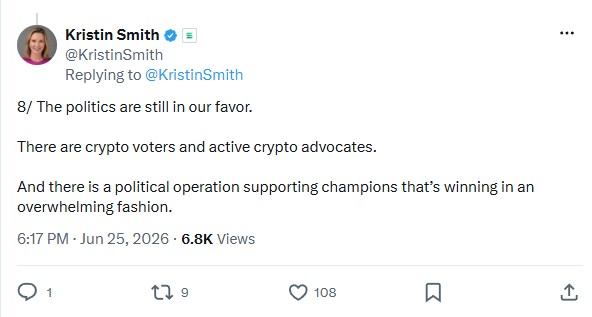
The crypto industry has spent years convincing Washington that it deserves a seat at the table. Now, as Congress inches toward passing the CLARITY Act, a long-awaited crypto market structure bill, it seems it finally has one.The question is no longer whether lawmakers are listening to digital asset advocates, but whether the crypto lobby’s deep pockets and influence in election campaigns will be enough to get the legislation over the line.That debate comes as Senate negotiators work toward a potential floor vote before Congress breaks for its August recess. In a June 25 thread on X, Kristin Smith, president of the Solana Policy Institute and former chief executive of the Blockchain Association, argued that crypto’s advocacy operation is “the strongest and most sophisticated it has ever been.”She pointed to bipartisan negotiations, daily meetings with lawmakers, and what she described as “a political operation supporting champions that’s winning in an overwhelming fashion” to illustrate her point.Kristin SmithSource: Kristin SmithAccording to a report from consumer advocacy organization Public Citizen, that “political operation” has spent $189 million so far to influence the 2026 midterm elections. Crypto’s opponents see the war chest as an illegitimate attempt to buy influence and votes, while the industry argues it’s a much-needed corrective to the anti-crypto forces that have dominated politics since 2022.Colin McLaren, the Solana Policy Institute’s head of government relations, told Cointelegraph the industry’s political infrastructure did not emerge overnight.“Fairshake, Cedar Innovation Foundation, Stand With Crypto, and the Blockchain Association built the political infrastructure that’s moving pro-crypto legislation forward,” he said.“These groups, alongside the advocacy of companies and projects, created and supported allies in Congress, giving them the resources and cover to legislate and lead without fear of electoral reprisal from the anti-crypto army.”The tide begins to turn on CLARITYThere are signs that momentum to pass the CLARITY Act is building.On July 3, the Major County Sheriffs of America (MCSA), a national association representing elected sheriffs from some of the largest counties in the US, announced that it had shifted from opposing the CLARITY Act to a neutral position following discussions over Section 604, also known as the Blockchain Regulatory Certainty Act. As Coinbase chief executive Brian Armstrong commented on X, that development is “huge.”Earlier that same day, the National Organization of Black Law Enforcement Executives (NOBLE) became the first major law enforcement body to endorse the bill.  But the BRCA, which includes protections for developers decentralized smart contracts, remains a sticking point. Four other attorneys and law enforcement groups representing 70,000 members between them, warned the Acting U.S. Attorney General in late June that the bill’s “broad exemptions could create gaps in oversight and accountability that sophisticated criminal actors may exploit.”So the race is far from won.MCSA letter to Senate Banking Leaders. Source: Eleanor TerrettRelated: Senate leaders push for July passage of CLARITY ActHow is the crypto lobby campaigning?Smith’s comments spotlight how closely the industry’s political organization has become intertwined with its legislative ambitions. No organization better exemplifies that shift than Fairshake, the crypto-backed political action committee (PAC), funded by companies like Coinbase, Ripple and Andreessen Horowitz. A PAC is an organization that raises and spends money to support or oppose political candidates and causes, and can pool contributions from multiple donors to fund campaign advertising and other political activity, subject to federal election rules. Political Action Committees (PACs). Source: Federal Election CommissionThroughout the 2026 US congressional primary election cycle, Fairshake and affiliated PACs have spent tens of millions of dollars supporting candidates in various races who are viewed as favorable to digital assets while opposing others seen as hostile to the sector.In May, affiliated PACs spent more than $20 million supporting candidates in Republican congressional primaries across Georgia, Alabama and Kentucky, including more than $7 million backing Rep. Andy Barr in Kentucky’s Senate primary. The group later expanded its efforts into Democratic contests, spending millions of dollars in Maryland and New York. Several crypto-backed candidates advanced in these states, further reinforcing Fairshake’s reputation as the industry’s most influential political organization.McLaren argued that the crypto’s lobby’s willingness to back candidates in competitive races is making a difference.“Adrian Boafo was polling behind the field in Maryland before the crypto industry’s ads ran. He won,” he said. “In Houston, the industry backed Christian Menefee, a young upstart challenging a sitting incumbent. He won. The industry supports its champions, even when that means taking risks.”Related: Democrat backed by Ripple co-founder’s PAC wins Colorado primaryFairshake spokesperson Geoff Vetter told Cointelegraph that election victories are only one measure of success.“Our goal is to increase the number of members who understand and are willing to act on these issues in good faith,” Vetter told Cointelegraph. “The difference we make will be creating the largest crypto-literate caucus in history, ready to act on responsible regulation.”But is Fairshake’s influence overstated?But how much of Fairshake’s influence stems from election outcomes themselves rather than simply the perception that it can shape them?In a June 30 analysis published by Brogan Law, journalist Veronica Irwin examined Fairshake’s involvement in 40 decided races during the current election cycle, comparing Federal Election Commission filings with polling data and election results.While Fairshake-backed candidates won in 38 of those contests, Irwin’s analysis found that many of those races already leaned heavily toward the eventual winner before the PAC entered the picture. Based on her methodology, only 16 races appeared to be genuinely competitive enough for Fairshake’s spending to have plausibly adjusted the outcome.How much difference does crypto money really make in elections? Source: Brogan LawThat’s still a considerable impact, and Irwin said her goal was never to argue that Fairshake lacked influence, but to show that its strategy is more sophisticated than many observers assume.“I was reading a lot of stories that were basically just the press release,” she told Cointelegraph. “That top-line narrative implies they are just buying up all of the elections outright and having these huge, huge wins. That kind of betrays the more complex strategy underlying it.”Rather than simply trying to swing every race, Irwin said Fairshake has the financial resources to “spray” campaign spending across a much wider range of contests than most PACs could afford.“They’re in this position where they have so much money that they can pursue these costly strategies,” she said.Her analysis raises the nuanced possibility that the organization’s greatest political strength may lie not in deciding elections outright, but in cultivating the belief that it can. Beyond campaign spendingCampaign spending alone does not always move legislation through Congress. The CLARITY Act’s progress also reflects months of negotiations involving lawmakers, industry groups and outside stakeholders. The MCSA’s shift to a neutral position shows that legislation still depends on coalition-building and compromise, particularly when addressing concerns around financial crime, consumer protection and law enforcement.“It is a combination of factors,” Ron Tarter, founder of self-custodial, multi-currency cryptocurrency wallet RockWallet and a former attorney, told Cointelegraph. “Adoption is the foundation… Lobbying translates that adoption into direct policy engagement… and campaign spending is the accelerant.”Irwin also argued that crypto’s political influence comes from more than campaign spending alone. “Crypto occupies this space where it matters a lot to you and me, but to the average voter it isn’t a top-five issue,” she told Cointelegraph.“That’s the sweet spot where lobbying and election influence can really flex their muscles… It’s pretty easy for a politician to switch to a more pro-crypto perspective without a lot of downside,” she said.“It’s this one-two punch between lobbying being really effective and the potential to raise a bunch of money if you side with crypto.”McLaren argued that campaign spending succeeded because it was built on a broader political strategy rather than replacing one.“Crypto didn’t come to Washington because it wanted to,” he said. “The industry played defense for years, then decided to meet the threat at the ballot box and build the apparatus to advocate for the clarity needed.”Magazine: Bitcoin’s quantum dilemma: Bigger blocks or STARK proofs?

Čítaj viac

Has Bitcoin bottomed for this cycle? Analysts say 'not yet'

Bitcoin is trading in a market that’s getting harder to define.Hovering around $64,000 at the time of writing, Bitcoin is down by almost 50% from its cycle peak. That’s a much shallower draw down than previous cycles, but the bull run this time around did not reach the same heights. The 2025 rally was driven by exchange-traded fund (ETF) inflows, post-halving momentum and renewed institutional demand, pushing the market to a new all-time high of more than $126,000 in October 2025.Since then, the trend has been inexorably downward, but analysts are split on what that decline signifies. According to Standard Chartered and other bullish institutional desks, Bitcoin may have already reached its cycle bottom last month, with structural demand from ETFs and treasury companies, and improving long-term capital flows reducing the likelihood of a deeper draw down. Other analysts take a more cautious approach, seeing Bitcoin as likely in the final stages of its bear market but not at a confirmed bottom yet. Bitcoin’s four-year cycles. Source: GalaxyGalaxy Research, for example, argued in June that traditional cycle signals have not fully reset, meaning the risk of further pain cannot be ruled out. Curiously, analysts are no longer just divided on price targets but on what a “cycle bottom” actually means in a market increasingly shaped by ETFs, macro liquidity, and shifting global capital flows.Some analysts still see further downside ahead At the most cautious end of the spectrum is Russell Thomson, chief investment officer at Hilbert Capital asset management firm.Speaking to Cointelegraph, Thomson said he believes Bitcoin remains in a downcycle and is likely to break below recent lows before forming a durable base. He said that the current structure is still dominated by global macro conditions and liquidity rather than crypto-native signals.Related: $60.4K Becomes ‘most important area’: Five things to know in Bitcoin this weekThomson expects Bitcoin to first revisit the $56,000-$52,000 range, representing summer 2024 lows, before potentially extending losses further to between $40,000 and $45,000, an area he associates with prior consolidation phases in the early 2024 market structure.Timing-wise, he sees Bitcoin’s broader cycle rhythm still broadly intact, with a potential low forming around October 2026, although he stressed that macro policy shifts could pull that forward.“Fed rate cuts and/or [the CLARITY Act] passing could put the bottom in earlier than that,” he said.He argued that institutional capital has not insulated Bitcoin from macro cycles, but rather deepened its sensitivity to global liquidity conditions, making it behave more like a “high-beta macro instrument” than a “detached crypto-native asset.” That view is echoed by analysts at Citibank, who cut their 12-month price target for Bitcoin to $82,000 from $112,000 on July 1, highlighting how Bitcoin’s growing integration into traditional financial markets has strengthened its correlation with risk assets and macro liquidity conditions rather than reducing volatility.Late-stage bear market, but not confirmed bottom yet A more positive but still cautious view comes from André Dragosch, head of research (Europe) at Bitwise.Dragosch told Cointelegraph that the current environment resembles a “late-stage bear market,” arguing that multiple indicators already suggest downside exhaustion.He noted that sentiment has deteriorated to levels last seen after the collapse of FTX in 2022, a period typically associated with seller fatigue.Dragosch also does not believe the cycle low has been confirmed. “I don’t think that we have seen the final bottom just yet, although we are probably very close,” he said, emphasizing that no single indicator can reliably identify a cycle bottom.Related: Dormant $1.9M Bitcoin tied to New York lawsuit moves after nearly 15 yearsHe also highlighted the structural shift in the market, pointing to the rise of ETFs and institutional participation, which have increased off-chain trading and reduced the reliability of some historical cycle indicators.Despite this uncertainty, he said downside risks appear increasingly limited at current levels, adding that Bitcoin could begin outperforming artificial intelligence equities over the coming months if macro conditions stabilize.Bitcoin price and its cycle bottoms. Source: GalaxyIn Galaxy’s base-case scenario, the firm pointed to a potential slide to between $40,000 and $46,000, depending on how liquidity and macro conditions evolve. ‘When will Bitcoin bottom?’ could be the wrong question A more structural interpretation comes from Dean Chen, an analyst at Bitunix Exchange.Chen told Cointelegraph that Bitcoin is still in a decline, but one increasingly defined by global liquidity competition rather than internal crypto market structure.“I believe Bitcoin remains in a down cycle, although it has entered a relatively stable valuation range supported by the structural capital base created after the approval of US spot Bitcoin ETFs in 2024,” Chen said.While ETFs have created a more persistent institutional bid, Chen argued that Bitcoin is now competing directly with other major global capital narratives, particularly artificial intelligence and equity markets, for marginal liquidity.Related: Tim Draper says Arkham got Bitcoin wallet attribution ‘wrong’“The bigger challenge isn’t Bitcoin itself; it’s the competition for global liquidity,” he said. “Capital continues to flow toward AI infrastructure, equities, and other high-growth opportunities.”In his view, this changes how cycle analysis should be understood altogether.“The wrong question is ‘when will Bitcoin bottom?’” Chen said. “The more important question is: ‘when will crypto once again become the most attractive destination for global risk capital?’”He noted that derivatives markets now play a significantly larger role in price discovery than in previous cycles, with funding rates and open interest increasingly driving short-term volatility.That means Bitcoin may not form a sharp V-shaped bottom at all, he said, but instead spend an extended period building a structural base.A Bitcoin cycle that no longer looks like previous cycles Beyond price targets, what emerges from these competing views is a deeper disagreement over how Bitcoin’s cycle structure should even be defined. Thompson sees Bitcoin as still firmly inside a macro-driven down cycle, where liquidity conditions have not yet fully turned.Dragosch sees a late-stage bear market where exhaustion signals are already visible, even if confirmation is still pending.Chen argues that Bitcoin is now competing directly with global capital allocation themes such as AI and equities, making traditional bottom-calling frameworks increasingly incomplete.In this cycle, it seems, the debate is not just about where Bitcoin bottoms but whether a “bottom” is still a single moment at all.Magazine: Bitcoin will not hit $1M by 2030, says veteran trader Peter Brandt

Čítaj viac

Získaj BONUS 8 € v Bitcoinoch

nakup bitcoin z karty

Registrácia Binance

Burza Binance

Aktuálne kurzy