Autor Cointelegraph by Charles Bennett

Bitcoin price steadies, ONDO rallies as US Treasury yields hit 2007 highs

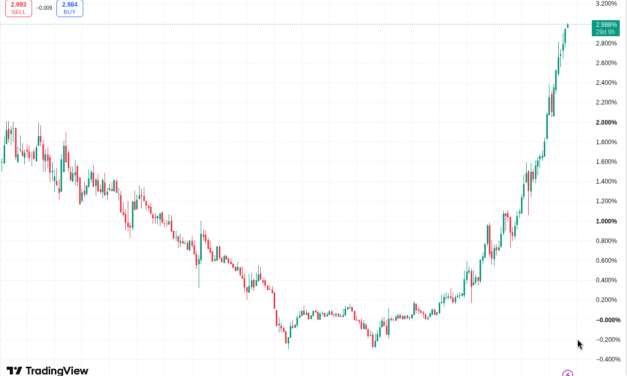
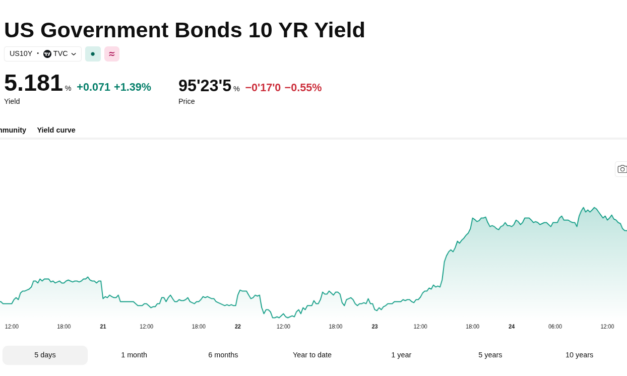
Bitcoin (BTC) had a volatile Thursday during US hours as the yield on the 10-year US Treasury note climbed to its highest level in nearly two decades. After briefly falling below $83,000, BTC struggled to reclaim $84,500. Ondo Finance (ONDO), meanwhile, was among the top-performing altcoins.Key points: Bitcoin briefly fell below $83,000 before stabilizing near $84,500 amid rising bond yields.Ondo’s token reclaims $0.50 for the first time since December 2025 as BlackRock-backed Ondo Intelligent Portfolios launch on Ethereum and BNB Chain.The US 10-year Treasury yield climbs to 5.18%, its highest since July 2007, while the 30-year yield reaches 5.46%.US 10-year Treasury gains 70 basis points this month, hits 5.18%The US 10-year Treasury yield rose more than 4 basis points to 5.18% on Thursday, its highest level since July 2007, according to TradingView data. The 30-year yield hit 5.46%, reclaiming 2004 highs.US 10-year note yield. Source: TradingViewThe climb came on the day the US Treasury was scheduled to buy back up to $6 billion in bonds maturing in roughly 20 to 30 years, part of an expanded program aimed at improving liquidity in long-dated debt markets.International bond markets also weakened, while the Japanese yen (JPY) came under renewed pressure. Mohamed A. El-Erian, president of Queen’s College Cambridge, wrote on X: “Flying under many radars for now, but probably not for long: The Japanese Yen has weakened back to 159 per U.S. dollar (CNBC chart), approaching the established FX intervention zone.”He continued: “This matters far beyond Japan for a key reason right now: Japanese foreign exchange intervention typically involves selling US securities to buy Yen, potentially adding yield pressures to an already sensitive Treasury market.”Higher yields make government bonds more attractive and can weigh on non-yielding assets such as Bitcoin. Even so, BTC has extended its August rally, challenging bearish predictions tied to Bitcoin’s traditional four-year cycle.ONDO token among top performers, reclaims $0.50 levelThe tokenized real-world asset (RWA) token ONDO was among the top gainers in the last 24 hours and rose back to the psychological $0.5 level, according to CoinGecko data. ONDO 1-year price chart. Source: CoinGeckoDespite the recent failure of the CLARITY Act to pass through a procedural vote in the US Senate, the token managed to reclaim a level last traded in December 2025. Related: CLARITY vote failure could stoke more crypto PAC spending in key racesThe rally came as BlackRock-backed Ondo Intelligent Portfolios launched on Thursday. While most RWA products focus on tokenizing individual stocks and commodities, the new offering allows non-US users to buy tokenized shares in diversified portfolios.The tokens went live on Ethereum and BNB Chain, with settlement handled through CoW Protocol, CoW DAO said on X. The first three tokens track model portfolio strategies developed by BlackRock for Ondo: BLKHIon (High Income), BLKDIGon (Diversified Growth) and BLKGRWon (High Growth).

Čítaj viac
Surprise nonfarm payrolls print sends Bitcoin back below 80K

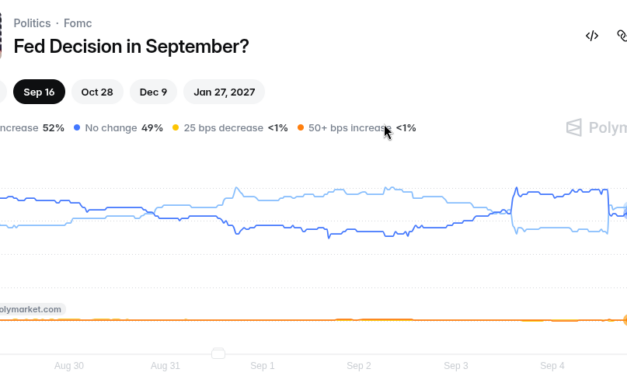
Key points:The US economy added 162,000 nonfarm payroll jobs in August, nearly triple economists’ consensus estimate of 56,000.Bitcoin sold off from $81,300 to local lows of $78,600 following the data, before recovering to $79,500.A rival Bitcoin fork using the Blake2b algorithm saw its first trading activity, with coins changing hands at $350 on exchange Neoxa.Labor market beats expectations threefoldAccording to data released on Friday, the US economy added 162,000 nonfarm payroll jobs in August, significantly outperforming economists’ consensus expectations of roughly 56,000 jobs. In response to the announcement, Bitcoin (BTC) sold off from $81,300 to local lows of $78,600. At the time of writing it stands at $79,500. Recent economic data carries added weight, given how divided rate outlooks remain ahead of the next Federal Open Market Committee (FOMC) meeting on Sept. 15-16. Under previous Federal Reserve chairs, expectations ahead of the FOMC were mostly well-anchored. However, the lack of forward guidance from Chair Kevin Warsh, along with potential dissenters in the committee, has resulted in added uncertainty. After Fed Governor Christopher Waller said on Thursday that he would favor a rate pause pending upcoming inflation data, Polymarket probabilities swung to 60% in favor of a pause and 40% for a 25 basis-point interest rate hike. Friday’s labor market data however, drove the implied probabilities back to a 50/50 split.Implied Probabilities for the Sep. 16 FOMC rate decision. Source: PolymarketIn response to the strong labor market data, US President Donald Trump leveled new rate-cut demands. “The Fed Board, with its great new leader, must get smart – BE PATRIOTS for a change,” he stated in a Truth Social post and continued: “High interest rates put the U.S.A. at a very unfair disadvantage, ⁠and I won’t allow that to happen!” Trump had frequently criticized former Chair Jerome Powell for not cutting rates, but had held back from making similar statements toward Warsh until Friday. Blake2b version of Bitcoin attracts first liquidityWhen the BIP-110 soft fork activated on Aug. 7, the Bitcoin network briefly split into two competing chains: one enforcing BIP-110’s new rules and another continuing under the existing rules. The BIP-110 side largely stalled because miners did not devote enough computing power to extending that chain.BIP-110 supporters viewed miners’ refusal to follow the user-activated soft fork (UASF) as evidence that Bitcoin’s mining layer has become too centralized. That criticism was sharpened by the absence of an organized counter-effort from the Bitcoin Core side, such as a user-rejected soft fork (URSF). Only five mining pools control the vast majority of Bitcoin’s hashrate, concentrating significant influence over which chain is extended and which transactions are included in blocks.Bitcoin Network Hashrate Distribution. Source: Blockchain.comIn response, a subset of BIP-110 supporters, led by LukeDashjr, decided to continue the BIP-110 chain with a change in the proof-of-work algorithm to Blake2b to allow for a new, more decentralized set of miners to emerge using DATUM gateway technology. The corresponding hard fork was initiated on Aug. 30. Every address that held SHA-256 Bitcoin before Aug. 7 (and possibly after) will hold an equivalent amount on the Blake2b version of Bitcoin. So far, the only exchange listing Blake2b Bitcoin is Neoxa. While liquidity remains thin, Blake2b coins are currently trading at $350 against USDC with a 1.1% spread. BTCB2/USDC orderbook. Source: Neoxa ExchangeRelated: Crypto Biz: AI took a back seat when Bitcoin started climbing

Čítaj viac

Bitcoin reclaims $80K as DXY falls amid continuing suspected yen intervention

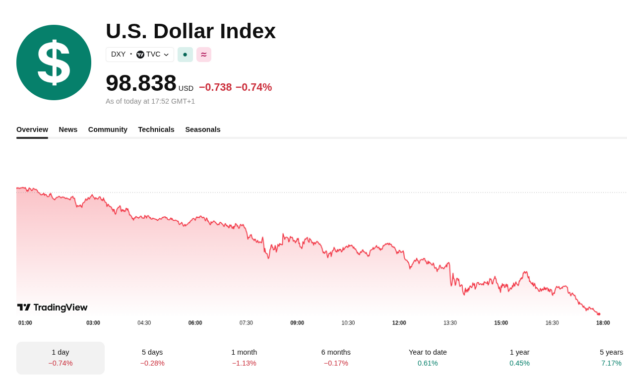
Bitcoin (BTC) rallied 5% during US trading hours, reaching $81,000. Key points: Bitcoin rallies above $81,000 in US trading, having risen more than 5% over the past 24 hours.USD/JPY drops to 155.4 amid suspected Bank of Japan (BOJ) intervention, dragging the US Dollar Index (DXY) down to 99.Polymarket odds for a BOJ rate hold collapse further from 12% to 1%, with a 98% probability now priced in for a 25-basis-point hike on Sept. 18.Weaker dollar drags crypto higherAt the time of writing, BTC stands at $81,000, near the highs seen during last month’s surprise upside. The move comes as the Japanese yen (JPY) continued to strengthen in a suspected central bank intervention, which Cointelegraph first reported on Wednesday. After dropping to 158.5 on Wednesday, the USD/JPY pair saw further downside to 155.4. This put pressure on the DXY, which fell to 99. Downside in the DXY has historically been positive for Bitcoin. US Dollar Index 1-day chart. Source: TradingViewShares of Michael Saylor’s Strategy (MSTR) participated in the rally and rose 8.6% on Wednesday. The stock is up 70% from its lows in late June, but still down roughly 10% year-to-date. Strategy’s perpetual preferred stock STRC, which had been frequently compared to a money market fund, is still trading below its par value of $100 and remains stuck at $97.80 at the time of writing. Related: Strategy turns 1,690 BTC into $108.6M STRC buybackAnalysts divided on impact of yen interventionThe latest suspected intervention to support the yen, coupled with the prospect of a Bank of Japan rate hike later this month, has also revived fears of another carry-trade unwind. “In the last 24 hours, USD/JPY has dropped almost 2.5%, which doesn’t happen without any major intervention,” The Macro Paper commented on X. “On top of that, BOJ is most likely expected to hike rates this month, with more rate hikes possible in Q4. This is the exact thing that happened in Q3 2024, when BOJ intervened and hiked rates together.”The Polymarket probabilities for a BOJ rate hold dropped from 12% to 1% Wednesday, cementing the prospect of a rate hike. The current market-implied probability of a 25-basis-point hike at the BOJ’s Sept. 18 meeting is 98%.Polymarket probabilities for BOJ rate decision on Sept 18. Source: PolymarketSome have also seen the currency intervention as liquidity-positive. Arthur Hayes, CIO of Maelstrom, has long held that the Foreign and International Monetary Authorities’ (FIMA) repo facility will provide Japan with dollar liquidity against Treasury collateral, easing global liquidity conditions. While no funds appear to have been drawn from this facility so far, Treasury Secretary Scott Bessent raised the prospect in late July.

Čítaj viac

Bitcoin’s apparent demand turns negative as price struggles with $77K

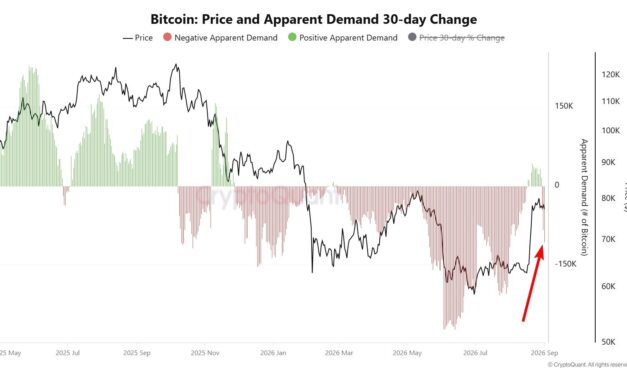
Bitcoin (BTC) sold off into the early European trading hours on Wednesday to hit local lows of $76,400, per data from CoinGecko.Key points: Bitcoin’s apparent demand indicator turns negative again, with BTC price dropping to a local low of $76,400 before reclaiming $77,000.USD/JPY drops sharply to 158.5, sparking speculation that another yen intervention has taken place.Asian equities sell off sharply as South Korea’s KOSPI falls 4.0% to 6,562.72 and Japan’s Nikkei 225 drops 2.9% to 64,325.64.Bitcoin’s apparent demand flips negative againThe move in BTC came after US spot Bitcoin exchange-traded funds (ETFs) recorded outflows of $236 million the day prior. Data from CryptoQuant now shows Bitcoin’s apparent demand turning negative once more after a brief reprieve during the August rally. Bitcoin price and apparent demand, 30-day change. Source: CryptoQuantThe indicator is inspired by similar metrics from commodity markets and measures the difference between newly mined issuance and changes in inactive supply. Positive demand implies that old coins are waking up and the market is absorbing them along with new issuance. This is taken to be a sign of active spot demand. Negative readings mean coins are aging into dormancy faster than miners issue them. At the time of writing, BTC has reclaimed $77,000, but remains pinned under a cluster of resistance that we have previously reported on. Bonds and Asian equities sell offThe global bond rout that Cointelegraph reported on Monday eased slightly as the US 10-year yield briefly dipped below 4.8%. There was inorganic price action in the USD/JPY pair at 13:00 UTC, which commentators widely took as a sign of another central bank intervention. USD/JPY declined to 158.5, retreating from the psychological 160 level widely seen as a line the Bank of Japan (BOJ) will defend. At the time of writing, no official announcement on the matter has been made. USD/JPY trading pair one-day chart. Source: TradingViewAsian equities, meanwhile, suffered steep declines, likely driven by soaring oil prices and further profit-taking in the AI sector. South Korea’s KOSPI led the decline, falling 4.0% to close at 6,562.72 as chipmakers SK Hynix and Samsung Electronics shed 4% and 4.7%, respectively.Related: Bitcoin lows pierce $63K as Asia chip-stock crash spreads to Wall StreetJapan’s Nikkei 225 fell 2.9% to 64,325.64, dragged down by tech heavyweights including SoftBank Group, an OpenAI investor. Taiwan’s TAIEX rounded out the losses with a 1.7% drop. Back in July, Cointelegraph reported on the first cracks beginning to show on the US side of the AI trade, as credit spreads on hyperscalers rose significantly. 

Čítaj viac

Bitcoin stays flat as global bond bear market rages on, pushing JGB to high

Japan’s JGB yield now at 30-year high Global long-term bond yields are now at the highest level since the 2008 financial crisis as major long-dated sovereign bonds continued to sell off into trading on Tuesday.The sell off comes only days after US Treasury Secretary Scott Bessent made headlines by announcing that the maximum size of debt buyback transactions would be increased to $4 billion from September.  While the Treasury does not conduct monetary policy, some commentators have compared this to a form of yield curve control. This has brought the debasement narrative, keenly followed by Bitcoin and precious metal investors, back into the spotlight. Japan’s 10-year government bond yield surged to 3% for the first time since 1996 on Tuesday, while the 30-year JGB yield topped a record 4.18%. The 10-year US bond yield also surged to a new multi-year high and stands at 4.78% at the time of writing. 10-Year Japanese government bond. Source: TradingView Officials in both countries face a mutual bind with respect to the Japanese yen: Tokyo can neither raise policy rates without incurring an operating loss that ultimately hits the Finance ministry, nor repatriate capital without divesting the Treasury securities on which Washington’s financing depends.Industry commentators such as Arthur Hayes have argued for years that the Fed will eventually use its Foreign and International Monetary Authorities (FIMA) repo facility. Through this swap line, Japan’s Finance ministry could borrow dollars against its Treasury holdings and sell them for yen, strengthening the currency without causing an imminent sovereign bond crisis. This mechanism would create new dollar liquidity, which is why Hayes recommends positioning in Bitcoin (BTC), gold and crypto. Treasury Secretary Scott Bessent hinted at the future use of the FIMA facility in August.Rising long-term yields may be the first sign that Hayes’s scenario is being priced in. Robin Brooks, senior fellow at the Brookings Institution commented on X: “For the past two years, Japan has been in a “Liz Truss” bond market crisis whereby its currency falls even as government bond yields go ever higher. We’ve never had a major G10 sovereign experience something like this and it’s deeply destabilizing…”10-year interest swap rate and trade-weighted JPY. Source: Robin Brooks on X.comBitcoin continues sideways movementIn the face of Tuesday’s bond sell-off, Bitcoin has been trading sideways near the $78,000 mark, following a minor corrective decline from its morning high close to $79,000. Cointelegraph previously reported on a thick patch of resistance between the current spot price and $86,000. This has slowed Bitcoin’s upside momentum despite positive news and renewed interest in the debasement trade. Related: Bitcoin faces true demand test above $83K as liquidity thickens: GlassnodeOverall sentiment across recent reports remains mixed to cautiously optimistic in the short term after the strong August recovery, with the $76,000-$82,000 range as the key battleground for the coming weeks.S&P 500 index futures sold off by 0.3% on Tuesday and the gauge now hovers around 7,660, the lowest level since Aug. 4. This comes as tensions in the Iran war flare up once more. Oil prices rose more than 2%, with WTI around $88 per barrel and Brent above $92, fueled by renewed US-Iran fighting, including strikes, tanker incidents in the Strait of Hormuz, and comments from President Donald Trump.S&P 500 out-of-hours futures. Source: X.com

Čítaj viac
  • 1
  • 2

Získaj BONUS 8 € v Bitcoinoch

nakup bitcoin z karty

Registrácia Binance

Burza Binance

Aktuálne kurzy