Autor Cointelegraph By Brian Quarmby

Few calls to 'Buy The Dip'… but uber-rich Family Offices are keen on crypto

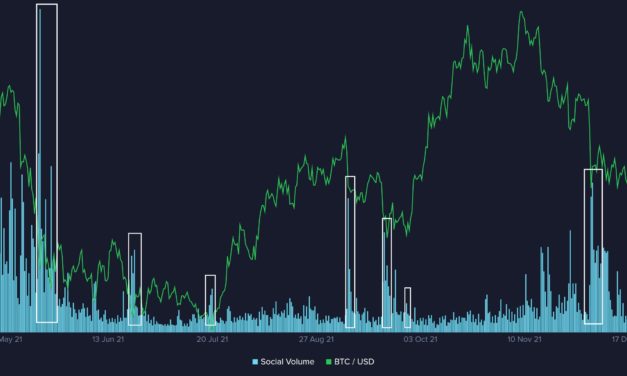
Short term social media data suggests that traders aren’t calling for buying the Bitcoin (BTC) dip right now… but the long term picture is much brighter, with separate research showing that 77% of family offices in the U.S. are either looking at, or have invested in crypto. The BTFD data was compiled from posts mentioning “buy the dip” on social media platforms such as Twitter, Reddit, Discord and Telegram by K J Lanaul and published on the Insights Santiment blog earlier this week. It tells a positive story too, in a roundabout way.The research indicated that many traders over the past year have called for buying the dip too early on a downward trend, with the price often falling significantly further afterward and failing to recover for months at a time.“Often the crowd unanimously call the dip/bottom earlier than the actual dip and the real bottoms forms when the crowd least expects which is represented by low to no mentions in Buy The Dip. As of now the mentions are very low.”For example, during mid-May, last year after the price of BTC started to crash in response to China’s Bitcoin mining ban and Elon Musk-related FUD, roughly 68,000 traders online mentioned buying the dip as BTC dropped to around $44,000. The bottom however, did not materialize until late July when BTC tagged roughly $29,000. “The pattern that we have recognized is a 3 wave of Buy the Dip mentions during the downtrend each lower than the previous one and after 3 waves the bottom occurs before the market recovers,” Lanaul wrote. Buy the Dip social volume x BTC price: Insights SantimentCrypto for the familyWhile prices fluctuate short term, long term growth in crypto seems inevitable as more high net worth individuals and families back the sector. According to the latest edition of BNY Mellon’s Global Family Office survey, 77% of family offices are either active in crypto, or are looking at investing in the sector in near future. Family offices are private firms that manage investments on the behalf of high-net-worth individuals or families. BNY Mellon is an investment banking giant that also provides services in the family office market. Related: Hedge fund report says Bitcoin price is ‘at a relatively inexpensive place’The survey polled 200 participants consisting of 144 multi-family offices and 56 single-family offices who all manage more than $150 million worth of assets each. Out of the large cohort who were keen on or active in crypto, 72% of them reported intentions to increase crypto exposure over the next 12-24 months. Notably, the poll also found that 64% of multi-family offices were actively investing in crypto, compared to 36% of single-family offices. In terms of crypto exposure methods, 58% of respondents stated that they preferred exchange-traded funds (ETFs), while 42% indicated a preference for direct ownership and custody.

Čítaj viac

$89M flows into Bitcoin funds despite looming conflict, but ETH funds are negative

Amid a marketwide downturn across major crypto assets over the past week, institutional traders tipped almost $89 million into Bitcoin (BTC) funds. However, the money men failed to ba Ethereum (ETH) investment products, which saw outflows totaling $15.2 million. Despite Cointelegraph reporting earlier this week that activity on the Bitcoin network was down 30% since its ATH levels three months ago, digital gold appears to be the asset of choice for sophisticated investors of late. According to CoinShares’ Feb. 22 “Digital Asset Fund Flows Weekly” report, BTC funds have now pulled in a total of $178.3 million this month following the latest $89 million influx between Feb. 14 and Feb. 18. In comparison, Ether investment products offering have now seen total outflows of $2.6 million in February so far, and have only generated inflows in one of the past 11 weeks. Over the past seven days, the price of BTC has dipped 14.6% to sit at roughly $38,000, while Ether has dropped 16.2% to $2,668 at the time of writing. Other top assets such as Cardano (ADA), Solana (SOL) and Ripple (XRP) have also suffered double-digit losses. CoinShares noted that despite “price weakness and perceived negative impact from the looming conflict in Eastern Europe,” digital asset investment products in general saw inflows totaling $109 last week. Outside of Bitcoin’s dominance, institutional traders also snapped up $25 million worth of investment products tied to Ethereum competitor Avalanche, while multi-asset and Solana funds also saw notable inflows of $9.4 million and $1.2 million each. “Following the run of outflows in January, the latest data marks the 5th week of inflows. While inflows were seen in both Europe and the Americas, it was predominantly the latter with inflows totaling US$101M.”Related: Bitcoin price could ‘probe lower’ as volumes dip and macroeconomic issues loom overheadIn terms of the institutional asset managers and fund providers, CoinShares XBT fund shed $21.6 million, while Purpose and ProShares saw inflows of $63.2 million and $26.6 million respectively.

Čítaj viac

Swiss index provider launches new product tracking 10 DeFi tokens

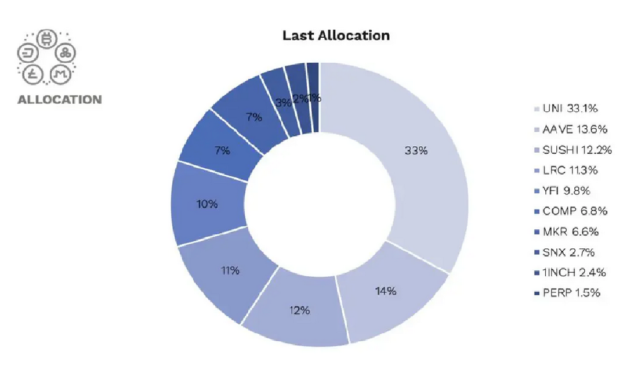
Switzerland-based fund manager Compass Financial Technologies has launched an index for 10 Decentralized Finance (DeFi) tokens dubbed the “Compass Crypto Basket Fundamental DeFi Index” (CCBFDEFI).The firm was founded in 2017 and offers indices and services tailored to crypto, commodities, multi-assets and real estate. It manages around $5 billion worth of investment products related to its indices. The CCBFDEFI went live on Feb. 22 and it provides institutional exposure to a group of 10 DeFi tokens that are individually weighted based on “ liquidity, market capitalization and protocol revenue metrics” and on-chain data. The max weighting for any given token is capped at 35% and the group of assets is selected each month. The firm has listed more than 20 approved tokens that can be used as the components for the Index each month such as UniSwap (UNI) Compound (COMP) Aave (AAVE) and SushiSwap (SUSHI). DeFi token allocation, CCBFDEFI Index: Compass Financial TechnologiesCompass Financial Technologies CEO Guillaume Le Fur emphasized the institutional appetite for crypto exposure is “growing significantly” as firms seek out ways to invest in the sector in a compliant manner: “Incorporating fundamental metrics in index creation offers investors the possibility to allocate in the most efficient DeFi tokens based on rational economic indicators.”The CCBFDEFI is live on the firm’s website along with Bloomberg and Refinitiv and is compliant with EU Benchmark Regulations (EU BMR). The product is also available for use under a license agreement with Compass Financial Technologies.Related: Automated order books eliminate DeFi costs and match CEX capabilityCompass Financial Technologies also partnered with top crypto fund manager CoinShares in late January to provide its indices for reference prices as part of CoinShares Physical Exchange-traded products (ETPs) which take zero management fees and offer staking rewards.Thanks to the @CoinSharesCo team for choosing our EU BMR-compliant Compass Crypto Reference Indices as reference prices for their Coinshares Physical ETPs including for the new CoinShares Physical Staked Tezos and CoinShares Physical Staked Polkadot ETPs. https://t.co/v3QgMxLLg0— COMPASS Financial Technologies (@CompassFT) January 26, 2022In April last year, the firm launched a suite of EU BMR compliant crypto indices that covered areas ranging from reference prices to smart-risk control and volatility targets.

Čítaj viac

Tether slashes commercial paper by 21% in latest reserves attestation

USDT stablecoin issuer Tether cut its reserves allocation to commercial paper by more than one fifth between September and December last year, dropping from around $30.5 billion to $24.16 billion. Tether is legally required to disclose its reserves every quarter as part of an $18.5 million court settlement with the Office of the New York Attorney General from February 2021. The firm was alleged to have misrepresented the specific amount of fiat backing USDT in 2017 and 2018. The latest attestation was conducted by Cayman Islands-based Accountants MHA Cayman and provides a breakdown of Tether’s reserves as of 31 December 2021.The report states that Tether’s “consolidated assets exceed its consolidated liabilities,” however the difference is minimal with total assets tallied $78.67 billion while liabilities sat at around $78.53 billion. Tether’s Latest Assurance Opinion Reveals That Reserves Held Exceeds Liabilities ⬇️https://t.co/QXQEQ0go0F— Tether (@Tether_to) February 22, 2022The makeup of Tether’s reserves shifted significantly since its prior report from late September, with cash and bank deposits dropping 42% to 4.187 billion, while its allocation to money market funds increased 200% to $3 billion, and its treasury bills also grew 77.6% to $34.52 billion. The significant amount of commercial paper backing Tether’s reserves — which hit 65.39% as of May 2021 — sparked criticism from onlookers who have questioned the lack of transparency regarding the origins of the paper and its credibility as an investment. There were also concerns last year Tether may be exposed to the Evergrande crisis via commercial paper holdings, although Tether said this was not the case.Commercial paper is often issued by large corporations and is used for financing payroll and short term-liabilities. It is referred to as unsecured debt as it is usually not backed by any form of collateral. Tether’s attestation states that $13.93 billion worth of its commercial paper has a maturation window of 0-90 days, $9.94 billion has 91-180 days and $823 million has between 181 and 365 days. Any commercial paper with a maturation period longer than 270 days (nine months) must be registered with the U.S. Securities and Exchange Commission (SEC). Related: Circle’s USDC stablecoin gobbles Tether’s market share with 50B milestoneAccording to data from Coingecko, USDT’s market cap sits at $79.47 billion at the time of writing, with its biggest competitor USD Coin (USDC) sitting at around $52.7 billion.

Čítaj viac

JPMorgan unveils research on quantum resistant blockchain network

U.S. banking giant JPMorgan Chase has unveiled research on a Quantum Key Distribution (QKD) blockchain network that is resistant to quantum computing attacks.QKD utilizes quantum mechanics and cryptography to enable two parties to exchange secure data and detect and defend against third parties that are attempting to eavesdrop on the exchange. The technology is seen as a viable defense against potential blockchain hacks that could be conducted by quantum computers in the future. According to a Feb.17 announcement, JPMorgan collaborated with Toshiba and Ciena to deploy and test the QKD blockchain. “At this time, QKD is the only solution that has been mathematically proven to defend against a potential quantum computing-based attack, with security guarantees based on the laws of quantum physics,” the announcement read. The study was conducted for use in metropolitan areas and had notable results such as being “capable of supporting 800 Gbps data rates for mission-critical applications under real-world environmental conditions.” “The proof of concept network infrastructure relied on Toshiba’s Multiplexed QKD System, manufactured by Toshiba Europe at their Cambridge UK base, and Ciena’s Waveserver 5 platform, equipped with 800 Gbps optical-layer encryption and open APIs running over Ciena’s 6500 photonic solution.” the announcement read. Related:  JPMorgan estimates ‘fair value’ of Bitcoin at $38KMarco Pistoia, engineer, and head of the FLARE Research group at JPMorgan Chase emphasized the significance of developing secure blockchain infrastructure before quantum computing hits the market: “This work comes at an important time as we continue to prepare for the introduction of production-quality quantum computers, which will change the security landscape of technologies like blockchain and cryptocurrency in the foreseeable future.”JPMorgan has been ramping up its blockchain initiatives of late, with Cointelegraph reporting earlier this week that the firm became the first bank to officially launch in the Metaverse. It now has a virtual lounge in the popular crypto-backed virtual world Decentraland and appears bullish on the Metaverse sector after it labeled it as a $1-trillion opportunity.

Čítaj viac

Získaj BONUS 8 € v Bitcoinoch

nakup bitcoin z karty

Registrácia Binance

Burza Binance

Aktuálne kurzy