Autor Cointelegraph By Brian Quarmby

Australian competition regulator takes Meta to court over fake crypto ads

The Australian Competition and Consumer Commission (ACCC) is taking Meta Platforms, Inc. (formerly Facebook) to the Federal Court, alleging that the firm and its Irish branch engaged in “false, misleading or deceptive conduct” by publishing scam celebrity crypto ads.Some users have lost hundreds of thousands of dollars to the sophisticated and long running scams tied to the ad.The spotlight on Meta has heated up in Australia since the start of February, with Cointelegraph previously reporting that the ACCC was investigating the firm over allegedly fraudulent crypto ads. Aussie mining billionaire Andrew Forrest also took legal action against the company for hosting ads that allegedly used his name to defraud victims.In an announcement posted earlier today, the ACCC asserted that Meta “aided and abetted or was knowingly concerned in false or misleading conduct and representations by the advertisers.”The ACCC highlighted unapproved or endorsed “scam” ads featuring prominent Australian figures such as entrepreneur Dick Smith, TV host David Koch and former NSW premier Mike Baird. The regulator stated that the ads contained dubious links which directed users off Facebook to a fake media article that featured quotes attributed to the public figure supposedly endorsing a “cryptocurrency or money-making scheme.” “Users were then invited to sign up and were subsequently contacted by scammers who used high-pressure tactics, such as repeated phone calls, to convince users to deposit funds into the fake schemes,” the announcement read. ACCC Chair Rod Sims didn’t mince his words as he asserted that, “Meta is responsible for these ads that it publishes on its platform” and that company the stood to gain financially by failing to remove them:“It is a key part of Meta’s business to enable advertisers to target users who are most likely to click on the link in an ad to visit the ad’s landing page, using Facebook algorithms. Those visits to landing pages from ads generate substantial revenue for Facebook.”“In one shocking instance, we are aware of a consumer who lost more than $650,000 due to one of these scams being falsely advertised as an investment opportunity on Facebook. This is disgraceful,” he added.Related: Instagram is adding NFTs soon, says Mark ZuckerbergThe ACCC is arguing that the firm’s conduct has breached the Australian Consumer Law (ACL) or the Australian Securities and Investments Commission Act (ASIC Act), and is seeking “declarations, injunctions, penalties, costs and other orders.”

Čítaj viac

Coinbase Wallet adds support for Solana

Top U.S. crypto exchange Coinbase has added wallet support for Solana (SOL) and its ecosystem of Solana tokens (SPL). Coinbase cited the surging interest in Solana over the past 12 months as investors look for low-cost alternatives to Ethereum as a key reason behind adding support to the network.The expanded wallet support comes just a few days after the firm launched Coinbase Pay, which enables users to fund their wallets directly via a web browser extension. In a March 18 blog post announcing the move, the firm also loosely outlined plans to “further integrate” with Solana by connecting the Coinbase Wallet with decentralized applications (dApps) and NFTs hosted on the network, which is famously championed by FTX CEO Sam Bankman-Fried. Users of Solana-based wallets such as Phantom and Solflare can now import their existing wallets into the Coinbase Wallet via a desktop browser extension as well. Following the addition of the Solana network, the Coinbase Wallet now supports Ethereum, Avalanche, Polygon, BNB Chain, Bitcoin, Dogecoin Litecoin, Stellar Lumens and the Ripple network. Coinbase said:“Many users have been looking for networks that are optimized for scale, offering low-cost transactions and fast transaction times. One of the fastest-growing blockchains over the past year has been Solana.”According to data from Defi Llama, the Solana blockchain is currently ranked fifth in terms of total value locked (TVL) in decentralized finance (DeFi) protocols at $6.94 billion. NFT data aggregator CryptoSlam ranked it as the second-highest blockchain for secondary sales volume last month at $156.28 million. Related: What is Solana (SOL) Pay, and how does it work?Much like the majority of the crypto market which has had a torrid performance this year, the price of SOL is down 18% over the past 30 days to sit at $85.90 at the time of writing. In the short term, Cointelegraph’s Rakesh Upadhyay has identified a bullish target of $122 for SOL if the price breaks above the 20 day moving average of $86, or the bearish figure of $66 if the market fails to support and hold above that zone.

Čítaj viac

GameStop looks toward NFT marketplace launch after big Q4 loss

Much loved retail video game store chain GameStop (GME) is looking ahead to its long-awaited NFT marketplace and Web3 gaming unit after suffering a net loss of $147.5 million during Q4 2021 GameStop quietly built a barebones NFT website in mid-2021 but has significantly ramped up efforts this year after unveiling an NFT and Web3 gaming division in January along with penning a major partnership with Ethereum (ETH) scaling solution Immutable X the following month to build an NFT marketplace. As part of the Q4 results — ending on January 29 and published on March 17 — GameStop revealed that it intends to launch its NFT marketplace by the end of Q2 2022.$GME will reportedly open their NFT marketplace at the end of their second quarter 2022.SHARE THIS ASAP! #GME #gamestop #stocks #news pic.twitter.com/CW2oDPHul1— carlostrades (@rockstar_stocks) March 17, 2022The firm also highlighted that the Immutable X deal is set to fetch the firm $150 million worth of IMX tokens upon the “achievement of certain milestones,” and noted that it has hired “dozens of additional individuals with experience in areas such as blockchain gaming, e-commerce and technology, product refurbishment and operations.”GameStop’s net loss of $147.5 million is 83% worse than the year prior, while its loss of $1.94 per share sits well outside of Wall Street’s estimates of $0.84 earnings per share. The price of GME appears to have been significantly impacted by the publishing of GameStop’s Q4 financials, with the price dropping 7.31% sit at around $81.29 at the time of writing. GME has, been on a strong downward trend this year despite positive developments in its Web3 initiatives, with the price dropping more than 40% since the start of January. Related: ApeCoin announcement surges BAYC floor price to near-ATH before correctionDiving into the report a bit further, GameStop posted $2.254 billion worth of sales last quarter, a slight increase on the $2.122 billion a year prior. A major hindrance on the latest figure was the $1.87 billion cost of sales, while selling, general and administrative expenses totaled $538.9 million. The firm was able to raise more than $1.67 billion in capital which was enough to eliminate “all of the Company’s long-term debt, other than a $44.6 million low-interest, unsecured term loan associated with the French government’s response to COVID-19.” Despite a bearish trend in the NFT market over the past couple of months, GameStop’s partner Immutable X has gone from strength to strength, the firm announced a $200 million Series C funding round at a $2 billion valuation on March 8, which sent the price of IMX surging roughly 50% within 24 hours to around $1.78. Since then the price has retraced to around $1.54.

Čítaj viac

Bank of Canada collaborating with MIT on CBDC research

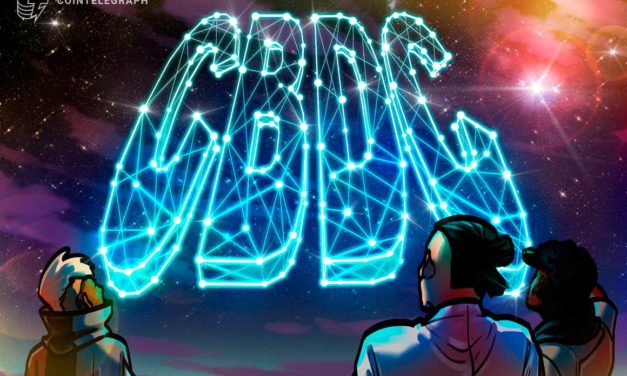
The Bank of Canada has partnered with the Massachusetts Institute of Technology (MIT) to work on a 12 month research project focused on the design of a Central Bank Digital Currency. According to a March 16 announcement, the bank will work alongside the MIT Media Labs’ Digital Currency Initiative (DCI) team to examine how “advanced technologies could affect the potential design of a CBDC.” The Bank of Canada stated that the project is part of a broader development agenda on digital currencies, fintech and how CBDCs could work in a Canadian context. It cautions that “no decision has been made on whether to introduce a CBDC in Canada,” but said it would provide an update once the research project has been completed. This is not the MIT DCI’s first partnership with a bank for CBDC research, with Cointelegraph reporting earlier at the start of February that it had published research on the topic in collaboration with The Federal Reserve Bank of Boston. Dubbed “Project Hamilton,” it tested a “hypothetical general purpose CBDC” using two potential models, including distributed ledger technology (DLT) and processing transactions in parallel on multiple computers, rather than relying on a single ordering server to prevent double-spending. CBDCs — memorably described by Asset Strategies International president Rich Checkan as being “concocted in hell by Satan himself” andwith Edward Snowden warning about the implications for privacy and freedom — have been grabbing the headlines of late. In terms of the U.S. President Joe Biden’s Executive Order on Ensuring Responsible Development of Digital Assets outlines that his administration will place “the highest urgency on research and development efforts into the potential design and deployment options” of U.S.-based CBDC. Related: Blockchain Association policy head: US shouldn’t compete with China’s CBDC using surveillance toolsThe Executive Order also directs the Secretary of the Treasury and other relevant officials to produce a research report on a local CBDC, while the attorney general has also been tasked with leading an effort to “to assess any necessary legislative changes” required for a CBDC and to promptly develop a legislative proposal afterward.

Čítaj viac

‘We’re already buying’: Terra founder plans to obtain $10B BTC for reserves

The founder of Terraform Labs (TFL) and Ethereum competitor Terra (LUNA) Do Kwon has outlined plans to accumulate a whopping $10 billion worth of Bitcoin (BTC) to add to the project’s stablecoin reserves. Terra is a decentralized blockchain platform that specializes in stablecoin minting. Its Terra USD (UST) is an algorithmic stablecoin pegged to the value of the U.S. dollar, with the USD value partly maintained via an equivalent amount of its native token LUNA. Specific details are sparse at this stage, however Kwon noted via Twitter on March 14 that Terra will not sell its native asset LUNA to build its reserves, and that more information is coming soon. Kwon also bullishly emphasized that its stablecoin TerraUSD (UST) backed by $10 billion plus in BTC reserves will “open a new monetary era of the Bitcoin standard.”“P2P electronic cash that is easier to spend and more attractive to hold” he added. $UST with $10B+ in $BTC reserves will open a new monetary era of the Bitcoin standard. P2P electronic cash that is easier to spend and more attractive to hold #btc— Do Kwon (@stablekwon) March 14, 2022Cointelegraph reached out to Kwon to see if the plans were already in motion, or it was just an idea being floated at this stage, and the founder simply responded: “I don’t understand the distinction, We’re already buying Bitcoin.”When users on Twitter asked Kwon what the BTC reserves will be used for, he responded that the funds will be used to backstop short-term UST redemptions and for a decentralized forex reserve.In a tweet shortly after, Kwon also noted that: “We start buying BTC and Twitter verifies me, I see you Jack,” in a nod to Jack Dorsey, who is a Bitcoin bull and former CEO of Twitter. Related: LUNA flips Ethereum, becoming second-largest network for staked valueThis is the second time this month Kwon has outlined plans to fortify the reserves backing Terra’s stablecoin. After TFL donated 12 million LUNA to the Luna Foundation Guard LFG on Friday (worth around $1 billion at current prices) to support growth of the Terra ecosystem and the sustainability of its stablecoins, Kwon outlined that the project will keep “growing reserves until it becomes mathematically impossible for idiots to claim de-peg risk for UST.”According to data from Coingecko, the marketcap of UST currently sits at $15.12 billion.

Čítaj viac

Získaj BONUS 8 € v Bitcoinoch

nakup bitcoin z karty

Registrácia Binance

Burza Binance

Aktuálne kurzy