Autor Cointelegraph By Brian Quarmby

Crypto industry fires back after EU vote to block ‘unhosted’ wallets

The crypto industry has reacted strongly against a European Union Parliament committee voting in favor of a regulatory package for tighter Know Your Customer (KYC) and Anti-Money Laundering (AML) rules for ”unhosted” private wallets. The new guidelines would require crypto service providers — most common exchanges — to verify the identity of every individual behind an unhosted wallet that interacts with them, while any transaction greater than 1,000 euros, or $1,100, would need to be reported to authorities. Coinbase CEO Brian Armstrong vented his frustrations against the move via Twitter, drawing comparisons with fiat to highlight the absurdity of reporting and verifying a 1,000 euro transaction: “Imagine if the EU required your bank to report you to the authorities every time you paid your rent merely because the transaction was over 1,000 euros. Or if you sent money to your cousin to help with groceries, the EU required your bank to collect and verify private information about your cousin before allowing you to send the funds.”“How could the bank even comply? The banks would push back. That’s what we are doing now,” he added.8/ This eviscerates all of the EU’s work to be a global leader in privacy law and policy. It also disproportionately punishes crypto holders and erodes their individual rights in deeply concerning ways. It’s bad policy. Act now here: https://t.co/b3Ll3xXiW4— Brian Armstrong – barmstrong.eth (@brian_armstrong) March 30, 2022The proposal was part of an amendment to the Transfer of Funds Regulation that was voted through by the Economic and Monetary Affairs (ECON) and Committee on Civil Liberties, Justice and Home Affairs (LIBE) on Thursday. For the new rules to be enacted, they must be passed via trialogue negotiations between the EU Parliament, European Council and the European Commission and if they remain unopposed, it would give the crypto industry nine to 18 months to come in full compliance with the legislation. The chairman and CEO Pascal Gauthier of digital wallet firm Ledger didn’t mince his words either, stating that the “EU Parliament chose fear over freedom:”“A new regulation was just voted on that paves the way for a massive surveillance regime over Europe‘s financial landscape.”Today, the EU Parliament chose fear over freedom. A new regulation was just voted on that paves the way for a massive surveillance regime over Europe’s financial landscape. #thread to understand what lies before us. #Crypto #Bitcoin #blockchain— Pascal Gauthier (@_pgauthier) March 31, 2022

The regulatory news appears to have had a significant impact on the price of Bitcoin (BTC), with the asset’s price declining 4.5% over the past 24 hours to sit at $45,243 at the time of writing. Ether (ETH) is also down 3.7% to $3,282 within that time frame. European decentralized finance (DeFi) firm Unstoppable Finance lamented the news, expressing hopes that proposals will get shot down in the upcoming negotiations. “The amendments are a huge setback for crypto in the EU & should be repealed in the trilogues,” the firm stated. Today, the EU Parliament voted in favor of measures that raise significant concerns for both individuals and the crypto ecosystem. If ultimately approved, these new measures will create fundamental issues for privacy, innovation, and access. Full statement below. pic.twitter.com/kjaeWxftz5— Crypto Council for Innovation (@crypto_council) March 31, 2022

Related: European ‘MiCA’ regulation on digital assets: Where do we stand?Unstoppable Finance’s head of strategy and business development Patrick Hansen also took to Twitter to vent his anger, calling the proposals a “big disappointment and a big threat to individual privacy.”“It introduces unfeasible wallet verification requirements and unjustifiable reporting requirements for crypto companies that would have massively detrimental effects for EU citizens and companies alike.”He noted it would be difficult, if not impossible, for crypto service providers to verify an “unhosted” counterpart and warned that to stay compliant and not compromise their legal position, some companies might want to cut off transactions with unhosted wallets altogether. Others, smaller ones, might find the potential operational costs of compliance too expensive, leaving it to the bigger established players, which would cause a further market consolidation.However, Hansen also noted that he holds optimism that the rules could be at least watered down in the trialogue negotiations, as “some Commission/Council members have voiced criticism” about the regulations. Last update on the vote for today: The final committee votes on the entire draft and the mandate to enter trilogue negotiations are in and the results are as clear as expected.Added these updates to the earlier thread on the vote. https://t.co/7NT6PxdDSB— Patrick Hansen (@paddi_hansen) March 31, 2022

Čítaj viac


Ethereum is like the best and worst parts of New York: Grayscale

Digital asset manager Grayscale has published a report on smart contract platforms in which it likens the Ethereum (ETH) blockchain to the best and worst parts of New York City.The report examines the granddaddy smart contract network Ethereum in comparison to newer competing blockchains such as Solana (SOL), Avalanche (AVAX), Polkadot (DOT), Cardano (ADA) and Stellar (XLM). The report comes in the wake of the firm launching a crypto fund dedicated to smart contract platforms excluding Ethereum. In a section titled “digital cities,” Grayscale analyzed Ethereum, Avalanche and Solana. The firm compared Ethereum to the Big Apple, noting that they both share similarities with issues that arise from their stature: “Ethereum is like New York City: it is vast, expensive, and congested in certain areas. However, it also features the richest application ecosystem, with over 500 apps that command a total value of over $100 billion—more than 10x larger than any other competing network.”“Users and developers take comfort that Ethereum will likely continue to be the center of gravity for application innovation and liquidity due to the size of its community and the amount of capital locked into the network’s smart contracts. An L2 solution like Polygon is comparable to a skyscraper in NYC: it scales by building upwards,” the report added. The firm went on to suggest that users moving to competing blockchains is like moving to a cheaper city due to the high gas fees and network congestion on Ethereum caused by overwhelming demand for decentralized finance (DeFi) services and nonfungbile tokens (NFTs) over the past two years. “As Ethereum fees began to eclipse $10 per transaction, smart contract platforms like Stellar, Algorand, Solana, and Avalanche experienced strong growth in daily on-chain transaction counts,” the report read. Grayscale described Solana as like Los Angeles, noting that it is a “structurally distinct network that is speedier and focuses on different use cases” such as on-chain order books such as Mango Markets, which requires fast transaction speeds and low fees to operate. “Solana’s architecture relies on a different consensus mechanism that prioritizes speed and lower fees though at the cost of more centralization — rather than scaling through L2 chains Solana runs transactions through a speedy L1 chain. Running roughly 2300 transactions per second as of March 15, 2022,” the report reads.Avalanche was compared to Chicago in that its economy is similar to NYC, but has a smaller network, “transactions are cheaper and less congested, and development is more centralized.”“Game-specific subnets like Crabada, and partnerships with firms like Deloitte should offer more differentiation compared to apps on other chains, helping Avalanche craft a distinct identity moving forward,” Grayscale wrote.Related: Grayscale gears up for legal battle with SEC over Bitcoin ETFRegardless of the comparisons, Grayscale emphasized the bullish use cases for smart contract platforms moving forward, with the firm pointing towards DeFi and the up and coming Metaverse sector in particular:”The market opportunity for DeFi and Metaverse applications combined, in our opinion, is likely larger than the $2 trillion market cap of the entire digital assets market today.”“Smart contract platforms are the operating layer that DeFi and Metaverse applications build on and leverage for transactions, ultimately driving value to the base chain as users accumulate native tokens for fees,” the report added.

Čítaj viac

Quantum computers are years away from cracking crypto: MIT Tech Review

Condensed matter theory physicist and quantum information expert Sankar Das Sarma has argued in MIT Technology Review that quantum computers remain a very long way away from cracking RSA-based cryptography.RSA-Cryptography utilizes algorithms, codes and keys to securely encrypt private data without interference from third parties or malicious actors such as hackers. An example of the methodology in crypto is with the creation of a new wallet that generates a public address and private key. Quantum security is seen as a major issue in the blockchain and crypto sector and it is widely believed that powerful quantum computers will one day become advanced enough to hack current cryptography. That could result in the theft of billions of dollars worth of digital assets, or bring blockchain tech to a grinding halt. There are numerous projects devoted to developing quantum proof cryptography and blockchains. Sarma currently serves as the director of the University of Maryland’s condensed matter theory center and outlined his thoughts earlier this week via an article for Technology Review. The physicist said that he was “disturbed by some of the quantum computing hype I see these days” and liked the current state of the technology to “a tremendous scientific achievement” but one which takes us “no closer to having a quantum computer that can solve a problem that anybody cares about.” “It is akin to trying to make today’s best smartphones using vacuum tubes from the early 1900s.”The physicist highlighted that prime factorization in which a “quantum computer can solve the hard problem of finding the prime factors of large numbers exponentially faster than all classical schemes” and crack cryptography is currently well beyond the grasp of current computing power. Sarma pointed to “qubits” which are quantum objects like an electron or photon that enable the enhanced capabilities of quantum computer:“The most advanced quantum computers today have dozens of decohering (or “noisy”) physical qubits. Building a quantum computer that could crack RSA codes out of such components would require many millions if not billions of qubits.”“Only tens of thousands of these would be used for computation — so-called logical qubits; the rest would be needed for error correction, compensating for decoherence,” he added.Related: Polygon ID platform seeks to enhance self-agency and privacy in the Web3 spaceWhile Sarma was hesitant to sound the cryptographic alarm bells, he did note that a real quantum computer will “have applications unimaginable today” in the same manner in which nobody could predict that the first transistor made in 1947 would lead to the laptops and smartphones of this era. “I am all for hope and am a big believer in quantum computing as a potentially disruptive technology, but to claim that it would start producing millions of dollars of profit for real companies selling services or products in the near future is very perplexing to me,” he said, Despite the danger being some way off, numerous firms are already making efforts to shore up quantum security. Cointelegraph reported last month that U.S. banking giant JP Morgan unveiled research regarding a quantum key distribution (QKD) blockchain network that is resistant to quantum computing attacks.Xx labs has also launched a blockchain it claims is a “quantum-resistant and privacy-focused blockchain ecosystem.”

Čítaj viac

Core Scientific strikes digital gold: Revenue up 800%, gross profit up 2500%

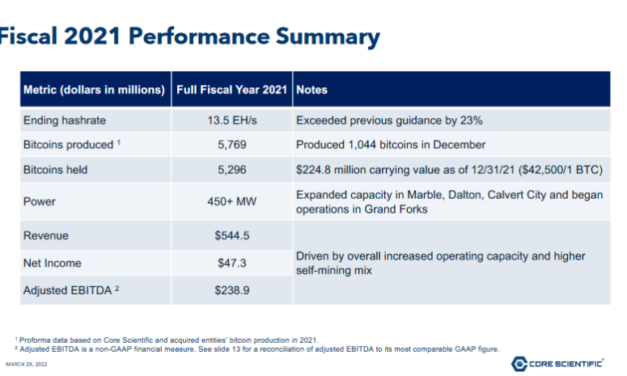
U.S. Bitcoin mining firm Core Scientific has posted bullish 2021 fiscal year results compared to the year prior, with its revenue increasing by 803% to $544.5 million and gross profit growing 2,443% to $238.9 million. The major BTC miner highlighted growth in hash rate, mining equipment sales, hosting revenue, digital asset mining income as key reasons for the improved performance. The booming price of Bitcoin (BTC) no doubt also played a part. The results were announced on March 29 and show a total net income (take-home after expenses) totaling $47.3 million last year. The figure marks a drastic increase from the net loss of $12.2 million seen in 2020. In terms of Core Scientific’s revenue streams, hosting revenue increased 91% from 2020 to $79.3 million in 2021, equipment sales increased by 1,871% to $248.2 million and digital asset mining income grew 3,440%, to $216.9 million. 2021 summary: Core Scientific Core Scientific CEO Mike Levitt said that the firm’s BTC mining hash rate increased “from less than 3.0 EH/s at year-end 2020 to 13.5 EH/s at year-end 2021” which resulted in more than 5,700 mined BTC. Looking forward, Levitt stated that the company is on track to meet its expansion plans in 2022: “In the first two months of 2022 our total hashrate grew to 15.9 EH/s and we self-mined over 2,000 Bitcoins. Across our business we are executing our plans effectively and remain well positioned to continue expanding our capacity and creating shareholder value.” While the firm posted strong increases across the board, the trend also occurred on the expenses side of the equation, with the cost of revenue increasing by 500% to $305.6 million and net income being partially offset by $41.3 million worth of “non-operating expenses related to our convertible notes” and a $14.6 million increase in interest expense from financing arrangements. Related: The Bitcoin shitcoin machine: Mining BTC with biogasi’d say $CORZ blew earnings out of the waterhttps://t.co/deIMOs8N2p— Dave Gretta | author of Night Trading (@DGretta_Author) March 29, 2022Core Scientific also noted that its operating income was also “primarily offset by $46.0 million of higher general and administrative expenses, which was driven by $29.8 million of higher stock-based compensation expense, and $37.2 million of higher impairments of digital currency assets. Following the company’s impressive 2021 results, Core Scientific founder Darin Feinstein also took some time to slam Greenpeace and Ripple chairman Chris Larsen, after the duo teamed up this week to launch the “change the code, not the climate” campaign. The initiative aims to fundamentally change Bitcoin to a more environmentally friendly consensus model such as Proof of Stake. Feinstein said Greenpeace had sold out Bitcoiners.Yesterday, out of the 100+ million global active bitcoin users 99% supported @Greenpeace Then, for $5M #Greenpeace sold all of them out, to support an unregistered security— Darin Feinstein (@DarinFeinstein) March 30, 2022

Čítaj viac

Did rapper YG just flex a $30M BTC stack in his new music video?

Keenon Dequan Ray Jackson, the rapper who goes by the name YG, appears to show off a fat $30 million stack of Bitcoin (BTC) in his latest music video. The reveal appears to either be an eye-watering — but possibly fake — flex, or a crafty bit of product placement, as a cold storage device from crypto wallet provider Ledger is featured prominently in the video. The social team from Ledger was on it immediately too:We see you! @YG knows how to secure those bags of #bitcoin … not your keys, no your coins.— Ledger (@Ledger) February 11, 2022In one of the scenes of the music video for the song titled “Scared Money” featuring J. Cole and Moneybagg Yo, YG is seen holding a Ledger wallet close to a smartphone which has a screen bearing a wallet application with more than $30.6 million of BTC in it. While the image could have easily been faked, rappers are well known for flaunting their wealth and success, especially so in this song which has a theme focused on spending money, investing and wearing half a million dollars worth of jewelry around one‘s neck. YG is quite the BTC proponent, as he has mentioned owning digital gold in multiple other songs such as “Big Bank” from 2018, and also in an interview with RollingStone from mid-2021. During that interview, YG said that he liked the simplicity of hodling crypto as he could invest his money into the asset class without being distracted from his music career. He drew comparisons to the real estate market, where he would have to spend a lot of time working and learning to do it successfully.“I f*ck with Bitcoin […] I got Ethereum recently and I got Dogecoin recently but I’ve had Bitcoin for about three years […] Bitcoin came around and it was like ‘what?’ and I can just do it and it turns into that?” he said in reference to the booming price of the asset last year.In a Reddit post on the r/Bitcoin Reddit community earlier today, users were questioning YG’s mammoth BTC stack, with “AvoidMyRange” stating that “the chance of all these ending at 0 and the cents ending in .00 is incredibly low. This is obviously fake.”“It is fake because that isn’t even the layout of the ledger app,” user “AKeveryday” responded. Other users saw the funny side of YG’s music-based BTC antics, with Redditor Lexstell11 doing the math on the lyrics from the Big Bank song when BTC was priced around the mid $7,000 range. “In YG’s song Big Bank, he says ‘I might buy her red bottoms with the crypto- 3 coins that’ll pay your whole semester…’ the song was released on 5/25/2018 when BTC was $7,459 at close. So presumably YG paid $132,000 by today’s conversion for a girl‘s semester at what I’m assuming was University of Phoenix. I think about this a lot.”Related: Year of sponsorships: Celebrities who embraced crypto in 2021Crypto has attracted a strong cohort of rappers over recent years, with icons such as Jay Z and nonfungible token-bull Snoop Dogg both making heavy plays in the sector. Other well-known figures to jump on the gravy train include Meek Mill, who snapped up Dogecoin (DOGE) amid the hype last year, Nas, who tokenized his music as NFTs earlier this year and Post Malone, who featured a Bored Ape Yacht Club NFT in one of his recent music videos.

Čítaj viac

Získaj BONUS 8 € v Bitcoinoch

nakup bitcoin z karty

Registrácia Binance

Burza Binance

Aktuálne kurzy