
Autor Cointelegraph By Brian Quarmby

Billionaire Citadel Securities founder compares crypto value to abstract art

Billionaire Citadel Securities founder Ken Griffin has compared cryptocurrency to abstract art, opining that the value of both is derived from the eye of the beholder. Griffin — who Forbes estimates to be worth around $26 billion — has made numerous anti-crypto comments and urged others away from it in the past, but appears to have gradually softened his stance over time. He also said that Citadel will make a play once it can do so in a compliant manner. Speaking on the value of crypto at the Milken Institute Global Conference in Los Angeles on May 2, Griffin drew comparisons with his collection of “American abstract art”, noting that: “Why is a painting worth $10 million? It’s oil on canvas. So value is in the eyes of the beholder.”While he may never become a full-blown proponent, Griffin appears to be at least happy to sit on the fence on a personal level as his market-making firm works to roll out crypto services. In that regard, he also noted that “the institutional increase in interest in cryptocurrency,” helped sway the firm, and may see it provide “liquidity to institutional, and potentially retail, investors.”“I have to live with the reality that an asset’s worth what people perceive it to be worth.”In terms of Citadel’s views on crypto, Griffin said it was a “great hotspot topic of debate” and suggested that the younger portion of his colleagues are the ones pushing for the company to make a play: “All my colleagues who are younger than I am, probably think I’m a dinosaur on this issue. They’re big believers. They believe that cryptocurrency has an important role in the global economy as a means of facilitating payment in a web3 world.”Still, Griffin outlined that the company will take its time to conduct due diligence before making any official moves, as he paid particular focus to the supposed threat of North Korea.Griffin in general has held highly skeptical views towards the crypto sector, going as far as to describe Bitcoin (BTC) as a “jihadist call” against the U.S. dollar back in October. However, he did also outline that he sees blockchain as “really interesting technology,” despite failing to see its value and argued that Ethereum-based tokens could one day replace BTC as the top dogs in crypto. In March, he even admitted that it was a mistake to be in the “naysayer camp” given the total market cap of crypto sat at around $2 trillion at the time, and noted that Citadel could soon make a plunge into the sector. Related: Buffett back bashing Bitcoin, claims it ‘doesn’t produce anything’Despite his relatively neutral comments on this latest occasion, the billionaire did however manage to squeeze in a fairly critical dig at crypto. Griffin argued that it’s easy for him to see how firms such as Amazon and Apple have been able to benefit the user with their services and products, but can’t say the same for Bitcoin. “These are businesses that have really, clearly changed the world for the better. I’m still looking for that story of how crypto has made the world so much better. I’m looking at stories about how Bitcoin consumes as much power as a small country,” he said.

Čítaj viac
Ethereum burning spikes to new high on Yuga Labs’ NFT hype

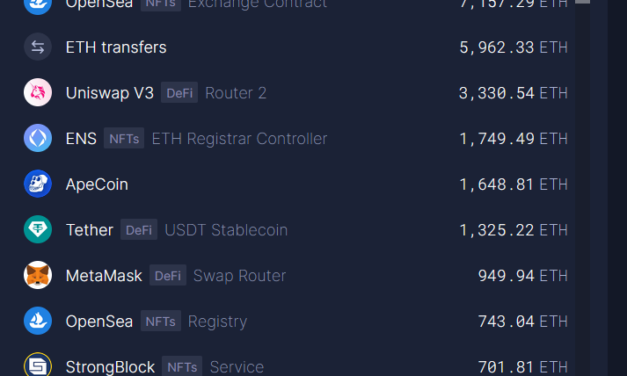
The burning rate of Ethereum (ETH) has spiked to new all-time high (ATH) levels following the heavily anticipated sale of tokenized land plots in Yuga Labs’ upcoming Metaverse project the “Otherside.”Yuga Labs, the creators of the Bored Ape Yacht Club (BAYC) sold 55,000 virtual land NFTs dubbed “Otherdeeds” on May 1. The overwhelming demand for the tokens saw Ethereum gas fees shoot up so high that a handful of users paid as high as 2.6 ETH ($7,400) to 5 ETH ($14,270) just to get their transactions through. A base fee of ETH is burned during each transaction on the network following the implementation of the London hard fork or EIP 1559 upgrade last year. According to data compiled from Glassnode and Data Always, nearly 70,000 ETH was burned on May 1, which is more than triple the previous ATH of around 20,000 in mid-January. This is approximating the rest of the day as normal burn. We could easily see the number go above 70k as other transactions need to catch up on missed blockspace. It’s just incomparable to anything we’ve seen before.— T. | dataalways.eth (@Data_Always) May 1, 2022Data from Ultrasound.Money shows that since the integration of EIP 1559 on August 5, 2021, the average burn rate has been 5.81 ETH per minute. However, amid the Otherdeed NFT sale, that figure jumped to 9.83 ETH per minute for a total of 99,084.65 ETH over the past seven days. Since then the burn rate has dropped back down to around 3.9 ETH per minute. Related: Ethereum gas fees drop to lowest levels since August 2021While other platforms and projects accounted for this figure, it’s notable that Otherdeed NFTs top the “burn leaderboard” over the past seven days at roughly 55,817 ETH or 56% of all burns during that period. This figure is significantly ahead of second-placed OpenSea at 7,152 ETH. Seven day ETH burn leaderboard: Ultrasound.MoneyThis may be the last time Yuga Labs clogs EthereumWith the demand for the sale temporarily overwhelming the Ethereum network, and many users losing funds on gas fees for failed ETH transactions, Yuga Labs has outlined intentions to build a blockchain and port its BAYC affiliated ApeCoin over. In a Twitter post yesterday, Yuga Labs stated that it will be refunding user’s gas fees, and noted that:“We’re sorry for turning off the lights on Ethereum for a while. It seems abundantly clear that ApeCoin will need to migrate to its own chain in order to properly scale. We’d like to encourage the DAO to start thinking in this direction.”

Čítaj viac

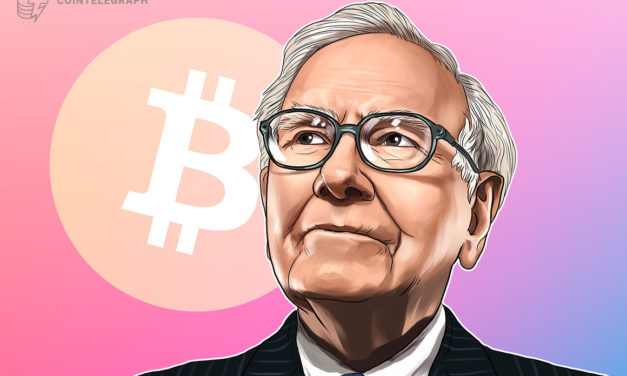
Buffett back bashing Bitcoin, claims it 'doesn't produce anything'

Billionaire investor Warren Buffett has once again slammed Bitcoin, asserting he “wouldn’t take” all of the BTC in the world for just $25.The 91-year-old, with a net worth of around $124 billion, is an avid crypto skeptic that once called Bitcoin “rat poison squared.” His arguments often stem around digital assets offering no tangible value, and the community has been quick to highlight on this occasion that there is a myriad of use cases and utility in crypto that Buffett likely hasn’t researched.Speaking at the Berkshire Hathaway Annual Shareholder meeting on April 30, Buffett commented on crypto in relation to the growing mainstream adoption of the sector. He noted that while he has no idea if the value of BTC will increase moving forward, he is sure that “it doesn’t produce anything.”Buffett argued that he would happily write “a check this afternoon” worth $25 billion for 1% of all the farmland or “apartment houses” in the U.S. as they both produce real-world utility, but wouldn’t even spend $25 for 100% of the supply of Bitcoin: “Now if you told me you own all of the Bitcoin in the world and you offered it to me for $25 I wouldn’t take it because what would I do with it? I’d have to sell it back to you one way or another. It isn’t going to do anything. The apartments are going to produce rent and the farms are going to produce food.”“Assets, to have value, have to deliver something to somebody. And there’s only one currency that’s accepted,” he added. Well-known crypto proponents were mocking Buffett’s comments on Twitter over the weekend.warren buffett thinking crypto is worth zero is funny bc he has literally no idea that ethereum just had a customer pay $150M to use the software for 2 hours.— Ξ (@scott_lew_is) May 1, 2022Co-founder of top crypto venture capital firm Andreessen Horowitz (a16z) Marc Andreessen noted that “it’s so wild he says this stuff while nakedly shilling diabetes,” in reference to an ensemble of See’s Candies boxes and soda cans on Buffett’s desk during the speech. In response, Tesla CEO and Twitter owner Elon Musk said “haha he says ‘Bitcoin’ so many times.” While MicroStrategy CEO Michael Saylor chimed in that “everyone can’t stop talking about Bitcoin.” Haha he says “Bitcoin” so many times— Elon Musk (@elonmusk) May 1, 2022

Related: Top 5 cryptocurrencies to watch this week: BTC, LUNA, NEAR, VET, GMTJamie Dimon pays crypto a small complimentOne crypto skeptic that is at least softening their stance a little, is JPMorgan CEO, Jamie Dimon. The banker once described Bitcoin as “fraud” and has continuously reiterated that he has no interest in backing the sector on a personal level, despite JP Morgan warming up to digital assets significantly over the past couple of years. Speaking with Omaha-based news outlet KMTV 3 on Friday, Dimon noted that while he still doesn’t particularly like crypto and urges caution when investing in it, he will “defend your right to do it.” He also went on to highlight that crypto does serve important use cases at times, especially in regards to cross-border payments: “Not all of it is bad. If you said to me ‘I want to send $200 to a friend in a foreign country,’ that could take you two weeks and cost you $40. You could do it through a digital currency and it’ll take you seconds.”

Čítaj viac

Senators Bragg and Lummis discuss crypto laws collaboration between US, Australia

Australian Senator Andrew Bragg hasmet with U.S. Senator Cynthia Lummis to discuss potential collaboration on cryptocurrency regulation between the two countries. Senator Bragg is a crypto-friendly politician from the ruling Liberal Party (a conservative center right party) that has been one of the driving forces behind a proposed forward-thinking regulatory scheme in Australia. Last year he fronted the Senate Committee on Australia as a Technology and Financial Center (ATFC) which tabled 12 extensive regulatory proposals relating to taxation, decentralized autonomous organizations (DAOs) and company licensing. Two months later, Treasurer Josh Frydenburg outlined intentions to begin implementing at least six of the proposals by mid-2022. Since then the proposals have been refined and packaged into the Digital Services Act, however, its implementation is up in the air. With the federal election set to take place next month, it is unclear if the act will be adopted if the opposition Labor party is voted in, given it is yet to provide a concrete stance on the crypto sector. Bragg spoke with Lummis — who is a known crypto proponent and Bitcoin (BTC) hodler — via a video call this week, and told Cointelegraph that the discussion focused mainly on the “opportunities for regulatory equivalents.”Thanks for the great visit! https://t.co/3tqrwhAj0v— Cynthia Lummis (@CynthiaMLummis) April 26, 2022While he wouldn’t go into specifics, Bragg emphasized the importance of aligning on as many issues as possible with the U.S. given the historical partnership between the two nations: “I see that as an economic growth area, as a security objective, because we have a unique relationship with the United States, which is cultural, economic, military. So we want to be close to our friends in the United States on these issues as much as we can.”He also suggested that both governments are looking to set global standards for crypto regulation, noting that “the executive order from President Biden is reasonably similar to what Treasurer Frydenberg released last December.” “[If] two large, sophisticated financial economies like the United States and Australia come together that could help drive standards in other parts of the world,” he said. In terms of collaboration, or at least regulatory equivalence, Bragg noted that it “looks like they’ve been able to move more quickly on getting different sorts of products into the market. So we’ll see what lessons we might be able to pick up there.” Related: Failure to launch: Australia’s first 3 crypto ETFs all miss launch dayOne area that may differ is the two nations’ approach to launching a central bank digital currency (CBDC), with Bragg noting that the U.S. seems more receptive to the idea. Australia’s Reserve Bank has stated there’s no compelling need for one due in part to the nation’s instant digital payments network and Bragg stressed that he was “very cautious” about it at this stage. “I think I’m, you know, probably more aware of the issues and the risks of going there. So we just need to get the Treasury report done on this issue. I’m hoping that can be done, you know, quickly after the election.”Asked if Labor being voted in would derail Bragg’s efforts at crypto reform over the past two years, the Senator frankly stated that he had no idea. “I mean, you’ll have to talk to Labor about it. But I mean, they haven’t got any policy. So, yeah, I certainly hope not, but I mean, they don’t have any policies,” he said. Bragg also delivered a speech at the Accounting Business Expo in Sydney yesterday, as he outlined his political parties’ intention to provide “good regulation” as opposed to stifling regulation. “Regulation which creates certainty while inviting the possibility of more innovation, including innovation which we cannot anticipate. Regulation which protects the interests of consumers and investors on a level playing field – while allowing for flexibility, inventiveness, and experimentation.”“Regulation which provides a safety net when the market fails but holds individuals accountable for the consequences of their actions,” he added.

Čítaj viac

Plan for $1M bug bounties and double the nodes in wake of $600M Ronin hack

The Ronin Network and Sky Mavis have vowed to upgrade their smart contracts, offer lucrative bug bounties and ramp up security following the $600 million hack late last month. As Cointelegraph previously reported, the Ethereum sidechain developed for the popular NFT game Axie Infinity was the victim of an exploit for 173,600 Ether (ETH) and 25.5 million USD Coin (USDC) worth more than $612 million at the time. Earlier this month the Federal Bureau of Investigation (FBI) attributed the attack to North Korea-based and state-sponsored hacking group Lazurus, as it fired off a warning to other crypto and blockchain organizations. Ronin announced its platform changes via a post-mortem report published yesterday, noting that all user funds are in the process of being restored as it vowed to make sure this “never happens again.”We have put together a postmortem regarding the Ronin exploit that occurred on March 23rd.• Why it happened• What we’re doing to make sure this never happens again• Ronin bridge re-opening updatehttps://t.co/FfwCtCG84E— Ronin (@Ronin_Network) April 27, 2022The hack run down The hack was the result of a spear phishing attack on a former Sky Mavis employee (developers of Axie Infinity). The bad actor was able to leverage the employee’s credentials to access Sky Mavis’s four validator nodes out of a total of nine in the Axie/Ronin ecosystem. This by itself was not enough to do any damage, but “the attacker found a backdoor through our gas-free RPC node, which they abused to get the signature for the Axie DAO validator.”“This traces back to November 2021 when Sky Mavis requested help from the Axie DAO to distribute free transactions due to an immense user load. The Axie DAO allowlisted Sky Mavis to sign various transactions on its behalf. This was discontinued in December 2021, but the allow list access was not revoked,” the report reads. Following the hack, big changes are being implemented at both Sky Mavis and the Ronin Network. RoninThe Ronin Network hopes to have its bridge open again by mid to late May, with Binance providing support until then with withdrawal and deposit infrastructure for Axie users. The team is about 80% through upgrading Ronin bridge smart contracts, they’ll be reworking the backend, migrating all pending withdrawals and launching a validator dashboard that “allows for approving large transactions and adding/removing new validators.”“The Ronin Network bridge is currently being redesigned and will open once we are confident that it can stand the test of time. We initially expected to be able to deploy the upgrade by the end of April, but this is not a process that we can afford to rush.”Related: Binance recovers $5.8M in funds connected to Ronin bridge exploitSky MavisSky Mavis will ramp up its security measures by seeking the help of “top tier security experts,” conducting contract audits and implementing stricter internal procedures such as training courses to “combat external threats.”Notably, it will also be significantly upping its node count to help decentralize the project. Having already increased from nine to 11, Sky Mavis intends to get that number up to 21 within three months. Longer-term, the project is eyeing more than 100 nodes. Sky Mavis will also be launching bug bounties of up to $1 million for any white hat hackers who are able to find further vulnerabilities. “We recognize the importance and value of security researchers’ efforts in helping keep our community safe. Sky Mavis is offering bounties of up to $1 million to encourage responsible disclosure of security vulnerabilities.”

Čítaj viac

Získaj BONUS 8 € v Bitcoinoch

nakup bitcoin z karty

Registrácia Binance

Burza Binance

Aktuálne kurzy