Autor Cointelegraph By Brian Quarmby

'Huge testing milestone' for Ethereum: Ropsten testnet Merge set for June 8

The Ethereum ecosystem is set for a “huge testing milestone” with the Ropsten testnet Merge set to be conducted on June 8. According to the Merge testnets page on Github, Ethereum DevOps engineer Parathi Jayanathi submitted a pull request for the Ropsten testnet Merge configuration code on Monday, suggesting the implementation is ready to go. Ropsten is one of several testnets created by the Ethereum Foundation in 2017 and which is currently maintained by the Geth developer team. This specific testnet is seen as the best replication of the Ethereum Mainnet as it follows a similar network structure. This enables devs to conduct realistic deployment testing before making updates to the actual mainnet. The Ropsten testnet Merge will see the proof-of-work network combined with a new proof-of-stake (PoS) consensus layer testnet, with its genesis set for May 30. It will simulate what will happen once the actual Merge between Ethereum and the Beacon Chain finally takes place and it becomes a PoS network.Devs in the community have been posting their bullishness about the testnet news online. Preston Van Loon, an Ethereum core developer at Prysmatic Labs said that: “Ropsten testnet is getting merged on June 8! Merging Ropsten is a huge testing milestone towards Ethereum’s mainnet Merge later this year.” Ropsten testnet is getting merged on June 8! Merging Ropsten is a huge testing milestone towards Ethereum’s mainnet merge later this year. https://t.co/X7eLIMA72g— prestonvanloon.eth @ Permissionless (@preston_vanloon) May 18, 2022Another core developer who goes by trent_vanepps on Twitter said last week prior to the June 8 confirmation of Ropsten that the Sepolia and Georli testnets could be set for trial Merges as well.rinkeby will not be mergedhttps://t.co/QhHD5GMOQI— trent.eth (@trent_vanepps) May 13, 2022

Notably, the testnet timeline falls in line with comments from Ethereum developer Tim Beiko who stated last month that the Merge would not be ready to go live until a “few months after June.” “No firm date yet, but we’re definitely in the final chapter of PoW on Ethereum,” he said. Related: 2 key Ethereum price metrics suggest traders will struggle to hold the $2K support levelAnother strong indicator that things are moving in the right direction, is the announcement from the Ethereum Foundation earlier this week that it had ‘merged’ its PoW mainnet and PoS consensus layer bug bounty programs into one. In general, the max reward now stands at $250,000 for reporting bugs on Ethereum, however the amount can also be doubled during important times such as upgrades going on public testnets which are also set for the mainnet. “In total, this marks a 10x increase from the previous maximum payout on Consensus Layer bounties and a 20x increase from the previous max payout on Execution Layer bounties,” the announcement read.

Čítaj viac


Russia will inevitably legalize crypto payments says trade minister

Russia will legalize crypto payments “sooner or later” according to the Ministry of Industry and Trade of the Russian Federation, Denis Manturov. The country’s government has been exploring various crypto adoption plays throughout 2022, but is yet to finalize any concrete policy concerning digital asset payments. However, its legalization has been recommended by Russia’s finance ministry via its “On Digital Currency” bill from April. According to a translation of a May 19 report from local media outlet TASS, Manturov was questioned at the New Horizon educational forum this week on whether legalized crypto payments were in the works.”I think so. The question is when this will happen, how it will happen and how it will be regulated. Now both the Central Bank and the government are actively engaged in this. But everyone is inclined to understand that this is a trend of the time, and sooner or later in one format or another, it will be carried out.”“But, once again, it must be legal, correct, in accordance with the rules that will be formulated,” he added. The Central Bank of Russia (CBR) and the Ministry of Finance have up until recently held entirely opposing views on crypto regulation, with the central bank looking for an outright ban while the ministry sought regulation for taxation. As recently as January the CBR had proposed a blanket ban on local crypto trading and mining due to the potential “financial stability risks” associated with the sector. Related: Russian government official calls to legalize mining ‘as soon as possible’However, following the on-going invasion of Ukraine, CBR admitted last month to taking too much of an aggressive stance towards crypto which may have stifled the growth of the sector. The bank’s governor, Elvira Nabiullina, noted the numerous economic sanctions placed on the country were a key driver in changing its anti-crypto sentiments, as it now looks to get the local digital asset market into a “working state.”

Čítaj viac

Cloudflare to run Ethereum node experiment to help 'build a better internet'

Ahead of Ethereum’s highly anticipated switch to proof-of-stake (PoS), cyber security firm Cloudflare is set to launch and fully stake Ethereum validator nodes over the next few months. It aims to study energy efficiency, consistency management, and network speed of the PoS network as part of its commitment to environmental sustainability and to help “build a better internet.” Cloudflare was founded in 2010 and provides web security services such as distributed denial-of-service (DDoS) mitigation to protect clients from DDoS attacks. Cloudflare said it was experimenting with the “next generation of Web3 networks that are embracing proof of stake,” with Ethereum being the first in line for the company. At this stage, it appears the Merge and transition to a PoS consensus mechanism is slated to go live by Q3 or early Q4, barring any further delays, with Cloudflare noting that this will lead to “significant energy efficiency improvements” for the network. According to a May 16 blog post, the firm will launch and fully stake Ethereum validator nodes (32 Ether required per node) over the next few months. It did not specify how many nodes, or a specific start date. “Cloudflare is going to participate in the research and development of the core infrastructure that helps keep Ethereum secure, fast, as well as energy-efficient for everyone.”“These nodes will serve as a testing ground for research on energy efficiency, consistency management, and network speed,” the blog post adds. Related: Polkadot vs. Ethereum: Two equal chances to dominate the Web3 worldThe firm said the tests relate to its commitment to the environment and helping pave a path “that balances the clear need to drastically reduce the energy consumption of Web3 technologies and the capability to scale the Web3 networks by orders of magnitude.”Cloudflare noted that Ethereum’s upcoming upgrades will significantly reduce its energy consumption as it shifts away from the environmentally “challenging” proof-of-work model, which has been at the forefront at Web3 adoption but does “not scale well with the usage rates we see today.” “The energy required to operate a Proof of Stake validator node is magnitudes less than a Proof of Work miner. Early estimates from the Ethereum Foundation estimate that the entire Ethereum network could use as little as 2.6 megawatts of power. Put another way, Ethereum will use 99.5% less energy post-merge than today.”While the firm did not outline which project it will focus on next, it teased that it will be working with partners across “cryptography, Web3, and infrastructure communities” moving forward.

Čítaj viac

Ethereum’s popularity 'a double-edged sword’ — a16z's State of Crypto Report

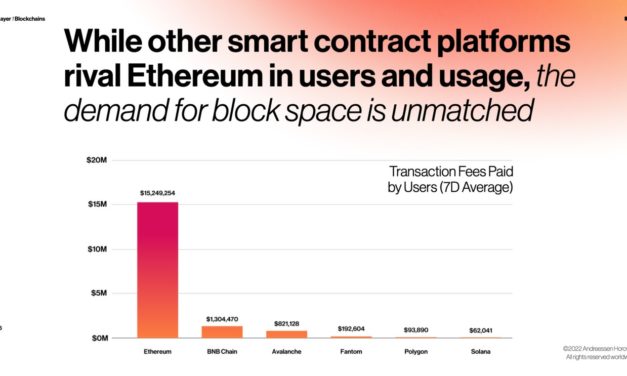
Crypto venture fund giant Andreessen Horowitz (a16z) has highlighted that development and demand on Ethereum is “unmatched” despite the network’s high transaction fees.The firm does warn, however, that its “popularity is also a double-edged sword” given Ethereum prioritizes decentralization over scaling, resulting in competing blockchains stealing market share with “promises of better performance and lower fees.”The comments came via a blog post introducing a16z’s 2022 “State of Crypto” report, with the firm’s data scientist Daren Matsuoka, head of protocol design and engineering Eddy Lazzarin, General Partner Chris Dixon, and head of content Robert Hackett all working together to provide five key takeaways from the study. Outside of Ethereum, the report focuses on topics such as Web3 development, crypto adoption rates, decentralized finance (DeFi) and stablecoins. Introducing a16z’s 2022 State of Crypto Report A lot has changed since we started investing in crypto nearly a decade ago. Here are 5 key takeaways from the a16z crypto web3 industry survey and data analysis by @darenmatsuoka, @eddylazzarin, @cdixon & @rhhackett ⬇️ pic.twitter.com/JFLXbNh03u— a16z (@a16z) May 17, 2022According to data from the report, Ethereum towers over the competition in terms of builder interest, as the network has around 4,000 active monthly developers compared to second-ranked Solana (SOL) at 1,000. Bitcoin (BTC) and Cardano (ADA) are next in line at roughly 500 and 400 apiece. The analysts noted that “Ethereum’s lead has much to do with its early start, and, the health of its community” but emphasized the significance of development continuing to surge on the network despite high transaction costs: “Ethereum’s overwhelming mindshare helps explain why its users have been willing to pay more than $15 million in fees per day on average just to use the blockchain — remarkable for such a young project.”The demand for Ethereum can also be seen across the report’s estimated transaction fees paid on a blockchain over a seven-day average (calculated as of May 12), with the data showing that Ethereum accounts for $15.24 million. To provide contrast, BNB Chain, Avalanche, Fantom, Polygon and Solana account for roughly $2.5 million worth of fees combined.Layer-1 Transaction fees: a16zThe report notes that Layer-2 scaling solutions are fighting to bring Ethereum’s fees down and transaction speeds up, while also pointing out that long-awaited upgrades are coming to Ethereum to make the network more efficient and cost-effective. The “long awaited” upgrades can’t happen soon enough however and  a16z also highlighted in the report that over a 30-day average (as of May 12), active addresses and transactions on competing blockchains including Solana, BNB Chain and Polygon are already well ahead of Ethereum. Related: Ethereum analytics firm Nansen acquires DeFi tracker Ape BoardThe data shows that Ethereum has 5.5 million active addresses that account for 1.1 million daily transactions, while Solana has a mammoth 15.4 million active addresses and 15.3 million daily transactions. BNB Chain ranks in third with 9.4 million and 5 million, while Polygon totaled around 2.6 million and 3.4 million. The analysts concluded it won’t be a winner-takes-all situation. “Blockchains are the hit product of a new computing wave, just as PCs and broadband were in the ‘90s and 2000s, and as mobile phones were in the last decade. There’s a lot of room for innovation, and we believe there will be multiple winners.”Other key takeaways from the report included the DeFi sector’s total value locked of roughly $113 billion would make it 31st largest bank in the U.S., estimations that Web3 adoption could hit 1 billion users by 2031 and that NFTs have generated $3.9 billion worth of revenue for creators so far.

Čítaj viac

RBI warns of crypto 'dollarization' of Indian economy

Officials from the Reserve Bank of India (RBI) have reportedly sounded the alarm bells again over crypto adoption which they claim will ultimately lead to the “dollarization” of the local economy.According to a May 16 report from the Indian branch of the Economic Times — which cited unnamed sources — the RBI’s concerns are focused on U.S. dollar-dominated cryptocurrencies taking away market share from the Indian rupee. The publication notes that RBI officials, along with its governor Shaktikanta Das, provided a briefing to the Parliamentary Standing Committee on Finance this week. In it they took a very skeptical stance toward crypto’s potential influence on the financial system. An unnamed official is quoted as saying: “Almost all cryptocurrencies are dollar-denominated and issued by foreign private entities, it may eventually lead to dollarization of a part of our economy which will be against the country’s sovereign interest.”“It [crypto] will seriously undermine the RBI’s capacity to determine monetary policy and regulate the monetary system of the country,” they added. The RBI was said to have been particularly irked by the notion of crypto being used in cross-border transfers instead of the rupee. While the common anti-crypto tropes of terror financing, money laundering, and drug trafficking, were also highlighted again. This is the second time this month that the RBI has expressed anti-crypto action, with Coinbase CEO Brian Armstrong suggesting last week that the exchange’s abrupt stoppage of its United Payments Interface (UPI) in India was due to pressure from the RBI. “So a few days after launching, we ended up disabling UPI because of some informal pressure from the Reserve Bank of India (RBI), which is kind of the Treasury equivalent there,” he said, adding that they basically applying “soft pressure behind the scenes to try to disable some of these payments which might be going through UPI.”Related: Indian minister wants global crypto rules to curtail money laundering riskIt appears that the Indian government is also not looking favorably on digital assets of late, and has instead taken a relatively stifling approach to crypto since outlining intentions to regulate the sector in December. On April 1, the government implemented a 30% crypto tax on digital asset holdings and transfers, along with several other stringent taxation guidelines that were based on gambling and lottery ticket win tax rules. In the following ten or so days after the laws went into effect, trading volume on top Indian crypto exchanges declined as much as 70%.

Čítaj viac

Získaj BONUS 8 € v Bitcoinoch

nakup bitcoin z karty

Registrácia Binance

Burza Binance

Aktuálne kurzy