Autor Cointelegraph By Brian Quarmby

Vitalik: How to create algo stablecoins that don't turn into ponzis or collapse

Ethereum co-founder Vitalik Buterin has shared two thought experiments on how to evaluate whether an algorithmic (algo) stablecoin is sustainable.Buterin’s comments were sparked by the multi-billion dollar losses caused by the collapse of the Terra (LUNA) ecosystem and its algo-stablecoin TerraUSD (UST). In a May 25 blog post, Buterin noted that the increased amount of scrutiny placed on crypto and DeFi since the Terra crash is “highly welcome,” but he warned against writing off all algo-stablecoins entirely. “What we need is not stablecoin boosterism or stablecoin doomerism, but rather a return to principles-based thinking,” he said: “While there are plenty of automated stablecoin designs that are fundamentally flawed and doomed to collapse eventually, and plenty more that can survive theoretically but are highly risky, there are also many stablecoins that are highly robust in theory, and have survived extreme tests of crypto market conditions in practice.”His blog focused on Reflexer’s fully Ether (ETH)-collateralized RAI stablecoin in particular, which isn’t pegged to the value of fiat currency and relies on algorithms to automatically set an interest rate to proportionally oppose price movements and incentivize users to return RAI to its target price range. Buterin stated that it “exemplifies the pure ‘ideal type’ of a collateralized automated stablecoin” and its structure also gives users an opportunity to extract their liquidity in ETH if faith in the stablecoin crumbles significantly. The Ethereum co-founder offered two thought experiments to determine if an algorithmic stablecoin is “truly a stable one.” 1: Can the stablecoin ‘wind down’ to zero users?In Buterin’s view, if market activity for a stablecoin project “drops to near zero”, users should be able to extract the fair value of their liquidity out of the asset. Buterin highlighted that UST doesn’t meet this parameter due to its structure in which LUNA, or what he calls a volume coin (volcoin), needs to maintain its price and user demand to keep its USD peg. If the opposite happens, it then almost becomes impossible to avoid a collapse of both assets. “First, the volcoin price drops. Then, the stablecoin starts to shake. The system attempts to shore up stablecoin demand by issuing more volcoins. With confidence in the system low, there are few buyers, so the volcoin price rapidly falls. Finally, once the volcoin price is near-zero, the stablecoin too collapses.”In contrast, as RAI is backed by ETH, Buterin argued that declining confidence in the stablecoin would not cause a negative feedback loop between the two assets, resulting in less chance of a broader collapse. While users would also still be able to exchange RAI for the ETH locked in vaults which back the stablecoin and its lending mechanism.2: Negative interest rates option requiredButerin also feels it is vital for an algo-stablecoin to be able to implement a negative interest rate when it is tracking “a basket of assets, a consumer price index, or some arbitrarily complex formula” that grows by 20% per year. “Obviously, there is no genuine investment that can get anywhere close to 20% returns per year, and there is definitely no genuine investment that can keep increasing its return rate by 4% per year forever. But what happens if you try?” he said. He stated that there are only two outcomes in this instance, either the project “charges some kind of negative interest rate on holders that equilibrates to basically cancel out the USD-denominated growth rate built into the index.”Related: Ethereum price dips below the $1.8K support as bears prepare for Friday’s $1B options expiryOr”: “It turns into a Ponzi, giving stablecoin holders amazing returns for some time until one day it suddenly collapses with a bang.” Buterin concluded by pointing out that just because an algo-stablecoin is able to handle the scenarios above, does not make it “safe”. “It could still be fragile for other reasons (eg. insufficient collateral ratios), or have bugs or governance vulnerabilities. But steady-state and extreme-case soundness should always be one of the first things that we check for.”

Čítaj viac


JPMorgan trials blockchain for collateral settlement in after-hours trading

Multinational investment bank JPMorgan Chase & Co is reportedly trialing the use of its own private blockchain for collateral settlements. According to Bloomberg JPMorgan conducted a pilot transaction last Friday which saw two of its entities transfer a tokenized representation of Black Rock Inc. money market fund sharesA money market fund is a type of mutual fund that is considered as a low risk investment as it offers exposure to liquid and short term assets such as cash, cash equivalents and debt-securities with high credit ratings.In terms of JPMorgan’s broader vision for its private blockchain, the bank said that it intends to enable investors to put forward a wide range of assets as collateral that can also be used outside of regular market hours. It pointed to equities and fixed income in particular.“What we’ve achieved is the friction-less transfer of collateral assets on an instantaneous basis,” stated JPMorgan’s global head of trading services Ben Challice. BlackRock wasn’t a counterparty but it has been heavily involved in the initiative “since day one and are exploring use of this technology.”JPMorgan has been actively involved with crypto and blockchain tech for quite some time now, and also founded Onyx Digital Assets (ODA) in late 2020. The project is described as a “blockchain-based network that enables the processing, recording and Delivery-versus-Payment (DVP) exchange of digital assets across asset classes.”While it wasn’t specifically outlined if JPMorgan used the ODA in this instance, the network is geared up for the exchange of cash for different types of tokenized collateral, providing intraday liquidity, and offering access to the bank’s digital payment infrastructure and token JPM Coin. Tyrone Lobban, head of JPMorgan’s Blockchain Launch and the ODA said the bank is aiming to get ahead of a trend in which it sees a broader range of traditional financial services being offered via blockchain tech:“There will be a growing set of financial activities that happen on the public blockchain, so we want to make sure that we are able to not only support that but also be ready to provide related-services.”Earlier this week, European bank BNP Paribas conducted its first trade through the ODA to explore tokenized fixed income market trading. Related: JPMorgan places BTC fair price at $38K, declares crypto a preferred alternative assetSpeaking on the move, BNP Paribas Global Markets managing director and head of US repo trading and sales Christopher Korpi, highlighted the significance of being able to streamline its processes via blockchain tech: “Tokenized assets and Onyx Digital Assets will allow for precise intraday liquidity management. As such, they could be foundational to adding velocity to collateral, security settlement and ultimately decreasing systemic risks through reduction of intraday credit. Onyx Digital Assets will further reinforce the intraday fungibility of UST and USD Cash.”

Čítaj viac

Injective partners with Wormhole to bring 10 new blockchains to the platform

Decentralized finance (DeFi) protocol Injective (INJ) has partnered with Wormhole to integrate “10 new blockchains” to its network. Injective is a Cosmos layer-2 decentralized exchange (DEX) that offers derivatives, token swaps and sports betting prediction markets. It is also focused on interoperability via cross-chain bridging, and currently supports digital assets from Ethereum, Polkadot and IBC-enabled chains such as Cosmos. Injective Labs, the protocol’s developers, noted in a May 25 announcement that the partnership will enable users to transfer and trade assets across any chain that is integrated with Wormhole. “The Wormhole integration will vastly enhance Injective’s capabilities with respect to interoperability. Users will soon find Wormhole integrated into the backend of the Injective Bridge whereby transferring assets from distinct EVM chains or Solana can be done with the click of a button,” Injective Labs stated. Injective announces new integration with @WormholeCrypto ‼️Wormhole brings ten new chains, such as @Avalancheavax and @Solana, to Injective’s already interoperable chain, making Injective the primary gateway to enter the @cosmos universe ⚛️ https://t.co/Zu8belwh7d— Injective | Cosmos IBC | Ethereum compatible (@InjectiveLabs) May 25, 2022Wormhole is a generic messaging protocol that interacts with different blockchains, providing services such as cross-chain application support and token bridges. Not all of the “10 new blockchains” are  named specifically. Wormhole’s website also only lists nine chain integrations which include Solana, Terra, Ethereum, Avalanche, Oasis Binance Smart Chain, Polygon, Fantom and Aurora. With Terra falling into a heap, and Ethereum already being supported, it is unclear what the other remaining chains out of the total of 10 are. However the project has highlighted the ability of Injective to “serve as the primary gateway for cross-chain native assets from Solana and other prominent Layer 1 chains” to enter the ecosystem. “The options for users can extend far beyond asset transfers as well. For instance, DApps on Injective could enable seamless cross-chain trading across the Cosmos and Solana ecosystems while also being able to offer yields on Solana (or any other Wormhole supported asset).” “Builders utilizing chains such as Avalanche, Algorand or Polygon can access assets within the broader Cosmos ecosystem via Injective,” it added. Cosmos developers will also be able to incorporate Wormhole’s generic messaging layer and add cross-chain functionalities within their dApps.— Wormhole (@wormholecrypto) May 25, 2022

Related: Assuming Bitcoin plays nice, higher timeframe analysis points to $90 Solana (SOL) priceThe announcement has done little to sway the value of Injective’s native token INJ so far, with the price dropping 2.6% in the past 24 hours to sit at $2.21 at the time of writing. The token is also down 91.1% since its all-time high of $24.89 in late April 2021, according to data from CoinGecko.

Čítaj viac

Ethereum Beacon Chain experiences 7 block reorg: What's going on?

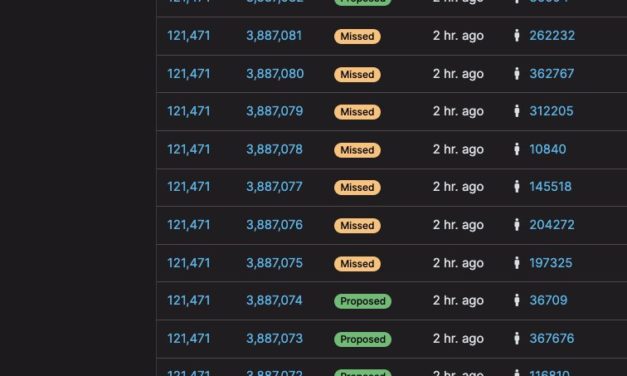
Ahead of the Merge tentatively penciled in for August, Ethereum’s Beacon Chain experienced a seven-block reorganization (reorg) yesterday. According to data from Beacon Scan, on May 25 seven blocks from number 3,887,075 to 3,887,081 were knocked out of the Beacon Chain between 08:55:23 to 08:56:35 AM UTC. The term reorg refers to an event in which a block that was part of the canonical chain, such as the Beacon Chain, gets knocked off the chain due to a competing block beating it out.It can be the result of a malicious attack from a miner with high resources or a bug. Such incidents see the chain unintentionally fork or duplicate. On this occasion, developers believe that the issue is due to circumstance rather than something serious such as a security issue or fundamental flaw, with a “proposer boost fork” being highlighted in particular. This term refers to a method in which specific proposers are given priority for selecting the next block in the blockchain. Core Ethereum developer Preston Van Loon suggested the reorg was due to a “non-trivial segmentation” of new and old client node software, and was not necessarily anything malicious. Ethereum co-founder Vitalik Buterin labeling the theory a “good hypothesis.”Block reorg: Beacon ScanMartin Köppelmann, the co-founder of EVM compatible Gnosis chain was one of the first to highlight the occurrence via Twitter yesterday morning, noting that it “shows that the current attestation strategy of nodes should be reconsidered to hopefully result in a more stable chain! (proposals already exist).”In response to Köppelmann, Van Loon tentatively attributed the reorg to the proposer boost fork which hadn’t fully been implemented yet: “We suspect this is caused by the implementation of Proposer Boost fork choice has not fully rolled out to the network. This reorg is not an indicator of a flawed fork choice, but a non-trivial segmentation of updated vs out of date client software.”“All of the details will be made public once we have a high degree of confidence regarding the root cause. Expect a post-mortem from the client development community!” he added.We suspect this is caused by the implementation of Proposer Boost fork choice has not fully rolled out to the network. This reorg is not an indicator of a flawed fork choice, but a non-trivial segmentation of updated vs out of date client software.— prestonvanloon.eth (@preston_vanloon) May 25, 2022Earlier today, another developer Terence Tsao echoed this hypothesis to his 11,900 Twitter followers, noting that the reorg seemed to be caused by “boosted vs. non boosted nodes in the network and the timing of a really late arriving block.” “Given that the proposer boost is a non-consensus-breaking change. With the asynchronicity of the client release schedule, the roll-out happened gradually. Not all nodes updated the proposer boost simultaneously.”Related: OpenEthereum support ends with the Merge fast approachingVan Loon spoke at the Permissionless conference last week and said that the Merge and switch to Proof-of-Stake (PoS) could come in August “if everything goes to plan.” While the reorg is sure to raise questions of this potential timeline, Van Loon and the other developers have not yet outlined whether it will have any impact at all.

Čítaj viac

Blockstream dreams up a whole new type of multisig called ROAST

The research unit of Bitcoin (BTC)-focused blockchain tech firm Blockstream has published a proposal for a new type of multisig standard called Robust Asynchronous Schnorr Threshold Signatures (ROAST). It hopes to avoid the problem of transaction failures due to absent or even malicious signers and can work at scale. The term multisig or multisignature, refers to a method of transaction in which two or more signatures are required to sign off before it can be executed. The standard is widely adopted in crypto. According to a May 25 blog post from Blockstream research, the basic idea of ROAST is to make transactions between the Bitcoin network and Blockstream’s sidechain Liquid more efficient, automated, secure and private. In particular, ROAST has been posited as a signature standard that could work with, and improve, threshold signature schemes such as FROST (Flexible Round-Optimized Schnorr Threshold Signatures):“ROAST is a simple wrapper around threshold signature schemes like FROST. It guarantees that a quorum of honest signers, e.g., the Liquid functionaries, can always obtain a valid signature even in the presence of disruptive signers when network connections have arbitrarily high latency.”The researchers highlighted that while FROST can be an effective method for signing off on BTC transactions, its structure of coordinators and signers is designed to abort transactions in the presence of absent signers, making it secure but suboptimal for “automated signing software.”To solve this problem, the researchers say that ROAST can guarantee enough reliable signers on each transaction to avoid any failures,and it can be done at a scale much larger than the 11-of-15 multisig standard that Blockstream primarily utilizes. “Our empirical performance evaluation shows that ROAST scales well to large signer groups, e.g., a 67-of-100 setup with the coordinator and signers on different continents,” the post reads, adding that:“Even with 33 malicious signers that try to block signing attempts (e.g. by sending invalid responses or by not responding at all), the 67 honest signers can successfully produce a signature within a few seconds.”To provide a simple explanation of how ROAST works, the team used an analogy of democratic council responsible for legislation of “Frostland.”Essentially, the argument is given that it can be complicated to get legislation (transactions) signed off in Frostland as there are a myriad of factors at any given time which can result in the majority of council members suddenly being unavailable or absent. A procedure (ROAST) to counteract this, is for a council secretary to compile and maintain a large enough list of supporting council members (signers) at any given time, so that there is always enough members to get legislation through. “If at least seven council members actually support the bill and behave honestly, then at any point in time, he knows that these seven members will eventually sign their currently assigned copy and be re-added to the secretary’s list.”“Thus the secretary can always be sure that seven members will be on his list again at some point in the future, and so the signing procedure will not get stuck,” the post adds. Related: ‘DeFi is not decentralized at all,’ says former Blockstream executiveROAST is part of a collaboration between Blockstream researchers Tim Ruffing and Elliott Jin, Viktoria Ronge and Dominique Schröder from the University of Erlangen-Nuremberg and Jonas Schneider-Bensch from the CISPA Helmholtz Center for Information Security.Accompanying the blog post, the researchers also linked to a 13 page research paper which gives a run down of ROAST in greater detail.

Čítaj viac

Získaj BONUS 8 € v Bitcoinoch

nakup bitcoin z karty

Registrácia Binance

Burza Binance

Aktuálne kurzy