Autor Cointelegraph By Brian Quarmby

DeFi community rallies behind PoolTogether to hit $1.4M NFT defense funding target

No-loss lottery decentralized finance (DeFi) platform PoolTogether has reached 100% of its legal defense funding goal via the sale of NFTs.It has taken the project just ten days to reach its funding goal of 769 Ether (ETH) or $1.4 million, signaling strong support from the DeFi community who are rallying against a lawsuit that some feel is an attack on the greater sector as a whole.the community has spoken @PoolyNFT https://t.co/pJSRUfjk3f— francom.eth (@francom619) June 5, 2022PoolTogther is currently selling three tiers of NFTs as part of a funding campaign dubbed “PoolyNFT” to fight a class-action lawsuit that it feels has “no merit.” The NFTs are priced at 0.1 ETH, 1 ETH and 75 ETH a pop, and vary in the number of total minted tokens, and the project will eventually roll out ‘hodler utility’ for the NFTs moving forward.Cointelegraph previously reported on June 1 that PoolTogether’s fundraising project had hit around 471 ETH last week, with support coming from big figures in the crypto space such as general partner of Andreessen Horowitz, Chris Dixon, who bought a Pooly Judge tier NFT for 75 ETH, or roughly $141,000 at current prices. At the time of writing, the figure for funding raised now stands at 788.40 ETH, or roughly $1.474 million. Notably, the campaign has another 16 days to go, and if all of its NFTs are sold it will have generated 1,076 ETH, or $2 million. The PoolyNFT team tweeted the milestone on June 6 and noted that “over 4,200 unique wallets are now holding Poolys. Absolutely amazing to see what’s been accomplished by the community rallying together.” While PoolTogether co-founder Leighton Cusack also stated: “Don’t have a lot of words right now. Blown away by how the community has rallied around PoolTogether Inc and myself.”As the litigation continues, updates will be posted to this account. Poolys are strong togetherThank you!!!— Pooly (@PoolyNFT) June 5, 2022

The class-action lawsuit in question is led by the former technology lead for Senator Elizabeth Warren’s 2020 presidential campaign, Joseph Kent, who after spending just $12 dollars on buying lottery tickets via PoolTogether, subsequently filed a lawsuit against the DeFi project in January. Kent is alleging that PoolTogther and its partners are operating an illegal lottery in New York, and he is seeking compensation worth double the value of funds he spent on PoolTogether (a whopping $24) and double the reasonable amount of attorney’s fees and costs of legal action. Related: Finance Redefined: Maker founder proposes endgame, Singapore explores DeFi and moreNotably, Kent also outlined a general distaste for crypto in his complaint, taking the time to raise concerns about scamming, environmental damage, and Ethereum’s high gas fees, among other things, suggesting his gripe runs deeper than PoolTogether.PoolTogether offers what it calls risk-free lotteries on stablecoin deposits in the platform by using ticket-buyers’ and liquidity providers’ capital to generate interest using DeFi lending protocols. The winner of the lottery receives the largest share of the yield, while a handful of runner-ups receive a smaller share and all remaining participants receive a full refund.

Čítaj viac

Bermuda confirms crypto hub ambitions despite market downturn

The Bermuda government is pushing on with its ambitious plans to become a cryptocurrency hub despite the massive market downturn in 2022. The small island territory known for its pristine pink sand beaches and attractive taxation policies has been actively expanding its crypto sector since 2017, according to Bermuda’s minister of economy and labor, Jason Hayward. He noted on June 3 that the government remains unfazed by the recent crash caused by the collapse of the Terra ecosystem in May, as the market has weathered many storms since 2017. Speaking with the Wall Street Journal (WSJ), Hayward pointed to the experience of the economy and local regulators in dealing with foreign business as a key factor that will help Bermuda become a crypto hub. He also bullishly stated that the crash will not hamper its plans moving forward: “We are aware of the recent devaluation in the price of cryptocurrencies and remain confident that it does not threaten the island’s ability to become a crypto hub.”“This industry downturn is likely to advance our goal and positively impact our long-term growth and role in this sector,” he added. So far the Bermuda Monetary Authority (BMA) has granted a total of 14 licenses for crypto firms to operate out of the British island territory, with four of those being approved in 2022, noted Crag Swan, chief executive of the BMA. The total list includes companies such as multi-asset-class trading firm Class T, crypto exchange Bittrex Global, USD Coin (USDC) issuers Circle Internet Financial Ltd., and crypto interest account providers  BlockFi, who obtained a license in January earlier this year. Swan highlighted, however, that the BMA is not looking to accept anyone that wants to set up shop in Bermuda and is looking at quality over quantity as part of its crypto hub ambitions. “So obviously the persons that we want in Bermuda must be fit and proper because essentially we’re looking at maintaining the jurisdiction’s quality name,” he said.Related: Bitcoin price needs to close above $29,450 for its first green weekly candle since MarchHayward stated that Bermuda’s licensing process is broken down into three stages: the testing license, a modified license, and finally the fully approved operating license. The testing phase usually lasts between three to 12 months but did not provide a comment on how long it takes to get fully licensed by the BMA. Commenting on the regulatory landscape in Bermuda, the president of the Financial & International Business Association (FATF) David Schwartz, told the WSJ that the Bermuda government has been making strides in its anti-money laundering compliance initiatives since 2020, but there was still work to be done. The Paris-based FATF sets global AML-standards, and Schwartz suggested the success of Bermuda’s crypto sector may hinge on how strongly the government oversees and regulates the companies that it offers licenses to: “They’ve got great rules and regulations and laws, but it’s all about the implementation at the end of the day.”

Čítaj viac

Vitalik shows support for Optimism’s governance structure and OP gas proposal

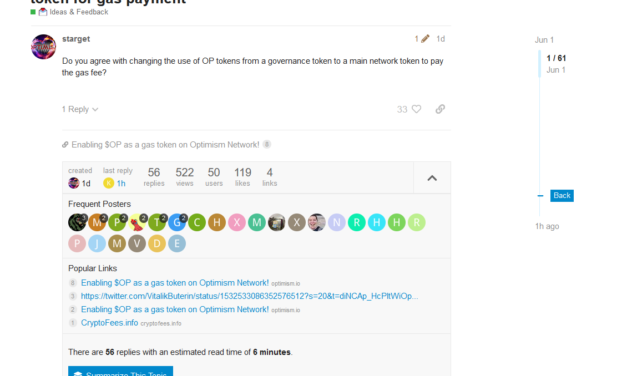
Ethereum co-founder Vitalik Buterin has shown support for Optimism’s new governance structure, noting that proposals such as using the OP token for gas fees shows “explicit representation of non-token-holder interests.”The Ethereum layer-2 scaling solution deployed the first round of its long-awaited OP token airdrop on June 1 as part of its new governance project the “Optimism Collective.” Optimism’s new governance structure involves two parties dubbed the “Token House” and “Citizens’ House.” The former is composed of OP governance token holders and the latter consists of “soul-bound” non-transferrable citizenship NFT owners.While it is unclear if Buterin is fully on board with a proposal from June 2 to utilize the OP governance token for gas fees, or just happy that such a discussion was taking place, he noted on Twitter today:This is a great example of why I’m so proud of @optimismPBC for adding non-token governance (the Citizen House).Optimism explicitly has goals *other* than just “make OP go up”, and the only way to do that long-term is with explicit representation of non-token-holder interests. pic.twitter.com/vofVVx53mC— vitalik.eth (@VitalikButerin) June 3, 2022The two parties mostly oversee different objectives with the Token House tasked with project incentives, protocol upgrades and treasury funds, while the Citizens’ House is focused on retroactive public goods funding. The duo also share governance decisions on network parameters and granting new citizenships to the Citizens’ House, something which Buterin seems to appreciate in this instance. According to Optimism, the number of citizens in the Citizens’ House will grow over time, and the “mechanism for distributing Citizenships will be determined by the Foundation with input from the Token House.” On several occasions, Buterin has outlined his thoughts that the crypto sector needs to “move beyond coin voting” in decentralized finance (DeFi) or decentralized governance (DeGov) as it runs the risks of having whale governance token holders dominating the voting process. Buterin argues this can often lead to a short-term focus of the whales approving proposals that intend to pump the price of certain assets. Such a method can result in small holders and platform users not having a voice in the DeGov process, or what Buterin describes as a lack of non-token-hodler interests. As for the OP gas fee proposal, which itself was floated in the Optimism governance forum for ideas and feedback yesterday, sentiment among the community appears mixed. Gas fee proposal: Optimism governance forumWhile many offered short and sharp comments of agreement, generally noting that it would give OP more utility, numerous others took the time to clearly outline why they were against the idea.Related: Balancer launches on Ethereum L2 network OptimismOne member, Kethic, stated, “I don’t think this is a good idea. Burning voting power on a governance structure feels counter productive,” while user Vrede stated: “Optimism is EVM equivalent. Accepting OP tokens as gas means giving up on EVM equivalence. Moreover, Optimism has to pay fees to Ethereum Mainnet in ETH. How will the OPETH conversion be handled?”User Massedai said that “this is a premature change to a system that hasn’t started to function yet the way Optimism intended,” suggesting that the project is looking to provide token value via “ecosystem profitability and not quick moves to try and pump a token.”

Čítaj viac

'Pig slaughtering' crypto scams reap millions on Silicon Valley dating apps

Lonely hearts in Silicon Valley are reportedly falling prey to a wave of “pig slaughtering” crypto scams via dating apps. An investigator for cybersecurity company Sift found that one in 20 people who approached her on dating apps in San Francisco was working the scam.Pig slaughtering, or butchering, is a type of scam in which an individual/group puts in weeks or months of work to build a fake relationship with the victim, metaphorically fattening them up. The end goal is to get the victim to invest in crypto via either a duplicated version of a legitimate website, or by transferring funds to a dodgy wallet address. The scammers often shift the conversations over from dating apps or social media to encrypted messaging services such as WhatsApp, and put in countless hours of daily conversation to make their fake personas seem realistic, without ever actually meeting in person in most cases.A June 2 report from the San Francisco Examiner detailed the accounts of two relatively tech-savvy individuals, referred to as Cy and R for anonymity purposes, who lost a combined $2.5 million to the scam. Both are now members of an online support group hosted by the Global Anti Scam Organization that sees “at least two or three new members” every week.The Federal Bureau of Investigation (FBI) reports that such cases are part of “a rising trend” in the local area .The FBI sent out a general warning over crypto-romance scams and pig slaughtering in April, noting that its Internet Crime Complaint Center received more than 4,300 complaints in 2021 resulting in more than $429 million in losses. It stated the scam first originated in China in late 2019, but has since become more prevalent in the U.S. R’s case in particular is notable as she is an IT manager from the Bay Area who lost around $1.3 million to the scam after first being approached via LinkedIn. Despite being well versed in computer tech, R stated that the scammer’s professional profile managed to win her trust by being listed as an alumni of the same top tech university that she graduated from in China. After the conversation moved over to WhatsApp, the scammer worked for a month before finally persuading R to invest in crypto via a dubious website that swiped her funds. “I never thought it could happen to me because I use tech. I’ve written software.”Cy, a real estate analyst lost $1.2 million over two months and ended up in psychiatric care after suffering suicidal thoughts. Related: ‘Yikes!’ Elon Musk warns users against latest deepfake crypto scam“I lost more than just money. I lost my self-confidence,” said Cy. “I have ruined my family’s lives.” The Global Anti-Scam Organization believes Silicon Valley workers are increasingly falling victim to these scams due to overconfidence in tech-savviness, loneliness as a result of the pandemic and an interest in gaining crypto exposure.

Čítaj viac

Optimism token falls 40%, prompting calls to bar dumpers from airdrops

Optimism’s freshly launched governance token, OP, has plunged 40% since peaking at $2.10, leading members of the community to discuss baring those who dumped their tokens from future airdrops. Cointelegraph reported on Tuesday that the Ethereum layer-2 scaling solution was overwhelmed with demand for the first OP governance token airdrop, as 5% of the token supply was distributed to around 250,000 eligible users. As per CoinGecko data, the token opened at roughly $1.43 before surging to $2.10, but as more users got their hands on the free airdrop over the day, OP dropped to as low as $1.09 before climbing back to $1.18 at the time of writing, marking a 43% drop. Yesterday was an absolute whirlwind. It wasn’t without hiccups, but to much excitement, OP was born. ‿We’ll have an extensive retro on Drop Day next week. Meanwhile, we want to share some stats coming out of the launch.With >50% of Drop 1 now claimed, let’s dive in! pic.twitter.com/oGnxB47E3f— Optimism (✨_✨) (@optimismPBC) June 1, 2022Following the sharp drop of OP’s price, a member of Optimism’s governance community who goes by OxJohn put forward a proposal in the Optimism governance forum to exclude addresses that dumped 100% of their airdropped tokens. The post garnered a significant amount of attention from the community, pulling in 11,200 views, 305 replies and 595 likes. OxJohn highlighted several addresses that received at least 32,000 OP tokens and promptly dumped them on the market, arguing that their actions are “counter-productive” to the community and diluted the governance process.The OP hodler went on to suggest that these accounts should be barred from the next round of OP airdrops with “a public list of accounts that engage in this behavior” excluded. In their view, doing so would see the distribution of governance weight to only those who plan to actively participate. “Why should Optimism Collective continue rewarding these kind of mercenary actors who will dump their tokens on first sight? Why should any future airdrops reward these addresses?”The proposal was submitted purely for ideas and feedback and is not close to the stage of being voted on. The reaction from the governance community has been mixed so far. Some users were in complete support, others rejected the idea totally, and some were calling for a more nuanced position. User Mohammedt75 said, “Very valid points. Incentivize people who care about the longer term and let others who don’t care about the ecosystem pack and get out.” Mgomes stated that “one of the goals of the airdrop is to incentivize people to use the chain. Even if they plan to dump it is fine, because they have used Optimism and if they liked the chain they will keep using it.“ Member JustinMarx also highlighted an interesting counterpoint, stating that dumpers should not be penalized as “you never know the personal circumstances of someone who dumped their tokens.”The proposal to punish $OP airdrop dumpers by excluding them from future airdrops is some Paraswap shit lol. Yes go punish the only people that have used your chain. Make sure they go straight to your competitor Arbitrum and never come back.— NoSleepJon (@nosleepjon) June 1, 2022

One of the most high-profile Crypto Twitter users to weigh in was Cobie, the co-host of the UpOnly crypto podcast who has nearly 700,000 followers. He responded to the proposal in his typical satirical/mocking manner.Cobie submitted a lengthy counter-proposal in the forum titled “Extended ineligibility for future airdrops” that was temporarily removed due to being flagged as “inappropriate” but has since been reinstated. In it, he said that “my lack of support for this proposal is not because I disagree with the sentiment. On the contrary, it is because this proposal does not go far enough.” “I propose that we, Optimism Collective, cancel the future airdrops of anyone that has sold any token in the last 6 months. These people have a pattern of undesirable behavior, we can consider them ‘potential future sellers’.”To counter potential future sellers, Cobie suggested issuing them with a debt token and also considering the use of “physical violence” against them.The post that *legitimately suggests banning sellers* is allowed on the Optimism forum. But a parody of that post is offensive, abusive and a violation of community guidelines and will be deleted.Thanks for the memories. pic.twitter.com/Ru0oFnZufw— Cobie (@cobie) June 1, 2022

However, after being prompted to provide a more serious response to the proposal, Cobie highlighted several reasons why he thinks that it’s a bad idea.Related: ETH/USD trading pair attracts more traders in the first quarter of 2022: ReportHe made points such as OP’s early price being irrelevant, sellers having different motives, the possibility to sell and still engage with governance, the token being used as part of customer acquisition costs from Optimism, and the ease of making a new address to avoid restrictions. “The only people that care are price-speculators, traders and short-term investors. Governance certainly performs the same whether the price is $1.50 or $2. Sure, extensive price changes could make governance attacks on Optimism cheaper, but there is not a single mention of that in the initial proposal.”“And it is not really a concern given the size of the airdrop or the short-term nature of the sell-pressure from ‘instant dumpers’,” he added. I was baited into posting a serious post since OP Labs staff were upset with my tone.https://t.co/wikRr8IB8Y pic.twitter.com/Z0fxtOJ8kx— Cobie (@cobie) June 1, 2022

Čítaj viac

Získaj BONUS 8 € v Bitcoinoch

nakup bitcoin z karty

Registrácia Binance

Burza Binance

Aktuálne kurzy