Autor Cointelegraph By Brian Quarmby

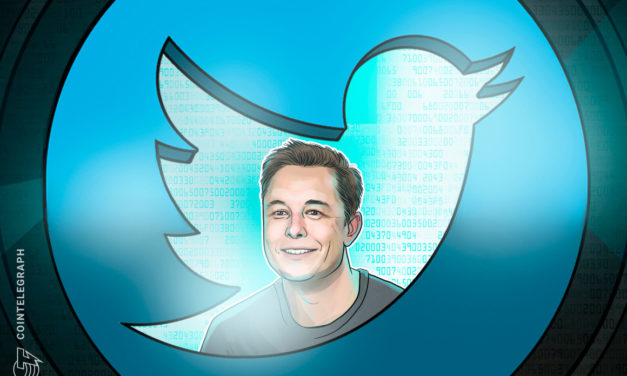
Twitter board recommends shareholders vote for Elon Musk’s takeover

The Twitter board has unanimously recommended that shareholders vote in favor of Elon Musk’s takeover of the social media giant.Twitter’s board of directors initially accepted the $44 billion takeover bid at $54.20 per share in late April, and shareholder approval is the final hurdle to the deal going through bar any potentially erratic antics from Musk.According to a June 21 U.S. Securities and Exchange Commission (SEC) filing, Twitter’s board of directors unanimously determined that the “merger agreement is advisable” and have called on shareholders to vote in favor of the deal.The board stated that Twitter will be hosting a virtual meeting — at an unspecified date — to vote on the merger which has a deadline of Oct. 24.If the merger goes through, shareholders will receive $54.20 in cash per share that they own, and with Twitter stock TWTR priced at $38.91 at the time of writing, the deal would mark a premium of roughly 39%.The takeover appeared to be up in the air earlier this month after Musk took aim at the Twitter board for not providing data relating to the number of fake users on the platform, and he threatened to withdraw his bid if the data wasn’t handed over.The board has since agreed to share data with Musk, and the issue has been resolved. Many onlookers believed that Musk was attempting to get out of the deal as a result of the share price fall since the takeover offer was first made.An indication that Musk seriously intends to push forward with his takeover came on June 16, when the Tesla CEO addressed employees for the first time in a Q&A session concerning his plans for the company moving forward.According to a leaked transcript of the call published by Vox, Musk suggested that he could be looking to integrate a host of digital payments into the service, including crypto:“I think it would make sense to integrate payments into Twitter so that it’s easy to send money back and forth. And if you have currency as well as crypto. Essentially, whenever somebody would find it useful.”“So my goal would be to maximize the usefulness of the service — the more useful it is, the better. And if one can use it to make convenient payments, that’s an increase in usefulness,” he added.Bots and verifying accounts was also another issue he highlighted, with Musk outlining the value of introducing paid verified accounts to enable users to differentiate between real and fake users.Related: Elon Musk gets hit with ‘ridiculous’ $258B Dogecoin lawsuitMusk highlighted there being “quite a lot of crypto scams on Twitter” as being of the key reasons to introduce such a feature.The issue is especially close to home for the Dogecoin proponent, given that a series of deepfake videos using his likeness to promote crypto scams recently circulated on the social media platform.

Čítaj viac


'Disappointing': Cardano devs delay Vasil hard fork by a month

Input Output Hong Kong (IOHK), the blockchain engineering firm behind the Cardano network has released some “disappointing news”, announcing a one-month delay to the long-awaited Vasil upgrade. The Vasil upgrade is set to provide a “massive performance improvement to Cardano” and its smart contract capabilities according to Cardano co-founder Charles Hoskinson. It was previously slated to go through on June 29, however the latest estimate is now set for the last week of July. IOHK’s head of delivery and project Nigel Hemsley noted in a June 20 blog post that the core Input Output Global (IOG) team working on the upgrade “is extremely close to finalizing the core work” but there are still seven bugs that remain outstanding and require work. None of them are categorized as “severe,” he added.“The work on Vasil has been the most complex program of development and integration to date, from several angles. It’s a challenging process that requires not only significant work from core teams, but also close coordination across the ecosystem,” Hemsley wrote.As a result, the Cardano Foundation — the non-profit that oversees the development of Cardano — and the IOG team agreed to defer sending the Vasil hard fork to the Cardano testnet from June 20 until June 29. Once the testnet has been hard forked, devs from Cardanao-based decentralized apps (dApps) and stake pool operators SPOs will have roughly four weeks “to carry out any required integration and testing work” before the Vasil hard fork is initiated on the mainnet in late July: “This is only reasonable and should not be rushed. The working assumption should therefore now be a Cardano mainnet hard fork occurring during the last week of July.”“We recognize that this news will be disappointing to some. However, we are taking an abundance of caution to ensure that we do this deployment correctly,” Hemsley added. The Vasil hard fork is the biggest upgrade to Cardano since the Alonzo hardfork from September which finally enabled smart contracts on the network. This latest upgrade is set to introduce four network improvements dubbed “CIP31, CIP32, CIP33, and CIP40.”Related: Price analysis 6/20: BTC, ETH, BNB, ADA, XRP, SOL, DOGE, DOT, LEO, AVAXIn theory, these upgrades are designed to reduce the size of transactions, therefore increasing the network’s throughput and lowering transaction fees on the network.Cardano is a proof-of-stake blockchain platform aiming to provide competition to Ethereum as a smart contract network with lower fees. It is currently ranked seventh out of all crypto assets in terms of market cap at around $16 billion.

Čítaj viac

Crypto lending platform Babel Finance reaches counterparty debt agreement

Hong Kong-based crypto lending firm, Babel Finance, has eased some of its immediate liquidity troubles by reaching debt repayments agreements with some of its counterparties. As previously reported, the firm issued a temporary suspension of redemptions and withdrawals from its products on June 17 after citing “unusual liquidity pressures” in the current bear market. The company stated it was taking swift action to protect clients and communicate with “all related parties.”In an update posted on June 20, Babel Finance stated that it has since taken three steps to help ease its current liquidity situation. These include: carrying out an emergency assessment of the firm’s business operations, communicating with shareholders/investors, and reaching “preliminary agreements” for some debt repayments. The company didn’t specify specific details about the debt repayment plans, such as interest rates or maturation date but did note that: ”We have communicated with major counterparties and relevant customers and reached preliminary agreements on the repayment period of some debts, which has eased the company’s short-term liquidity pressure.”The firm also stated that it communicated with certain shareholders and investors about the potential to obtain liquidity support and will “actively fulfill its legal responsibilities to customers and strive to avoid further transmission and diffusion of liquidity risks.”“We thank our customers for their understanding and support during this period and hope to obtain further support from our partners,” the firm stated. The firm’s liquidity issues come just a month after it raised $80 million in a Series B funding round at a valuation of $2 billion. The year prior, the firm also raised $40 million in a Series A funding round led by Zoo Capital, Sequoia Capital China, Dragonfly Capital, and Tiger Global Management.Babel Finance offers financial exposure to Bitcoin (BTC), Ether (ETH), and stablecoins to a “select clientele of about 500 customers,” according to the firm.Related: Crypto lending can still survive bear market, analyst saysThe company joins a host of crypto firms undergoing liquidity troubles in the current bear market, including Three Arrows Capital, Celsius, and Finblox, to name a few, with the latter two also moving to pause withdrawals.

Čítaj viac

China’s WeChat bans crypto and NFT-related accounts

The top social media platform in China, WeChat, has updated its policies to ban accounts that provide access to crypto or NFT-related services. Under the new guidelines, accounts involved with the issuance, trading, and financing of crypto and NFTs will be either restricted or banned and will fall under the “illegal business” category. The policy also covers secondary NFT trading, with the firm noting that “accounts that provide services or content related to the secondary transaction of digital collections shall also be dealt with in accordance with this article.” The move was highlighted by Hong Kong-based crypto news reporter Wu Blockchain (Colin Wu) on June 20, as he pointed out the significance of the action given that WeChat has more than 1.1 billion daily users in China. WeChat with more than 1.1 billion daily active users in China, has updated its rules: WeChat public accounts which involved in the issuance, trading and financing of crypto and NFTs will be limited function or banned. https://t.co/0I9oMrvFTp pic.twitter.com/mzclYjFZNg— Wu Blockchain (@WuBlockchain) June 20, 2022In terms of punishments, the new policy states that “once such violations are discovered, the WeChat public platform will, according to the severity of the violations, order the violating official accounts to rectify within a time limit and restrict some functions of the account until the permanent account is banned.” The Chinese government rolled out a phased ban on the local crypto sector between May and September last year. However, given the timing of the latest policy update on WeChat, it could suggest the platform has been letting some crypto activity go unnoticed since then. Furthermore, there is still a regulatory gray area in the country concerning NFTs as the assets can be purchased in fiat. Still, companies and platforms generally bar secondary trading to avoid potential compliance issues over the financialization of the tech.In general, officials have frowned upon NFTs, with the China Banking Association, the China Internet Finance Association, and the Securities Association of China issuing a joint statement in April warning the public about the “hidden risks” of investing in the assets. Related: Christie’s NFT expert to lead CryptoPunks, fake heiress launches NFT collectionPopular platforms such as WeChat and Ant group-owned WhaleTalk have been distancing themselves from the tech since March after they both reportedly began removing or restricting NFT platforms from their networks over a lack of regulatory clarity and fear of a crackdown from Beijing.Despite this, a local media report from June 16 highlighted data showing the number of digital collectible platforms in China has grown to over 500, a 5X increase since February 2022.

Čítaj viac

SBF and Alameda step in to prevent crypto collapse contagion

Sam Bankman-Fried’s (SBF) Alameda Research is “stepping in” to prevent further contagion across the crypto sector during the current bear market. Numerous crypto companies are facing liquidity issues (of varying severity) as a result of the strong market downturn throughout 2022. Major firms such as Celsius and Three Arrows Capital (3AC) are both reportedly on the brink of insolvency, and could potentially bring others down with them if they were to collapse. During an interview with NPR on June 19, SBF stated that given the stature of his companies Alameda and FTX, he believes they “have a responsibility to seriously consider stepping in, even if it is at a loss to ourselves, to stem contagion.” “Even if we weren’t the ones who caused it, or weren’t involved in it. I think that’s what’s healthy for the ecosystem, and I want to do what can help it grow and thrive.”SBF added that his companies have done this “a number of times in the past” as he pointed to FTX providing Japanese crypto exchange Liquid with $120 million in financing last year after it was $100 million in August. Notably, FTX announced plans to acquire Liquid shortly after providing it with funding, and the deal reportedly closed in March this year. “We, I think about 24 hours later, stepped in and gave them a pretty broad line of credit to be able to cover all of their demands, to make sure customers were made whole while thinking about the longer-term solution,” he said. Most recently, however, crypto brokerage Voyager Digital announced on June 18 that Alameda had agreed to give the company a 200 million USDC loan and “revolving line of credit” of 15,000 Bitcoin (BTC) worth $298.9 million at current prices. Voyager Digital noted that its credit facilities offered by Alameda will each expire on Dec. 31 2024 and have an annual interest rate of 5% payable on maturity. The firm stated it will only use the credit lines “if needed to safeguard customer assets” amid severe market volatility. “The proceeds of the credit facility are intended to be used to safeguard customer assets in light of current market volatility and only if such use is needed,” the firm stated. Related: Celsius recovery plan proposed amid community-led short-squeeze attemptWhile SBF has outlined good intentions to help suffering crypto companies, contradictory rumors surfaced this month that Alameda played a part in the recent instability of Celsius. Analysts such as ‘PlanC’ suggested to their 145,300 followers on Twitter last week that Alameda conducted a 50,000 stETH sell-off earlier this month in a bid to depeg its price from ETH and jeopardize a large stETH position held by Celsius, as it would stop the company from exchanging the asset for the equivalent amount of ETH. After the rumors would put forward to SBF via Twitter on June 20, they completely rejected the claims, noting that: “lol this is definitely false. We want to help those we can in the ecosystem, and have no interest in hurting them — that just hurts us and the whole ecosystem.”lol this is definitely falsewe want to help those we can in the ecosystem, and have no interest in hurting them — that just hurts us and the whole ecosystem— SBF (@SBF_FTX) June 20, 2022

Čítaj viac

Získaj BONUS 8 € v Bitcoinoch

nakup bitcoin z karty

Registrácia Binance

Burza Binance

Aktuálne kurzy