Autor Cointelegraph By Brian Quarmby

THORChain token price up 16% following mainnet launch

The price of THORChain’s token RUNE is up 16% since the project announced the official launch of its mainnet on June 22. The team announced the mainnet launch on Wednesday, alongside the rollout of a “Rune in a Million Campaign” on Binance that contains a total of $1 million worth of RUNE rewards for users of the exchange. The announcement has been followed by a 16% bump for RUNE to $2.18 at the time of writing, and the price is up 31.6% over the past seven days. The surge has provided some much-needed relief for RUNE, though the price is still down 31% from $3.21 at the start of June. THORChain is a cross-chain exchange and proof-of-bond network that enables users to swap assets by liquidity pools across various networks such as Binance Smart Chain, Ethereum, Dogecoin and Bitcoin. The exchange also supports the trading of synthetic assets (tokenized derivatives that mimic the value of other assets).According to the project, it has processed more than $3.7 billion worth of native on-chain swaps, and has roughly $299.7 million worth of total value locked (TVL). “Mainnet marks the achievement of a fully functional, feature-rich protocol with a large ecosystem and strong community. It has been a long time coming and the community is very excited about this important milestone,” the team stated. Notably Binance, Crypto.com, Coinspot, Swyftx and Ku Coin have all stated they will support the asset. 1/ @THORChain Mainnet is opening up the floodgates! @binance, @kucoincom, and @cryptocom all announced they’ll support native $RUNE the past few days. What an exciting time to be a #ThorChad! LFG!— ImpossibleHunter77⚡ (@ImpossibleHunt7) June 23, 2022The project launched in 2018 and THORChain is transitioning from its beta version dubbed the “multichain chaosnet,” which went live in April 2021. It was the subject of multi-million dollar hacks in the past . The team notes it has also transitioned over the last four years from a fully centralized project to a community-driven one whose “network is solely controlled by 100 decentralized nodes.”While the introduction of the mainnet doesn’t necessarily bring forward any fundamental changes to how the protocol operates apart from less bugs and network stability/security, it will provide key changes to how the project is governed and adopted, and marks Thorchain’s development into a fully fledged network. Prior to launching its own blockchain, THORChain initially launched with two variants of its token on Binance Chain and Ethereum, and the team has expressed concerns with the minting features behind these two assets in the past, along with divided the trading markets for the asset.As part of the mainnet launch, THORChain is hoping to wind down these two variants of RUNE over the next six months as part of push to phase in the new fully native and unified variant of the token. The team stated that this will also help more wallets provide support for the asset. THORChain validators started the vote on initiating the IOU RUNE token “kill switch” this week. The @THORChain node operators have begun voting to active the Kill SwitchDetails on the importance https://t.co/ZbsguIfC45 pic.twitter.com/kV5fg2h3ZU— Dan Smith (@smyyguy) June 20, 2022

Related: Voyager Digital cuts withdrawal amount as 3AC contagion ripples through DeFi and CeFiMoving forward the team stated that it will work on developing an Architecture Design Record (ADR) to keep track of network changes and the governance process. It will also look to establish new chain integrations, wallet integrations, aggregator implementations and a single-sided yield feature. Further decentralization has also been earmarked as a key goal. “Centralized points of failure must be removed as they are a risk to the future of the network. The largest remaining centralized point is Treasury management. Treasury plans to hand over full control to the community soon,” the team wrote. The RUNE rally this week follows the sharp surge of native DeFi tokens from competing platforms such as synthetic derivatives trading platform Synthetix, which has seen its SNX pump 75% over the past seven days to sit at $3.06. The price appears to have surged in response to Synthetix Improvement Proposal 120 that went live last week which increased the speed of trade on the platform.

Čítaj viac
Nifty News: Apecoin no longer going bananas, Pharrell touts Doodles and more…

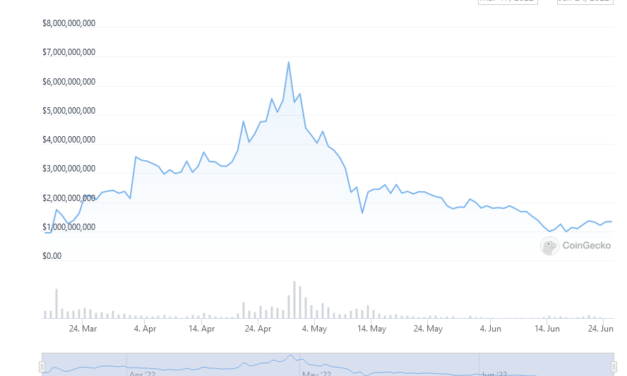
Apecoin, the Ethereum-based token tied to the widely popular and almost definitely probably not 4Chan-related Bored Ape Yacht Club NFT project, saw its market cap drop by 67.2% or $4.3 billion during May and it has continued to slide since. Despite bearish macro factors looming over both crypto and stock markets throughout 2022, May in particular was a difficult month for crypto (thanks Terra!) Much like many other assets, Apecoin was unable to escape the brunt of this downturn, and its market cap declined by $4.3 billion to sit at roughly $2.1 billion by May 31 as the price dropped from $21.27 to $6.97, according to data from CoinGecko. APE/USD: CoinGecko Trading volumes were around $5.7 billion at the start of May but fell to $498 million by the end of the month. Since then the market cap has continued to slide to $1.3 billion, with a price of $4.40 per token at the time of writing, while 24-hour trading volume is currently totaling around $264 million. That’s the lowest since it launched in March. Overall, Apecoin is down 83.5% since its all-time high market cap of $6.81 billion at a price of $26.70 per token on April 28. Pharrell Williams signs on to Doodles NFTs Doodles, one of the top NFT projects in the space founded by respected artist Burnt Toast, has signed iconic musician Pharrell Williams as its Chief Brand Officer. To date, the Doodles NFT project has generated around $503 million worth of secondary sales since launch in October 2021, and the team is currently gearing up for its second NFT drop of 10,000 tokenized avatars at a yet-to-be-revealed time later this year. Doodles 2… coming soon. https://t.co/8gw3OeeQfs pic.twitter.com/c33BB0GLqP— doodles (@doodles) June 22, 2022Williams is the man behind the much-loved, gut-wrenching, headache-inducing song “Happy” that has more than 1 billion plays on YouTube, and will work to guide the project’s strategy relating to artwork, music, product lines, animation and virtual/public events. The musician will also produce a Doodles-inspired music album titled “Doodles Records: Volume 1.”The announcement was made at the NYC NFT event on June 22, with the project also revealing it had closed a funding round led by Reddit co-founder Alexis Ohanian’s VC firm, Seven Seven Six. The amount of capital was undisclosed however. “I’m a big fan of the brand,” said Williams in a video message, adding that “We’re going to build from the core community outward and bring Doodles to new heights, new levels.”NFT art is helping the overall art market: Expert Art expert Magnus Resch thinks that mainstream adoption of NFT tech is helping break down the barriers to art collection and is attracting new buyers to a field that has often struggled for numbers due to its elitist nature. Resch is an art market economist and holds a Ph.D. in economics from Harvard University. He has also authored two books on the art business dubbed “Management of Art Galleries” and “How to Become a Successful Artist.”Speaking with Art News on June 23, Resch highlighted an interesting point on tokenized art, as he argued that the price transparency and the relative ease of purchasing makes it much less threatening for new collectors to enter the market: “The biggest problem in the art market is that we have too many visitors and too few buyers, the number of buyers is going down. And why is that? Because buyers are scared to enter the art world. It’s too elitist, it’s not open to first-time buyers. If you don’t manage to convince rookies [to join] into the art world, we will all fail.“But NFTs can help solve this issue. Suddenly there are people buying because they had the full transparency of prices and automatic access,” he added. Related: Nonfungible airdrops: Could NFA become the next big acronym in the crypto space?Solana is building a smartphone, cue jokesSolana blockchain/Solana Labs co-founder and CEO Anatoly Yakovenko has announced that the team will roll out an Android web3-focused smartphone in Q1 2023 named Saga. The phone will have a 6.67-inch 120Hz OLED display, 512GB of storage, 12GB of RAM, and will be powered by Qualcomm’s latest Snapdragon 8 Plus Gen 1 chip. It will also have a 50-megapixel primary camera and a 12-megapixel ultra-wide shooter. It will be priced at $1,000 and pre-orders with a deposit of $100 are now open. No word yet on whether the phone will go offline every other month and require a manual reboot.the solana phone is bullish for humanityforced downtime will liberate many minds and lives— mewny (@mewn21) June 23, 2022

Other Nifty News: Instagram’s parent company, Meta, announced on June 22 that it will begin testing NFTs on Instagram Stories using its augmented reality platform Spark AR.eBay, an e-commerce giant, on June 22 announced the acquisition KnownOrigin — an NFT marketplace that will help the firm foray further into the world of blockchain technology and digital collectibles.

Čítaj viac

‘Bad’ crypto projects should not be bailed out says Binance founder CZ

Binance founder and CEO Changpeng “CZ” Zhao argues that “bad” crypto projects should be left to fail and not receive bailouts from crypto firms with healthy cash reserves. In a June 23 blog post, CZ said that firms that have been poorly operated, poorly managed or have released poorly designed products shouldn’t receive bailouts — and should instead be left to crumble: “In short, they are just ‘bad’ projects. These should not be saved. Sadly, some of these ‘bad’ projects have a large number of users, often acquired through inflated incentives, ‘creative marketing, or pure Ponzi schemes.”“Further, in any industry, there are always more failed projects than successful ones. Hopefully, the failures are small, and the successes are large. But you get the idea. Bailouts here don’t make sense,” he added. The comments come amid recent moves by crypto billionaire Sam Bankman Fried and his firm Alameda Research to bail out companies and projects with recent liquidity troubles such as Voyager Digital with a revolving loan of 350 million USD Coin (USDC) and 15,250 BTC, which is worth $464.48 million at time of writing. CZ went on to note however, that Binance could look to support some cash-light firms that either have “problems but are fixable” or are “barely surviving but have great potential.”“Many projects have come to us who want to engage and talk. Again, in real life, these categories are not clear labels. All projects view themselves as the third category, and we need to look at each project in detail to decide. There is some subjectiveness to it,” he said. A number of firms are undergoing liquidity issues as a result of the current bear market, while others are reeling from exposure to potentially insolvent firms and projects such as Three Arrows Capital and Celsius. Related: Cristiano Ronaldo to get football fans into Web3 with Binance partnershipThe comments from the Binance CEO echo similar sentiments from U.S. Securities and Exchange Commission (SEC) commissioner Hester Peirce on Tuesday, who argued against crypto bailouts altogether. In an interview with Forbes on June 21, the crypto-friendly commissioner known as “Crypto Mom” argued that instead of bailing out struggling firms, it’s better to “let these things play out” to create a more sustainable industry. “When things are a bit harder in the market, you discover who’s actually building something that might last for the long, longer term and what is going to pass away,” she said. Centralized BinanceOn June 23 CZ stated during an interview with Bloomberg Business week the mission of his company is to support autonomous blockchain-based projects that can operate without a central authority or leader, as opposed to the traditional centralized model. The CEO also referred to his own company as an “organization” and his employees as “team members,” as part of this mission of decentralization.However, the publication cited comments from supposed anonymous former Binance employees saying that the company may not be as decentralized as claimed, stating that CZ has the sole authority over the company and its business decisions. “At the end of the day, he’s the holding company,” a former employee told the publication. The angle of the Bloomberg article may require a pinch of salt, given that CZ has never explicitly stated that Binance was a decentralized company despite his advocacy for the concept. Although the Binance Smart Chain does claim to be a decentralized eco-system but has drawn valid critiques over a lack of such in the past. While CZ has taken aim at poorly managed companies this week, the management structure of Binance has also been brought into question.

Čítaj viac

Voyager's 60% share price plunge leads sea of red for crypto stocks

A 60% plunge of Voyager Digital’s (VYGVF) share price since it disclosed its Three Arrows Capital (3AC) exposure has been accompanied by further falls in crypto industry stocks.According to data from trading view, VYGVF plunged as much as 60% during regular trading hours on June 22 before closing at $0.5998 to mark a drop of 50.84% for the day.The sharp drop followed Voyager Digital disclosing that the potentially insolvent Three Arrows Capital (3AC) owes the company 15,250 Bitcoin (BTC) and 350 million USD Coin (USDC) worth around roughly $660 million in total. Voyager has given 3AC until Friday (June 24) to pay $25 million, and until the following Monday (June 27) to pay full the amount before the loan will be considered in default. The company also stated that it is working with lawyers on how to pursue legal action against 3AC, should the supposed venture fund be unable to repay its debt. Alameda Research has extended a 200 million USDC revolving loan and a 15,000 BTC revolving loan to cover Voyager’s current liquidity troubles. The company has also tightened its 24 hour withdrawal limit this week from $25,000 to $10,000. “$10,000 better than $0 at Celsius,” commented Redditor AdLongjumping5010 in the r/CelciusNetwork sub-Reddit in response.Other crypto-related stocks continued to suffer. Coinbase stock (COIN) suffered a 9.71% dip to $51.91, while the heavily BTC exposed MicroStrategy (MSTR) led by Michael Saylor saw its shares drop 4.50% to $170.91. Coinbase at $14 billion is one of the dumbest things I’ve ever seen in the public markets.Rivaled maybe only by Apple trading at 50% above its cash balance in late 2008.I can’t believe boomer mispricing is going to cause me to move money into stonk account.— Ryan Selkis (@twobitidiot) June 22, 2022Crypto mining stocks also saw notable damage, with Riot Blockchain (RIOT) shedding 9.63%, while Bitfarms (BITF), Hut 8 (HUT), Marathon Digital Holdings (MARA), Core Scientific (CORZ) all dropped around 5-7% a piece. Related: SBF and Alameda step in to prevent crypto collapse contagionThe crumbling prices of crypto stocks are just a microcosm of a broader downward trend in the stock and crypto markets in 2022, with the benchmark S&P 500 Index in bear market territory and down 21.6% since the start of the year. This marks the first time this has happened since 1970 according to Bloomberg data.Related: Binance U.S. makes BTC trading fee-free as competitors feel the heatInvestors have in general been spooked by the U.S. Federal Reserve’s monetary policy and efforts to curb inflation this year by introducing a series of interest rate hikes. Fed chair Jerome Powell has kept his cards close to his chest on how the government body will reel in inflation of late however, but did suggest that as the Fed continues to push borrowing costs higher, it could be bracing for a recession. Testifying to the Senate Banking Committee on June 22, Powell stated “It’s certainly a possibility,” in response to a question from Democrat Sen. John Tester, adding that “It’s not our intended outcome, but it’s certainly a possibility.”

Čítaj viac

DeFi summer 3.0? Uniswap overtakes Ethereum on fees, DeFi outperforms

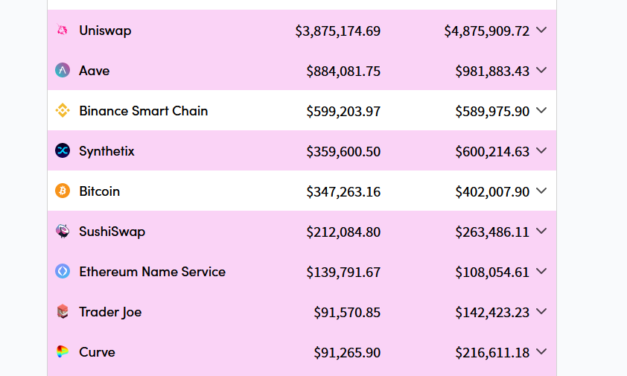
Decentralized exchange (DEX) Uniswap has overtaken its host blockchain Ethereum in terms of fees paid over a seven-day rolling average.The surge appears part of a recent spate of high demand for DeFi amid the current bear market. Decentralized finance (DeFi) platforms such as AAVE and Synthetix have seen surges in fees paid over the past seven days, while their native tokens, and others such as Compound (COMP) have also boomed in price too.According to data from Crypto Fees, traders on Uniswap accounted for an average daily total of $4.87 million worth of fees between June 15 and June 21, overtaking the average fees from Ethereum users which accounted for $4.58 million. Uniswap’s most advanced V3 protocol (based on the Ethereum mainnet) accounted for the lion’s share of the total fees with $4.4 million, while the V2 variant also contributed a notable $336,556. During this period, Ethereum’s total fees only outpaced Uniswap’s on two days out of the seven. In terms of a peak day of fees generated, Uniswap topped out at $8.36 million on June 15, beating out Ethereum on the same day at $7.99 million. Top fees paid: Crypto Fees Uniswap enables peer-to-peer (P2P) swaps of Ethereum-based tokens without having a central authority to facilitate trades. This is achieved by automated smart contracts. Under Uniswap’s fee structure, fees are paid by traders to liquidity providers who receive 100% of the fees on the DEX.Related: Uniswap breaks $1T in volume — but has only been used by 3.9M addressesConsidering Ethereum is the blockchain home to the majority of DeFi, and is known for its expensive fee structure, a DEX such as Uniswap beating out the blockchain in fees over a week is notable. According to data from CoinGecko, UNI has pumped 17.4% over the past seven days to sit at $5.18 at the time of writing. Recent acquisitions of the NFT marketplace aggregator Genie and the appointment of the former president of the New York Stock Exchange Stacey Cunningham as an advisor at Uniswap Labs may have contributed to this. DeFi surgeUniswap is not the only platform to see a surge in its fees and token price of late, as data is also showing strong investor demand for several DeFi platforms despite the current bear market. Lending protocol AAVE and synthetic derivatives trading platform Synthetix in particular are ranked third and fifth in terms of average fees paid over the past seven days with $981,883 and $600,214 apiece. Much like Uniswap, AAVE saw a surge of fees on June 15, as its total increased by 69% to $1.44 million. Its native token AAVE has also pumped 22% since then. Sythentix’s rise has been the most notable. The platform saw a whopping 928% increase in fees paid between June 11 and June 13 as the figure rose to $843,297. The total fees then dropped to roughly $400,000 by June 17, before surging another 150% to roughly $1 million on June 19. The boom can also be seen by observing Synthetix’s native asset SNX, the price of which has gained 105% since June 19 to sit at $3.08 at the time of writing. A key reason behind this appears to be the Synthetix Improvement Proposal 120 that went live last week that enables users to “atomically exchange assets without fee reclamation” therefore increasing the speed of trading. Bucking this trend however, fees on lending platform Compound have been declining since April, and generated a mere seven day rolling average of $11,753 over the past week, though its native token COMP has increased 16.7% within that time frame to sit at $40.50.

Čítaj viac

Získaj BONUS 8 € v Bitcoinoch

nakup bitcoin z karty

Registrácia Binance

Burza Binance

Aktuálne kurzy