
Autor Cointelegraph By Brian Quarmby

Battle-hardened Ronin bridge to Axie reopens following $600M hack

Sky Mavis, developers of the popular play-to-earn (P2E) NFT game Axie Infinity have announced that the Ronin bridge is back online three months after it was hacked for more than $600 million. The Ronin bridge is an Ethereum sidechain built for Axie Infinity, and it enables users to transfer assets between the sidechain and the Ethereum mainnet. On March 29, 173,600 Ether (ETH) and 25.5 million USD Coin (USDC) was drained from the bridge after hackers managed to gain access to private validator keys. The hack was worth more than $620 million at the time. According to the June 28 announcement from the Sky Mavis team, the Ronin bridge is back online after three audits (one internal, two external), a new design and full compensation of users’ stolen assets. “All wETH and USDC owned by Ronin Network users is now fully backed 1:1 by ETH and USDC on Ethereum, as promised. All users’ have been made whole.”In total, Sky Mavis has now reimbursed 117,600 ETH and 25.5 million USDC by providing the ETH liquidity to back users’ wrapped ETH (wETH) on the Ronin network. In April, around 46,000 of that ETH had already been compensated after Binance provided a bridge to its exchange so that users could swap out wETH for ETH. Liquidity was sourced from the Axie Infinity balance and founders’ funds to support the move. Binance also led a $150 million funding round to help Sky Mavis repay Axie Infinity users.The remaining 56,000 of the total stolen ETH belongs to the Axie DAO Treasury and will remain uncollateralized as Sky Mavis “works with law enforcement to recover the funds.” good job. — CZ Binance (@cz_binance) June 28, 2022As part of the revamped bridge design, Sky Mavis has updated the smart contract software to enable validators to set daily withdrawal limits, with the initial amount set at $50 million at this stage. The team also introduced a circuit breaker system that breaks down the monetary value of withdrawals into three tiers. Tier 1 is for withdrawals less than $1 million, and requires 70% of validators to sign off, and tier 2 is for amounts greater than $1 million and requires 90% of validator signatures. Tier 3 is for withdrawals greater than $10 million and requires a 90% validator sign-off, a small transaction fee and a seven-day review process. “The new bridge design includes a circuit-breaker system as a contingency plan which increases the security of the bridge by halting large suspicious withdrawals.”Sky Mavis admitted in a postmortem report in late April that its lack of decentralization had made the Ronin bridge vulnerable to the hack. At the time it had just nine validator nodes, with employees having access to four of them. After promptly raising the number of node to 11, Sky Mavis outlined intentions to raise the count to 21 within three months of the postmortem, with the long-term goal of surpassing 100 total nodes. Related: Harmony hacker sends stolen funds to Tornado Cash mixerThe team did not provide an update on how many validators nodes the Ronin network now has in the latest announcement however. Axie Infinity has seen its monthly NFT sales volume tank dramatically in 2022, with data from CryptoSlam showing that the game went from generating $126.4 million in January to just $2.8 million in June.

Čítaj viac

Crypto community confused as Celsius continues with weekly rewards

Members of the crypto community on Twitter have been left bewildered by the beleaguered Celsius Network continuing to pay weekly rewards despite pausing withdrawals two weeks ago.As previously reported, crypto lending platform Celsius paused withdrawals on June 13 after citing extreme market conditions amid the current bear market. Reports soon followed that the firm was undergoing liquidity issues and may be heading towards insolvency, potentially putting users’ funds at risk.Why is @CelsiusNetwork still paying rewards if apparently they are talking bankruptcy? Why not pause rewards and set a low withdrawal limit? Is it me or does that make too much sense?— Crypto V (@crypto_kid2021) June 27, 2022Figures such as Bitcoin (BTC) OG and CEO and co-founder of online investment platform BnkToTheFuture, Simon Dixon, tweeted his bewilderment to his 59,300 followers on June 27 over receiving nearly $4,000 worth of crypto rewards but being unable to withdraw them: “Email on one of my accounts. Can’t withdraw but @CelsiusNetwork is still paying out. I’m curious if you think the rewards should still be coming? Thoughts?” Upon searching “Celsius still paying” on Twitter, there are countless users raising questions over the lending platform, with some such as ‘CryptoStylesUSA’ calling it “insulting” that Celsius continues to pay weekly rewards while keeping their “crypto hostage.”This is honestly insulting, @CelsiusNetwork is still paying weekly rewards while holding my crypto hostage. pic.twitter.com/Cst0iqNkDc— CryptoSteve.eth (@CryptoStylesUSA) June 27, 2022

According to Celsius’ website — which is currently undergoing revamp due to the liquidity issues — the company is still advertising annual percentage yields (APYs) of up to 18.63% on crypto deposits, which many have argued is unsustainable. The SNX native token from decentralized finance (DeFi) platform Synthetix is the only asset this promotio offers at the time of writing. The top tier stablecoins have roughly a 9% APY listed, while Polkadot (DOT) and Polygon (MATIC) have offered APYs as high as 11.87% and 9.52% apiece. Celsius also appears to be still offering 10% rewards on first deposits up to $250,000 despite not currently allowing users to withdraw from the platform. While it is still uncertain what the exact fate of funds belonging to Celsius users will be, the firm reportedly onboarded advisers from a management consulting firm in advance of the company possibly facing bankruptcy. Celsius also hired lawyers on June 14 to help restructure the company amid its financial woes.Related: ‘Crypto is just like the end of the 90s with the internet bubble,’ says Hodl CEO Maurice MureauOn June 27, rumors started circulating that Celsius CEO Alex Mashinksy allegedly attempted to leave the country via Morrison Airport in New Jersey but was stopped by authorities. It appears the story originated from crypto analyst Mike Alfred, however, the firm has reportedly denied the accusations.

Čítaj viac

Institutional crypto asset products saw record weekly outflows of $423M

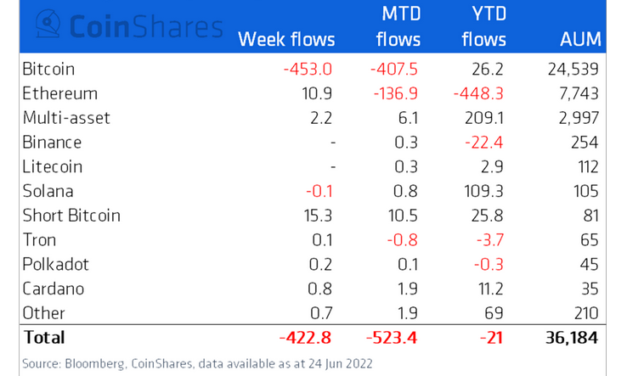
Digital asset investment products saw record outflows totaling $423 million last week, with institutional investors from Canada representing nearly all of the carnage. According to the latest edition of CoinShares’ weekly “Digital Asset Fund Flows” report, Canadian investors offloaded a whopping $487.5 worth of digital asset products between June 20 and June 24. The total outflows for the week were partially offset by $70 million worth of inflows from other countries, with U.S.-based investors accounting for more than half of the inflows with $41 million. Outside of the U.S., investors from Germany and Switzerland accounted for inflows totaling $11 million and $10.4 million apiece. In comparison, Brazilians and Australians also pitched in with minor inflows of $1.6 million and $1.4 million. Overall the outflows totaled $422.8 million, marking the largest weekly shedding by institutional investors since CoinShares records began. Notably, the figure is more than double the previous record of $198 million posted in January this year. “Regionally, the outflows were almost solely from Canadian exchanges and one specific provider. The outflows occurred on 17th June but were reflected in last week’s figures due to trade reporting lags, and likely responsible for Bitcoin’s decline to US$17,760 that weekend.”Regarding outflows by asset, investment products offering exposure to Bitcoin (BTC) saw $453 million worth of outflows, while Solana (SOL) products also saw minor outflows of $100,000. The sharp offloading of BTC products last week has nearly pushed the year-to-date (YTD) flows into the negative, with the figure now standing at just $26.2 million worth of inflows during 2022 so far. Related: Final Capitulation — 5 reasons why Bitcoin could bottom at $10,000Investment products offering exposure to shorting the price of BTC generated the largest inflows for the week at $15.3 million. CoinShares noted this was primarily due to ProShares launching the first-ever short Bitcoin exchange-traded fund (ETF) in the U.S. on June 22. Ethereum (ETH) investment products also bucked an 11-week trend of outflows by posting inflows of $10.9 million. However, YTD Ether products have seen outflows totaling $448.3 million, making it the least favored investment choice amongst institutional investors this year.Flows by Asset: CoinShares

Čítaj viac

ANZ's stablecoin used to buy tokenized carbon credits

ANZ’s stablecoin A$DC has been used to buy Australian tokenized carbon credits, marking another critical test of the asset’s use cases in the local economy. In March, the “Big Four” bank became the first major Australian financial institution to mint its own stablecoin after overseeing a pilot transaction worth 30 million AUD ($20.76 million) between Victor Smorgon Group and digital asset manager Zerocap. ANZ’s stablecoin is fully collateralized by Australian dollars (AUD) held in the bank’s managed reserved account. So far, A$DC transactions have primarily been conducted over the Ethereum blockchain. According to a June 27 report from the Australian Financial Review (AFR), the latest transaction saw its long-time institutional partner Victor Smorgon use A$DC to purchase Australian Carbon Credit Units (ACCUs). The carbon credits were tokenized and provided by BetaCarbon, a blockchain-based carbon trading platform that issues digital security assets dubbed “BCAUs,” which represent one kilogram of carbon offsets per credit. The transaction also saw participation from Zerocap again, who provided market-making services and liquidity by exchanging the A$DC sent from Victor Smorgon into USD Coin (USDC) so that BetaCarbon could accept the deal. The value of the transaction has not been specified, however. In terms of the bank’s outlook on the crypto/blockchain sector, ANZ’s banking services portfolio lead Nigel Dobson told the AFR that the firm is looking at blockchain tech as a means of “pursuing the transition of financial market infrastructure” and is not necessarily interested in speculative crypto assets themselves. “We see this is evolving from being internet-protocol based to one of ‘tokenized’ protocols. We think the underlying infrastructure – efficient, secure, public blockchains – will facilitate transactions, both ones we understand today and new ones that will be more efficient.”Dobson echoed similar sentiments at the Chainalysis Links event in Sydney on June 21, noting that ANZ promptly “banned the word crypto immediately in all of our internal communications and narrative” when it started exploring blockchain tech a few years ago. He went on to add that the bank has explored multiple use cases for blockchain tech, such as supply chain tracking and providing on-ramps via stablecoins for institutions to invest in digital assets. However, Dobson suggested that tokenized carbon credits were a key area that the bank has been gearing up for: “Another area where we have a strong position in terms of sustainability is where we feel the tokenization of carbon credits and marketplaces driven by tokenized assets and tokenized value exchange will be really efficient.”Related: BTC Markets becomes first Australian crypto firm to get a financial services licenseAt the start of this month, ANZ ruled out offering any crypto exposure to retail investors due to their lack of financial literacy. Maile Carnegie, an executive for retail banking, noted at the Australian Financial Review Banking Summit that “the vast majority of them don’t understand really basic financial well-being concepts.”

Čítaj viac

Nifty News: Yuga Labs breaks silence, X2Y2 outpaces OpenSea and more…

Yuga Labs has finally broken its silence over the conspiracy theory that alleges the team embedded alt-right and Nazi memes/imagery into the artwork and branding behind the Bored Ape Yacht Club (BAYC). As Cointelegraph previously reported, the BAYC conspiracy theory was once again brought into the limelight on June 20 after YouTuber Philion published a video exploring the supposed evidence that artist Ryder Ripps initially compiled at the start of this year.In a Medium blog post shared via Twitter on June 25, Yuga Labs co-founder Gordon Goner said that the team finally decided to clear the air after the theory had gotten so much attention that one of their favorite podcasters was talking about it. “We’ve not responded in further detail to these allegations because frankly they are insanely far-fetched.”“That said, we woke up this morning to a podca///ster we respect talking about this conspiracy theory, and that was pretty surreal. Made us feel like it was time to come out and put an end to all this,” he added. In particular, Ryder Ripps alleged the BAYC NFT artwork featured racist caricatures of Black and Asian people, and the project’s logo and branding have several nods to certain Nazi symbology and language. The artist also made a BAYC derivative NFT collection called RR/BAYC as a satire and protest against Yuga Labs. While the team didn’t address all of the points outlined against the BAYC, it flat out denied the allegations that its logo was derived from the Nazi Totenkopf (skull and crossbones) symbol. It also reiterated that using Apes in the BAYC is a nod to crypto degens and not a racist troll. However, not everyone was pleased with their response, as several points went unaddressed. dude’s like ‘we’re minorities’ and gets some sham cover from the ADL. Well I’m a jew and descendant of holocaust survivors and this imagery offends me but keep gaslighting pic.twitter.com/kbJlJaEYE4— jpəġ jəđ (@h0listicrypto) June 24, 2022In an update later that day, the Yuga Labs team also stated it had taken legal action and filed a lawsuit to “stop the continuous infringement, and other illegal attempts to bring harm” to the firm and community. Although It didn’t mention Ryder Ripps by name directly by name.(1/2) The outpouring of support from our community today has been overwhelming. We will continue to be transparent with our community as we fight these slanderous claims. In order to put a stop to the continuous infringement, and other illegal attempts to bring harm to…— Yuga Labs (@yugalabs) June 25, 2022

Volume on NFT marketplace X2Y2 surges past OpenSeaOver the past several weeks, the sales volume on Ethereum-based NFT marketplace X2Y2 has surged past the top platform in the sector OpenSea. According to data from DappRadar, X2Y2 generated $144.16 million worth of NFT sales from just 11,534 traders over the past week, compared to the $117.64 million generated from 155,734 traders on OpenSea.Seven day NFT marketplace sales volume: DappRadarThe X2YX platform launched in February earlier this year, and while it doesn’t appear to host the sale of any top-tier NFT projects, it does provide an OpenSea Sniper feature that enables users to bundle NFT purchases on both X2YX and OpenSea into one transaction. X2YX has seen its daily volumes surge to new highs in June, with its highest ever recorded day of volume coming on June 6 with $32.92 million. One of the reasons behind the platform’s bullish growth this month appears to be its zero trading fees promo from June 1 until June 30. Crawley Town to release soccer kits tied to NFTsProfessional English football (soccer) club Crawley Town F.C. are rolling out a soccer kit (playing uniform) that can only be obtained by fans that purchase the corresponding NFT. Crawley Town currently plies its trade in the fourth tier of the English professional league structure, and it was acquired by sports-focused crypto firm WAGMI late last year. Pro-teams generally have three different kits each season, one for home games, one for away and a third alternate kit. In this instance, the third kit will be offered to fans via the sale of NFTs. Speaking with U.K. news outfit the Mirror on June 25, Crowley Town co-owner Preston Johnson stressed that the club is not trying to launch NFTs for a quick profit and is instead looking for ways to integrate the tech with avenues such as shirts and ticketing: “Our NFTs are more like virtual season tickets. They’re not items we’re trying to sell to local fans.”Related: Can Metaverse technology enhance human-AI efficiency?BCware launches NFT app in Shopify App Store California-based Web3 tech firm BCware has launched a new multi-chain NFT app in the Shopify App Store that enables merchants to provide NFT buying and selling services from multiple blockchains in their stores.The app is currently integrated with Ethereum, Polygon, Flow and Solana, and also enables customers to pay via fiat or cryptocurrency. The firm also stated that the app will support “wallet onboarding for buyers who are new to crypto.”The move comes the same week that Shopify rolled out an NFT-gated storefronts feature that allows brands/merchants to make their online stores more exclusive. Sell Where You TweetYou know Twitter is where your people are, and now they can discover your products directly on your profile.So next time you have a tweet doing numbers, you can plug your own products instead of someone else’s. Right @trixiecosmetics? pic.twitter.com/teuIkQkzbL— Shopify (@Shopify) June 22, 2022

Other Nifty News: On June 24, Eminem tweeted that a new song called “From The D 2 The LBC” would be released. The post included the song’s art, which is in a comic book style with two cartoon monkeys representing both Snoop Dogg and Slim Shady and their connection to the Bored Ape Yacht Club.Football superstar Cristiano Ronaldo has signed an exclusive multi-year NFT partnership with crypto exchange Binance. The collaboration aims to introduce soccer fans to the Web3 ecosystem through global NFT campaigns.

Čítaj viac

Získaj BONUS 8 € v Bitcoinoch

nakup bitcoin z karty

Registrácia Binance

Burza Binance

Aktuálne kurzy