Autor Cointelegraph By Brian Quarmby

Aussie FPA supports 'crypto rule book' and regulation of exchanges

The Financial Planning Association of Australia (FPA) has shown its support for the “crypto rule book” idea and called for regulating exchanges instead of crypto assets.In May, the Australian Law Reform Council (ALRC) proposed to tackle crypto regulation through a rule book-style framework which sets out a series of gradually updated compliance principles for local crypto firms to adhere to. The comments came via a submission to the Treasury by FPA’s head of policy, strategy and innovation, Ben Marshan, who also argued that the regulation of crypto exchanges should fall under the current financial services regime and not under a new separate legal framework. “Firstly, it would create an alternate, duplicate regulatory regime to regulate what at the core is the purchase and holding of a financial asset to either retail or wholesale investors.”“Secondly, it would require existing financial service licensees to apply for and hold a separate type of license, adding to cost and regulatory duplication,” he added. Mashan also emphasized a need to roll out greater consumer protections for local Australian crypto users and highlighted that regulating secondary providers (crypto exchanges, brokers etc.) is the best way to do this.“The regulation of a financial product or service should not depend on the technology which underlies the asset,” he said, adding that “it would be virtually impossible to regulate the product because it’s so decentralized, they’re in all sorts of foreign jurisdictions.”Focusing regulation on crypto service providers will remove a lot of “complexity” from the equation given the rapidly evolving nature of blockchain tech and crypto, argued Mashan, adding that the ALRC’s crypto rule book idea for firms to follow “makes sense.” “It makes it a lot easier because instead of having to work your way through thousands of pages of the Corporations Act people can go to a specific section, and it’s much more efficient.”Speaking with Cointelegraph, Ryan Parsons, the co-CEO of local crypto exchange Swyftx, echoed the calls from Mashan and noted that his firm wants to see “sensible measures that support consumer protections” enacted soon so that Australia doesn’t risk falling behind the United States and European Union: “Our preference is for crypto platforms to operate within the existing financial services licensing framework, albeit in a way that accounts for the unique characteristics of digital assets.”“We think this is the best way to reduce complexity and cost, as well as build confidence in crypto as an asset class among Australian investors,” he added. Related: Chainalysis tips Australia will crack down on misleading crypto adsAnother key idea highlighted in the ALRC’s report was to introduce the Twin Peaks regulatory model, in which regulation is split between one entity that is tasked with overseeing the maintenance of financial system stability while the other takes care of institutional market conduct and consumer protection. The same model is used in Australia’s financial regulatory system, with the Australian Securities and Investments Commission (ASIC) in charge of good market conduct and consumer protection, while the Australian Prudential Regulation Authority (APRA) is responsible for financial system stability. Since the Liberal party was emphatically booted out of government in May, the regulatory landscape of crypto in Australia has become uncertain as the Labor party appears to have other fish to fry. As it stands, Labor is yet to provide any concrete initiatives but has outlined that introducing greater consumer protections in crypto will be a key area of focus.

Čítaj viac

34% of gamers want to use crypto in the Metaverse, despite the backlash

Despite a backlash from a vocal part of the gaming community, a new survey has revealed one-third of gamers have expressed interest in using crypto in the Metaverse.And more gamers than not believe the Metaverse will have a positive impact on gaming. The survey was published on July 13 by institutional software developer Globant. It was conducted by YouGov and polled 1,000 adult PC, console and/or mobile gamers last month, with 34% of respondents indicating an interest in conducting crypto transactions in Metaverse. The concept of play-to-earn (P2E) in the Metaverse is also relatively well received by gamers, with 40% of respondents stating that they are “interested in pursuing a mix of both the ‘playing’ and ‘earning’ aspects of the Metaverse.” While 11% indicated they are more interested in earning, and 49% stated they are only interested in playing. More than half (53%) of respondents also stated that they would happily work in virtual game worlds if they were able to earn digital currency from their labor. In terms of NFTs, 16% of gamers stated that they have purchased at least one in the past, however it was unclear whether they were gaming related NFTs. More than half (52%) of gamers believe the Metaverse will change the video game industry and “a plurality of 41% think that the Metaverse will have a positive impact on the industry (vs. 25% who disagree).” Notably however, despite 40% of respondents associating blockchain tech with Metaverse, only one blockchain-native platform made the list of the most recognized Metaverse brands. The most recognized is Meta at 73%, followed by Fortnite creators Epic Games at 27%, Roblox at 21%, Ethereum-based The Sandbox at 15%, and Pokemon Go developers Niantic at 10%. Some die-hard gamers have voiced distaste for crypto and NFTs on numerous occasions, often in response to major companies and brands announcing such integrations into their product lines. They criticize the environmental impact of the technology, suggest that it negatively impacts the gaming experience, but the core rationale appears to be a belief companies are just looking for cash grabs in a similar vein to the controversial in-game microtransactions. Related: NFT volume sees yearly low in June, but first-time buyers remain consistentRecently video game developer Mark Venturelli launched an attack on NFTs during Brazil’s International Games Festival in a presentation titled “Why NFTs are a nightmare.” Venturelli argued that the introduction of speculative economic activity via NFTs will end up ruining the experience for people who just want to play games for fun, as “organized groups” will take over as they work to profit at scale.

Čítaj viac

Hyosung America makes Bitcoin purchasing app available to 175,000 ATMs

Hyosung America has signed a partnership deal with cash-to-crypto provider DigitalMint that enables Bitcoin (BTC) purchasing across the firm’s 175,000 ATMs located in the U.S. Apart from offering its own BTC and Litecoin (LTC) payment rails such as ATMs, bank wires and tellers, DigitalMint also provides software API integrations that allow retailers or ATM operators to sell BTC through their machines. As part of the deal, which was announced on July 12, Hyosung America will add DigitalMint’s crypto buying services to its upcoming API-based app store, which is being built for the firm’s ATMs. However it will be up to the specific ATM operator to decide whether they want to incorporate DigitalMint’s services or not, which means it is unlikely the majority of Hyosung’s 175,000 ATMs will actually support BTC buying. The CMO for Hyosung America, Brad Nolan stated the API-based app store will not only offer ATM operators a chance to sell BTC, but also offer a chance to provide a host of new services on them:“With the app store, any ATM operator using our retail software platform can subscribe and download apps such as DigitalMint, to enable their ATMs to do more — driving new revenue streams for the operators and the retailers with whom they partner.” Given the scale of Hyosung America’s ATM network, it may provide significant customer exposure for DigitalMint’s services. It is unclear if the duo have plans to launch further collaborations however, considering that DigitalMint offers crypto buying services for just two crypto assets. Excited to partner with DigitalMint in launching new innovative technology. Read more here: https://t.co/OyqzhJSmk4 https://t.co/ZkHVZWJB6U— Hyosung America (@HyosungAmericas) July 12, 2022Hyosung America is the North American subsidiary of South Korean firm Hyosung, Inc, and claims that it is the “largest provider of ATMs” in the U.S. The company has not made any notable plays in crypto apart from this, but given that it is working on an API-based app store, more crypto partnerships could follow. Related: Bitcoin ATM operators set up association to counter money launderingAccording to data from Coin ATM Radar, as of this month there are currently 33,772 Bitcoin ATMs installed in the U.S., making it the country with the most BTC ATMs in the world. For contrast, second-placed Canada has just 2,438 BTC ATMs installed, while the combined figure for the entire world stands at 38,430. Coin ATM Radar data suggests that interest in crypto friendly ATMs is waning, with Cointelegraph reporting on June 5 that global Bitcoin ATM installations hit a record low in May of just 202, a range not seen since 2019. The figure did surge back to around 714 by June, however the number is still well off ATH figures of 2,037 posted in August 2021.

Čítaj viac

Nifty News: GameStop NFT's first day, Limewire trends and game dev attacks!

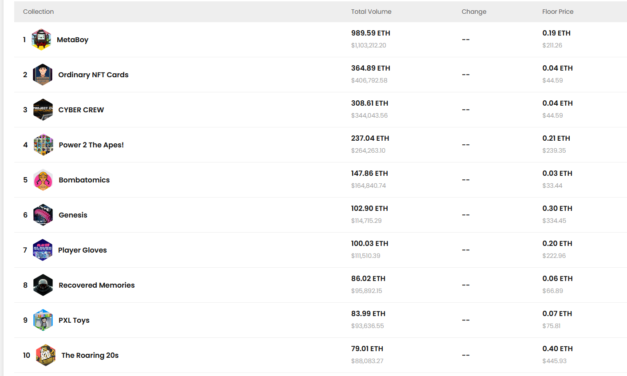
GameStop’s new NFT marketplace took home roughly $44,500 from transaction fees in the first 24 hours after it launched via a public beta on Monday. GameStop NFT reportedly generated around $1.98 million worth of NFT sales on its first full day of business. As the platform charges a 2.25% fee on NFT sales, this equates to roughly $44,500 worth of fees. While that sum may seem underwhelming, considering it would represent just 0.27% of GameStop’s daily revenue for 2021, it depends on your perspective. According to gaming news outlet Kotaku, GameStop had 4,816 stores across the U.S. at the start of 2021, which on average accounted for $3,426 worth of daily net sales for the company. To provide further contrast, despite much anticipation in the lead-up to its launch in May, Coinbase NFT generated just $75,000 worth of NFT sales on its first day, and took roughly a month to generate $1 million worth of sales volume. Coinbase NFT also offered zero fees to attract new users that month. GameStop NFT, which is based on Ethereum Layer 2 Loopring, is currently home to a long list of new and unknown NFT projects. However, it will soon be home to several projects from Ethereum Layer 2 scaling solution, Immutable X such as Gods Unchained, and Guild of Guardians. The duo partnered back in February to develop NFT games together. At this stage, the MetaBoy NFT project depicting animated GameBoy-like console avatars is the marketplace’s top-selling collection so far, and has generated 989.597 ETH worth of volume, or $1.1 million at current prices. Top 10 selling projects: GameStop NFTWhen game devs attack: ‘Why NFTs are a nightmare’Video game developer Mark Venturelli launched a surprise attack on NFTs during Brazil’s International Games Festival on Friday. The event was sponsored by multiple NFT/blockchain companies such as Lakea and Ripio.Venturelli, known for his work on Chroma Squad was penciled in to provide a virtual presentation on the future of gaming, however after introducing himself he promptly switched gears by launching into a tirade about “why NFTs are a nightmare.”Venturelli’s presentation, which also has an English version, essentially argues that the introduction of speculative economic activity via NFTs will end up ruining the experience for people who just want to play games for fun.During an interview with PC Gamer on July 11, Venturelli said:”What’s actually going to happen is that organized groups are going to operate and scale with ever-diminishing margins, and just push out everybody else. Because that’s what happens. If you play EVE Online or Runescape, or any other game that simulates economy, that’s what happens.” “Organized groups are going to fucking crush you. What actually is going to happen is that if you just naively play a game and have fun—imagine that—then you want to sell your stuff, your stuff is not going to be worth anything,” he added.Tony Hawk drops in… to the MetaverseSkateboarding icon Tony Hawk has partnered up with The Sandbox to build the “biggest skatepark” in the Metaverse. The move was announced on July 13, and early previews show users socializing at Hawk’s skatepark and the ability to build customized courses their avatars can skate around. Specifics are sparse at this stage, but Hawk noted that it will be the “biggest skatepark” to hit the Metaverse. The deal marks another notable mainstream partnership for The Sandbox this week, after Playboy announced that it was launching the MetaMansion on the platform. Coming soon to The Sandbox: alongside @Autograph, I’m helping to create the biggest skatepark in the #metaverse. Stay tuned for updates. pic.twitter.com/0R2ODsR4qt— Tony Hawk (@tonyhawk) July 13, 2022Limewire is back with a bang Limewire, the brand famous for providing file sharing/pirated music between 2000 and 2010, is trending on Twitter this week following its relaunch as a music and entertainment focused NFT platform.Limewire is trending, and no it’s not the Limewire that used to give your computer viruses. The company has now rebranded as a music NFT marketplace. Now that Limewire has released its new promo, the internet has some thoughts (: @limewire) pic.twitter.com/RB4Gp7o2XE— What’s Trending (@WhatsTrending) July 13, 2022

The platform launched on July 7 and has nothing to do with the torrent software apart from purchasing the rights to use the name. It has partnered with iconic musicians from the 2000’s such as Soulja Boy to spread the word. Many people on Twitter have since had fun pointing out the irony of Limewire going from an music pirating platform, to selling NFTs in which their artwork can easily be “stolen” via a right-click and save. Limewire has joined in on the fun however by retweeting such memes.https://t.co/b7jS5TLhY9 pic.twitter.com/ycuZEbddXN— LimeWire (@limewire) July 13, 2022

Related: UK court allows lawsuit to be delivered via NFTOther Nifty News: Blockchain analytics service Nansen published its NFT Indexes Report for the second quarter of 2022, with the data showing June recorded the lowest figure of the calendar year despite buyers remaining consistent. China’s biggest city Shanghai officially intends to boost the development of innovations such as blockchain, NFTs, the Metaverse and Web3 during its next five-year plan.

Čítaj viac

Why Coinbase is banning slide decks and 'endless meetings'

Crypto exchange Coinbase is getting rid of slide decks and “endless meetings” as a way to improve productivity following the purge of roughly 18% of employees last month. In a July 13 blog post, Coinbase CEO Brian Armstrong noted that the company is currently focused on “driving more efficiency” as it continues to scale, pointing to a 200% year-on-year employee growth over 18 months that had started to put a strain on the firm’s organizational structure. He suggested that many major firms experiencing rapid growth generally end up becoming complacent and slowing down, while great companies do the opposite: “While this trajectory is natural, it is not inevitable. Every great company, from Amazon to Meta to Tesla, found ways to retain their founding energy in conjunction with appropriate controls, even as they scaled to be much larger than Coinbase is today.”As part of the focus on efficiency, Armstrong stated the firm is “experimenting with banning slide decks in product engineering reviews” to speed up the product development process. “Inside growing companies, there’s a danger that product and engineering teams start shipping great slide decks instead of great products,” said Armstrong.Slide decks are essentially a series of slides used for visual representation when presenting ideas. They are very popular ways to communicate big ideas but have a reputation for frequently not being realized. “But our customers never see the slide decks we create. They only see the product.”Armstrong says that he wants his employees to instead show realistic previews of how the products work in real-time using dashboards with metrics, product mockups, and the actual product itself. “The important thing is to get hands-on with the product, see what the customer is seeing (or is about to see), and make it better,” he said. The crypto exchange boss says he also wants to scrap internal meetings amongst its product and engineering teams, as Armstrong said they often get bogged down with “endless meetings around prioritization and feature requests.”The firm will instead be moving to a model where all product and engineering teams will publish APIs under an internal API catalog that will provide “consistent libraries and languages for authentication, logging, instrumentation, etc.” Such a feature will help different teams benefit from each other’s work “without ever needing to schedule a meeting.” “In other words, they need to productize their services and allow other teams to use them in a self-service way,” he explained. Related: Risk profile of crypto markets similar to oil and tech: CoinbaseArmstrong also outlined that the company will be organizing its teams into “small pods” of 10 or fewer people who will be assigned to a specific feature or area, give more decision powers to directly responsible individuals (DRIs) and provide information sharing services between product teams. This year, Coinbase launched an NFT marketplace, an upgraded mobile wallet app, expanding staking offerings to Solana (SOL) and also has plans to offer futures trading to its clients if its application to operate as a futures commission merchant (FCM) is approved. The price of Coinbase’s stock COIN has seen a challenging year however, crashing 78.21% since the start of 2022 to sit at $54.24 at the time of writing, according to data from TradingView.

Čítaj viac

Získaj BONUS 8 € v Bitcoinoch

nakup bitcoin z karty

Registrácia Binance

Burza Binance

Aktuálne kurzy