Autor Cointelegraph By Brian Quarmby

Once-hacked for $77M, Beanstalk's algo stablecoin protocol relaunches

Ethereum-based algorithmic stablecoin project Beanstalk Farms has relaunched its protocol just under four months after going offline after suffering a devastating $77 million governance exploit.The protocol and its governance have been paused since April following the governance exploit and flash loan attack, but were relaunched as of Aug. 6 in an event called the “Replant.” In an announcement shared with Cointelegraph, Beanstalk said it has come out of the ordeal stronger than ever, likely in reference to protocol’s governance and security. “Beanstalk has come out on the other end of this ordeal stronger than ever. It is a testament to the creditworthiness of the protocol and its potential to help realize a permissionless future,” said Publius, the developer group behind the BEAN stablecoin and protocol. Publius stated that it has now moved protocol governance to a community-run multisig wallet until “a secure on-chain governance mechanism can be implemented.” The team also stated that it has completed two protocol audits from “top not smart contract auditing firms” in Trail of Bits and Halborn. The spokesperson also highlighted that new application development on the network is already in the works, with the Root Protocol announcing a $9 million seed round on July 26 to develop financial, commerce, and sports betting marketplaces on Beanstalk.Today, Beanstalk Farms is thrilled to announce that Beanstalk has been Unpaused on the one year anniversary of its initial deployment.https://t.co/HxZmwWksZe— Beanstalk Farms (@BeanstalkFarms) August 6, 2022The project has a long way to climb back until it’s matching the previous metrics it hit before the hack. In mid-April, Beanstalk’s algo-stablecoin BEAN topped a market cap of $100 million, however at the time of writing the figure stands at just $284,426, with the asset far off the $1 peg at $0.0039, according to data from CoinGecko. The project has also had limited success clawing back the funds stolen in the April exploit. As of Jun. 5, the project raised $10 million via a fundraiser to restore the stolen funds.Long-term sustainabilityHowever, as the jury is also still out on algorithmically backed stablecoins, it remains to be seen how sustainable BEAN will be long-term. Publius even highlighted such back in June, as he noted: “At present, it is unclear whether Beanstalk is good enough to sustain itself in perpetuity. There still remain some inefficiencies in the model. However, Beanstalk is likely good enough to continue to sustain itself in the short term.”“The thing about a system like Beanstalk is that it works until it doesn’t. You can never actually know if it works, only that it has worked so far. So much uncertainty is scary, particularly without a clear definition of success,” Publius added. Related: Vitalik: Centralized USDC could decide the future of contentious ETH hard forksMany projects have come up with various ways to get around collateral requirements and centralization problems associated with launching a scalable stablecoin. Beanstalk’s variation relies on a decentralized credit facility, decentralized price oracle, and governance community to operate and hover around its intended $1 peg.

Čítaj viac

Crypto bear market will provide ‘excellent’ M&A opportunities: White Rock CEO

White Rock Management CEO Andy Long believes bear markets “present excellent opportunities” for expansion via mergers and acquisitions in the crypto mining sector. Speaking with Cointelegraph, the crypto mining company CEO noted that companies who have managed their balance sheets effectively are in “great shape” during this bear market, and will continue to do well even if there’s more volatility to come. “The bear market has presented challenges for the miners who leveraged up at the top of the market, however, the sector has been here before, and well capitalized and efficient miners will do just fine,” he said.Long suggested that the current bear trend will provide key merger and acquisition opportunities for such companies, as they will have proven to investors that they can survive extreme market conditions: “Bear markets actually present excellent opportunities, so we expect to see M&A and consolidation activity in the mining sector involving both public and private players — to realize economies of scale and combine complementary operations.” “We’ll also see network growth picking up again, not to the level forecasted at the end of the year, but we’ll likely be at least 20% higher by year-end,” he added. Long also noted that the Texas mining sector has done well despite the ongoing heatwave. He noted the sector’s effective coordination with the Electric Reliability Council of Texas (ERCOT) to overcome energy supply issues over the past couple of months: “There’s a ton of activity in Texas and the mining sector is in great shape. Grid-connected miners are working with ERCOT to provide demand response during challenging weather, and we see continued growth ahead across the state.”White Rock is a crypto mining firm based out of Switzerland, that claims to have around 24 MegaWatts worth of plant capacity installed. In June announced plans to expand its operations to the U.S., starting with Texas. As part of the move, White Rock partnered with Natural Gas Onsite Neutralization (NGON) to operate out of its facility which utilizes “environmentally responsible” methods to mine Bitcoin (BTC). Heat waves As previously reported on July 11, mining firms such as Riot Blockchain and Core Scientific powered down parts of their Texas mining operations in June to reduce stress on the energy grid following temperatures rising well over 100 degrees. Both f were proactive in easing the pressure on Texas’ energy supply, but another contributing factor was that energy prices had soared amid the heat wave. Related: Will the Bitcoin mining industry collapse? Analysts explain why crisis is really opportunityAs a result of the move, the firms suffered reduced mining productivity. However, with the price of BTC gaining 14.7% over the past month, and with temperatures looking set to drop slightly to around the 90-degree mark, there is a feeling that miners will be switching their machines back on as the BTC mining profitability will be too good to ignore. “The Bitcoin price increase has led to increased profitability for miners and some miners who were pushed offline in June and July have likely plugged in their machines again,” noted Jaran Mellerud, a crypto-mining analyst at a research firm Arcane Crypto, in an interview with Bloomberg on Aug. 5. The price of Bitcoin is sitting at $23,088 at the time of writing. 

Čítaj viac

Jack Dorsey-led Block posts $1.5B in Q2 profits, BTC revenue down

Former Twitter CEO Jack Dorsey’s digital payments firm Block Inc. saw its year-on-year (YoY) profits soar 29% to $1.47 billion in Q2, though its Bitcoin business slumped on decreased customer demand and a fall in Bitcoin (BTC) prices.The financial services firm primarily generates Bitcoin revenue by providing BTC trading services via its digital payments application Cash App. Block Inc. noted the business generated $1.79 billion of Bitcoin revenue in the quarter, down 34% YoY, while Bitcoin gross profit was only $41 million, which suggests it may be a high-cost venture to provide Bitcoin services to its customers. Block Inc. said the fall in Bitcoin revenue was attributed to “broader uncertainty” in crypto assets, stating: “The year-over-year decrease in Bitcoin revenue and gross profit was driven primarily by a decline in consumer demand and the price of bitcoin, related in part to broader uncertainty around crypto assets, which more than offset the benefit of volatility in the price of Bitcoin during the quarter.” However, Block Inc. emphasized that the BTC profit slump doesn’t reflect the broader performance of the business. It also noted that BTC profits will likely fluctuate over time as a result of “changes in customer demand or the market price of Bitcoin.” The company also noted that it recognized a $36 million impairment loss on its BTC holdings, however this is likely just a loss on paper. Under U.S. accounting procedures, crypto is classified as an intangible asset on balance sheets and companies must report a loss when the price of the asset drops below its cost basis, even if a gain or loss has been realized through a sale during the given quarter. The company noted that as of June 30, 2022, the fair value of its investment in Bitcoin is $160 million based on market prices. Related: Interview with Kevin O’Leary: $28K Bitcoin next or lower? | Market Talks with Crypto JebbInvestors appear un-impressed with Block Inc.’s performance in Q2 however, as the firm’s stock SQ has dipped by 7.42% in after-hours trading to sit at $83 at the time of writing. Bloomberg suggested this was due to the company reporting lower than expected transaction volume at $52.5 billion, as opposed to the estimated $53.47 billion. Bitcoin from the Block Dorsey, the fervent Bitcoin maxi, has been relatively quiet about his plans for digital gold since announcing that Block Inc. was bypassing the Web3 model to build the Bitcoin blockchain-focused Web5 project in June. Web5 is essentially a decentralized web platform, or DWP, that allows developers to create decentralized web apps via DIDs and decentralized nodes, which will also have a monetary network built around BTC, and not smart contract backed tokenization. nah pic.twitter.com/RTHLWYjY0L— jack (@jack) June 16, 2022

Čítaj viac

Starbucks teases Web3 rewards program to attract new customers

Global coffee store franchise giant Starbucks is looking to launch a new Web3 rewards program to attract and retain customers, according to its interim CEO Howard Schultz.Speaking during the firm’s fiscal Q3 earnings call on Aug. 2, Schultz noted that Starbucks will soon reveal a new Web3 “digital initiative” that will expand upon the company’s loyalty program:“This new digital Web 3-enabled initiative will allow us to build on the current Starbucks Rewards engagement model with its powerful spend-to-earn Stars approach while also introducing new methods of emotionally engaging customers.” The CEO kept his cards close to his chest, but briefly mentioned during the call that the firm is looking at “integrating our digital Starbucks Rewards ecosystem with Starbucks-branded digital collectibles as both a reward and a community building element.” The full reveal is set to occur during Starbucks’ Investor Day on Sept. 13. “This will create an entirely new set of digital network effects that will attract new customers and be accretive to existing customers in our core retail stores,” he said. So @Starbucks wants to come into web3 well I just hit every popular drink and Starbucksmenu.eth pic.twitter.com/1c2wRbl02U— Jay (@BitBoyJay) August 4, 2022The company’s quarterly results reportedly beat analyst estimates, with a 9% quarter-over-quarter bump in global revenue to a record $8.2 billion. During the call, Schultz also said that the Web3 move is part of a push to attract and retain the younger side of Starbucks’ customer base. “We don’t want to be in a business where our customer base is aging and we have a less relevant situation with younger people,” he said, adding that the company has “never been, in our history, more relevant than we are today to Gen Z.”do yₐ ₜᵢₙₖ wₑₙ @Starbucks gᵢₜ ₜₐ gₒbₗₑₙₜₒwₙ @molly_mccutch wᵢₗₗ cᵤₘ giₜ ₘₐₜcₕₐ wᵢₜ @goblintherapiss ? pic.twitter.com/KSIQvgjql0— goblintown.wtf (@goblintown) August 4, 2022

Starbucks initially announced plans to jump on the NFT bandwagon back in April, as Schultz noted that “sometime before the end of the calendar year, we are going to be in the NFT business.”Related: Canadian taco franchise uses NFTs for customer loyalty programStarbucks may not be the only major brand to launch a Web3 loyalty program in the near future. Last month business-to-business blockchain startup Hang raised $16 million in Series A funding led by Paradigm. The company is looking to help brands transition their current membership and loyalty programs over to the blockchain and incorporate NFTs.The firm is reported to have beer manufacturer Budweiser, sports media outlet Bleacher Report, and popular music festival groups Bonnaroo and Superfly as some of its early clients.

Čítaj viac

After four years, Japan brings back its first crypto ATM

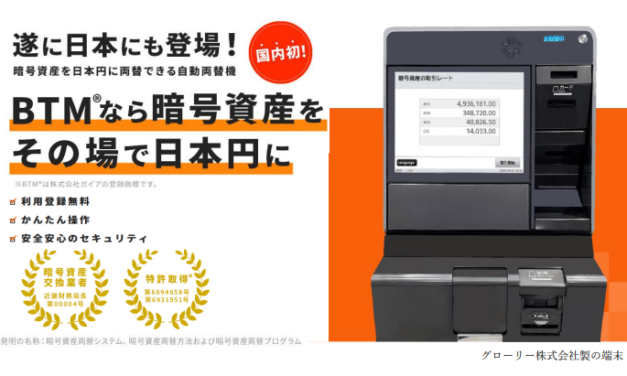
Crypto ATMs — or BTMs as per local terminology — are back in Japan after a lengthy four-year hiatus.Local crypto exchange firm Gaia Co., Ltd announced on Aug. 2 that it will soon roll out BTMs that support Bitcoin (BTC), Ethereum (ETH), Bitcoin Cash (BCH), and Litecoin (LTC). Despite Bitcoin ATMs having made their debut in Tokyo as early as 2014, the country has not seen any active digital asset ATMs since the crypto winter of 2018 which saw local exchange Coincheck hacked for $530 million, bringing the local sector to its knees and souring interest in crypto ATMs. Initially, the BTMs will be installed in locations across Tokyo and Osaka, but the firm has outlined plans to set up 50 BTMs across the country within the next 12 months. The company said it hopes to increase the installed base to 130 BTMs within the next three years.The BTMs will allow users to withdraw a max of $747 (100,000 yen) per transaction, with a max withdrawal cap of $2,243 (300,000 yen) per day. The limited withdrawals are part of anti-money laundering compliance measures. BTM: Gaia Co., LtdAccording to an Aug. 3 report from local media outlet Mainichi Shimbun, the move from Gaia will mark the first time a locally-registered crypto company has installed crypto ATMs in Japan. To withdraw funds from the BTMs, users need to register with the company to obtain a special card that grants them access to do so. Once approved, users can send crypto assets to the BTM via a smartphone and then withdraw the cash amount in yen. The BTMs will help speed up the current withdrawal process in the country which often takes a few days to wire funds from an exchange to a local bank account, the Japanese-language outlet noted. Crypto interest resurfacing?The Coincheck hack, along with the $500 million hack on the Mt.Gox crypto exchange in 2014 ultimately resulted in the government opting for a hands-off approach by assigning oversight to the self-regulatory agency, Japan Virtual Currency Exchange Association (JVCEA). However, it appears the government has had a renewed interest in helping the market prosper this year. Related: Japan’s crypto groups call for end of taxing paper gainsAs previously reported in July, Japan’s Financial Services Agency (FSA) gave the JVCEA “stern warnings” to speed up its rollout of AML regulation. Meanwhile, prime minister Fumio Kishida has also called on the entity to speed up its lengthy screening process for new digital asset listing applications from local exchanges. Last month Cointelegraph reported that The Ministry of Economy, Trade, and Industry (METI) opened up its landmark Web3 Policy Office in the Minister’s Secretariat. The newly established entity will work to develop an innovative business environment for Web3 companies, along with the roll-out of regulation to support the sector.

Čítaj viac

Získaj BONUS 8 € v Bitcoinoch

nakup bitcoin z karty

Registrácia Binance

Burza Binance

Aktuálne kurzy